Section 4:
 Note
 Call Kai
 Learn
 Practice Test
 Spaced Repetition
 Match
 Flashcards
 Knowt Play
1/41

There's no tags or description
Looks like no tags are added yet.
42 Terms
The Renaissance is often termed as?
Rebirth
The Renaissance promoted the rediscovery of ______________.
Classical philosophy, literature, and art
Perspective was re-developed by who and why?
The architect Filippo Brunelleschi as a mathematical means of understanding depth in painting and the representation of buildings
____________ is the European period between the early 15th and early 17th centuries in different regions, demonstrating a conscious revival and development of certain elements of ancient Greek and Roman thought and material culture.
The Renaissance
Renaissance places emphasis on what?
Symmetry, proportion, geometry, and the regularity of parts
Features of Renaissance buildings include the ___________________ combined with a desire for symmetry, proportion, and harmony. Columns, pediments, arches and domes are imaginatively used in buildings of all types.
Use of the classical orders and mathematically precise ratios of height and width
Renaissance architecture traits:
The Classical orders were analyzed and reconstructed to serve new purposes.
While the obvious distinguishing features of Classical Roman architecture were adopted by Renaissance architects, They were recombined in new, complex, and decorative ways.
Emphasis on symmetry, proportion, geometry, and the regularity of parts. Geometry and mathematical precision of the plan and the façade, combined into a harmony of proportion and rational order.
The plans of Renaissance buildings have a square, symmetrical appearance in which proportions are usually based on a module.
Façades are symmetrical around their vertical axis. Church façades are generally surmounted by a pediment and organized by a system of pilasters, arches and entablatures. The columns and windows show a progression towards the center.
The leading architects of the Early Renaissance were:
Brunelleschi
Michelozzo
Alberti

Foundling Hospital; Renaissance Architecture; Brunelleschi
The major portion of the Foundling Hospital completed by Brunelleschi was an ___________.
Arcade or loggia with nine arches
Who won the project for Neri’s dome?
Filippo Brunelleschi won and received the commission. He was the only one to figure out how to build the dome, with technical knowledge he kept to himself so as not to lose the project. Communicated just enough to convince others he did actually have a solution.

The Duomo, Florence; Renaissance Architecture; Brunelleschi

Palazzo Medici-Riccardi; Renaissance Architecture; Michelozzo
This tripartite division in Palazzo Medici-Riccardi is emphasized by ______________.
Horizontal stringcourses that divide the building into stories of decreasing height
The transition from the ______ masonry of the ground floor to the more delicately refined stonework of the third floor makes the Palazzo Medici-Riccardi seem lighter and taller as the eye moves upward to the massive cornice that caps and clearly defines the building's outline.
Rusticated

Basilica of Sant’ Andrea; Renaissance Architecture; Alberti
Alberti finishes the façade on an ____________.
Incomplete Gothic/Romanesque church (Santa Maria Novella)
The ____________ was a short period of the most exceptional artistic production in the Italian states, particularly Rome (capital of the Papal States) and in Florence, during the Italian Renaissance.
High Renaissance
The point is that the Renaissance in Italy was high intensity period of ________________.
Classical rebirth, and as architects learned and used the pieces and parts, a gradual transformation occurred from simple (Alberti) to refined (Bramante) to intricate/complex (Mannerism)(Michelangelo). Eventually this evolves into the Baroque.
The leading architects of the High Renaissance were:
Bramante
Palladio
Michelangelo
The leading architects of the Mannerism/Late Italian Renaissance were:
Michelangelo
Giacomo della Porta
Central-plan churches as an ideal become popular during ________.
The Renaissance

The Tempietto; Renaissance Architecture - High; Bramante

St. Peter’s Basilica; Renaissance Architecture – High
His palaces and villas were imitated for 400 years all over the Western world; he was the first architect to systematize the plan of a house, and consistently to use the ancient Greco-Roman temple front as a portico, or roofed porch supported by columns.
Palladio
Who wrote the Four Books of Architecture and why was it important?
Palladio; possibly the most influential architectural pattern book ever printed
Palladio's own designs celebrated what?
The purity and simplicity of classical architecture

Villa Rotonda; Renaissance Architecture - High; Palladio

Which building is this a floor plan of?
Villa Rotonda

San Giorgio Maggiore; Renaissance Architecture - High; Palladio
Palladio's solution for the San Giorgio Maggiore was what?
He superimposed two facades, one with a wide pediment and architrave, extending over the nave and both the aisles, apparently supported by a single order of pilasters; and the other with a narrower pediment (the width of the nave) superimposed on top of it with a giant order of engaged columns on high pedestals
_________ is the term applied to certain aspects of artistic style, mainly Italian, in the period between the High Renaissance of the early 16th century and the beginnings of Baroque art in the early 17th.
Mannerism
Mannerism was antithetical to many of the principles of the High Renaissance. Instead of harmony, clarity, and repose it was characterized by ___________.
Extreme sophistication, complexity, and novelty. Mannerist architects were no less interested in ancient Classical architecture than were their predecessors, but they found other qualities in ancient Roman architecture to exploit

Medici Tomb; Renaissance Architecture – Late Renaissance - Mannerism; Michelangelo

Vestibule of Laurentian Library; Renaissance Architecture – Late Renaissance - Mannerism; Michelangelo

Sant Andrea della Valle; Renaissance Architecture – Late Renaissance - Mannerism; Giacomo della Porta
Late Renaissance in Europe is primarily the application of ____________.
Italian renaissance elements and detailing to the more solid and secure residential estates (palaces, chateaus, manors, etc.) of the wealthy and royalty

Palace of Charles V; Spanish Renaissance Architecture
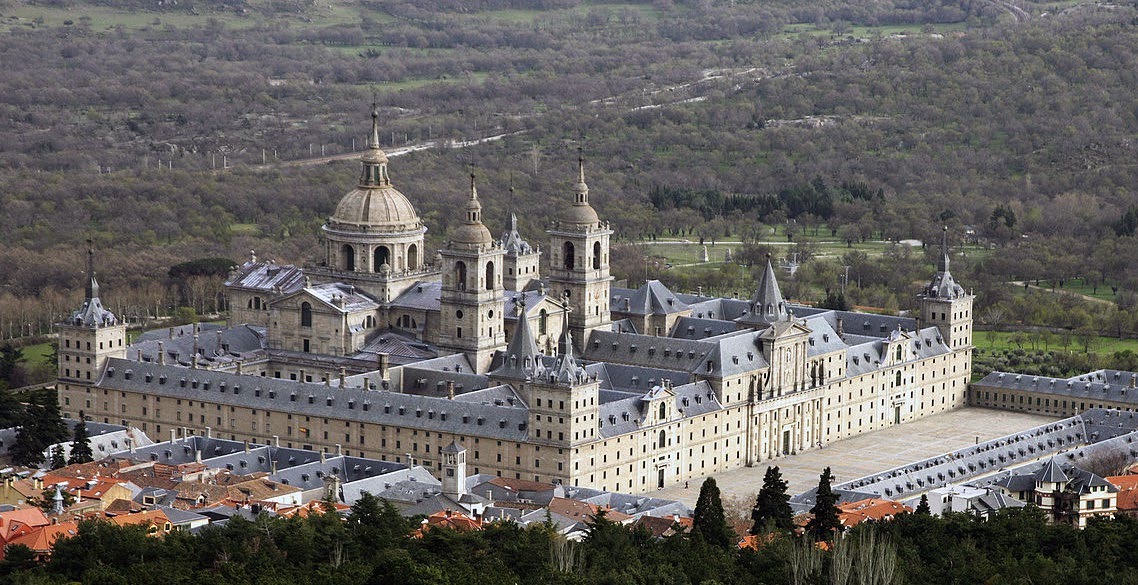
El Escorial; Spanish Renaissance Architecture
_________ is the largest Renaissance building in the world.
El Escorial
What is the design of the El Escorial?
Still a fortress. Plain exterior, Classical in roofs, entries, and courtyards