11b — Korsakoff + H.M. / Scoville & Milner
 Call Kai
 Learn
 Practice Test
 Spaced Repetition
 Match
 Flashcards
 Knowt Play
1/29

There's no tags or description
Looks like no tags are added yet.
30 Terms
What syndrome did Wernicke describe in the 1880s?
A syndrome of gait disorder, abnormal eye movements, and confusion that usually led to death within two weeks.
What syndrome did Korsakoff describe a few years later?
An amnesic syndrome with the same neurological symptoms (gait and eye-movement abnormalities) but milder.
What is the relationship between Wernicke's and Korsakoff's syndromes?
They are the same syndrome at different stages: the acute Wernicke phase, then the chronic Korsakoff phase if the patient survives.
What causes Wernicke-Korsakoff syndrome?
Chronic alcohol abuse combined with thiamine (vitamin B1) deficiency.
What happens in the acute Wernicke phase with and without thiamine treatment?
Without thiamine the patient usually dies within two weeks from fatal hemorrhages, but massive doses of thiamine in time let the patient survive into the chronic Korsakoff phase.
What are the two phases of Wernicke-Korsakoff syndrome?
The Wernicke phase (transient confusional state with neurological abnormalities) and the Korsakoff phase (chronic severe amnesia, personality changes, and confabulation).
What personality change is typical in Korsakoff patients?
They change from volatile, impulsive, and aggressive to passive, calm, and uninterested, with no taste for alcohol.
What is confabulation, and which amnesic patients show it?
Filling gaps in memory by making things up without concern for accuracy; Korsakoff patients do this, while hippocampal amnesics say "I don't know."
How did Heindel's Korsakoff patient explain being in the cafeteria?
He made up a story about visiting a buddy who had a heart attack on the fifth floor, after spending two hours being tested by Heindel.
What did Korsakoff (1889) observe about his patients in conversation?
They seem in complete possession of their faculties and reason perfectly well, but remember absolutely nothing, even forgetting a conversation from one minute earlier.
What is the primary pathology in Korsakoff patients?
Damage to the mammillary bodies and anterior thalamic nuclei.

What did Kim et al. (2009) find about mammillothalamic connectivity? [Figure: kim-2009-mammillothalamic.png]
The severity of memory impairment tracks disruption of mammillothalamic connectivity (recall r = 0.771, recognition r = 0.825).
What do the cases of patients B.J. and N.A. show?
Selective damage to either the mammillary bodies (B.J., a snooker cue through the nostril) or the anterior thalamic nucleus (N.A., a fencing foil through the nostril) alone produces a comparable amnesic syndrome.
What additional damage do Korsakoff patients have beyond the mammillary bodies and ATN?
Damage to the mediodorsal nucleus of the thalamus, which projects to the prefrontal cortex.
What does mediodorsal nucleus damage add to the Korsakoff syndrome?
A frontal lobe syndrome on top of amnesia, explaining the personality changes and confabulation.
Is the hippocampus damaged in Korsakoff patients?
No, the hippocampus is intact.
Who was patient H.M.?
Henry Molaison (1926–2008), who had uncontrollable seizures from age 8 after a bicycle accident.
What is Scoville & Milner (1957)?
"Loss of Recent Memory after Bilateral Hippocampal Lesions," the paper that first linked the hippocampus to memory.
Why did Scoville develop the medial temporal lobe resection?
As a substitute for prefrontal lobotomy for psychosis, aiming for the benefits of lobotomy without its side effects.
Why was the surgery tried on H.M.?
His seizures were totally incapacitating, the medial temporal lobe is often an epileptic focus, and the procedure had not caused seizures in psychotic patients.

How extensive was H.M.'s resection? [Figure: resection-8cm-diagram.jpeg]
Bilateral, extending posteriorly 8 cm and removing most of the hippocampus.
What did Scoville later call the decision to do the bilateral 8 cm resection?
A "tragic mistake."
What was the lobotomy era that motivated Scoville's procedure?
Prefrontal lobotomies (Moniz in the 1930s; Freeman's 10-minute transorbital "ice pick" lobotomy) reached 20,000 in the US by 1951 and 50,000 by the late 1960s, mostly on women.
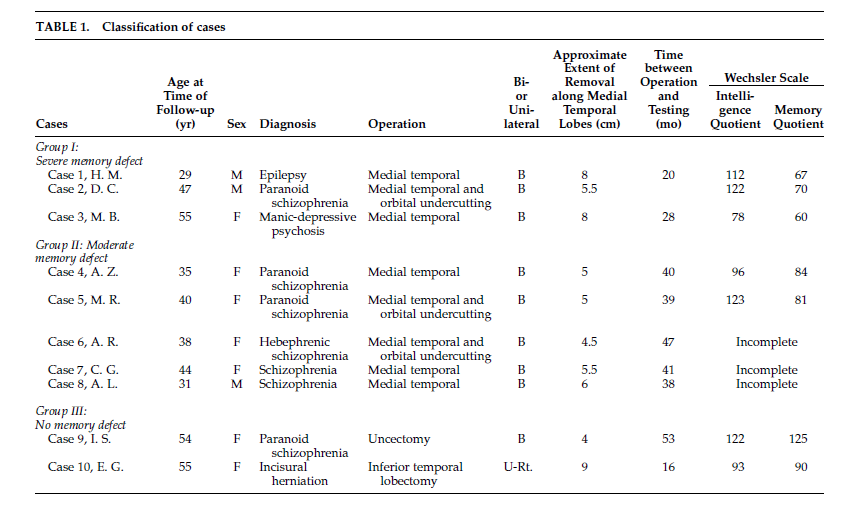
What were the 10 cases in Scoville & Milner (1957)? [Figure: scoville-milner-table1.png]
7 schizophrenia, 1 manic-depressive psychosis, 1 incisural herniation, and 1 epilepsy (H.M.).
What determined the severity of the memory deficit?
The lesion had to be bilateral and extensive (5–8 cm) enough to damage most of the hippocampus.
Why was the memory impairment not noticed in the psychotic patients?
Their disturbed emotional state masked it, so it was only recognized once H.M., who was not psychotic, showed it immediately.
What did the paper conclude about the surgery's effect on psychosis?
Bilateral medial temporal lobe resections were without significant therapeutic effect in psychosis.
What was the "one striking and totally unexpected behavioural result"?
A grave loss of recent memory when the resection involved the major portion of the hippocampal complex bilaterally.
How did H.M.'s memory loss show in daily life?
He could no longer recognize hospital staff or find the bathroom, and ten months after his family moved he still had not learned the new address though remembering the old one perfectly.
Did H.M. acquire any new memories after his surgery?
No, he acquired no memory of any event in his life after 1953 and lived in a "permanent present tens