ANS 150 FINAL exam review
 Call Kai
 Learn
 Practice Test
 Spaced Repetition
 Match
 Flashcards
 Knowt Play
1/1122

There's no tags or description
Looks like no tags are added yet.
1123 Terms
What are the ancient ancestor of dogs?
Wolves or wolf-like creatures
Where and when were the first bones of wolves discovered near humans?
North China 300k years ago
Kent, England 400k years ago
Approximately when were dogs domesticated?
12,000 years ago
Where were dogs probably first domesticated?
Near modern-day Germany
What is the oldest recorded domesticated animal?
Dogs
Which domesticated animal is considered the oldest recorded domesticated species
Dogs
What animals are the precursors to modern dogs?
Wolves or Jackals
Why were dogs originally domesticated?
Companionship and hunting
What makes dog domestication different from most livestock species?
Dogs were not domesticated for food
When did distinctive dog breeds begin appearing?
About 3000-4000 years ago
By what historical period were most major dog breeds well defined?
Roman Empire
What is an intact male dog called?
Stud
Whis is the birth process in dogs called? Why?
Whelping
The female makes a distinctive sound during birth
What is spaying? What is this also called?
Removal of the ovaries and uterus
Ovariohysterectomy
Can a male dog be spayed?
No (they are neutered)
What makes a dog’s estrous cycle unusual compared to livestock species?
It is highly variable and breed-depend while the other species have had a precise 21 day estrous cycle length
What is the average duration of estrus in dogs?
9 days
What is the range of estrus length in dogs? Why?
3-21 days
No one knows why
What is the average canine estrous cycle length? Is this stable or variable?
183 days
Extremely variable
What is the range of the estrous cycle length between dog breeds?
minimum of 60-80 days or up to a year
How many estrus periods per year in a dog? When is this? Why?
2
Very inconsistent, April/Oct or Dec/June
No one elses why
What is the estrous cycle length influenced by in dogs?
Breed
How long is the German Shepard estrous cycle length? How many cycles does the Basenji (African Dog) have per year?
4-4.5 months (3-4, sometimes 5 times per year)
1
What is unique about the stud reproductive tract?
They have an os penis that allows them to achieve penetration without erection
Where is the os bone?
In the bulbus glandis (head of penis)
What is the “tie” during dog breeding?
Erection of the penis (os penis engorges with blood and swells) occurs inside the vagina causing the pair to become temporarily locked together
Is the tie necessary for pregnancy in dog breeding?
No. AI can result in pregnancy without a tie
How do dogs come apart after the tie?
The tie breaks spontaneously
Is throwing water on dogs helpful during breeding?
No (just scares them)
What is a pseudopregnancy? What structures and physiological changes are present during pseudopregnancy? Does this happen in every species?
A false pregnancy where a female acts pregnant despite a lack of fetuses
CL, high progesterone, uterus fills with fluid
Yes (abnormality/very rare)
What percentage of intact female dogs experience pseudopregnancy?
50-75%
Do dogs have to bred to experience a pseudopregnancy? What is the most common way that dogs get a pseudopregnancy?
No
Breeding without conception
Why might pseudopregnancy have evolved in dogs?
It is a vestigial behavior from canine ancestors. It allows females to help nurse puppies of the alpha female if they died during whelping
What were the prehistorical ancestors of cats?
Saber-toothed tigers
Why are large animals no longer advantageous?
The environment changed to favor small animals
When were saber-toothed tigers widespread and where?
35 million years ago in Europe, Asia, Africa, North Africa
How old are the oldest fossils that show similarities to today’s modern small cats?
12 million years old
When and where did cat domestication begin?
6000 years ago in Egypt
Why were cats domesticated?
For religious reasons and companionship
Who is credited with the domestication of cats?
Egyptians
What is unique about the domestication of cats compared to livestock species?
They were not domesticated for food
How did cats become domesticated?
Cats were attracted to mice/rats that lived in and near the stored grain.
What is the wild ancestor of modern cats?
African bush cat
When did the concept of cat begin? What did this start?
mid 1800s
Pedigree records
What species did the concept of breeds begin in? Then what species?
Dogs
Cattle, then cats
What is the birth process of cats called?
Queening
T/F both cats and dogs make a distinctive sound when giving birth
T
What is the sound that queens and toms make during mating called? Do livestock species vocalize much during mating?
Calling
Not really
What kind of ovulators are cats? What does this mean?
Induced ovulators
They will not ovulate during estrus unless bred (never bred = no progesterone)
What kind of ovulators are all other animals discussed expect cats?
Spontaneous ovulators
What do you have to do if cats are bred with AI
physically stimulate the vagina and cervix to induce ovulation
What kind of process is inducing ovulation? Describe the process when mated
Neural reflex arc
Nerves run from the vagina/cervix to the brain that releases LH and FSH to start ovulation. The follicles grow to the preovulatory size and will not ovulate until bred
How long are estrous cycles of unmated queens on average? What is the range?
13-15 days
10-22 days
What is unique about the tom reproductive tract?
Toms have spurs on the penis that help stimulate the vagina and cervix for mating
Can ovulation in cats be induced at any time?
Yes, but there are better success rates when bred during estrus
When is the queen receptive to toms?
When she has a large follicle
What are the vocalizations for dogs? Are they simple or complex?
bark, whine, howl, go
How do dogs make complex vocalizations?
Put vocalizations together in different organizations and vary tone and amplitude (latter is done more often)
What is the dog bark? Do they communicate with other species by barking? How did it develop?
territorial call that is altered in tone and amplitude for different meanings
Yes
Humans selected for the bark for protection
What is the dog whine?
Care-soliciting vocalization that could signify pain, fright, or mild frustration based on amplitude
What is the dog howl? Do they communicate with other species by howling?
Likely communication between dogs, but the meaning has been debated. A certain part of the howl cannot be heard by humans. Canids can distinguish between familiar and strange howls
No
What is the dog growl? Do they communicate with other species by growling?
Aggressive or distance-increasing call used when attacked or threatened
Yes
What body parts do dogs use to convey moods and emotions?
tail, face, ears, mouth, hair, body position
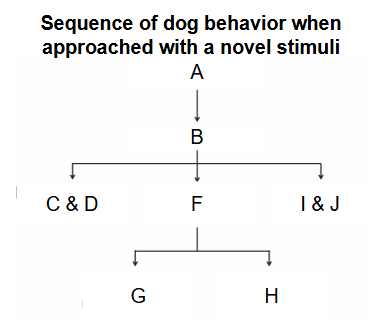
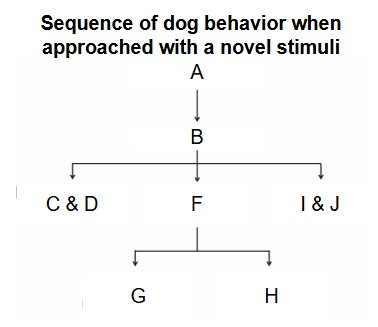
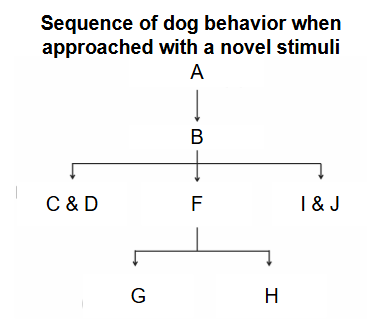
Label the letters in the dog behavior sequence
A - Neutral
B - Aroused/interested
C - play soliciting
D - active greeting
F - aggression
G - offensive
H - fear
I and J - submission

What is A? Describe this behavior
Neutral
Tails down, ears down, standing upright
What is B? Describe this behavior
Aroused/Interested
Tail up, ears up, standing upright on toes, front leg raised

What is C and D? Describe these behaviors
C - Play Soliciting
Tail up and wagging slightly, ears erect, standing upright and moving, gesturing slightly with front paws
D - Active Greeting
Tail wagging over a wide range, lots of wiggles, ears erect, more exaggerated motion with front paws
What is F? Describe this behavior
Aggression
Tail up, ears erect, weight on front feet, exposed teeth

What is G and H? Describe the H behavior
G - Offensive Aggression (fighting)
F - Defensive Aggression (fear)
tail tucked, ears back and down, weight on rear feet, exposed teeth

What is I & J? Describe this behavior
Submission
Tail tucked, ears back and down, crouching on all four legs or rolled over to expose belly (giving up)
What is the most vulnerable position of a dog?
Submission
What is the development of behaviors called?
ontogeny
Put the following dog behaviors in order of appearance: play soliciting, mouthing, snapping, fighting, face licking
Mouthing, play soliciting, fighting, snapping, face licking
Put the following dog vocalizations in order of appearance: bark, whine, growl
growl, bark, whine
Which dog behaviors and vocalizations do not have a critical window of learning
(snapping, mouthing, play soliciting, face licking, fighting; growl, whine, bark)
face licking, growl, bark, whine
When do most people think dogs should be weaned? What are the other times that people believe?
70-80 days
28, 43, 70 days
What is the critical window of learning?
The period when animals have to learn a behavior otherwise they never will
Do dogs learn how to play or fight first:
play
Do most dog behaviorist believe that growls, barks, howls, and whines are learned or instinctual?
Growls barks and whines are learned
Howls are instinctual
What behaviors do dogs learn before they can growl, bark, and whine?
Mouth and play
What behaviors do dogs learn at the same time as their vocalizations?
Fighting and snapping
Do dogs learn to be friendly or be aggressive first?
Friendly
What does positive stimulation in early life of dogs cause?
Greater mental acuity
What happens if puppies are hand reared? Why? What does this mean?
They are more socialized to humans, but have difficulties socializing with dogs
They imprinted on the humans
Socialization with dogs isn’t instinctual
What effect does isolation from dogs and humans have on days from day 0, 25, and 60? What does this show?
0 - cannot socialize with humans
25 - no social play or aggression
60 - no effect
Dogs need to be around other humans and dogs to learn
What are simple vocalizations also known as?
simple vocalizations
What animal uses vocalizations the most?
cats
Do cats have a large or small vocabulary of simple vocalizations?
large
How do cats make complex vocalizations?
Combine simple vocalizations or use their complex calls
How do cats convey mood and emotions?
Using their tail, face (ears and pupils), ears, mouth, and hair
What is the difference between dogs and cats in terms of how they convey mood and emotions?
Cats have more variation, change position of body instead of moving, and use crouching positions instead of lying positions
What does it mean when the cat tail is high? Low and tip wagging?
Greeting or investigating
Hunting
What are signs of aggression in cats?
walking on tiptoes, lowered head, arched back, raised hair, open mouth with teeth exposed
What are two important aspects of facial expressions in cats?
Position of ears and pupils
What does the size of pupils convey in cats? What does small/constricted pupils mean? Large/dilated?
Emotions
Aggression
Defensive
Put the following cat behaviors in order of development:
play sequences, approach avoidance, pounce, fear responses, chase, horizontal leap
Which have a critical window of learning?
fear responses, approach avoidance, play sequences, pounce, horizontal leap, chase
None, cats are life long learners
T/F Play sequence development occurs at around the same time in cats and dogs
T
What do cats learn before play sequences? What do dogs?
Fear responses
Exploration
What happens if kittens are handled and stimulated by humans from birth?
They have accelerated eye opening and exploratory behavior
What does handling and play with different people early in life with kittens do?
Reduce fear