ch55- Ecosystems
 Call Kai
 Learn
 Practice Test
 Spaced Repetition
 Match
 Flashcards
 Knowt Play
1/36

There's no tags or description
Looks like no tags are added yet.
37 Terms
The gas carbon dioxide is an
a) end product of both photosynthesis and cellular respiration.
b) input to cellular respiration.
c) end product of photosynthesis.
d) input to photosynthesis and an end product of cellular respiration.
d
When an organism breaks down organic molecules, some of the energy that had been stored as chemical energy is lost as heat. This happens because
a) chemical energy can only be converted to heat energy.
b) the enzymes in cellular respiration are inefficient.
c) every energy transfer or transformation increases entropy.
d) the enzymes in photosynthesis are inefficient.
c
On a global scale, energy __________ ecosystems whereas chemical elements __________ ecosystems.
a) is biologically magnified in, are recycled in
b) is continuously supplied to, are continuously removed from
c) flows through, are recycled in
d) is recycled in, flow through
c
Consider this segment of a food web: snails and grasshoppers eat pepper plants; spiders eat grasshoppers; shrews eat snails and spiders; owls eat shrews. The shrew occupies the trophic level(s) of __________.
a) tertiary consumer only
b) primary and secondary consumers
c) secondary and tertiary consumers
d) secondary consumer only
c
A scientist who is studying a tropical rainforest ecosystem identifies two fundamental ecological processes that sustain life across multiple trophic levels. These processes ensure the continuous transfer of essential resources and energy within the system. Which of the following best describes these key emergent properties of an ecosystem?
a) the circulation of essential chemical elements within the environment and the one-way transfer of energy from producers to higher trophic levels
b) the breakdown of organic material by decomposers and the recycling of nutrients between living organisms and the environment
c) the transfer of sunlight into biological energy by producers and the movement of organic compounds through the food web
d) the conversion of light energy into stored chemical energy via photosynthesis and the release of energy through cellular respiration
a
Which of the following are the main forms of energy inputs and outputs that move through an ecosystem?
a) soil elements, water, oxygen, carbon dioxide, chemicals within detritus (dead organisms)
b) sunlight and heat
c) water, nitrogen, phosphorus, carbon and heat
d) inorganic and organic compounds plus solar radiation
b
A team of researchers was analyzing the movement of energy from its initial source through various trophic levels, in a forest ecosystem. They observe that while essential nutrients cycle or transfer repeatedly within the system, energy behaves differently. Why is a continuous supply of solar energy required to sustain life on Earth?
a) Once energy enters a food web, it is repeatedly recycled among different organisms, ensuring that no additional energy input is required.
b) Energy from the sun flows through ecosystems, transferring from one organism to another but ultimately dissipates as heat, preventing its reuse.
c) The sun is the direct source of all chemical energy in organisms, as its energy is immediately converted into biological molecules without transformation.
d) Solar energy primarily functions to regulate global temperatures, allowing life to exist in a habitable climate.
b
In a grassland ecosystem in Colorado, scientists measure the movement of essential elements and energy through plants, herbivores, predators, and decomposers. They observe that while certain materials are recycled and reused, others follow a one-way path and cannot be reclaimed by the ecosystem. Which of the following is not continuously cycled within the ecosystem and instead follows a linear flow?
a) thermal energy released by organisms as a byproduct of metabolism
b) phosphorus transferred between soil, plants, and decomposers
c) carbon molecules exchanged between the atmosphere, organisms, and decomposers
d) nitrogen compounds absorbed by plants and converted into proteins
a
A group of ecologists is studying energy transfer in a coastal wetland ecosystem of Alabama. They analyze how solar radiation is captured by plants, transferred through trophic levels, and eventually released. After repeated measurements, they conclude that energy follows predictable patterns within the system. Which of the following statements best describes the principles governing energy flow in this ecosystem?
a) The total energy in an ecosystem fluctuates as it moves through producers and consumers, since matter is lost at each step.
b) Energy is continuously recycled within an ecosystem, with no need for additional input from external sources.
c) The amount of energy stored in plant biomass equals the total solar energy absorbed minus the portions reflected and lost as heat.
d) During photosynthesis, plants permanently trap all incoming solar energy, preventing any loss from the system.
c
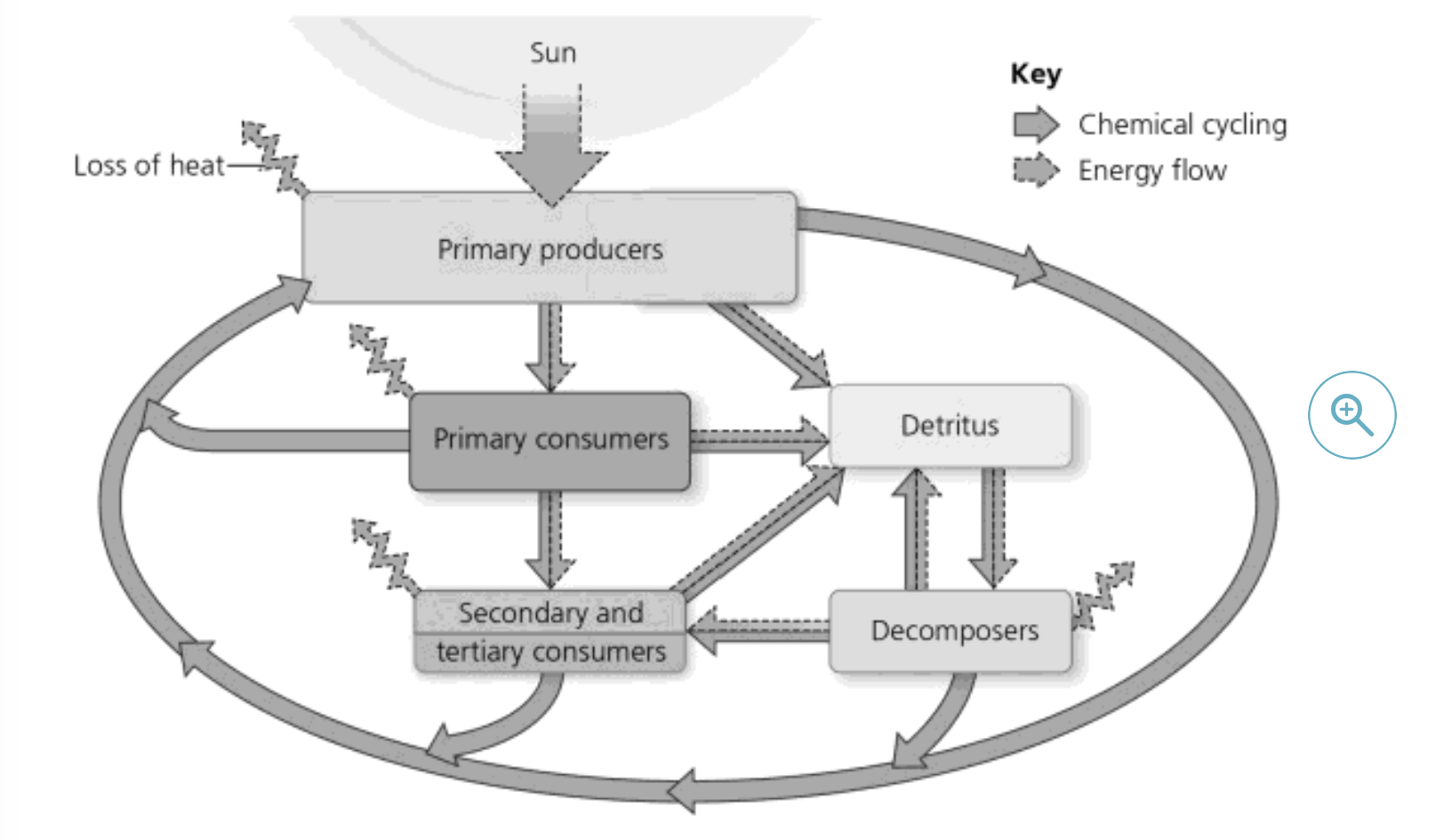
The blue arrow exiting the left side of the "Primary consumers" box could best be described as which of the following examples of nutrient transfer?
a) production consumed by the primary consumer
b) decomposition of dead matter
c) feces excreted by the primary consumer
d) predation of the primary consumer
c
A researcher studying energy flow in ecosystems observes how sunlight interacts with different surfaces and organisms. Based on fundamental ecological principles, which of the following best describes what happens to solar radiation when it reaches Earth?
a) Only a small portion of solar radiation is absorbed by plant pigments, while the rest is reflected, absorbed by land and water, or lost as heat.
b) Solar energy is evenly distributed across all regions of Earth, regardless of latitude.
c) Most solar radiation directly heats Earth's atmosphere, with very little reaching the surface or organisms.
d) The majority of solar radiation is captured by plants and converted into chemical energy through photosynthesis.
a

Use the following figure to answer the question.
Food web for a particular terrestrial ecosystem (arrows represent energy flow, meaning arrows point from prey to predator, and numbers represent species)
In the food web, if species 3 is toxic to predators, then which species is most likely to benefit from being a mimic of species 3?
5
2
1
4
2

Use the following figure to answer the question.
Diagram of a food web (arrows represent energy flow, meaning arrows point from prey to predator, and letters represent species)
If the figure represents a marine food web, tertiary consumers are most likely ________.
D
E
H
C
H
In a freshwater lake ecosystem, organisms are classified based on how they obtain energy within the food web. Which of the following organisms is correctly matched with its trophic role?
a) zooplankton—primary producer
b) algae—primary producer
c) frog—primary producer
d) mushroom—secondary consumer
b
Which of the following equations is correct?
a) Ra ≡ NPP + GPP
b) NPP ≡ GPP⁄Ra
c) NPP ≡ GPP + Ra
d) NPP ≡ GPP − Ra
d
The relationship between biomass and primary productivity is that _____.
a) biomass is the rate of primary productivity
b) biomass is the inverse of primary productivity
c) biomass is the natural log of primary productivity
d) primary productivity is the rate at which biomass is produced
d
The amount of energy from light (or chemicals, in chemoautotrophic systems) converted to the chemical energy of organic molecules per unit time is defined as which of the following?
a) gross primary production
b) primary production
c) net primary production
d) total photosynthetic production
a

Which ecosystem in the choices provided, if completely converted by humans to cultivated land, would have the largest negative impact on total percentage of Earth's NPP?
a) woodland and shrubland
b) boreal forest
c) temperate evergreen forest
d) savanna
d
Which of the following best explains why terrestrial productivity is higher in equatorial climates than in temperate climates?
a) Productivity increases with day length.
b) Productivity increases with solar intensity.
c) Productivity increases with temperature and water availability.
d) Productivity increases with proximity to the sun.
c
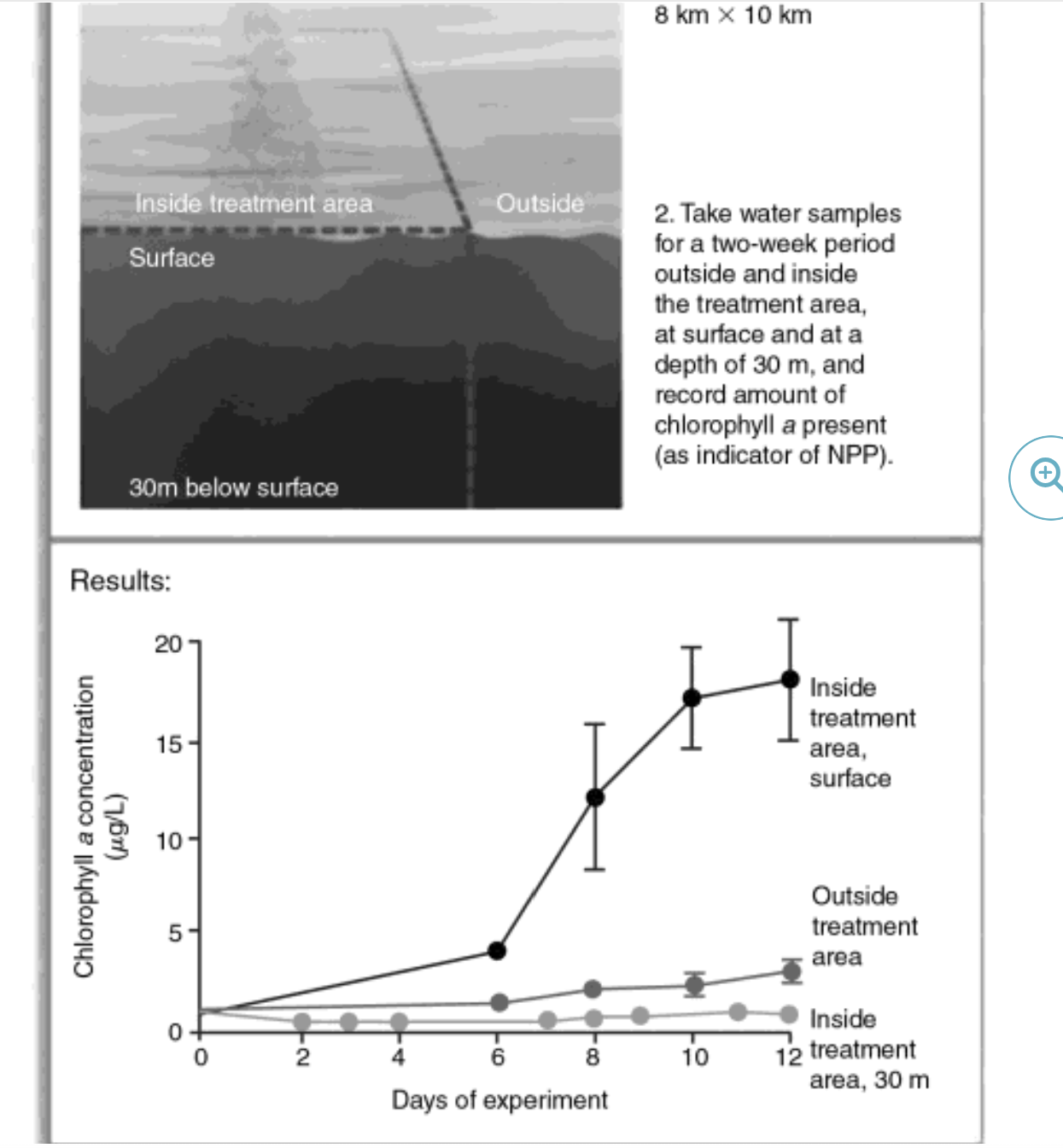
After looking at the evidence from the experiment in the figure, which of the following is the most accurate conclusion about productivity in marine ecosystems?
a) Marine organisms break down iron for energy and thus for productivity.
b) Productivity increases when chlorophyll a is added.
c) Iron availability limits productivity.
d) Nothing can be said based on this information.
c
Which of the following conclusions about productivity within the confines of the experimental ecosystem is most consistent with the data?
a) Productivity is higher at the surface than at depth; however, an additional experiment could further test the effect of depth by introducing FeSO4 at 30 m deep and measuring the chlorophyll a response.
b) Productivity is higher at the surface than at depth, and would be predicted to increase sharply after day 12.
c) Productivity is higher at depth than at the surface, but only initially.
d) Productivity at a depth of 30 m is low only because of a lack of sunlight, not a lack of iron sulfate.
a
Which of the following statements correctly explains why a diagram of energy flow from trophic level to trophic level is shaped like a pyramid?
a) There are more producers than primary consumers, and so on.
b) Organisms eventually die.
c) Most energy at each level is lost, leaving little for the next.
d) Organisms at each level store most of the energy and pass little on.
c

Which arrow, if representing magnitude, should show the largest biomass exiting primary producers?
a) loss of heat arrow
b) arrow leading to detritus
c) arrow leading to primary consumers
d) arrow leading back to primary producers
b
Which of the following is primarily responsible for limiting the number of trophic levels in most ecosystems?
a) Many primary and higher-order consumers are opportunistic feeders.
b) Nutrient cycling rates tend to be limited by decomposition.
c) Energy transfer between trophic levels is usually less than 20% efficient.
d) Decomposers compete with higher-order consumers for nutrients and energy.
c
Which statement best describes what ultimately happens to the chemical energy that is consumed but not used to produce new biomass in the process of energy transfer between trophic levels in an ecosystem?
a) It is used by organisms to maintain their life processes through the reactions of cellular respiration.
b) Heat produced by cellular respiration is used by heterotrophs for thermoregulation.
c) It is eliminated as feces or is dissipated into space as heat as a result of cellular respiration consistent with the second law of thermodynamics.
d) It is undigested and winds up in the feces and is not passed on to higher trophic levels.
c
Consider the food chain of grass → grasshopper → mouse → snake → hawk. About how much of the chemical energy fixed by photosynthesis of the grass (100%) is available to the hawk, assuming a 10% trophic efficiency?
10%
0.01%
1%
0.1%
0.01%
A porcupine eats 3,000 J of plant material. Of this, 2,100 J is indigestible and is eliminated as feces, 800 J are used in cellular respiration, and 100 J are used for growth and reproduction. What is the approximate production efficiency of this animal?
11%
0.03%
33%
3%
11%
How do pyramids of net production and pyramids of biomass differ?
a) Unlike pyramids of biomass, pyramids of net production are based on measurements per unit time.
b) Pyramids of net production include fewer trophic levels than pyramids of biomass.
c) Unlike pyramids of net production, the shape of a pyramid of biomass varies with the size of the organisms in the ecosystem.
a

Some aquatic ecosystems have inverted biomass pyramids, in which primary consumers outweigh the producers. Why is it that a pyramid of biomass, but not a pyramid of net production, may be inverted?
a) A pyramid of biomass may be inverted when the producers (e.g., phytoplankton) are much smaller than the consumers (e.g., zooplankton). Producers always have higher productivity than consumers, so pyramids of net production are never inverted.
b) A pyramid of biomass may be inverted because it is based on biomass at one point in time. Pyramids of net production are based on productivity per unit time.
c) A pyramid of biomass may be inverted when the producers (e.g., phytoplankton) are much more plentiful than the consumers (e.g., zooplankton). Producers are always outnumbered by consumers, so pyramids of net production are never inverted.
b
Biogeochemical cycles are crucial to ecosystem function because __________.
a) they remove poisons and keep them locked up in sinks
b) nutrients and other life-sustaining molecules are in limited supply and must be continually recycled
c) they prevent catastrophic extinctions
d) they keep the planet warm enough for living things to survive
b
Which of the following was a result of the Hubbard Brook watershed deforestation experiment?
a) The nitrate concentration in waters draining the deforested area became dangerously high.
b) Most minerals were not recycled within the intact forest ecosystem.
c) Deforestation decreased water runoff.
d) Calcium levels remained high in the soil of deforested areas.
a
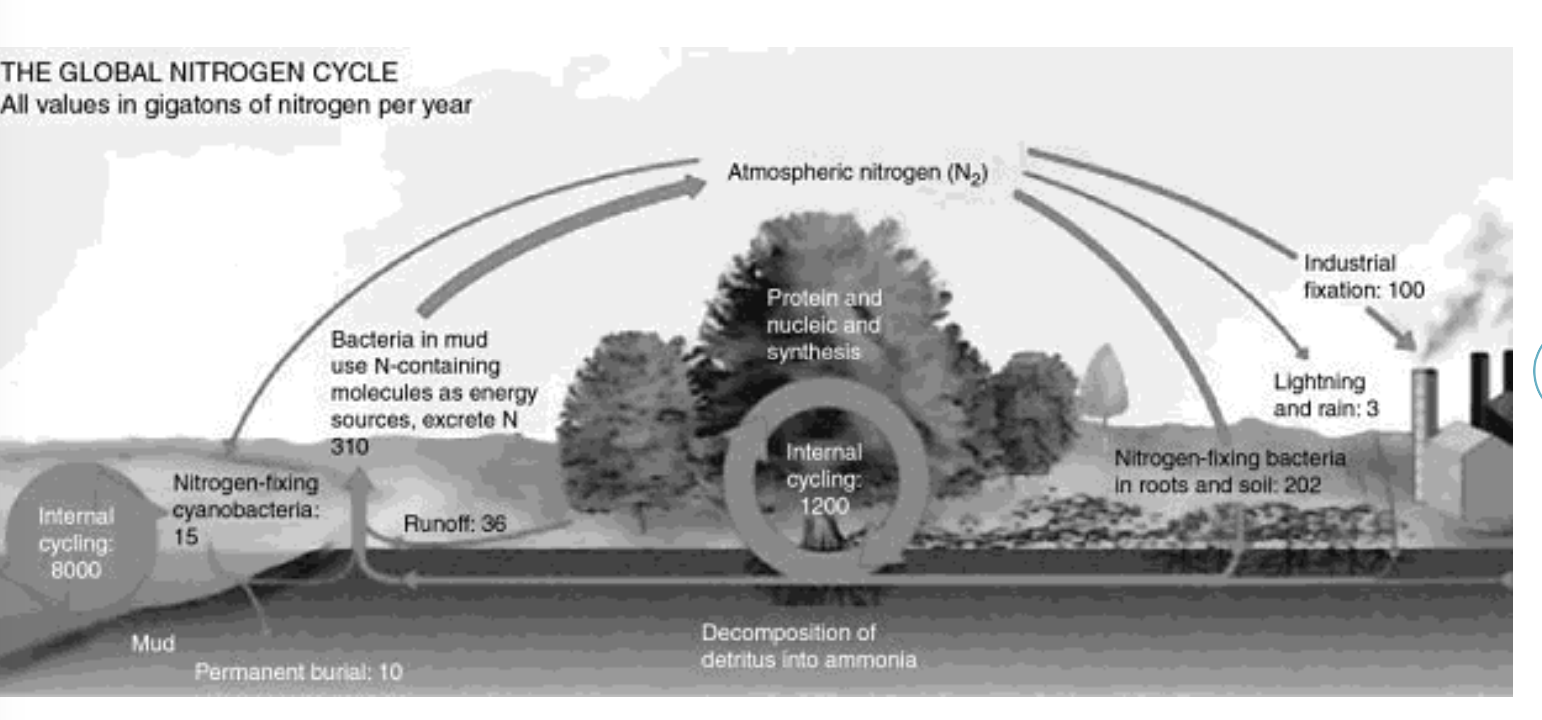
Based on the information provided, which of the following represents the human impact on the global nitrogen cycle?
a) industrial nitrogen fixation
b) nitrogen lost to the atmosphere
c) reduction of nitrogen available to terrestrial ecosystems
d) reduction of nitrogen fixation by bacteria
a
Which of the following is a reason that logged tropical rain forest soils typically have nutrient-poor soils?
a) Logging results in soil temperatures that are lethal to nitrogen-fixing bacteria.
b) Tropical bedrock contains little phosphorous.
c) Most of the nutrients in the ecosystem are removed in the harvested timber.
d) The cation exchange capacity of the soil is reversed as a result of logging
c
Select the correct statement describing the nitrogen cycle.
a) Denitrifying bacteria reduce ammonia (NH3+) to molecular nitrogen (N2).
b) Bacteria obtain energy from nitrification.
c) Nitrogen-fixing microbes provide energy for carbon fixation.
b
Why is it that nitrogen is often a limiting plant nutrient, despite the fact that the atmosphere is 80% nitrogen gas (N2)?
a) Because N2 easily leaches away from soil.
b) Because plants cannot fix N2.
c) Because plants cannot assimilate nitrogen-containing compounds.
b
In contrast to bioremediation, which is a strategy for __________, biological augmentation __________ a degraded ecosystem.
a) using organisms to add essential materials, removes harmful substances from
b) removing harmful substances, uses organisms to add essential materials to
c) adding new species to control problem species, adds fertilizer to nutrient-poor soils in
d) replacing extirpated species, removes man-created pollutants and toxins from
b
Which of the following is an example of bioremediation?
a) adding nitrogen-fixing microorganisms to a degraded ecosystem to increase nitrogen availability
b) adding seeds of a chromium-accumulating plant to soil contaminated by chromium
c) reconfiguring the channel of a river
d) using a bulldozer to regrade a strip mine
b