Ecosystem Ecology and Marine Biology
 Call Kai
 Learn
Learn Practice Test
 Spaced Repetition
 Match
Match Flashcards
 Knowt Play
1/61

There's no tags or description
Looks like no tags are added yet.
Name | Mastery | Learn | Test | Matching | Spaced | Call with Kai | Chat |
|---|
No analytics yet
Send a link to your students to track their progress
62 Terms
Gross Primary Productivity (GPP)
Total carbon fixed by photosynthesis.

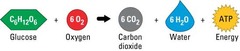
Respiration
The process by which cells break down simple food molecules to release the energy they contain.
Autotrophic respiration (Ra)
Respiration by primary producers.
Heterotrophic respiration (Rh)
Respiration by consumers and decomposers.
Ecosystem respiration (Re)
Total respiration in an ecosystem: Ra + Rh.
Net Primary Production (NPP)
Carbon remaining after producer respiration: GPP − Ra.

Net Ecosystem Production (NEP)
Carbon remaining after both autotrophic and heterotrophic respiration; indicates whether an ecosystem is a net carbon sink or source.

In situ primary production
Primary production occurring within the ecosystem itself, rather than being imported from elsewhere.
Autotrophic ecosystem
An ecosystem where in situ primary production exceeds respiration; it can accumulate or sequester carbon.
Carbon sequestration (storage)
The act of removing carbon from the atmosphere and storing it. Plants sequester, or store carbon from the atmosphere.

Heterotrophic ecosystem
An ecosystem where respiration exceeds in situ primary production and therefore relies on imported organic matter.
Dissolved inorganic carbon (DIC)
Carbon in inorganic forms in seawater, including CO₂ and carbonate-system compounds.
Dissolved organic matter (DOM)
Organic carbon dissolved in water and available to microbes to varying degrees.

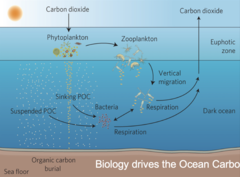
Particulate organic carbon (POC)
Organic carbon in particles, which can sink and export carbon to deeper waters.

Labile DOM
Easily used organic matter with rapid turnover, such as simple sugars and amino acids.
Semi-labile DOM
DOM that breaks down over decades.
Refractory DOM
Very persistent DOM that may remain in the ocean for thousands of years.
Redfield ratio
Typical elemental ratio in healthy algal cells: 106 C : 16 N : 1 P.

Nutrient limitation
Reduced growth or productivity because an essential nutrient is insufficient.

Biomass limitation
A nutrient is exhausted, limiting how much biomass can accumulate.
Rate limitation
Nutrient supply or uptake is too slow to support faster growth.
Liebig's law of the minimum
Biomass is limited by the scarcest essential resource.
Compensation irradiance (Ec)
Light level at which photosynthesis equals respiration.

Oligotrophic
Low-nutrient, low-productivity water.

Mesotrophic
Intermediate nutrient and productivity conditions.
Eutrophic
Nutrient-rich, highly productive water.
Eutrophication
Enrichment of a water body with nutrients, often increasing algal production.

Phytoplankton bloom
Rapid increase in phytoplankton abundance.

HNLC region
High nutrient, low chlorophyll region where nutrients are present but phytoplankton biomass remains low.

Food web
A network of feeding relationships among organisms in an ecosystem.

Secondary production
Increase in heterotrophic biomass over time; energy available to the next trophic level.
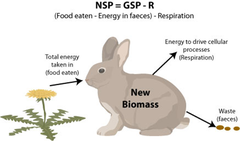
Biomass
Amount of living material, usually measured as a density.

Production
Rate at which biomass is generated.
P/B ratio
Production-to-biomass ratio; biomass produced per unit standing biomass per unit time.
Food-chain efficiency (FCE)
Proportion of energy fixed by primary producers that reaches the top trophic level.
Basal species
Species with no prey.
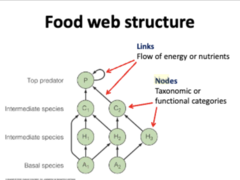
Intermediate species
Species that have both prey and predators.
Top species
Species with no predators.
Connectance
Degree to which species in a network are linked by interactions.

Clustering coefficient
Average proportion of a node's neighbors that are also linked to one another.

Network motif
Small, recurring, over-represented interaction pattern in a network.

Small-world network
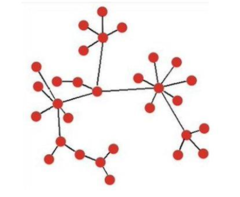
A network with high clustering but short paths between nodes.

Scale-free network
A network in which a few nodes have many links and most have few.
Keystone species
A species with an effect on the ecosystem disproportionate to its abundance or biomass.
Generalism
Having many feeding links or a broad diet.
Redundancy
Multiple species performing similar trophic roles.

Top-down control
Regulation of lower trophic levels by predators.
Bottom-up (resource) control
Regulation of higher trophic levels by resource availability and primary production.
Mesopredator release
Increase of intermediate predators after removal of top predators.
Biodiversity
Variation in life, including species identities, abundances, genes, and functional roles.
Alpha diversity
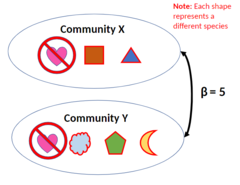
Diversity within a single location or community.
Beta diversity
Change in species composition between locations or communities.
Gamma diversity
Total diversity at a regional scale.

Species richness
Number of species in an area.
Functional trait
A feature of an organism's phenotype that influences ecosystem processes.
Functional diversity
Diversity of functional traits within a community.
Mass-ratio hypothesis
Ecosystem processes are largely determined by the traits of dominant species.
Selection effect
Higher diversity increases the chance that a highly productive or competitively dominant species is present.
Asynchrony
Species respond differently through time or to disturbance, helping stabilize ecosystem functioning.
Trait-based ecology
An approach that uses organism traits to explain community composition and ecosystem processes.
Metabolic theory of ecology
Framework linking body size and temperature to metabolic rates and ecological patterns.
Gape-limited predation
Predation constrained by the predator's mouth size; prey are often eaten whole.