Econ Exam I (lectures 1-4)
 Call Kai
 Learn
 Practice Test
 Spaced Repetition
 Match
 Flashcards
 Knowt Play
1/85

There's no tags or description
Looks like no tags are added yet.
Name | Mastery | Learn | Test | Matching | Spaced | Call with Kai | Chat |
|---|
No analytics yet
Send a link to your students to track their progress
86 Terms
Economics
the study of the choices individuals make given the presence of scarcity
Scarcity
limited resources but unlimited wants
-Because of scarcity, we have to make choices
Resources
inputs used to produce goods and services
Human Resources
skill, strength, knowledge
Physical Resources
tools, machines, buildings, etc.
Natural Resources
land, minerals, oceans, rivers
Rationing
allocating a limited supply of goods/resources among people
-criterion used to determine who will receive and who will go without
The economy
the institutional structure through which individuals in a society coordinate their diverse wants
economic agents
households, firms, government
The economy will answer 3 questions:
What and how much to produce
How to produce it
For whom to produce it
All issues of ALLOCATION
#1 Decision Makers choose purposefully. How do we make rational choices?
we weigh the costs and benefits
We economize (getting the maximum benefit at the minimum cost
Utility (in economics)
The subjective benefit or satisfaction an individual expects from the choice or course of action
HAPPINESS
differs widely from person to person
#2 The value of a good or service is subjective
Or, costs and benefits are subjective
People have different preferences for goods and services
This is partly why economics is hard → it’s difficult to know how much value a person places on something
Guess how hard it is to make a good gift for even close friends or family member.
#3 Incentives matter
The payoff derive from a choice increases, people will be more likely to choose it.
You’d be more likely to bend over to pick up a $20 bill then a quarter
#4 Individuals make decisions at the MARGIN
Economists “think at the margin”
– Actually, everyone thinks at the margin!
– “Additional” is often used as a substitute for
“Marginal”
• Examples:
– Deciding to attend class
– Food consumption choices
The Economic Decision Rule
If the marginal (incremental) benefit of an action exceeds the marginal (incremental) cost, do it.
Basically if the MB > MC, do it
If the MC > MB, don't do it.
#5 The use of scarce resources is costly, so trade-offs must be made
Also known as “there is no such thing as a free lunch” principle.
Opportunity Cost
• The highest valued alternative that must be sacrificed as a result of choosing an option
• NOT the sum of all your forgone opportunities
– subjective
Examples:
The Economic cost of…
…going to college for a year is not just the tuition, books,
and fees, but also the foregone wages
Explicit costs
costs that require a money payment
Implicit costs
costs that do NOT require a money payment
#6 The acquisition of information is costly
• More information help us to make better choice.
• However, the time needed to gather it is scarce.
- impact of the internet
- Making choices with imperfect information.
#7 Beware of secondary effects
• Secondary effects : The indirect impact of an
event that may not be immediately observable.
• Intended consequences
– Think of medicine.
• Unintended consequences
– Sugar Tariffs in the U.S.
#8 The test of a theory is its ability to predict
…
Economic theory
generalizations about the workings of an abstract economy
Economic models
we use abstract models to study larger, more complex concepts
Positive statement
a statement that can be tested and either proven or disproven
Normative statement
a statement of opinion, cannot be proven or disproven (Key words: ought, should, good, bad)
The Art of Economics
▪ Positive Statement allows us to study
the facts about how the economy
works.
▪ Normative Statement used to identify
problems and prescribe solutions
#9 Forces influence economic outcomes
• Scarcity creates economic forces that ration scarce resources in our economy
• Unhindered- economic forces become market forces.
• Market forces ration goods and services by changing the price level
Invisible Hand
the price mechanism (Adam Smith)
“The market price acts like an invisible hand to guide economic forces to coordinate actions and allocate scarce resources. “
Invisible Handshake
social and historical forces (cultural norms
Invisible Foot
political and legal forces
• Selling alcohol to underage drinkers
• Selling marijuana
• Selling babies
• Selling body parts
Positive relationship
As X goes up Y goes up
Negative or Inverse relationship
As X goes up, Y goes down
Deterministic Relationship
Independent variable completely determines value of dependent variable
Stochastic Relationship
Other things besides the independent variable influence the value of the dependent variable
Interpret the slope:
As the # of (X) increases by 1 (unit), (Y) increases by (slope)(unit)
ex: As the number of Doritos increases by 1 bag, the number of bottles of Pepsi decreases by 2 bottles.
Production Possibility Frontier (PPF)
A graph that shows the possible combinations of two goods (products) or other outcomes (e.g. grades) that can be produced given a fixed level of technology and resources (including time) being used efficiently at a fixed point in time.
A PPF with a constant slope has…
constant opportunity cost or a constant transformation relationship
A PPF with a changing slope has…
changing opportunity costs or a changing transformation relationship
The slope of a PPF changes because of…
diminishing marginal returns
Does the second bowl of ice cream taste as good as the first? What about the fifith?
The law of increasing marginal opportunity costs
As an economy produces more of a good, the opportunity cost of an additional unit, expressed in terms of other goods sacrificed, will increase.
Why?
All resources are not equally efficient
or suitable for producing all outputs.
Comparative Advantage of a resource
What restricts an economy from producing more of everything?”
A lack of resources
Over time, it’s possible for a country to shift its PPF outward…
Economic growth
4 factors that can shift the PPF
outwards:
1) An increase in the economy’s resource base
would expand our ability to produce goods and
services
2) Advancements in technology can expand the
economy’s production possibilities
3) An improvement in the rules under which
the economy functions can also increase output
4) By working harder and giving up current
leisure, we could shift the PPF outward
Invention
creating new products (e.g. electricity,
computers, etc.)
Innovation
practical and effective adoption of
new techniques
Entrepreneurs
introduce new products to satisfy
consumers at a lower cost
Negative Shocks
Earthquake
Political Upheaval
Uneven Shocks
- Drought
Lettuce…
Positive Shocks
- Technology Breakthrough
- New Natural Resources
Long-term investment
PPFo before capital accumulation
PPF1 during capital accumulation (inwards)
PPF2 after capital accumulation (outwards past original)
Comparative Advantage
if you have the lowest opportunity cost of producing something
Absolute Advantage
if you can produce more of a good with the same amount of resources as someone else.
(due to previous experience and/or natural endowments)
Law of Comparative Advantage
Individuals, firms, regions, or nations can gain by specializing in the production of goods that they produce cheaply (at a low opp. cost) and exchanging them for goods they cannot produce at a low opp. cost.
Quantity Demanded
the amount of a good that households want to consume given their income and prices in a given time period.
demand
is what you are willing and able to buy
given your income and the price of the good
(limited)
want
is a desire, but not necessarily something
you have the resources to buy (unlimited)
Demand Schedule
SHOWS THE RELATIONSHIP
BETWEEN THE PRICE LEVEL AND THE QUANTITY
DEMANDED.
The Demand curve looks like what?
downwards
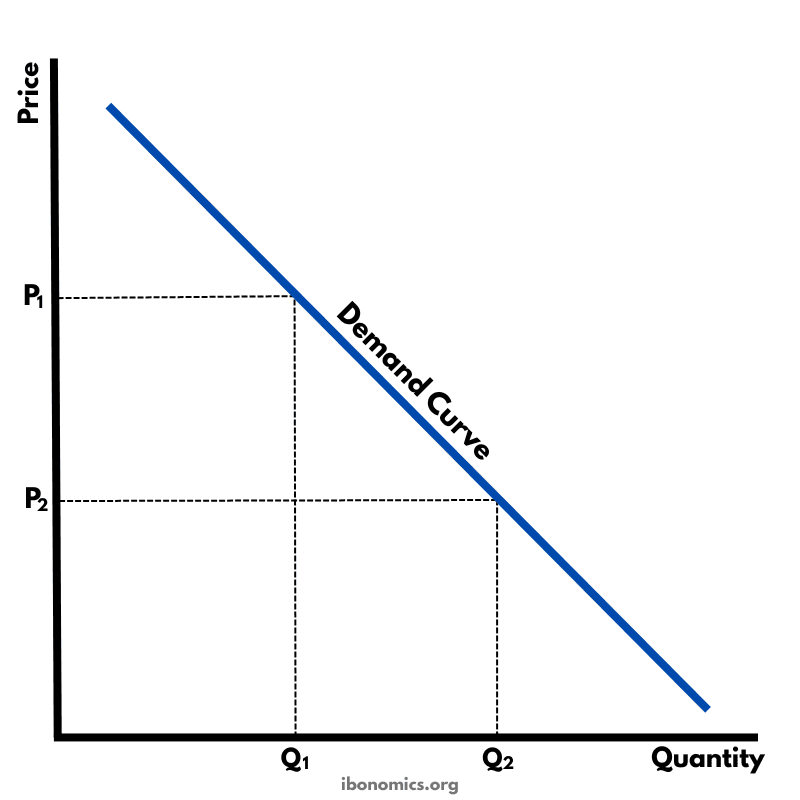
Law of Demand
As the price of a good increases, the quantity
demanded falls, (ceteris paribus)
ceteris paribus
holding all else constant
the relative price
the price of a good compared to the price of
other goods.
Law of diminishing marginal benefit
(law of diminishing marginal returns)
As more units of a good are consumed,
additional units provide less benefit.
Consumer Surplus
Amount willing to pay - Amount actually must pay
(market equilibrium price)
“the one on top”
in other words it is the area under the demand curve and above the price
Supply is thinking like the…
producer
Quantity Supplied
the amount of a commodity that a firm plans to sell in a given time period at a
given price.
The law of supply
as the price for which a good can be sold increases, the quantity of the good that
is supplied will increase, ceteris paribus
Supply Schedule
shows the relationship between the price level and the quantity supplied
The Supply Curve look like what?

The Law of Increasing Costs
To supply additional units of a good, producers have greater opportunity costs, so the price must rise to induce producers to supply greater quantities.
Producer Surplus
The difference between the price suppliers actually receive (market price) and the minimum price they would be willing to accept)
“the one under or on the bottom”
in other words it is the area under the demand curve and under the price
Equilibrium
in the market, is the point where QS = QD.
(No tendency for change)
Economic efficiency
A situation in which all of the potential gains from trade have been realized. An action is efficient only if it creates more benefit than cost. With well-defined property rights and competition, market equilibrium is efficient.
Disequilibrium
When the market is not in equilibrium, there is either
excess demand or excess supply
Excess supply
a surplus, the quantity supplied is greater than the quantity demanded, and prices fall.
At a given price, the excess of quantity supplied
over quantity demanded
QD < QS
◆Price of the good will fall as sellers compete with each
other to sell more of the good than buyers want
Excess demand
a shortage, the quantity demanded is greater than the quantity supplied, and prices rise.
At a given price, the excess of quantity
demanded over quantity supplied
QD > QS
◆Price of the good will rise as buyers compete with
each other to get more of the good that is available