Music Theory: Key Signatures, Clefs, and Solfege
 Call Kai
 Learn
Learn Practice Test
 Spaced Repetition
 Match
Match Flashcards
1/15

Earn XP
Description and Tags
Vocabulary practice flashcards covering clef note names, order of sharps and flats, rules for finding 'do' and 'la', key signatures, and identifying major vs. minor keys.
Name | Mastery | Learn | Test | Matching | Spaced | Call with Kai | Chat |
|---|
No analytics yet
Send a link to your students to track their progress
16 Terms

Treble Clef Lines
The line notes on the treble clef staff (E, G, B, D, F), remembered by the mnemonic "Elmo Goes Belly Drives Fast".
Treble Clef Spaces
The space notes on the treble clef staff, which spell F-A-C-E.
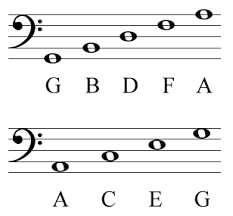
Bass Clef Lines
The line notes on the bass clef staff (G, B, D, F, A), remembered by the mnemonic "Gosh Block Days Feel Awful".
Bass Clef Spaces
The space notes on the bass clef staff (A, C, E, G), remembered by the mnemonic "All Cows Eat Grass (Burp)".
Order of Flats
The fixed sequence in which flats appear: B♭, E♭, A♭, D♭, G♭, C♭, F♭ (remembered as BEAD + Greatest Common Factor).

Order of Sharps
The fixed sequence in which sharps appear: F#, C#, G#, D#, A#, E#, B# (remembered by the mnemonic "Fat Cats Go Down Alleys Eating Birds").
Rule for Finding "Do" (Flats)
The second to last flat in a key signature is always "do" ("FALL BACK…to the NEXT TO THE LAST FLAT").
Flat Key Naming Exception
Flat keys are named [letter name] flat, except for the key signature with only one flat, which is the key of F.
Finding "La" in Flat Keys
To find "la" from "do", go down 3 steps: "do – ti – la". For example, if E-flat is "do", going down 3 steps (E♭ – D – C) makes C "la".
Key Signature with 3 Flats
Contains B♭, E♭, and A♭; its corresponding keys are E♭ Major or c minor.
Rule for Finding "Do" (Sharps)
The last sharp in the key signature is always "ti"; go up a half step (or go UP ONE in the alphabet) from the last sharp to find "do".
Finding "La" in Sharp Keys
To find "la" from "do", go down 3 steps: "do – ti – la". For example, if G is "do", going down 3 steps (G – F# – E) makes E "la".
Key Signature with 1 Sharp
Contains F#; its corresponding keys are G Major or e minor.

Circle of Fifths
A visual diagram showing the relationships between major and relative minor key signatures and their corresponding number of sharps or flats.
Solfege Harmony for Major vs. Minor
If voices start and end a song with "do – mi – sol", the piece is probably in MAJOR. If they start and end with "la – do – mi", the piece is probably in minor.
Tonic
The "home" pitch of a piece, often identified by looking at the starting note of the lowest vocal part ("do" or "la").