Language of Cinema Exam 1
 Call Kai
 Learn
Learn Practice Test
 Spaced Repetition
 Match
Match Flashcards
 Knowt Play
1/60

There's no tags or description
Looks like no tags are added yet.
Name | Mastery | Learn | Test | Matching | Spaced | Call with Kai | Chat |
|---|
No analytics yet
Send a link to your students to track their progress
61 Terms
form
patterning of a film; how all of its parts work together to create effects
style
how a film uses cinematic techniques (mise-en-scene, cinematography, editing, sound)
production
stage at which film is planned, shot, and edited (can also refer to the managing of financing and planning by a producer)
storyboard
series of comic strip-like sketches of shots in each scene, with notes about costume, lighting, and camera work
distribution
marketing of a film and organization of delivery to theaters and other outlets such as DVD/Blu-ray, streaming services, and television
shot
basic building block of every film; continuous action on screen from (what appears to be) a single run of the camera
scene
a unified action that carries the plot forward
motif
repeated image, sound/music, action, dialogue, object, character trait, etc. that draws our attention to character personalities, create expectations as to how they will act, what will happen next, and so forth
ideology
system of values, beliefs, ideas shared by a social group and taken for granted as natural/inherently true
unity
all relationships we perceive are clear and interwoven (tight); or disunity (“loose ends” or continuity errors)
narrative form
type of filmic organization in which the parts relate to one another through series of causally related events taking place in time and space
story
the chain of events in chronological order
plot
all of the events that are presented to us (and their causal relations, order, duration, frequency, and location)
narration
the plot’s way of distributing story information to achieve specific effects
Point-Of-View (POV) shot
a shot taken with the camera placed approximately where the character’s eyes would be, showing what the character would see; usually cut in before or after a shot of the character looking
mise-en-scene
all elements placed in front of the camera to be photographed, including settings and props, lighting, costumes and makeup, and staging (where/how people & objects are placed; includes acting and movement)
setting
carefully chosen location (real existing place) or a carefully constructed set (imaginary space or recreation of real space); helps us understand location in time and space and/or symbolic meaning
frontal lighting
light directed into the scene from a position near camera
sidelight
light coming from one side of person or object
backlighting
light cast onto scene from the side opposite the camera
underlighting
light from below figure/object

top lighting
light coming from above figure/object
three-point lighting
arrangement using three directions of light on a scene
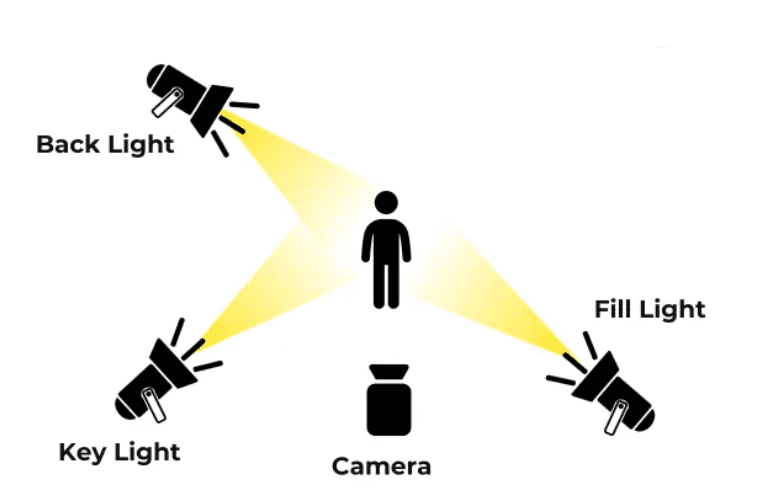
key light
brightest light coming into the scene
fill light
less bright source to balance key light; “fills in” shadows created by key light
high-key lighting
use of fill light and backlight to create low contrast between light and dark
low-key lighting
lesser (or no) use of fill light to create high contrast between high and dark
staging
where/how people & objects are placed; includes acting and movement an actor’s movements and overall performance style-what they do with their faces and bodies
cinematography
the manipulations made to the film strip by the camera during shooting and by the laboratory in the developing phase; includes tonal range, speed of motion, perspective, framing the shot/camera movement, and the duration of the shot
contrast
comparative difference between the darkest and lightest areas of the frame
exposure
how much light passes through the camera lens
filters
slices of glass or gelatin placed in front of the camera lens or printer to reduce certain color frequencies
rate
frames per second (fps); the standard rate for shooting is 24 fps
ramping
changing the speed of photographed motion within a single shot
focal length
the distance from the center of the lens to the point at which the light rays meet in sharp focus; determines the perspective relations of the space represented on the flat screen
zoom lens
lens with focal length that can be changed during the shot; resizes and changes perspective of what’s being shot
focus
degree to which light rays coming from the same part of an object through different parts of the lens re-converge at the same point on the film frame, creating sharp outlines/distinct textures
depth of field
a range of distances within which objects can be photographed in sharp focus given a certain exposure setting
deep focus
a use of the camera lens and lighting that keeps objects in both close and distant planes in sharp focus
racking focus
shifting the area of sharp focus from one plane to another during a shot
superimposition
special effect in which images are laid over one another, creating multiple perspectives within the frame
rear projection
a technique for combing a foreground action with a background action filmed earlier (foreground is filmed in studio, against a screen; background is projected from behind the screen)
matte work
type of process shot in which different areas of the image (usually actors and setting) are photographed separately and combined in laboratory work
framing
the use of the edges of the film frame to select and to compose what will be visible onscreen
aspect ratio
ratio of frame width to height
masking
at production stage, placing opaque screen in camera or printer to block part of frame off and change the shape of the photographed image (leaving black bar at top and bottom of screen); at exhibition stage, placing stretches of black fabric that frame the theater screen
Anamorphic Lens
a lens for making widescreen films using regular Academy ratio frame size; camera takes in a wide field of view and squeezes it onto the frame, and a similar projector lens unsqueezes
canted framing
a view in which the frame is not level; either right or left side is lower than other; slanted view
Extreme Long Shot
framing in which the scale of the object shown is very small; a building, landscape, or crowd of people will fill the screen
long shot
framing in which the scale of the object show is small; background is still dominates
medium long shot
framing at a distance that makes an object about 4 or 5 feet high appear to fill most of the screen vertically (ex: human figures from knees up)
Medium Shot
framing in which the scale of the object shown is of moderate size (ex: waist up)
medium close-up
framing in which the scale of the object shown is fairly large (ex: chest up)
close-up
framing in which the scale of the object shown is relatively large (ex: neck up)
extreme close-up
framing in which the scale of the object shown is very large (ex: just part of body)
mobile framing
changing camera angle, level, height, or distance during the shot
pan
camera movement with the camera body turning to the right or left; scans space horizontally
tilt
camera movement with the camera body swiveling upward or downward on a stationary support; scans space vertically
tracking shot
aka dolly shot; mobile framing that travels through space forward, backward, or laterally
crane shot
a shot with a change in framing accomplished by placing the camera above the subject and moving through the air in any direction
handheld camera
use of the camera operator’s body as a camera support, either holding it by hand or using a harness