Urinary System: Anatomy, Physiology, and Fluid Balance
 Call Kai
 Learn
Learn Practice Test
 Spaced Repetition
 Match
Match Flashcards
 Knowt Play
1/77

Earn XP
Description and Tags
Vocabulary practice flashcards covering renal anatomy, nephron histology, urine formation processes, fluid and blood pressure regulation, hormonal control, and acid-base disturbances.
Name | Mastery | Learn | Test | Matching | Spaced | Call with Kai | Chat |
|---|
No analytics yet
Send a link to your students to track their progress
78 Terms
Glomerular Filtration
The first step in blood processing and urine formation, wherein water and protein-free solutes filter out of the glomerular capillary blood across endothelial pores and into the Bowman capsule, producing approximately 180L of filtrate per day.
Tubular Reabsorption
The movement of fluid, essential electrolytes, and nutrients out of the renal tubule fluid and back into the peritubular capillary blood.
Tubular Secretion
The active or passive transport of substances out of the peritubular blood and into the renal tubular fluid for excretion in urine.
Glomerular Filtration Rate (GFR)
The rate of fluid movement out of the glomerulus and into the capsular space, averaging 100–125ml of filtrate formed per minute.

Renal Corpuscle
The filtration component of a nephron located in the renal cortex, composed of the glomerulus surrounded by the double-walled Bowman capsule.
Proximal Convoluted Tubule (PCT)
The convoluted segment of the renal tubule nearest to the Bowman capsule, lined with brush-border microvilli, where passive and active reabsorption of Na+, H2O, glucose, amino acids, and urea takes place.
Loop of Henle
The hairpin-shaped portion of the renal tubule whose descending limb reabsorbs H2O and picks up urea, and whose ascending limb reabsorbs Na+ and Cl− into the interstitial fluid to establish the medullary osmotic gradient.
Distal Convoluted Tubule (DCT)
The portion of the renal tubule whose wall is impermeable to water, where active transport reabsorbs Na+ and where tubular secretion transports K+, H+, NH3, and drugs from blood into the filtrate.
Juxtaglomerular Apparatus
A microscopic endocrine structure situated where the afferent arteriole brushes past the distal convoluted tubule that secretes renin into the bloodstream when blood pressure drops.
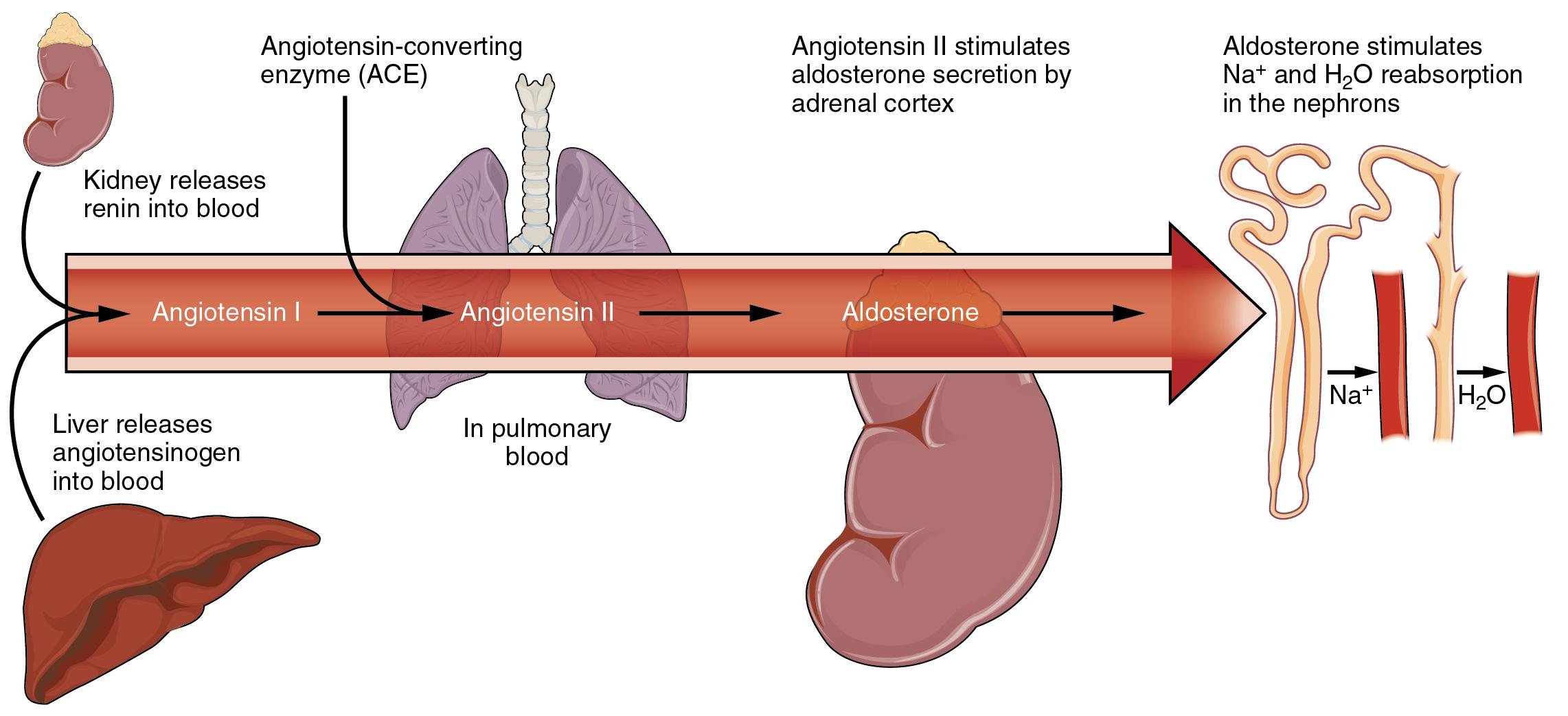
Renin-Angiotensin-Aldosterone Mechanism
A hormonal cascade triggered by low blood volume or low blood pressure in which renal renin converts circulating angiotensinogen to angiotensin I, which is subsequently converted by pulmonary ACE into angiotensin II.
Angiotensin II
A potent vasoconstrictor peptide that raises blood pressure by increasing peripheral resistance, promoting aldosterone and ADH secretion, and stimulating the hypothalamic thirst reflex.
Aldosterone
A mineralocorticoid hormone that acts on the nephrons to increase Na+ and water reabsorption into the blood while increasing K+ excretion, thereby expanding blood volume and elevating blood pressure.
Antidiuretic Hormone (ADH)
A hormone released from the pituitary gland that promotes water reabsorption in the renal tubules along the medullary osmotic gradient, preventing water loss and concentrating urine.
Atrial Natriuretic Peptide (ANP / ANH)
A hormone released by cardiac atrial tissue that decreases Na+ reabsorption in the kidney, inhibits ADH, stimulates natriuresis, and increases urinary fluid loss to reduce blood volume and blood pressure.
Detrusor Muscle
The smooth muscle layer of the urinary bladder wall that undergoes involuntary contraction triggered by a parasympathetic reflex during micturition.
Levator Ani
Skeletal muscle of the pelvic floor that acts as the external urethral sphincter under voluntary motor control from the central nervous system.
Micturition
The physiological act of urination or voiding, initiated as a parasympathetic stretch reflex when bladder volume reaches approximately 250ml and completed upon voluntary relaxation of the levator ani.
Hilum (Kidney)
The concave notch on the medial surface of the kidney through which the renal artery, renal vein, nerves, and ureter pass.
Renal Papilla
The apex or base of each medullary pyramid that features multiple openings to release formed urine from converging collecting ducts into the minor calyces.
Renal Arterial Pathway
The branching pattern of blood flow through the kidney: Renal artery → segmental arteries → lobar arteries → interlobar arteries → arcuate arteries.
Ureter
A muscular tube approximately 28–32cm in length originating near L1 that propels urine from the renal pelvis to the bladder via peristalsis and has bladder-end valves to prevent backflow.
Metabolic Acidosis
An acid-base disturbance characterized by an acidic blood pH (often caused by severe diarrhoea), in which the kidneys eliminate excess H+ ions, potentially reducing urine pH from a normal 6 down to 4.
Metabolic Alkalosis
An acid-base disturbance resulting from excessive base or acid loss (often caused by vomiting or overuse of antacids), compensated for by renal elimination of base.
Erythropoietin
A hormone manufactured by the kidneys that stimulates red blood cell production in the bone marrow.
Urobilin
The metabolic pigment derived from bile degradation that imparts the characteristic normal yellow colour to urine.
Clinical Judgement Model: Noticing
The initial assessment phase of collecting cues regarding urinary function, such as small frequent voids, burning sensations, cloudiness, or suprapubic tenderness.
Anuria
The complete absence of urine output or excretion from the body.
Oliguria
The production or excretion of an abnormally small, scanty volume of urine.
Polyuria
The elimination of an abnormally large volume of urine over a given timeframe.
Dysuria
Difficult, burning, or painful micturition commonly associated with inflammation or lower urinary tract infection.
Haematuria
The abnormal presence of red blood cells or blood in the urine, often indicative of glomerular injury or trauma.
Pyuria
The presence of elevated white blood cells or pus in the urine indicating infectious or inflammatory processes.
Prerenal Dysfunction
Decreased renal blood flow and perfusion caused by external systemic factors such as dehydration, hypovolaemic shock, sepsis, or cardiac failure.
Postrenal Dysfunction
Impaired renal function secondary to mechanical obstruction anywhere along the urinary outflow tract, including calculi, strictures, or prostatic enlargement.
Adult Bladder Sensation Threshold
The initial volume of 150–200ml of urine in the bladder that stimulates stretch receptors to signal the urge to void.
Stress Incontinence
Involuntary loss of urine triggered by increased intra-abdominal pressure during coughing, laughing, sneezing, or physical exertion.
Urge Incontinence
Involuntary leakage of urine preceded by an abrupt, intense, and uncontrollable need to void.
Functional Incontinence
Involuntary loss of urine resulting from physical immobility, cognitive impairment, or environmental obstacles preventing timely access to a toilet.
Urinary Retention
The incomplete emptying or failure of the bladder to empty following micturition, manifesting as suprapubic distension and absence of urine flow.
Mid-Stream Urine Collection (Clean Catch)
A sampling protocol where the initial voided volume is discarded into the toilet to flush resident urethral bacteria before gathering 30–60ml of urine into a sterile receptacle.
Leukocyte Esterase and Nitrite Dipstick Test
Urinalysis reagent parameters whose combined positive identification provides a 74% predictive probability for a bacterial urinary tract infection.
Urinary Tract Infection Presentation in Older Adults
An atypical clinical picture where classical dysuria is frequently absent, presenting instead with acute confusion, delirium, lethargy, and dehydration.
Catheter-Associated Urinary Tract Infection (CAUTI)
The leading nosocomial urinary tract infection across healthcare settings, primarily caused by Escherichia coli colonization along indwelling drainage devices.
Uridome Application Spacing
The essential safety clearance of 2–5cm required between the tip of the glans penis and the end of the external sheath to prevent skin excoriation and urine pooling.
Mimi
The Māori term translating to 'urine', utilised to promote cultural safety, respect, and clear communication in patient partnerships.
Glycosuria
The abnormal excretion of glucose in the urine, occurring when serum glucose concentrations surpass the renal tubular transport threshold.
Proteinuria
The abnormal excretion of albumin or other serum proteins in the urine, indicating compromised glomerular membrane integrity or defective tubular uptake.
Diuresis
The physiological process of increased or excessive urine production by the kidneys, stimulated by high fluid intake, caffeine, or specific medications.
Nocturia
The condition of awakening from nighttime sleep one or more times to pass urine.
Urinary Frequency
A voiding alteration defined clinically as the need to micturate more than 7 times within a 24-hour timeframe.
Paediatric Bladder Sensation Threshold
The filling volume of 50–200ml that activates stretch receptors in young children to produce the initial conscious awareness of a need to void.
Voluntary Bladder Control Developmental Milestone
The neuromuscular ability to consciously regulate micturition, typically emerging between 18–24months of age and maturing into reliable control by 4–5years.
Nocturnal Enuresis
Involuntary urination during sleep occurring in individuals past the developmental age of expected bladder control, observed in approximately 1 in 5 young children.
Normal Adult 24-Hour Urine Output
The typical daily volume of urine excreted by a healthy adult, averaging between 1500–1600ml.
Intrarenal (Renal) Dysfunction
Structural or functional damage occurring directly within the kidney parenchyma, resulting from glomerulonephritis, nephrotoxic agents, systemic lupus, or diabetic nephropathy.
Alcohol Effect on Fluid Regulation
Inhibition of posterior pituitary antidiuretic hormone secretion, which halts water reabsorption in the collecting ducts and promotes significant dilute fluid loss.
Diaphoresis Effect on Urine Output
Substantial loss of fluid via heavy sweating that triggers compensatory renal conservation, resulting in a diminished volume of dark, concentrated urine.
Marjory Gordon's Elimination Pattern
The functional assessment domain examining regularity, quality, sensory symptoms, and client perception regarding bladder, bowel, and skin excretory functions.
Clinical Judgement Model: Interpreting
The cognitive stage of analyzing gathered clinical data and recognizing trends to determine underlying health alterations, such as urinary retention or sepsis.
Clinical Judgement Model: Responding
The phase of initiating evidence-based clinical interventions, including performing bladder ultrasonography, executing clean-catch urinalysis, or initiating rehydration.
Clinical Judgement Model: Reflecting
The retrospective evaluation of therapeutic interventions, reviewing whether voiding comfort returned, whether urine clarified, and determining practice insights.
Overactive Bladder
A urinary syndrome marked by a sudden, compelling desire to pass urine that is difficult to defer, typically accompanied by daytime frequency and nocturia, with or without leakage.
Mixed Incontinence
Involuntary urine leakage featuring overlapping manifestations of both sudden urgency and physical exertion or heightened intra-abdominal pressure.
Post-Micturition Dribble
The involuntary loss of a minor quantity of urine experienced immediately after an individual has finished voiding.
Wharepaku
The Māori word for 'toilet', used to foster cultural safety, effective communication, and partnership in healthcare.
Kope
The Māori term for an absorbent continence pad or containment aid, utilized to maintain client dignity and cultural competence.
Turuturu
The Māori word describing an involuntary 'leak' of fluid.
Māturuturu
The Māori word describing a 'trickle' or weak, hesitant flow of fluid.
Clean-Catch Container Lid Placement
Setting the container cap down with its outer surface in contact with the table and its sterile inner rim pointed upward to prevent environmental contamination.
Dipstick Immersion Technique
Briefly submerging all reagent blocks in fresh urine for under 2seconds and wiping the long edge against the container lip to shed excess fluid.
Dipstick Reading Orientation
Holding the chemical strip horizontally after withdrawal to prevent reagents from diffusing across adjacent test squares and contaminating caregiver hands.
Normal Urine pH Range
A biochemical parameter typically spanning 4.5–8.0, with most healthy individuals exhibiting an average value of 5.0–6.0.
Normal Urine Specific Gravity Range
An indicator of urinary solute concentration that spans from 1.016–1.022 under physiological hydration conditions.
Nitrite Dipstick Urinalysis Limitation
A diagnostic vulnerability wherein non-nitrate-converting bacterial species, such as Streptococcus faecalis, fail to yield a positive reaction despite clinical infection.
Urinalysis Documentation Standards
The professional requirement to record collection time, positive and negative findings, sensory observations, and the nurse's full legal name and complete designation.
Indwelling Catheter Assessment Protocol
Conducting routine evaluations at least once per clinical shift to ensure unkinked tubing, dependent bag placement, secure fixation, and pristine perineal hygiene.
Aged Care Residential Facility UTI Risk Factor
Strict rationing or financial caps placed on absorbent containment supplies, causing residents to remain in saturated products for prolonged intervals.
Benign Dietary Causes of Red-Pigmented Urine
The temporary, harmless red discoloration of urine following consumption of pigments found in beetroot or blackberries.