BIOL 1107 Photosynthesis: Light Reactions, Calvin Cycle, C4 and CAM
 Call Kai
 Learn
 Practice Test
 Spaced Repetition
 Match
 Flashcards
 Knowt Play
1/107

There's no tags or description
Looks like no tags are added yet.
108 Terms
What is photosynthesis?
The process that converts solar energy into chemical energy within chloroplasts.
Why is photosynthesis important?
It nourishes almost the entire living world directly or indirectly.
What are autotrophs?
Organisms that sustain themselves without eating anything derived from other organisms; they produce organic molecules from CO2 and inorganic molecules.
What are photoautotrophs?
Autotrophs that use the energy of sunlight to make organic molecules, such as almost all plants.
What do heterotrophs obtain?
Organic material from other organisms; they are the consumers of the biosphere.
What role do decomposers play in the ecosystem?
They eat dead organic material or feces, recycling nutrients in the ecosystem.
Where does most photosynthesis occur in plants?
In the leaves.
What are chloroplasts?
Organelles in photosynthetic organisms that contain the machinery for photosynthesis.

What is the stroma?
The dense fluid inside chloroplasts, surrounded by an envelope of two membranes.
What are thylakoids?
Connected sacs in chloroplasts that compose a third membrane system and contain chlorophyll.

What is the function of stomata?
Microscopic pores that allow CO2 to enter and O2 to exit the leaf.
What is the significance of the experiments conducted by C.B. van Niel?
They challenged the idea that O2 released during photosynthesis comes from CO2.
What did the first experiment with labeled CO2 reveal?
No 18O was found in the O2 released by the plant, indicating O2 does not come from CO2.
What did the second experiment with labeled H2O show?
18O was present in the O2 released by the plant, indicating that O2 comes from H2O.
What is the general yield of photosynthesis?
Photosynthesis converts light energy to the chemical energy of food.
What is the role of chlorophyll in photosynthesis?
It is the pigment that gives leaves their green color and resides in the thylakoid membranes.

What is the relationship between autotrophs and heterotrophs?
Almost all heterotrophs depend on photoautotrophs for food and O2.
What is the structure of chloroplasts?
Chloroplasts have an envelope of two membranes and contain thylakoids and stroma.
What is the function of veins in leaves?
They transport water from the roots and export sugar to non-photosynthetic parts of the plant.
What is the significance of the 1930s experiments on photosynthesis?
They helped determine the details of the process and the source of O2 released.
What is the source of oxygen released by plants during photosynthesis?
Oxygen (O2) released by plants comes from H2O absorbed.
What did the experiments reveal about the source of oxygen in photosynthesis?
Plants produced O2 containing 18O only when supplied with labeled H2O, never with labeled CO2.
What is the Calvin cycle?
The Calvin cycle is the cyclic pathway that produces sugar from CO2, traced by Melvin Calvin using radioactive 14C.
What major award did Melvin Calvin receive for his work on the Calvin cycle?
Melvin Calvin received the Nobel Prize in 1961.
What are the two main stages of photosynthesis?
The two main stages are the light reactions (light-dependent) and the Calvin cycle (synthesis part).
What occurs during the light reactions of photosynthesis?
The light reactions split H2O, release O2, reduce NADP+ to NADPH, and generate ATP from ADP.
What is the role of chloroplasts in photosynthesis?
Chloroplasts use light energy to make sugar by coordinating the light reactions and the Calvin cycle.
What is the main electron carrier in photosynthesis?
The main electron carrier in photosynthesis is NADP+/NADPH.
How does photosynthesis differ from respiration in terms of electron flow?
Photosynthesis reverses the direction of electron flow compared to respiration.
What is the significance of the absorption spectrum in photosynthesis?
The absorption spectrum shows a pigment's ability to absorb various wavelengths of light.
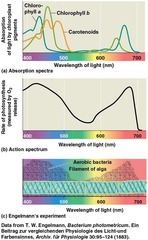
What are the three types of pigments found in chloroplasts?
Chlorophyll a, chlorophyll b, and carotenoids.
Why do most leaves appear green?
Leaves appear green because chlorophyll absorbs violet-blue and red light while reflecting green light.
What is the action spectrum for photosynthesis?
The action spectrum is a profile of the relative effectiveness of different wavelengths for photosynthesis.
What is the electromagnetic spectrum?
The electromagnetic spectrum is the entire range of electromagnetic energy, including visible light.
What is the wavelength range of visible light that drives photosynthesis?
The wavelength range of visible light that drives photosynthesis is 380 nm to 740 nm.
What is the relationship between photon energy and wavelength?
Photon energy is inversely related to the wavelength; shorter wavelengths have more energy.
What is a spectrophotometer used for in photosynthesis studies?
A spectrophotometer measures a pigment's ability to absorb various wavelengths of light.
What is the role of NADP+ in photosynthesis?
NADP+ is reduced to NADPH during the light reactions, serving as an electron carrier.
What is the significance of the light reactions in photosynthesis?
The light reactions convert solar energy into chemical energy in the form of ATP and NADPH.
What method did Engelmann use to measure O2 production in photosynthesis?
He exposed different segments of a filamentous alga to different wavelengths of light and measured the growth of aerobic bacteria.
How does the action spectrum for photosynthesis compare to the absorption spectrum of chlorophyll?
The action spectrum for photosynthesis is broader than the absorption spectrum of chlorophyll.
What role do accessory pigments play in photosynthesis?
Accessory pigments, such as chlorophyll b, broaden the spectrum used for photosynthesis.
What is the structural difference between chlorophyll a and chlorophyll b?
The difference in their absorption spectrum is due to a slight structural difference between the pigment molecules.
What are carotenoids and what colors do they produce?
Carotenoids are accessory pigments that are yellow or orange because they absorb violet and blue-green light.
What is one function of carotenoids in plants?
Some carotenoids are photoprotective, absorbing excessive light that could damage chlorophyll.
Why do leaves change color in the fall?
Colorful foliage in Fall is due to carotenoids that persist longer than chlorophyll in senescent leaves.
What happens when a pigment molecule absorbs light?
An electron goes from a ground state to an excited state, which is unstable.
What is fluorescence in the context of photosynthesis?
Fluorescence is the release of excess energy as heat or light when excited electrons fall back to the ground state.
What are the components of a photosystem?
A photosystem consists of a reaction-center complex surrounded by light-harvesting complexes.
What is the role of the primary electron acceptor in a photosystem?
The primary electron acceptor accepts excited electrons and is reduced as a result.
What are the two types of photosystems and their absorption peaks?
Photosystem II (PS II) is called P680 and absorbs light at 680 nm; Photosystem I (PS I) is called P700 and absorbs light at 700 nm.

What is linear electron flow in photosynthesis?
Linear electron flow is the primary pathway during light reactions that involves both photosystems and produces ATP and NADPH.
What initiates the linear electron flow process?
A photon hits a pigment in a light-harvesting complex of PS II, exciting P680.

What is produced when water is split during linear electron flow?
The splitting of water produces 2 electrons, 2 H+, and ½ O2.
What is the role of the electron transport chain in photosynthesis?
Electrons are passed down the chain, releasing energy used to pump H+ into the thylakoid space, creating a proton gradient.
How is ATP produced during the light reactions?
Potential energy stored in the proton gradient drives ATP production by chemiosmosis.
What happens to P700 in Photosystem I during linear electron flow?
P700 loses an electron to the primary electron acceptor and accepts an electron passed down from PS II.
What is the final step in the linear electron flow?
The enzyme NADP+ reductase catalyzes the transfer of electrons from ferredoxin to NADP+, forming NADPH.
What is the significance of NADPH in photosynthesis?
NADPH provides high-energy electrons for the reactions of the Calvin cycle.
What do light reactions use solar power to generate?
Light reactions generate ATP and NADPH, which are needed by the Calvin cycle to make sugar.
What is the primary function of light reactions in photosynthesis?
To generate ATP and NADPH, providing the energy and reducing power needed for the Calvin cycle.
What two pathways exist for electron flow during light reactions?
Cyclic and linear electron flow.
What happens to H2O during the light reactions?
It is split (photolysis) to release 2 electrons, 2 H+, and O.
What is the role of Photosystem II in the light reactions?
It absorbs light energy, excites electrons, and initiates the electron transport chain.
What is produced as a result of the electron transport chain in Photosystem II?
ATP and NADPH.
What occurs in Photosystem I during the light reactions?
A photon excites electrons, which are then passed to a primary electron acceptor and to another electron transport chain.
What is the significance of the Calvin cycle in photosynthesis?
It is the light-independent stage where ATP and NADPH are used to convert CO2 into sugar.
What is photorespiration?
A process in plants where oxygen is consumed and CO2 is released, often occurring when CO2 levels are low.
What distinguishes photosynthesis from respiration in terms of electron flow?
Photosynthesis reverses the direction of electron flow compared to respiration.
What is an endergonic process in the context of photosynthesis?
Photosynthesis is endergonic because it requires an input of energy (from light) to proceed.
What is the role of the primary electron acceptor in Photosystem II?
It captures the excited electron from P680 after it is energized by light.
What does the term 'chemiosmosis' refer to in photosynthesis?
The movement of H+ ions back into the stroma through ATP synthase, driving ATP production.
What happens to the energy of electrons as they move through the electron transport chain?
Electrons lose energy at each step, which is used to transport H+ ions into the thylakoid space.
What replaces the electron lost by chlorophyll a in Photosystem I?
Electrons coming from the electron transport chain.
What is the outcome of linear electron flow in the light reactions?
It produces both ATP and NADPH.
What is the significance of the thylakoid space in photosynthesis?
It is where H+ ions accumulate, creating a concentration gradient used to produce ATP.
What is the role of light in photosynthesis?
Light provides the energy needed to excite electrons and drive the light reactions.
What are alternative mechanisms of carbon fixation?
Processes that allow plants to fix carbon in ways other than the Calvin cycle, often to adapt to different environmental conditions.
What is produced at the end of the light reactions in photosynthesis?
ATP and NADPH
What process involves the splitting of water during light reactions?
Photolysis
What is the main purpose of cyclic electron flow?
To produce ATP without generating NADPH or oxygen
Which photosystem is used in cyclic electron flow?
Photosystem I (PS I)
What is the primary function of the Calvin cycle?
To reduce CO2 to sugar using ATP and NADPH
What is the initial CO2 acceptor in the Calvin cycle?
Ribulose bisphosphate (RuBP)
What enzyme catalyzes the fixation of CO2 in the Calvin cycle?
Ribulose 1,5-Bisphosphate Carboxylase Oxygenase (Rubisco)
What are the three phases of the Calvin cycle?
Carbon fixation, reduction, and regeneration of RuBP
What is the net product of three turns of the Calvin cycle?
One molecule of glyceraldehyde 3-phosphate (G3P)
How does photorespiration affect the Calvin cycle?
It drains away carbon fixed by the Calvin cycle and does not produce ATP or sugar
What is C3 metabolism?
A type of photosynthesis where the first product of CO2 fixation is a three-carbon molecule (3-phosphoglycerate)
What adaptation do C4 plants have to minimize photorespiration?
They incorporate CO2 into a four-carbon compound as the first product of the Calvin cycle
What is the role of PEP carboxylase in C4 plants?
It has a higher affinity for CO2 than Rubisco and can fix CO2 even at low concentrations
What is the main advantage of CAM plants?
They open their stomata at night to conserve water and fix carbon
How do CAM plants store CO2?
They incorporate CO2 into organic acids that are stored in vacuoles
What is the difference between C4 and CAM pathways?
C4 separates the steps of carbon fixation and the Calvin cycle spatially, while CAM separates them temporally
What is the significance of photosynthesis in plants?
It converts sunlight energy into chemical energy stored in organic compounds
What happens to excess sugar produced in photosynthesis?
It is stored as starch in chloroplasts and other plant structures
What is chemiosmosis in chloroplasts?
The process where ATP is generated as protons diffuse back into the stroma
How does photophosphorylation differ from oxidative phosphorylation?
Photophosphorylation uses light energy, while oxidative phosphorylation uses chemical energy from food
What is the role of ATP synthase in photosynthesis?
It couples the diffusion of protons down their gradient to the phosphorylation of ADP to ATP
What is the relationship between chloroplasts and mitochondria in ATP production?
Both use chemiosmosis and electron transport chains to generate ATP