BIO Lab Midterm Practical
 Call Kai
 Learn
Learn Practice Test
 Spaced Repetition
 Match
Match Flashcards
 Knowt Play
1/103

Earn XP
Description and Tags
Labs 1-6
Name | Mastery | Learn | Test | Matching | Spaced | Call with Kai | Chat |
|---|
No analytics yet
Send a link to your students to track their progress
104 Terms
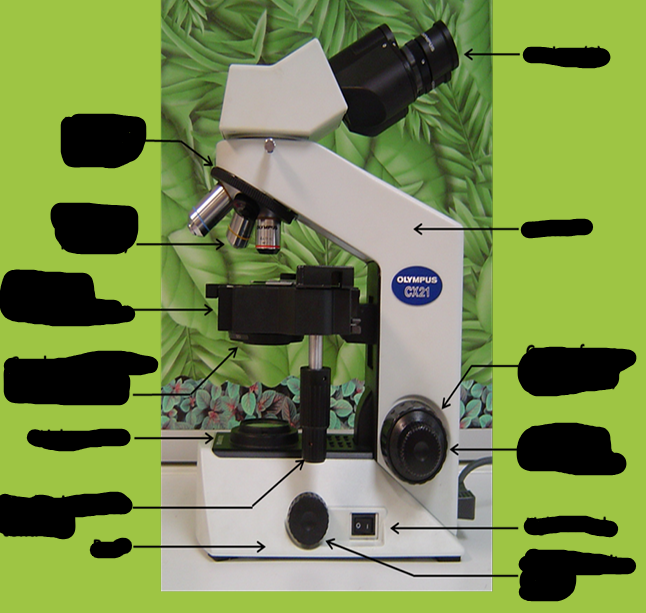
Label the compound light microscope

Calculate Total Magnification using the ocular power and the low power objective
10 × 4 = 40x total magnification
Calculate Total Magnification using the ocular power and the medium power objective
10 × 10 = 100x total magnification
Calculate Total Magnification using the ocular power and the high power objective
10 × 40 = 400x total magnification
What are the 8 taxon levels in order?
Domain, Kingdom, Phylum, Class, Order, Family, Genus, Species
Which level is the most general? Most specific?
Domain - most general; greatest number of organisms
Species - most specific; fewest number of organisms
Which two taxon levels make up the scientific name of an organism?
Genus + Species
What are the three domains?
Bacteria, Archaea, Eukarya
What are the six kingdoms?
Bacteria, Archaea, (Eukarya): Protista, Fungi, Plantae, Animalia

Label the Bacterial Cell


What are these cell shapes?
Coccus/cocci (spherical)
Bacillus/bacilli (rod-shaped)
Spirillum/spirilla (wavy)

What are these cell arrangements?
Diplococci (pair of round cells)
Streptococci (chain of round cells)
Staphylococci (cluster of round cells)
Diplobacilli (pair of rods)
Streptobacilli (chain of rods)
What are the 4 stains/solutions used in the Gram Stain Technique? Which color indicates gram + and gram - for each?
Crystal violet; gram + = purple, gram - = purple
Iodine; gram + = purple, gram - = purple
Alcohol; gram + = purple, gram - = clear
Safranin; gram + = purple, gram - = pink
Which solution is the decolorizer? Which stain is the counterstain?
Alcohol; Safranin

Are the cells at letter A, Gram + or Gram – bacteria?
Are the cells at letter B, Gram + or Gram – bacteria?
Gram +
Gram -

Identify the cell shape for 1, 2, & 3
Coccus
Spirillum
Bacillus

Identify the cell shape and arrangement of the bacteria at letter A.
Diplobacilli
What are the characteristics of Amoeboid?
Use pseudopods for motility and food
Take in large material by phagocytosis
Some have external shells
What are the characteristics of Protozoa?
Unicellular heterotrophic eukaryotes
Most have some level of motility
Mostly free-living; some are parasitic
What are the characteristics of Ciliates?
Use cilia for motility
Contain two nuclei (macronucleus and micronucleus)
Many have trichocysts for obtaining food and defensive purposes
Asexual binary fission and sexual conjugation both occur
What are the characteristics of Flagellates?
Use flagella for motility
Parasitic
What are the characteristics of Apicomplexans?
Nonmotile protozoa
Parasitic
Alternating asexual and sexual stages of development

What is this protist? Where are it’s pseudopodia, nucleus, and cell membrane?
Amoeba

Does this protist have a cell wall?
By what means do these organisms use their pseudopodia to take in large, solid material?
No
Phagocytosis

Name the structures at letter A.
Name the structure at letter B.
Pseudopods
Nucleus

What are these amoeboid protozoans?
What substance makes up their cell wall?
Foraminifera
calcium carbonate

What are these protists?
These protists have a cell wall composed of what substance?
Radiolarians
silica

What is this protist?
What is the asexual reproductive process seen here?
Paramecium
Binary fission

What structures does this protist use for motility/locomotion?
Does this protist have a cell wall?
cilia
no cell wall—-pellicle (flexible)

What is the process of reproduction seen in the picture?
Sexual Conjugation
What is the function of the macronucleus?
What is the function of the micronucleus
Daily functioning
Reproduction
What is the name of the organelle that helps expel excess water?
Contractile vacuole
What is the name of the flexible protein that helps these protists change their shape. (hint: this structure is also seen in Euglena)
pellicle

Name the short, hair-like extensions at letter A.
cilia

Name the protist at letter A.
What disease does this protist cause in humans?
Name the vector that transmits this protist to humans?
Is this protist a parasite?
Name the cell at letter B.
Trypanosoma
Sleeping Sickness
Tsetse fly
Parasite
red blood cell (erythrocyte)

This slide shows a red blood cell infected with spores from what parasite?
What is the name of the vector that transmits these spores to humans?
What is name of the disease caused by the vector?
Plasmodium
Female Anopheles mosquito
Malaria
What are the characteristics of Algae?
Photosynthetic protistans
Unicellular, colonial and multicellular forms occur
Serve as primary producers in aquatic food webs
Major producers of oxygen in the environment
What are the characteristics of Dinoflagellates?
Unicellular flagellates with two flagella
Many have cellulose cell walls
Associated with Red Tide
What are the characteristics of Diatoms?
Unicellular golden algae
Planktonic
One of the most abundant forms of plankton
Possess two-part silica cell walls (“valves”)
What are the characteristics of Euglenoids?
Unicellular flagellates
Possess an anterior flagellum and chloroplasts
Possess eyespot to detect light
No cell wall
Pellicle – flexible protein
What are the characteristics of Green Algae?
Unicellular, colonial and multicellular forms occur
Sexual reproduction occurs via conjugation
What are the characteristics of Brown Algae?
Contain the photosynthetic pigment fucoxanthin
Possess air bladders
What are the characteristics of Red Algae?
Contain the photosynthetic pigment phycoerythrin

What is the name of the protists at the tips of the pointers?
These protists have a cell wall made up of what substance?
These protist produce a toxin that colors the water red, what is that condition?
What are the structures these protists use for motility?
Dinoflagellates
Cellulose
Red Tide
Two flagella
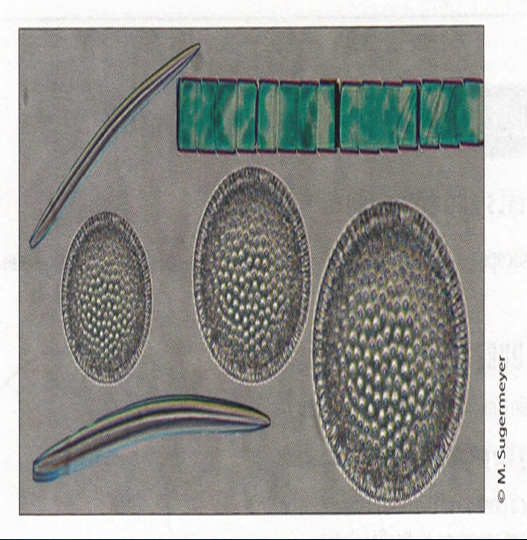
What is the algal protists seen here?
What is their cell wall made of?
These protists are an example of what?
These protists store what substance that aids in buoyancy?
Diatoms
Silica
Plankton
Oil

What is the name of the algal protists seen here?
What is the name of the structures at letter A?
Is this algal protist photosynthetic or heterotrophic?
Is this algal protist unicellular, colonial, or multicellular
Volvox
Daughter colonies
Photosynthetic
Colonial
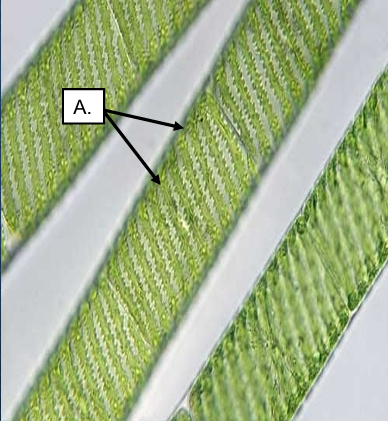
What is the name of the filamentous, colonial green algae seen here?
Is this algae autotrophic or heterotrophic?
What is the name of the structure at letter A?
Spirogyra
Autotrophic
Chloroplasts
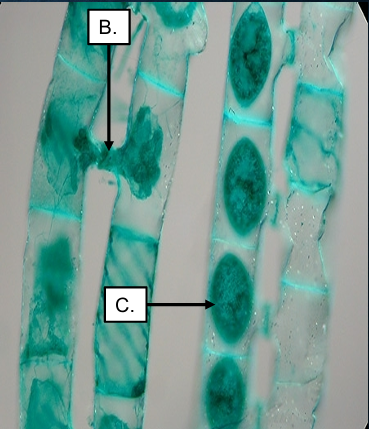
What is the name of the structure at letter B?
What is the name of the structure at letter C?
What is the name of the process of sexual reproduction?
Conjugation tube
Zygospore
Conjugation

What is the structure at letter A?
What is the structure at letter B?
What is the structure at letter C?
What is the structure at letter D?
What is the function of B?
Blades
Air bladders
Stipe
Holdfast
Provide buoyancy
What are the characteristics of Kingdom Fungi?
Eukaryotic
Heterotrophic
Most are saprobes, but some are parasitic
Digestion occurs externally
Cell walls contain chitin
What are the characteristics of Bread Mold?
Produce diploid zygospores through sexual reproduction
Hyphae do not have crosswalls (septa) between nuclei; hyphae are therefore non-septate hyphae
What are the characteristics of Sac Fungi (Cup Fungi)?
Septate hyphae to separate nuclei
Contain dikaryotic (n + n) cells; Dikaryon stage
What are the characteristics of Club Fungi?
Septate hyphae to separate nuclei
Contain dikaryotic (n + n) cells in basidia; Dikaryon stage

What is this? Label.
Rhizopus (black bread mold)


L: What is the name of the small, black dots that contain spores?
R: What is the name of the filaments that make up the mycelium?
L: Sporangia
R: Hyphae

What is this?
What phylum is this?
What does it produce?
Label.
Penicillium
Sac Fungi
Antibiotic Penicillin

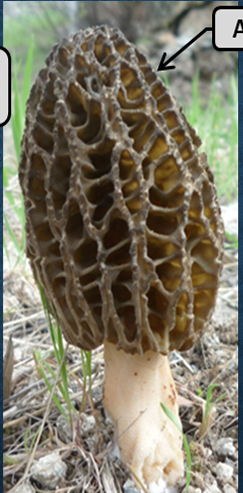
What is this?
What is its taxonomic group?
Morchella
Ascomycota (Sac Fungi)

What is this? Label.
Coprinus


Label.


Label.
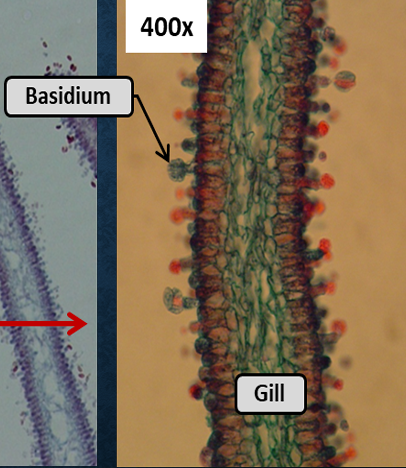

Label.

What are the characteristics of Lichen?
Symbiotic relationship between a fungus and algae or cyanobacteria
Fungal component of most lichens is a sac fungus
Symbiotic relationship is called mutualism; both organisms benefit
What are the three basic shapes of Lichen?
Foliose – looks like peeling paint
Crustose – looks like paint stains
Fruticose – typically branch-like; typically grows upright

Which is this?
Crustose

Which is this?
Foliose

Which is this?
Fruticose
The sporophyte generation produces spores by what cell division process?
Meiosis
The gametophyte produces the ___________ by what cell division process?
gametes by mitosis
When a sperm cell fertilizes an egg cell, a 2n (diploid) ____________ is produced.
zygote
What’s another name for seedless nonvascular plants and what is the taxonomic group called?
Bryophytes and Liverworts (Marchantia)
What are the characteristics of Liverworts?
Seedless plants that lack vascular tissues
Fertilization requires the presence of water for sperm transport
Lack true roots
Possess rhizoids for anchorage and water absorption

What is this?
Marchantia sporophyte on underside of archegonial receptacle

Is the archegonial receptacle a male or female reproductive structure?
female
What are the names of the structures that are found in the sporophyte capsule?
Spores
Elaters
Operculum (the lid)
Peristome teeth (help release spores)

What is this? Label.
Antheridial Receptacle


What is this? Label.
Antheridium with Sperm Cells


What is this? Label.
Archegonial Receptacle

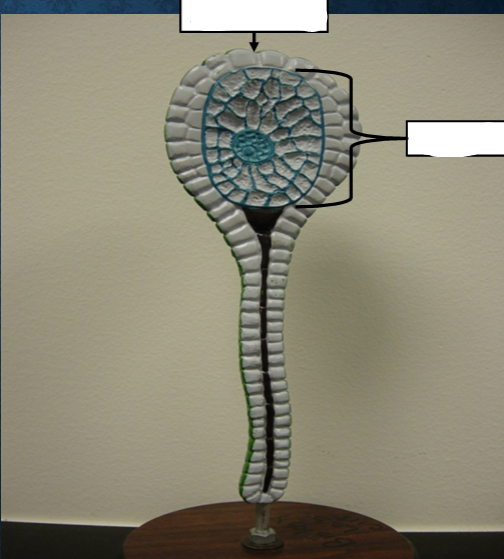
What is this? Label.
Archegonium with Egg Cell

What are the taxonomic groups in seedless vascular plants?
Ferns
Fern Allies
What are the characteristics of seedless vascular plants?
Seedless plants with vascular tissue; monoecious
Fertilization requires the presence of water for sperm transport

What is this? Label.
Fern Sorus


What is this? Label.
Fern Gametophyte with Sporophyte

What is the taxonomic group for vascular plants with seeds?
Gymnosperms (pine trees, red woods, cycads, & Ginkos)
What are the characteristics of Gymnosperms?
Vascular plants which produce ‘naked seeds’
Most are monoecious
Reproduce by alternation of generations, with a dominant sporophyte
Wind dispersal of pollen grains

What is this? Label.
Pine needle


What is this? Label.
Male pine cone


What is this? Who produces it?
Pollen grains; male pine cones

What is this? Label.
Female pine cone

What is the taxonomic group for Vascular plants with flowers and fruit?
Angiosperms
What are the characteristics of Vascular plants with flowers and fruit?
Flowering, vascular plants that produce seeds enclosed in fruit
Anthers produce pollen grains
Wind dispersal of pollen grains

Label parts of the flower.
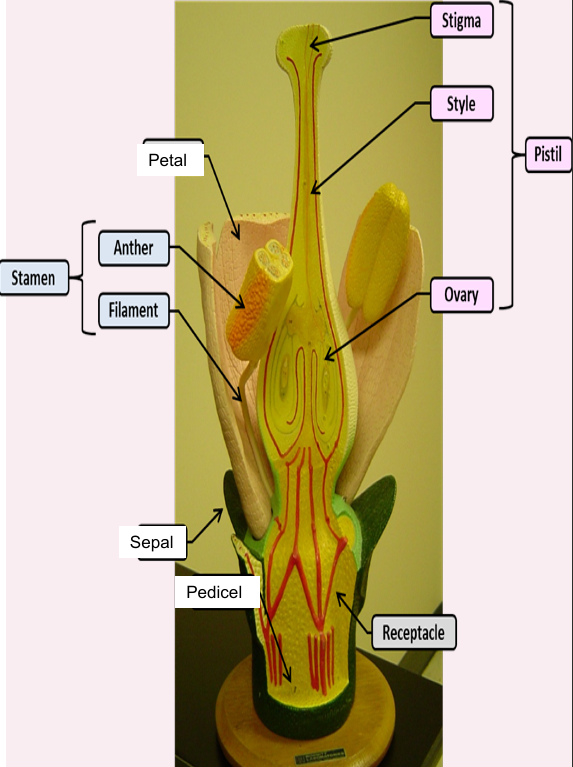
What are the characteristics of monocots?
One cotyledons
Parallel venation of leaves
3’s or multiples of 3 for petals
Scattered vascular bundles in stems
Fibrous root system
Examples: Corn, orchid, lily, grass
What are the characteristics of eudicots?
Two cotyledons
Branched, netted, or flared venation of leaves
4’s or 5’s or multiples of 4 or 5 for petals
Arranged in a distinct circle (ring) vascular bundles in stems
Taproot system (most)
Examples: Apple, daisy, rose, oak tree
What are the characteristics of Fibrous Root?
Multiple slender roots growing from the base of the stem
Found in most monocots and some eudicots
What are the characteristics of Taproot?
Thick, central root extending from the base of the stem
Common in eudicots
What are the characteristics of Adventitious Roots?
Roots that form from lateral parts of the stem
Sometimes called prop roots
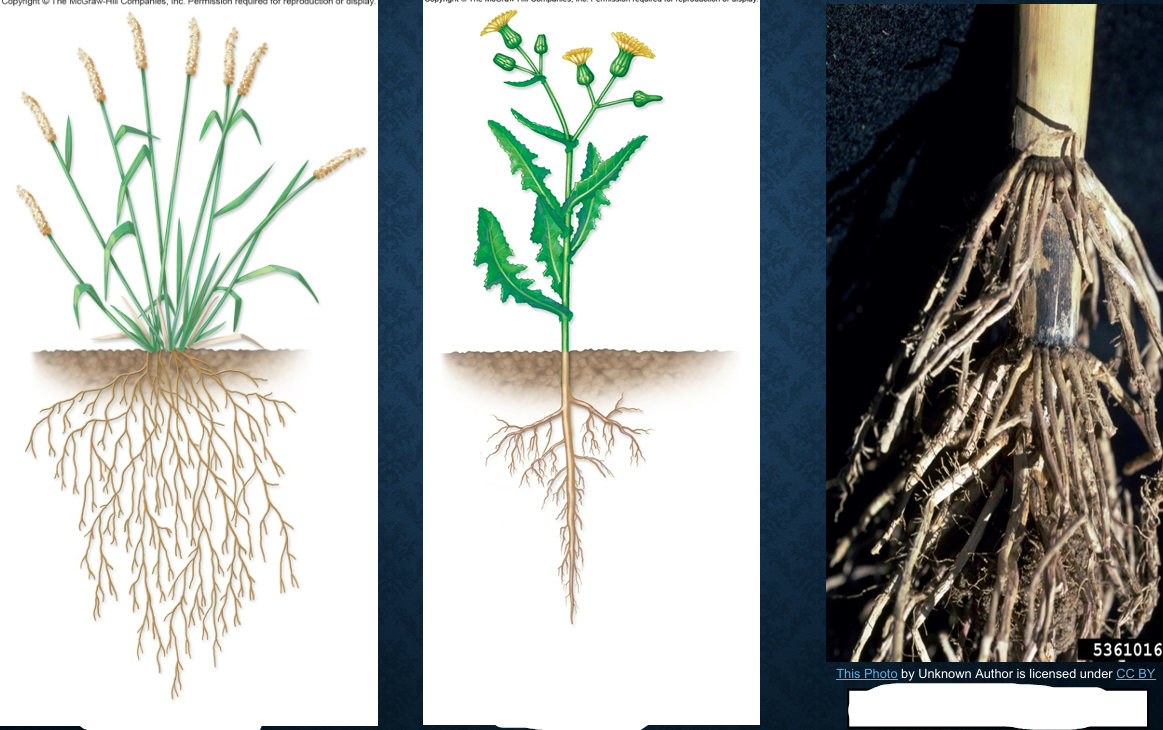
Which roots are these?
Fibrous, Taproot, Adventitious


Label
Root cap (1)
Apical meristem (2)
Zone of elongation (3)
Zone of maturation (4)
Root hair (6)
Epidermis (7)
Cortex (8)
Phloem (11)
Cambium (12)
Xylem (13 & 14)
Is this root tip from a monocot or a eudicot? (Hint: Does it have cambium? If so, it produces wood and is a eudicot.)
Eudicot
What is the function of the xylem?
What is the function of the phloem
Xylem: transfers water and minerals
Phloem: transfers food and hormones