Equities 2
 Call Kai
 Learn
 Practice Test
 Spaced Repetition
 Match
 Flashcards
 Knowt Play
1/11

There's no tags or description
Looks like no tags are added yet.
12 Terms
Limitations of Constant growth model
Some companies do not have dividends histories
Difficult to estimate their share valuation then
Model is sensitive to changes in r and g
Share price approaches infinite, when r and g approach the sum of zero in the denominator
Unrealistic
What is earnings per share (EPS)?
This is how much accounting profits (after interest, taxes and preferred shares) is accounted to ordinary shares.
Tells us how profitable a company is, in terms of per share

What is the dividends payout ratio?
Measures the proportion of ordinary dividends given out relative to earnings per share.
Whatever isn’t given out as dividends is retained profits, which can be reinvested.

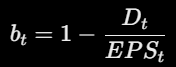
What is the plowback/retention ratio?
bt = retention ratio
Measures the proportion of retained earnings
Minuses the dividends payout ratio from 1 to give the percent that is retained profits after dividends payments are made
Growth rate in relation to plowback ratio
g is the growth rate, g is the plowback ratio and rE is the return on retained profits
This equation comes from the idea that when a company has retained profits, it has the possibility to reinvest and grow, hence increasing dividends and the share price.
This is not guaranteed.

What is the price to earnings ratio (P/E)?
Measures the current share price relative to earnings per share over the last 12 months

Why investors might pay a high P/E ratio?
Stable cash flows
perceived low risk
Expect future growth of company
Why do higher expected interest rates reduce valuation of assets?
For a share:
At a higher interest rate, the present value of all future cash flows are discounted more heavily
And capital gains are also lowered or turn to losses.
What are the four types of risk and what do they affect?
Interest risk - The challenge of interest rates rising decreasing the valuation of shares and bonds
Price risk - Prices decreasing reducing capital gains for shares and bonds
Credit risk - The risk a borrower isn’t able to pay promised payments, for bonds only.
Inflation risk - Issue that inflation reduces the purchasing power of returns, for investors.
Inflation on returns
Even if a financial asset has reliable returns, it is difficult to determine the purchasing power of the return due to inflation.
When looking at nominal and real returns, inflation can reduce the nominal returns.
What does term structure of interest rates mean?
Describes the relationship between time to maturity and yield to maturity at particular points in time.
Time to maturity meaning many time periods till the asset is matured and its par value is redeemed.
Yield to maturity refers to the annual expected return when buying at current market price and holding to maturity, assuming all promised payments are made.
it is depicted as a graph
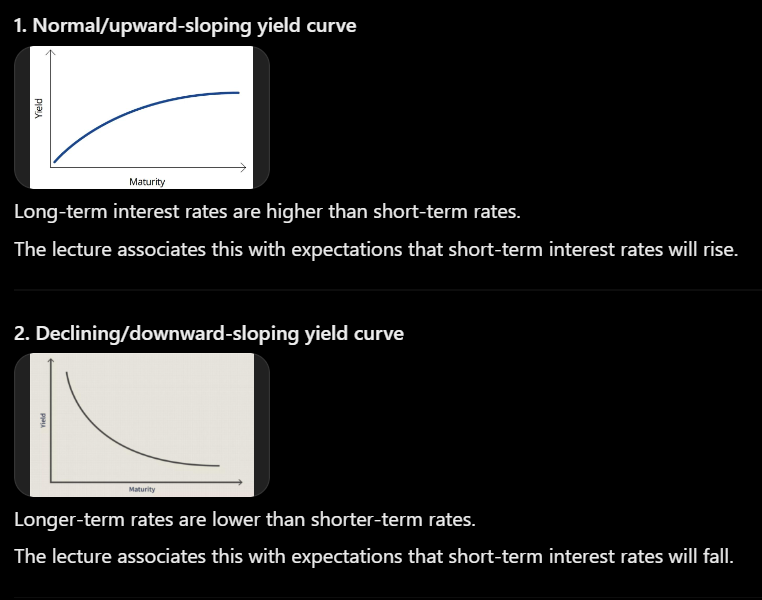
Types of yield curves