Unit 2 Knee, Patella, Tibia, and Fibula - quizlet
 Call Kai
 Learn
 Practice Test
 Spaced Repetition
 Match
 Flashcards
 Knowt Play
1/337

There's no tags or description
Looks like no tags are added yet.
338 Terms
femur
What is 1?

patella
What is 2?

lateral epicondyle
What is 3?

lateral condyle
What is 4?

lateral tibial plateau
What is 5?

intercondylar eminence
What is 6?

head of fibula
What is 7?
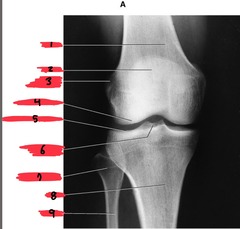
tibia
What is 8?

fibula
What is 9?

lateral
What is 1?

medial
What is 2?

adductor tubercle
What is 3?

medial epicondyle
What is 4?

medial condyle
What is 5?

5-7 degrees
What is 6?

medial condyle
What is 1?

patella
What is 2?

trochlear groove
What is 3?

lateral condyle
What is 4?

intercondylar fossa
What is 5?

base
What is 1?

apex
What is 2?

off set
The medial and lateral condyles are what?
adductor tubercle
What does the medial condyle of the knee contain that helps see rotation of knee?
intercondylar fossa
What seperates the lateral and medial condyle?
trochlear groove
Whats holds the patella in place?
Knee Joint (oblique)
What view can be used as an alternative when the sunrise is bad to see the patellar/femur
femorotibial and patellofemoral joints
What are the two knee joints?
posterior cruciate, anterior cruciate, fibular collateral, and tibial collateral
What are the four major ligaments of the knee?
ACL and medial meniscus tear
Tear in medial coleteral ligament is associated with what?
MRI
What modality is best to visualize soft tissue knee injuries?
ligaments
What holds the femur, tibia, and fibula together?
ligament tears
Most knee injuries are what?
lateral and medial meniscus
What absorbs shock on the knee and prevents the femur from breaking the tibia?
bursa
What are little sacs of serous fluid that help with movement?
the grid and whether they can do standing exams
Why is bariatric patient a consideration when taking knee exams?
bone densitometry and nuclear medicine
What two modalities can be used if there are knee issues with no known cause?
1/2 inch below patellar apex
For an AP knee where is centering point?
if patient measures 18 cms or below 5 degree caudad, if patient measures 19 to 24 cms no angle, and if patient measures 25 cm and above 5 degrees cephalad
How should you angle the tube in an AP knee?
femoral epicondyles
What should you align to make sure patient is not rotated in AP knee?
The patient is medially rotated
On a lateral knee the fibia is in the tibula and the abductor tuubercle is super anterior, whats wrong?
The patient is laterally rotated
On a lateral knee the fibia is super far from the tibula and the abductor tuubercle is super posterior, whats wrong?
place caliper under back then to the top of the asis
How do you measure patients for views that are dependent on size?
exits 1/2 inch inferior to the patellar apex
For a PA knee where is the CR?
5 to 7 degrees caudal
What is the angle for a PA knee?
tibial plateau
CR should be parallel with what for a PA knee?
femoral epicondyles
What should be parallel in a PA knee?
symmetrical tibial plateau
How can you tell a good PA knee?
20 to 30 degrees
In a lateral knee (mediolateral) turn patient on affected side and flex knee how much?
epicondyles
What should you make sure is perpendicular to IR in lateral knee (mediolateral)?
1 inch distal to medial epicondyle
Where does CR enter for lateral knee (mediolateral)?
5 to 7 degrees cephalad
How is CR angled in lateral knee (mediolateral)?
65 to 80
What is kV in all normal knee exams? (not tunnel or bilateral)
lateral knee (lateromedial)
What view is good to visualize air fluid levels of the knee?
lateral knee (lateromedial)
What view is used for trauma or cases when patient can not flex knee 20-30 degrees?
slightly flexed with medial side of knee against IR
How do you want knee in lateral knee (lateromedial)?
the abductor tubercle
In a lateral knee (lateromedial) what do you look at to see if the knee is rotated?
the fibula should sit out (but not a lot)
How else can you tell if a lateral knee (lateromedial) is rotated?
midway between the knee joints at a level 1/2 inch distal to the patellar apex
Where should you center for a AP standing knee exam?
if patient measures 18 cms or below 5 degree caudad, if patient measures 19 to 24 cms no angle, and if patient measures 25 cm and above 5 degrees cephalad
How should you angle the tube in a AP standing knee exam?
70-80
What is kV in AP standing knee exam?
shoes
What needs to be off for AP standing knee exam?
1/2 below the patellar apex
Where is CR for AP oblique knees?
if patient measures 18 cms or below 5 degree caudad, if patient measures 19 to 24 cms no angle, and if patient measures 25 cm and above 5 degrees cephalad
How is tube angled in AP oblique knees?
45 degrees
How much do you rotate in oblique knees?
Fibula pops out and the fib/tib articulation is better visualized
Why is a medial oblique knee preferred over a lateral?
angle the tube 5 degrees caudad
If a patients pelvic measurement is 18 cms or below what do you do to the tube?
none
If a patients pelvic measurement is 19 to 24 cm how much should you angle tube?
5 degrees cephalad
If a patients pelvic measurement is 25 or above how should you angle tube?
tibia should be parallel with IR and knee should flexed 60 to 70 degreea
In the holmblad tunnel view how is the patient positioned?
midpopliteal crease
In the holmblad tunnel view where is CR?
70-80
What is kV in the holmblad tunnel view
patient is prone with knee flexed 40 t0 50 degrees with foot on sponge
In the camp-coventry tunnel view how is patient positioned?
Around 40 to 50 degrees, match perpendicular to tib/fib
In the camp-coventry tunnel view how is tube angled?
70-80
In the camp-coventry tunnel view what is kV?
popliteal depression
In the camp-coventry tunnel view where is CR?
camp-coventry tunnel view
What view is done to visualize osteo phytes?
patient supine to make long axis of femur 40-45 degrees to long axis of tibia
How is the patient positioned in the beclere method?
to long axis of tibia
How is tube angled in beclere method?
1/2 below the patellar apex
Where is CR in beclere method?
superior
Base of patella is what?
inferior
Apex of patella is what?
to decrease OID
Why is a PA projection of the patella preferred?
to the midpopliteal region
Where is CR directed in a PA knee?
If a patient has injured their patella it may be uncomfortable to put all their weight down on it
Why can a PA knee be hard?
70-80 kV
What is kV for a PA of the knee?
elevate patient to have patella hover over table instead of placing it down
What can you do if a patient can not tolerate a PA knee?
it is good for showing patella fractures and patient may not be able to do other views if their patella is fractured
Why is it important to check your PA view of a patella before doing others?
5 to 10 degrees, the knee is almost straight
For a lateral patella how much is the knee flexed?
the midpatellofemoral joint, right behind the patella
Where does CR enter for lateral patella?
70-80
What is kV for lateral patella?
patient is prone with IR under knee and leg flexed around 50 to 60 degrees, foot dorsiflexed
In a patella tangential hughston view how is the patient positioned?
10 to 15 degrees cephalic from axis of leg and direct through patellofemoral joint (around 45 degrees)
How do you angle CR for patella tangential hughston view?
patellofemoral joint
Where does CR enter for patella tangential hughston view?
70-80
What is kV for patella tangential hughston view?
flex knee till it is 90 degrees with IR, dorsiflex foot
In a patella tangential settagast how is patient positioned?
15 to 20 degrees to be perpendicular to the joint space
In a patella tangential settagas how is tube angled?
patellofemoral joint
Where is CR for patella tangential settagas?
70-80
What is kV in patella tangential settagas
sitting, flex knee till patella is perpendicular to IR , place IR under knee
How is patient positioned in patella tangential Hobbs?