Exam 2 Audio Eval
 Call Kai
 Learn
 Practice Test
 Spaced Repetition
 Match
 Flashcards
 Knowt Play
1/221

There's no tags or description
Looks like no tags are added yet.
222 Terms
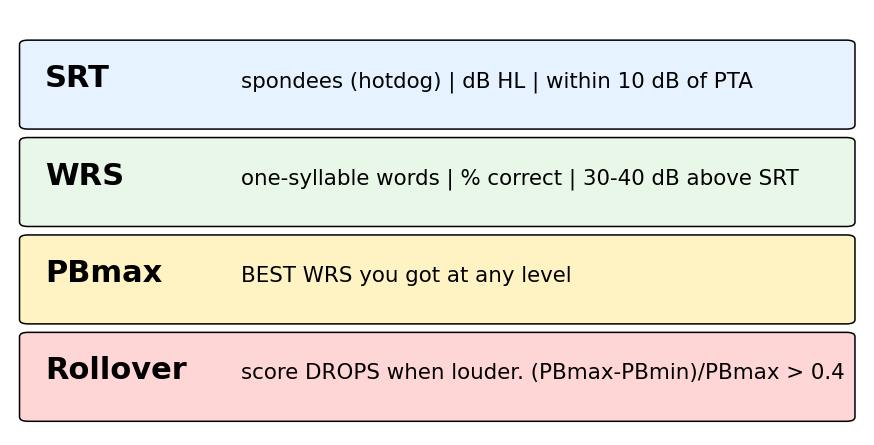
SRT
Quietest level you can repeat 2-syllable words (spondees) half the time. Units: dB HL.

WRS
Percent of one-syllable words repeated correctly, tested LOUD (30-40 dB above SRT). Units: %.
SRT should match your ___ within ___ dB
PTA; 10 dB
No SRT? Use the ___ instead
PTA
Is SRT a threshold or suprathreshold test?
Threshold (quietest level)
Is WRS a threshold or suprathreshold test?
Suprathreshold (loud, above threshold)
SDT/SAT: patient only has to…
Notice that speech is there (not understand it). About 10 dB better than SRT.
PBmax means
Your BEST word recognition score at any level
Rollover means
Score gets WORSE when the speech gets louder

Rollover index formula
(PBmax - PBmin) / PBmax

Rollover index example: PBmax 64%, PBmin 38%
(64-38)/64 = 0.41. Over 0.4 = significant
A rollover index over ___ is significant
0.4 (suggests retrocochlear, but does not prove it)
Normal hearing: expected WRS
About 90-100%
Conductive loss: expected WRS
About 90-100% (just make it louder)
Cochlear loss: expected WRS
WRS is generally consistent with the degree of hearing loss
Retrocochlear loss: WRS pattern
Lower than the chart predicts and/or rollover

Dubno graph: what the dots show
PTA (across) vs best word score (up). Dashed line = lowest normal score for that PTA.
Score BELOW the dashed line on the Dubno graph means
Disproportionately low WRS: possible retrocochlear

SPRINT chart: how to read it
Find PTA on the left, WRS across the top. White box = as expected. Gray box = too low.

SPRINT: PTA 60, WRS 60
White zone = as expected for a cochlear loss

SPRINT: PTA 40, WRS 50 (Alfred)
Gray zone = lower than expected; retest at a higher level; if still low, think retrocochlear

SPRINT: acoustic neuroma, PTA 40. Expected WRS?
Below the cutoff for PTA 40 (under about 60%), which is the gray zone. A cochlear loss would score above it.
A gray-zone WRS: what do you do first?
Retest at a second, higher level (maybe PBmax was not reached)
Do the SPRINT/Dubno charts work for conductive loss?
No. SNHL only.
Fletcher average
Average of the 2 BEST thresholds out of 500, 1000, 2000 Hz. Used for steeply sloping loss.
Dynamic range formula
UCL minus SRT. Example: 100 - 45 = 55 dB
Recruitment makes dynamic range
Smaller (quiet is inaudible, loud is very loud)
MCL
Most comfortable level (about 40-55 dB above SRT)
UCL
Level that is uncomfortable (not painful)
Longer word lists give scores that are
More reliable (less variable)
Kids who cannot repeat words: use
Picture-pointing tests (WIPI, NU-CHIPS)
Masking: why?
Stop the NON-test ear from answering the test ear's tone
Crossover
Tone from the test ear travels through the skull to the other cochlea. ALWAYS happens.
Cross-hearing
The other ear actually HEARS the crossover. (Crossover can happen without it.)
The ___ cochlea always responds
Best (better) cochlea
IA for supra-aural earphones
40 dB
IA for insert earphones
70 dB
IA for bone conduction
0 dB

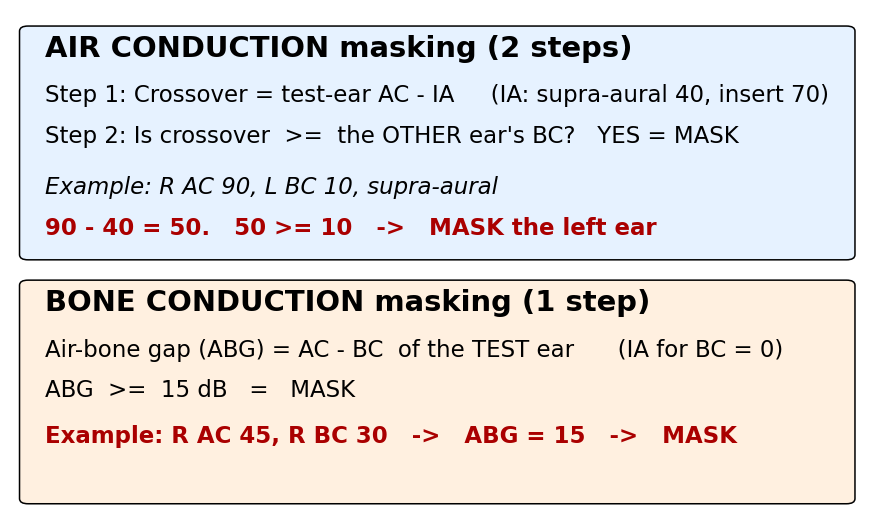
AC masking step 1
Crossover = test-ear AC minus IA

AC masking step 2
Is crossover >= the OTHER ear's BC? If yes, MASK.

AC masking: R AC 60, L BC 10, supra-aural
60 - 40 = 20. 20 >= 10. MASK the left ear.
AC masking: R AC 50, L BC 0, supra-aural
50 - 40 = 10. 10 >= 0. MASK.

AC masking: R AC 90, L BC 10, supra-aural
90 - 40 = 50. 50 >= 10. MASK.

AC masking: R AC 30, L BC 20, supra-aural
30 - 40 = -10. -10 is NOT >= 20. NO mask.

AC masking: R AC 80, L BC 0, INSERTS
80 - 70 = 10. 10 >= 0. MASK.
No BC at 8 kHz: mask when AC difference between ears is at least
40 dB (supra-aural) or 70 dB (inserts)

BC masking rule
Mask when the test ear's air-bone gap is 15 dB or more
Air-bone gap formula
AC minus BC

BC masking: R AC 45, R BC 25
Gap 20 = 15 or more. MASK.

BC masking: R AC 45, R BC 30
Gap 15. MASK.

BC masking: L AC 20, L BC 10
Gap 10. NO mask.
Why is BC masking about the air-bone gap?
IA is 0, so you can't tell which cochlea answered when the test ear has a gap
Air rule or bone rule: 'AC minus IA'
Air conduction rule
Air rule or bone rule: 'gap of 15'
Bone conduction rule
Where does the masking noise go?
The NON-test ear
Best noise for pure-tone masking
Narrowband noise

Masked right AC symbol
Triangle
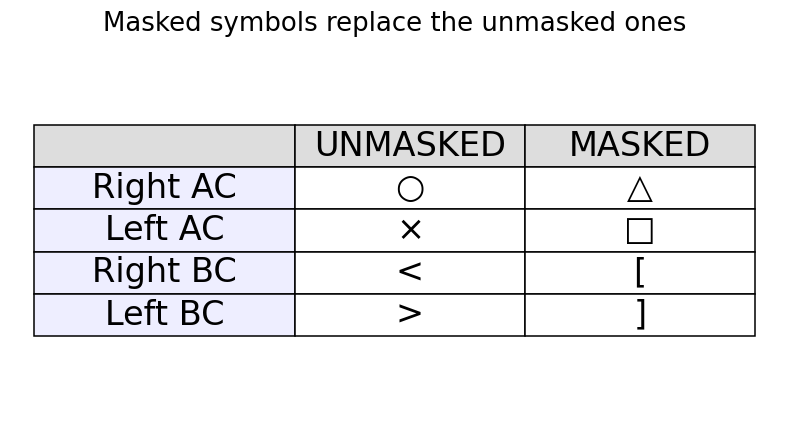
Masked left AC symbol
Square

Masked right BC symbol
[

Masked left BC symbol
]
Undermasking
Noise too soft; non-test ear can still answer
Overmasking
Noise so loud it crosses over and raises the TEST ear's threshold
Plateau
Test-ear threshold stays the same as masker goes up. This is the goal.
Masking dilemma
No safe level between too little and too much. Classic: both ears conductive with big gaps.
Tympanogram shows
How easily the middle ear moves (admittance) as ear-canal pressure changes
Normal probe tone for adults
226 Hz
Three parts of the tymp probe
Speaker, air pump, microphone
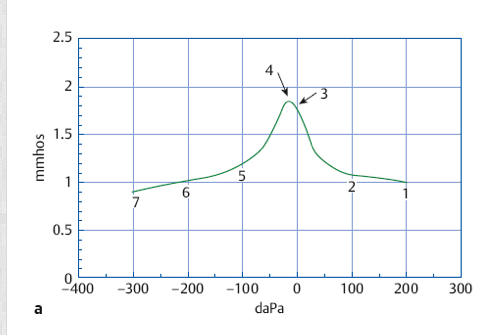
Normal peak pressure range
-150 to +25 daPa

Type A
Normal. Also seen with sensorineural loss.

Type As
Shallow peak = STIFF (example: stapes fixation)

Type Ad
Very tall peak = FLOPPY (example: ossicular disarticulation)

Type B
Flat. Look at the ear-canal volume to decide why.

Type C
Peak shifted to negative pressure: Eustachian tube problem / resolving ear infection

Type B + normal volume
Fluid behind the eardrum

Type B + small volume
Blocked canal (earwax)

Type B + large volume
Hole in the eardrum or open PE tube

Normal adult ear-canal volume
0.9 - 2.0 cc (child: 0.3 - 0.9 cc)
Mild sensorineural loss, normal ear exam: tymp?
Type A
Ear infection: tymp?
Type B with normal volume
Earwax plug: tymp?
Type B with small volume
Eardrum perforation: tymp?
Type B with large volume (and conductive loss)
Can a tympanogram tell you the hearing loss amount?
No. It only tests middle-ear function.
Acoustic reflex =
Loud sound makes both stapedius muscles tighten (bilateral)
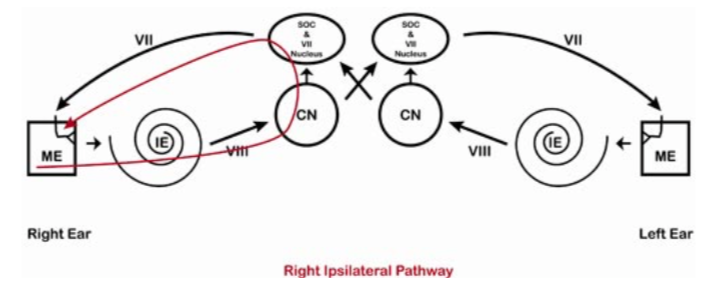
Reflex nerve path
IN: CN VIII (hearing nerve). OUT: CN VII (facial nerve).
Stimulus ear
The ear that gets the LOUD sound. Names the condition.
Probe ear
The ear where the change is MEASURED
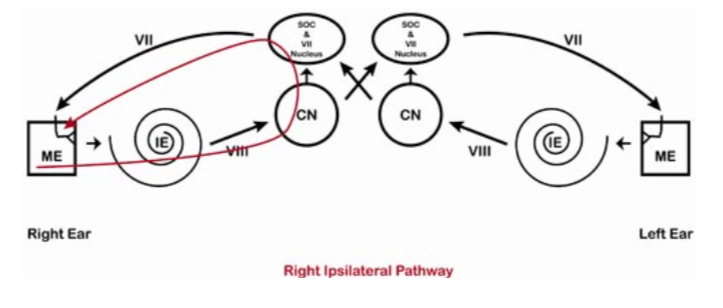
Right ipsi
Stimulus R, probe R
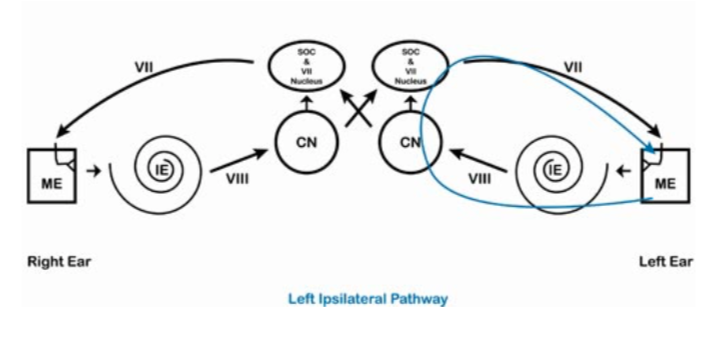
Left ipsi
Stimulus L, probe L

Right contra
Stimulus R, probe L

Left contra
Stimulus L, probe R
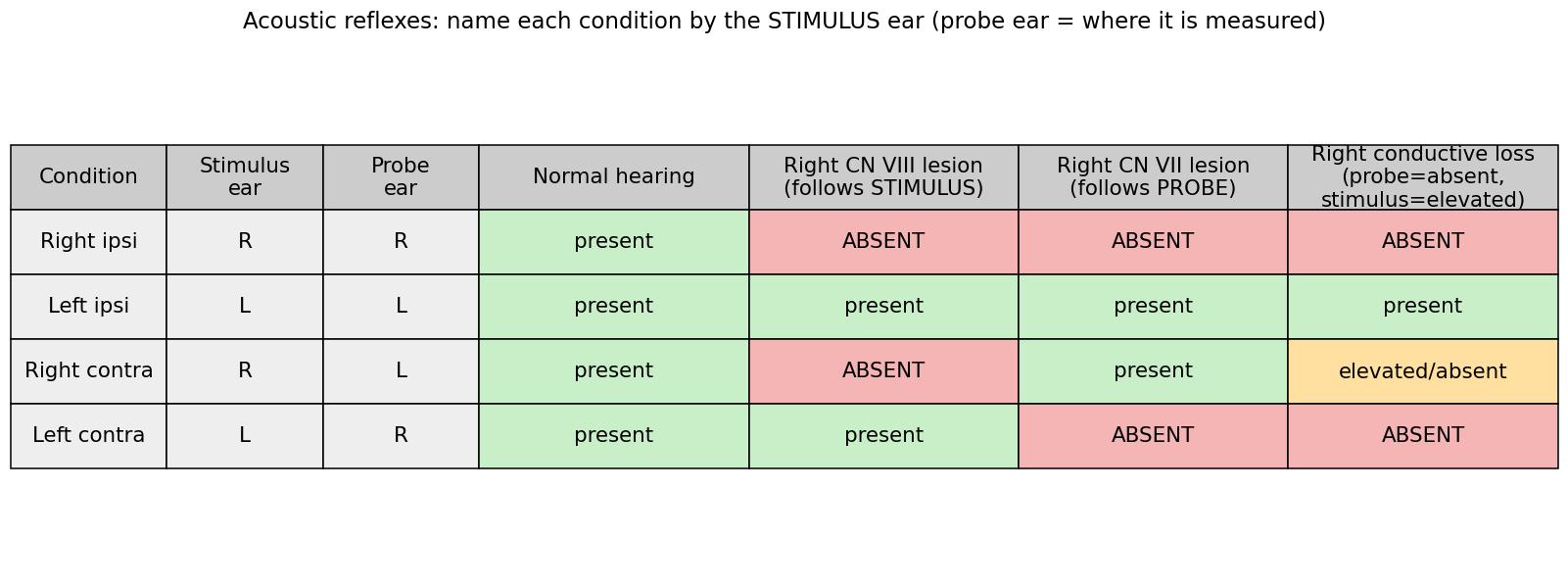
Normal ears: reflexes
Present in all 4 conditions

CN VIII lesion: reflexes go absent when the bad ear is the ___ ear
STIMULUS ear

CN VII lesion: reflexes go absent when the bad ear is the ___ ear
PROBE ear

Right CN VIII lesion: which conditions absent?
Right ipsi and Right contra

Right CN VII lesion: which conditions absent?
Right ipsi and Left contra
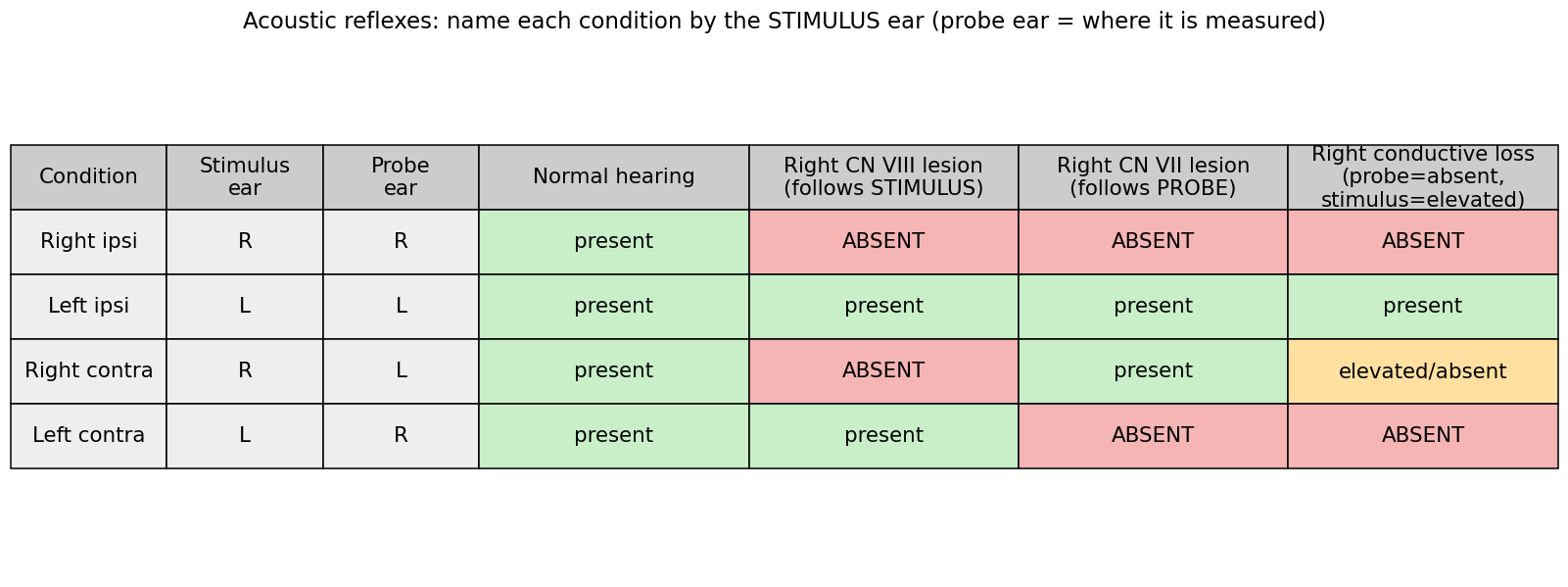
Conductive loss in the PROBE ear
Reflex ABSENT (can't measure it)
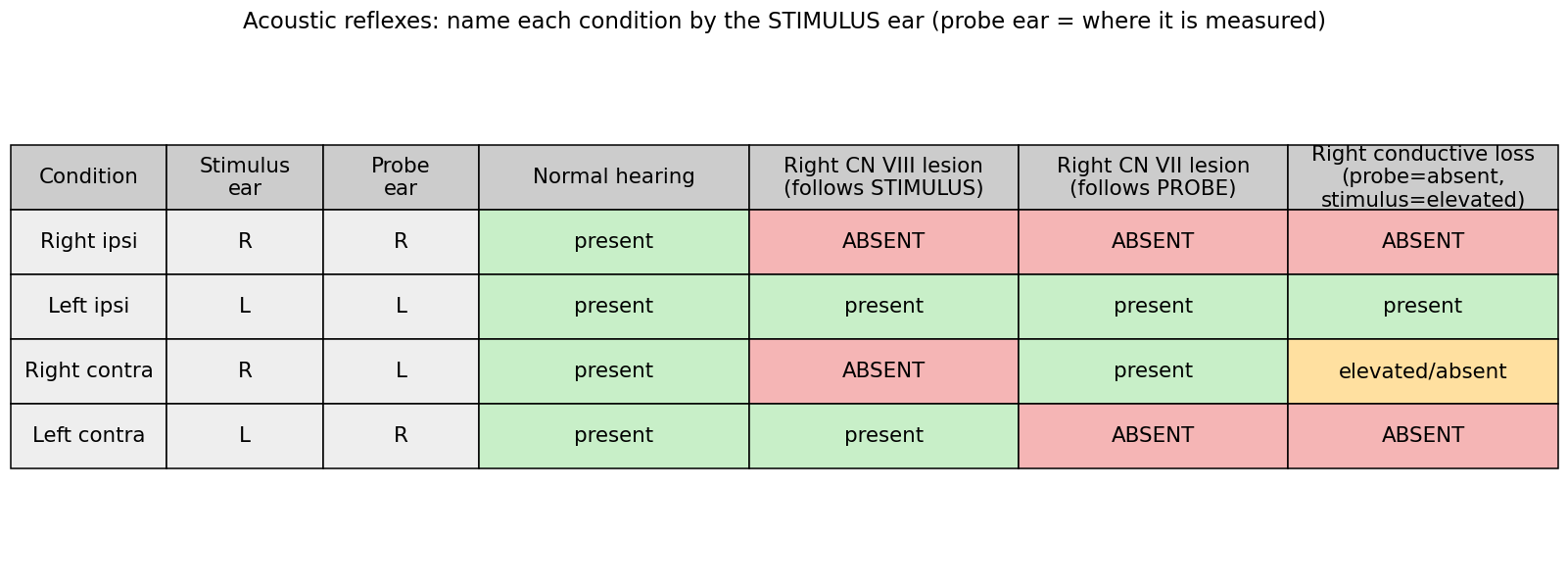
Conductive loss in the STIMULUS ear
Reflex threshold raised by the air-bone gap; absent if gap over 30 dB
Both ears conductive: reflexes
Absent in all four
Cochlear hearing loss 80 dB HL or less: reflex
Present
Cochlear hearing loss over 80 dB HL: reflex
Absent