AFOQT Physical Science - Electronics
 Call Kai
 Learn
 Practice Test
 Spaced Repetition
 Match
 Flashcards
 Knowt Play
1/16

There's no tags or description
Looks like no tags are added yet.
17 Terms
Atom
The smallest unit of an element of matter, made up of subatomic particles.
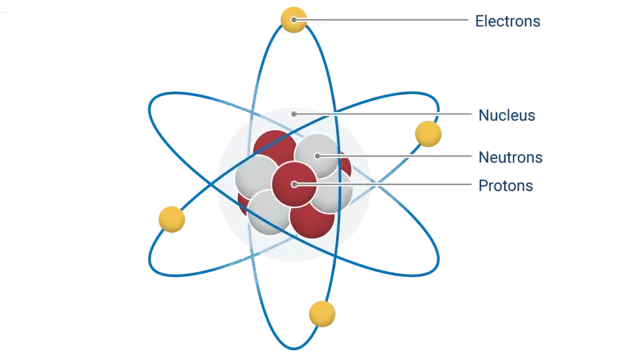
Nucleus
Contains an atom’s protons and neutrons, surrounded by a field of orbiting electrons.
Ion
A charged atom, having an unequal number of positive and negative charges (protons and electrons). A cation has a positive charge; the anion has a negative charge.
Resistor
An electrical component made of material that is difficult for electrons to pass through. They reduce the rate at which electrons flow through a circuit, changing its voltage and current.
Capacitor
An electrical component made of two parallel plates with a dielectric (non-conducting) material between them. They can accumulate charge, modulate the amount of current in a circuit, or store electricity for later.
Transistor
An electrical component that can hold information. They usually operate as a switch, turning ON (1) or OFF (0) based on the presence of a current.
Inductor
An electrical component, also known as a coil, that stores voltage as a magnetic field as electrons pass through it.
Diode
A two-terminal electrical component, possessing high resistance in one terminal and low resistance in the other. This creates a “one-way” passage for electricity to flow, and is used to convert alternating current (AC) to direct current (DC)
Voltage (Volt)
The potential difference between the start and end of a circuit.
Current (ampere)
The flow of electrons; the greater the current, the faster the flow.
Direct Current (DC)
An electrical current in which electricity flows constantly, and in one direction always.
Alternating Current (AC)
An electrical current in which electricity flows back and forth, and allows electrons to travel a long distance.
Resistance (Ohm)
Caused by friction in a circuit, which hinders the free flow of electrons.
Ohm’s Law
The electric current flowing through a conductor is directly proportional to the voltage across it and inversely proportional to its resistance.
V = I * R
where:
V = Voltage
I = current in amperes
R = resistance in Ohms
Formula for electrical resistance in a wire
R = pL/A
where:
R = resistance
p = material resistivity in ohm-meters
L = Length of material in meters
A = Cross sectional area in square meters

Conductor
A material that can effectively transfer electricity. Examples include metals like copper, brass, silver, gold, and aluminum. This ability is called charge mobility.
Insulator
A material that does not allow electricity to flow through it. Examples includer rubber and plastic