Biodiversity Lab Final Part 2
 Call Kai
 Learn
 Practice Test
 Spaced Repetition
 Match
 Flashcards
 Knowt Play
1/22

Earn XP
Description and Tags
Ecdysozoa and Deuterostomes
23 Terms
Ecdysozoa
clade within Bilateria, includes phylum Arthropoda and Nematoda. Characterized by the act of ecdysis.
Ecdysis
The shedding/molting of skin
Phylum Arthropoda
Meaning “jointed feet,” comprise three-quarter of all living species, numerical abundance as high as 1018. Important components of terrestrial and aquatic habitats and contribute ecologically and economically by acting as pollinators, biological control agents, food, and commodity.
Subphylum Trilobita
Ancient arthropods that used to live on the bottom of shallow water during the Paleozoic era. Like living arthropods, they have a chitinous exoskeleton, fused segments, and branched appendages. Dorsoventrally flattened and divided into three longitudinal section: two lateral lobes and a ventral lobe. Also have three anterior-posterior regions, head, thorax, and abdomen. Each body segment has two biramous appendages.
Biramous
Two branched
Subphylum Chelicerata
Includes horseshoe crabs, arachnids, and pycnogonids (sea spiders). Have first pair of appendages, the chelicerae, which r used for feeding. Have a second pair called pedipalps, which are modified for capturing prey, sensing the environment, or copulating. Body consists of two tagmata, the cephalothorax and abdomen; a tail-like telson is also present.
Class Merostomata
Horseshoe crabs — a common marine arthropod found along coasts. More closely related to spiders than crustaceans. Their blood is blue due it being copper based, so medical tests are often run on it (checking vaccines and injectable medications/devices). They remain unchanged morphologically for at least 250 million years.

Book Gills
How horseshoe crabs breathe; can be found as appendages on the abdomen.
Class Arachnida
Small group of chelicerates; over 60,000 species including spiders, ticks, mites, and scorpions. Most are terrestrial. Produce silk used for prey capture.
What is the telson used for in a horseshoe crab?
Horseshoe crabs use their telson, or tail, to steer and to flip themselves right-side up if they become overturned by waves or predators
How are horseshoe crabs differentiated gender-wise?
Females are usually larger. Males have small hooks on their legs, while females have claws.
How does breathing occur in class arachnida?
Gas exchange occurs via book lungs or tracheal tubes, or both.
Spider Anatomy

Scorpion Anatomy

Subphylum Crustacea
Organisms that inhabit marine and freshwater (some are terrestrial), consumers of algae and detritus, e.g. shrimp, lobsters, crabs, barnacles, and isopods.
How are crustacean bodies segmented?
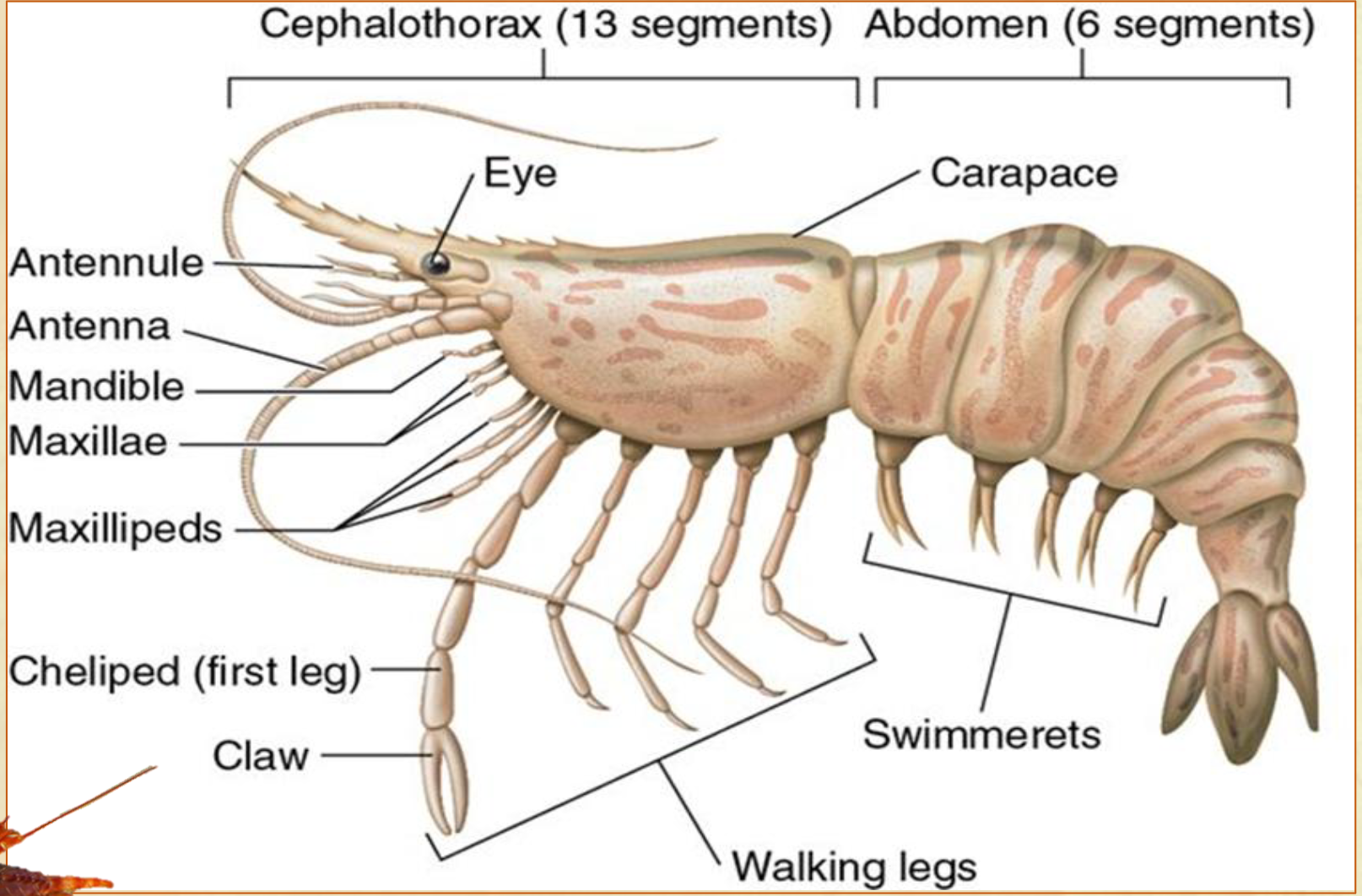
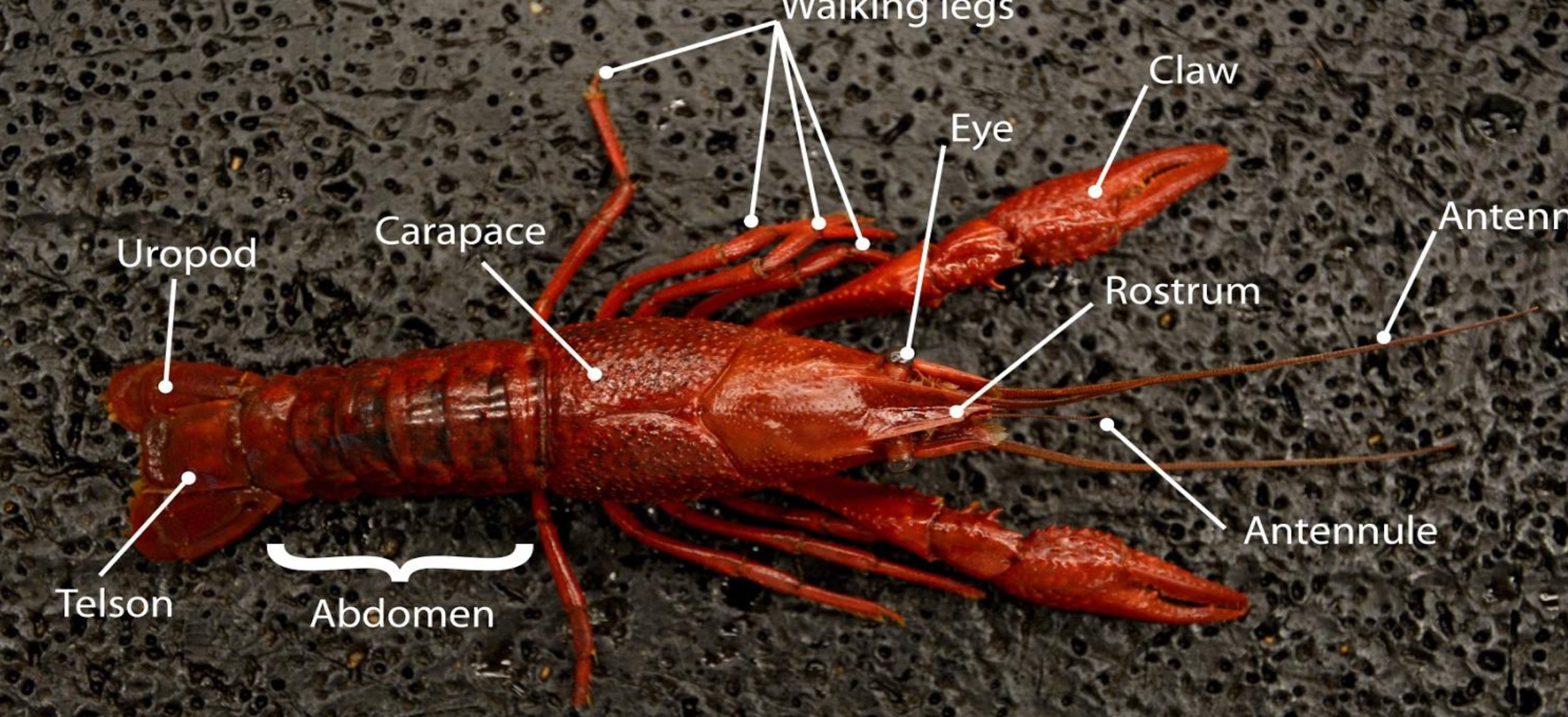
They are divided into two tagmata: a cephalothorax (often covered by a carapace), and an abdomen.
Mandibles
Third pair of appendages, opposable mouthparts used for biting and chewing.
What antennae do the crustaceans have?
One pair of mandibles, macillae, and maxillipeds. They are used for touch and tase.
What are the first and second maxillae used for?
Located behind the mandibles, they are used for sorting and handling food.
Cephalothorax
Serves sensory, feeding, and locomotion functions.
Crayfish Anatomy (External)
Crayfish Anatomy (External again)
Crayfish Anatomy (Internal)