Math Pure AS/A level C1
 Call Kai
 Learn
 Practice Test
 Spaced Repetition
 Match
 Flashcards
 Knowt Play
1/27

There's no tags or description
Looks like no tags are added yet.
28 Terms

The equation of a circle is:
(x − a)² + (y − 3)² = 20
The line y = x/2 + 6 is tangent to the circle at P.
(a) Show that one possible value of a is 4 and find the other possible value.
(b) For a = 4, find the equation of the normal to the circle at P.
(c) For a = 4, find the equations of the two tangents to the circle that are parallel to the normal found in part (b).
(a) a = 4 or a = −16
(b) y = −2x + 11
(c) y = −2x + 1 and y = −2x + 21

The point P lies on the line y = mx + c, where m and c are positive constants. The curve has equation y = −m/x. The line is tangent to the curve at P.
(a) Find the coordinates of P, giving the y-coordinate in terms of m.
The normal to the curve at P intersects the curve again at Q.
(b) Find the coordinates of Q in terms of m.
(a) P = (−1, m)
(b) Q = (m², −1/m)
Solve method: Equate the line and curve and use Δ = 0 to find the tangent point. Then find the normal’s gradient and intersect the normal with the curve again.
Working steps:
(a) At an intersection:
mx + c = −m/x
Multiply by x:
mx² + cx + m = 0
For tangency:
Δ = 0
c² − 4m² = 0
c = 2m because c and m are positive.
The repeated root is:
x = −c/(2m)
x = −2m/(2m)
x = −1
Use y = −m/x:
y = −m/(−1)
y = m
Therefore:
P = (−1, m)
(b) Tangent gradient = m
Normal gradient = −1/m
The normal passes through P:
y − m = −(x + 1)/m
Intersect it with y = −m/x:
−m/x − m = −(x + 1)/m
Multiply by mx:
−m² − m²x = −x(x + 1)
Factorise:
(x + 1)(x − m²) = 0
x = −1 is point P, so at Q:
x = m²
Use the curve:
y = −m/m²
y = −1/m
Therefore:
Q = (m², −1/m)

The circle has equation x² + y² = 20. Two tangents to the circle pass through A(0, 10), touching the circle at B and C.
By letting the equation of a tangent be y = mx + 10, find the two possible values of m.
m = 2 or m = −2
Solve the equation:
9(1 + 9ˣ⁻¹) = 10 × 3ˣ
Answer: x = 0 or x = 2
Solve method: Let u = 3ˣ and rewrite 9ˣ⁻¹ as u²/9. Solve the resulting quadratic in u, then substitute back.
Step-by-step: 9ˣ⁻¹ = (3ˣ)²/9 = u²/9 → 9(1 + u²/9) = 10u → 9 + u² = 10u → u² − 10u + 9 = 0 → (u − 1)(u − 9) = 0 → u = 1 or 9 → 3ˣ = 1 or 9 → x = 0 or 2

The graph has equation:
y = ax + b√x + c, for x ≥ 0
The graph crosses the x-axis at (1, 0) and (49/4, 0), and meets the y-axis at (0, 7).
Find a, b and c.
Answer: a = 2, b = −9, c = 7
Solve method: Let u = √x so that x = u², transforming the equation into a quadratic in u. Use the two roots to factorise it.
Step-by-step: The point (0, 7) gives:
c = 7
Let:
u = √x, so x = u²
Therefore:
y = au² + bu + 7
The x-intercepts x = 1 and x = 49/4 give:
u = 1 and u = 7/2
Therefore:
y = a(u − 1)(u − 7/2)
Use the point (0, 7), where u = 0:
7 = a(−1)(−7/2)
7 = 7a/2
a = 2
Expand:
y = 2(u − 1)(u − 7/2)
y = 2u² − 9u + 7
Therefore:
a = 2, b = −9, c = 7

A parabola passes through the points (0, 4), (1, 0) and (−2, 0).
Find the equation of the parabola.
Answer: y = −2x² − 2x + 4
Solve method: Use the two x-intercepts to write the quadratic in factorised form, then use the third point to find the multiplier.
Step-by-step: The x-intercepts are x = 1 and x = −2.
Therefore:
y = a(x − 1)(x + 2)
Substitute (0, 4):
4 = a(0 − 1)(0 + 2)
4 = −2a
a = −2
Therefore:
y = −2(x − 1)(x + 2)
Expand:
y = −2(x² + x − 2)
y = −2x² − 2x + 4

Back:
Answer: x < 2
Solve method: Move everything to one side, combine into one fraction and determine when the fraction is negative.
Step-by-step: x/(x − 2) − 1 ≤ 0 → [x − (x − 2)]/(x − 2) ≤ 0 → 2/(x − 2) ≤ 0 → numerator 2 is always positive, so x − 2 must be negative → x < 2

Answer: −3 < x < −2 or x > 1
Solve method: Find the critical values, divide the number line into intervals and determine the sign of the fraction in each interval.
Step-by-step: Critical values: x = −3, −2 and 1 → signs of the fraction are negative for x < −3, positive for −3 < x < −2, negative for −2 < x < 1 and positive for x > 1 → select the positive intervals → −3 < x < −2 or x > 1

Answer: 0 < x < 3 or x > 4
Solve method: Move everything to one side, combine into one fraction, factorise the numerator and use a sign diagram.
Step-by-step: (x² + 12)/x − 7 > 0 → (x² − 7x + 12)/x > 0 → (x − 3)(x − 4)/x > 0 → critical values: x = 0, 3 and 4 → signs are negative for x < 0, positive for 0 < x < 3, negative for 3 < x < 4 and positive for x > 4 → 0 < x < 3 or x > 4
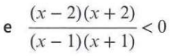
Answer: −2 < x < −1 or 1 < x < 2
Solve method: Find the critical values, divide the number line into intervals and use a sign diagram.
Step-by-step: Critical values: x = −2, −1, 1 and 2 → signs are positive for x < −2, negative for −2 < x < −1, positive for −1 < x < 1, negative for 1 < x < 2 and positive for x > 2 → select the negative intervals → −2 < x < −1 or 1 < x < 2

The cost of producing n items is $(950 + 63n). Each item can be sold for $(280 − 5n).
How many items must be produced and sold to make a profit? Give the answer as M ≤ n ≤ N, where M and N are integers.
Answer: 5 ≤ n ≤ 38
Solve method: Use revenue > cost, form a quadratic inequality, find its roots and select the whole-number values between them.
Step-by-step:
Revenue = number of items × price per item
Revenue = n(280 − 5n)
For a profit:
n(280 − 5n) > 950 + 63n
Expand:
280n − 5n² > 950 + 63n
Rearrange:
5n² − 217n + 950 < 0
Find the boundary values:
n = [217 ± √28089]/10
n ≈ 4.94 or n ≈ 38.46
The quadratic is negative between the roots:
4.94 < n < 38.46
Since n must be an integer:
5 ≤ n ≤ 38
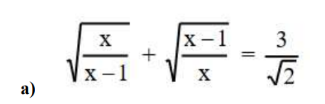
Solve method: Recognise that the two square-root expressions are reciprocals, then use substitution to form a quadratic.
Step-by-step: Let u = √[x/(x − 1)] → √[(x − 1)/x] = 1/u → u + 1/u = 3/√2 → √2u² − 3u + √2 = 0 → (√2u − 1)(u − √2) = 0 → u = 1/√2 or √2 → x/(x − 1) = 1/2 or 2 → x = −1 or 2

Answer: x = −2 or x = 1
Solve method: Name the two square roots A and B, then use the difference of two squares to find A before solving for x.
Step-by-step: 7 + x(1 + x) = x² + x + 7 → let A = √(x² + x) and B = √(x² + x + 7) → A + B = 3 + √2 → B² − A² = 7 → (B − A)(B + A) = 7 → B − A = 7/(3 + √2) = 3 − √2 → (A + B) − (B − A) = 2√2 → 2A = 2√2 → A = √2 → x² + x = 2 → (x + 2)(x − 1) = 0 → x = −2 or 1

Answer: x = 5
Solve method: Let s equal the left side and recognise that the right side is s² − 12. Solve for s, then substitute back.
Step-by-step: Domain: x ≥ 4 → let s = √(x + 4) + √(x − 4) → s² = 2x + 2√(x² − 16) → right side = s² − 12 → s = s² − 12 → s² − s − 12 = 0 → (s − 4)(s + 3) = 0 → s = 4 because s cannot be negative → let A = √(x + 4) and B = √(x − 4) → A + B = 4 and A² − B² = 8 → (A − B)(A + B) = 8 → A − B = 2 → A = 3 and B = 1 → √(x − 4) = 1 → x = 5

Answer: x = −1
Solve method: Let t = (x + 1)², then compare the minimum possible value of the left side with the maximum possible value of the right side.
Working steps:
Let t = (x + 1)², so t ≥ 0.
3x² + 6x + 7 = 3t + 4
5x² + 10x + 14 = 5t + 9
4 − 2x − x² = 5 − t
Therefore:
√(3t + 4) + √(5t + 9) = 5 − t
Since t ≥ 0:
√(3t + 4) ≥ 2
√(5t + 9) ≥ 3
Therefore, the left side is ≥ 5, while the right side is ≤ 5.
They can only be equal when t = 0.
(x + 1)² = 0
x = −1
The height h metres of an object above the ground is:
h = −16t² + 64t + 190, t ≥ 0
where t is the time in seconds.
Find the time taken for the object to reach the ground. Give the answer to 3 significant figures.
Answer: 5.98 seconds
Solve method: Set h = 0 because the object is on the ground, solve the resulting quadratic and reject the negative time.
Working steps:
At the ground:
h = 0
Therefore:
−16t² + 64t + 190 = 0
Simplify:
8t² − 32t − 95 = 0
Use the quadratic formula:
t = [32 ± √(32² − 4(8)(−95))]/16
t = [32 ± √4064]/16
t ≈ 5.984 or t ≈ −1.984
Reject the negative value because t ≥ 0.
To 3 significant figures:
t = 5.98 seconds

The curve has equation:
y = −x² + 10x + a
and the straight line has equation:
y = bx + 25
The x-coordinates of their intersection points A and B are 4 and 8 respectively.
Find a and b.
Answer: a = −7, b = −2
Solve method: Set the curve and line equal. The resulting quadratic has roots 4 and 8, so write it in factorised form and compare coefficients.
Working steps:
At the intersection points:
−x² + 10x + a = bx + 25
Rearrange:
−x² + (10 − b)x + (a − 25) = 0
The roots are x = 4 and x = 8.
Since the coefficient of x² is −1:
−(x − 4)(x − 8) = 0
Expand:
−x² + 12x − 32 = 0
Compare the x-coefficients:
10 − b = 12
b = −2
Compare the constant terms:
a − 25 = −32
a = −7
Therefore:
a = −7, b = −2
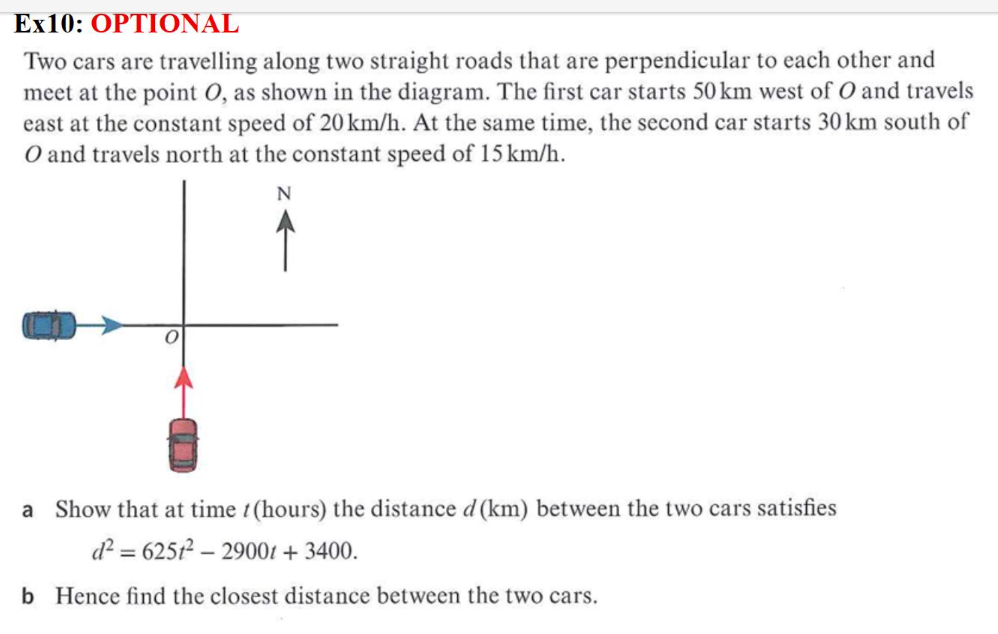
Two cars travel along perpendicular roads that meet at O.
The first car starts 50 km west of O and travels east at 20 km/h. The second car starts 30 km south of O and travels north at 15 km/h.
(a) Show that after t hours, the distance d km between the cars satisfies:
d² = 625t² − 2900t + 3400
(b) Find the closest distance between the cars.
Answer:
(a) d² = 625t² − 2900t + 3400
(b) Closest distance = 6 km
Solve method: Express each car’s distance from O in terms of t, use Pythagoras to find d² and find the minimum of the resulting quadratic.
Working steps:
After t hours:
First car’s distance from O:
50 − 20t
Because it begins 50 km away and moves towards O at 20 km/h.
Second car’s distance from O:
30 − 15t
Because it begins 30 km away and moves towards O at 15 km/h.
Using Pythagoras:
d² = (50 − 20t)² + (30 − 15t)²
Expand the first bracket:
(50 − 20t)² = 2500 − 2000t + 400t²
Expand the second bracket:
(30 − 15t)² = 900 − 900t + 225t²
Add them:
d² = 2500 − 2000t + 400t² + 900 − 900t + 225t²
d² = 625t² − 2900t + 3400
Therefore:
d² = 625t² − 2900t + 3400

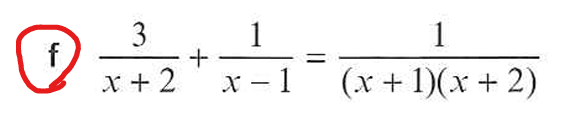
Answer: x = 0 or x = −1/2
Solve method: Multiply every term by the lowest common denominator.
Working steps:
Restrictions:
x ≠ −2, −1 or 1
Lowest common denominator:
(x − 1)(x + 1)(x + 2)
Multiply every term:
3(x − 1)(x + 1) + (x + 1)(x + 2) = x − 1
3(x² − 1) + (x² + 3x + 2) = x − 1
3x² − 3 + x² + 3x + 2 = x − 1
4x² + 3x − 1 = x − 1
4x² + 2x = 0
2x(2x + 1) = 0
x = 0 or x = −1/2

Answer: 20 cm, 21 cm and 29 cm
Solve method: Factorise the quadratic, reject the negative value of x and calculate the sides.
Working steps:
2x² + x − 210 = 0
(2x + 21)(x − 10) = 0
x = −21/2 or x = 10
Reject x = −21/2 because lengths cannot be negative.
Therefore:
x = 10
2x = 20 cm
2x + 1 = 21 cm
The three sides are:
20 cm, 21 cm and 29 cm

Back:
Answer: x = −2/3, 1/2, 4, 6 or 7
Solve method: A power can equal 1 when:
The power is 0.
The base is 1.
The base is −1 and the power is even.
Working steps:
Case 1: Power = 0
6x² + x − 2 = 0
(3x + 2)(2x − 1) = 0
x = −2/3 or x = 1/2
Case 2: Base = 1
x² − 11x + 29 = 1
x² − 11x + 28 = 0
(x − 4)(x − 7) = 0
x = 4 or x = 7
Case 3: Base = −1
x² − 11x + 29 = −1
x² − 11x + 30 = 0
(x − 5)(x − 6) = 0
x = 5 or x = 6
When x = 5, the power is 153, which is odd:
(−1)¹⁵³ = −1
So x = 5 is rejected.
When x = 6, the power is 220, which is even:
(−1)²²⁰ = 1
So x = 6 is accepted.
Therefore:
x = −2/3, 1/2, 4, 6 or 7

2 cases. x= 2,3,4,5
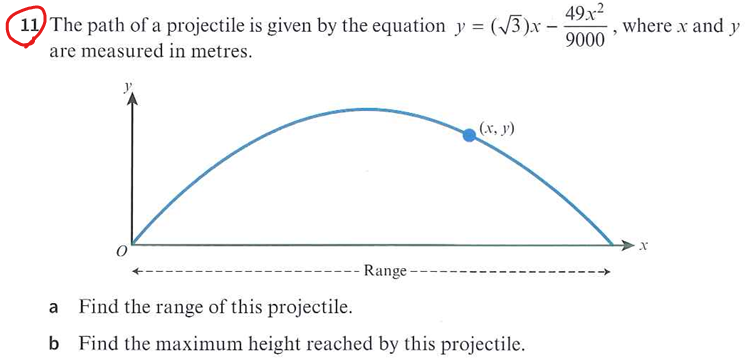
Answers:
a) Range = 9000√3/49 m ≈ 318 m
b) Maximum height = 6750/49 m ≈ 138 m
Solve method:
For the range, set y = 0.
For the maximum height, find the vertex using x = −b/(2a), then substitute x into the equation.
Working steps:
a) Range
Set y = 0:
0 = √3x − 49x²/9000
Factorise:
0 = x(√3 − 49x/9000)
Therefore:
x = 0
or:
√3 − 49x/9000 = 0
49x/9000 = √3
x = 9000√3/49
x ≈ 318
The first answer, x = 0, is where the projectile starts.
Therefore:
Range ≈ 318 m
b) Maximum height
From:
y = −49x²/9000 + √3x
a = −49/9000
b = √3
Find the x-coordinate of the vertex:
x = −b/(2a)
x = −√3/[2(−49/9000)]
x = 4500√3/49
Substitute into the equation:
y = √3(4500√3/49) − 49/9000(4500√3/49)²
y = 13500/49 − 6750/49
y = 6750/49
y ≈ 138
Therefore:
Maximum height ≈ 138 m

m = 0
The equation
y = k
is simply a horizontal line.
For the curve:
y = (x − 2)(x − 3)²
it touches/crosses the x-axis at:
x = 2 and x = 3
So the important height is:
y = 0
Any horizontal line below 0, meaning k < 0, cuts the curve only once.
At k = 0, it meets the curve twice: x = 2 and x = 3.
Therefore, the “one intersection” condition stops at 0.
So:
k < 0
The question writes this as k < m, so:
m = 0
That’s literally the whole idea: below the x-axis = one intersection; at the x-axis = two.

Answer: k = −9 or k = 9
The positive difference between the solutions of:
x² + kx + 3 = 0
is √69.
Step 1: Use the quadratic formula
x = [−k ± √(k² − 12)]/2
Therefore, the two solutions are:
x₁ = [−k + √(k² − 12)]/2
x₂ = [−k − √(k² − 12)]/2
Step 2: Find their positive difference
x₁ − x₂
= [−k + √(k² − 12)]/2 − [−k − √(k² − 12)]/2
= [2√(k² − 12)]/2
= √(k² − 12)
The question says this difference is √69:
√(k² − 12) = √69
Step 3: Square both sides
k² − 12 = 69
k² = 81
k = ±9
Answer: k = −9 or k = 9

Question 5a
Express:
6x² + 10x + 5
in the form:
a(x + b)² + c
Take 6 out of the x-terms:
6(x² + 5x/3) + 5
Half of 5/3 is 5/6:
6[(x + 5/6)² − 25/36] + 5
Expand outside the bracket:
6(x + 5/6)² − 25/6 + 5
6(x + 5/6)² − 25/6 + 30/6
6x² + 10x + 5 = 6(x + 5/6)² + 5/6
Therefore:
a = 6, b = 5/6 and c = 5/6
Question 5b
Find the range of:
(6x² + 10x + 5)²
From part (a):
6x² + 10x + 5 = 6(x + 5/6)² + 5/6
Because a square cannot be negative:
(x + 5/6)² ≥ 0
Therefore:
6(x + 5/6)² ≥ 0
So:
6(x + 5/6)² + 5/6 ≥ 5/6
The smallest value inside the outside square is therefore 5/6.
Square this minimum value:
(5/6)² = 25/36
Therefore, the range is:
(6x² + 10x + 5)² ≥ 25/36
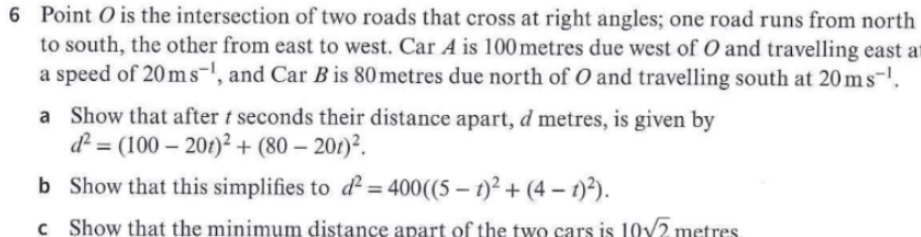
Answer: Minimum distance = 10√2 m, occurring after 4.5 seconds.
Solve method: Use Pythagoras to form d², then complete the square to find its minimum.
Working steps:
After t seconds, Car A’s horizontal distance from O is:
100 − 20t
Car B’s vertical distance from O is:
80 − 20t
The roads are perpendicular, so use Pythagoras:
d² = (100 − 20t)² + (80 − 20t)²
Factorise each bracket:
100 − 20t = 20(5 − t)
80 − 20t = 20(4 − t)
Therefore:
d² = [20(5 − t)]² + [20(4 − t)]²
d² = 400[(5 − t)² + (4 − t)²]
Expand inside:
d² = 400[(t − 5)² + (t − 4)²]
d² = 400[2t² − 18t + 41]
Complete the square:
2t² − 18t + 41
= 2(t − 4.5)² + 0.5
Therefore:
d² = 400[2(t − 4.5)² + 0.5]
d² = 800(t − 4.5)² + 200
The smallest value of (t − 4.5)² is 0.
Therefore:
d² = 200
d = √200
d = 10√2 m

2ˣ⁺¹ + 2ˣ⁻¹ = 160
Use:
2ˣ⁺¹ = 2ˣ × 2¹ = 2 × 2ˣ
And:
2ˣ⁻¹ = 2ˣ × 2⁻¹ = 1/2 × 2ˣ
Therefore:
2 × 2ˣ + 1/2 × 2ˣ = 160
Factorise 2ˣ:
(2 + 1/2) × 2ˣ = 160
2.5 × 2ˣ = 160
Divide by 2.5:
2ˣ = 64
Since:
64 = 2⁶
Therefore:
x = 6