CHBE 403 Unit 1
 Call Kai
 Learn
Learn Practice Test
 Spaced Repetition
 Match
Match Flashcards
 Knowt Play
1/105

There's no tags or description
Looks like no tags are added yet.
Name | Mastery | Learn | Test | Matching | Spaced | Call with Kai | Chat |
|---|
No analytics yet
Send a link to your students to track their progress
106 Terms
what is design?
human-centered approach to innovation that draws from designer’s toolkit to integrate needs of ppl, possibiliites or tech, and requirements for business success
what types of design constraints are there?
chemical, thermodynamic, mechanical, economic, legal, standards/codes, ethical, social (work outside in)
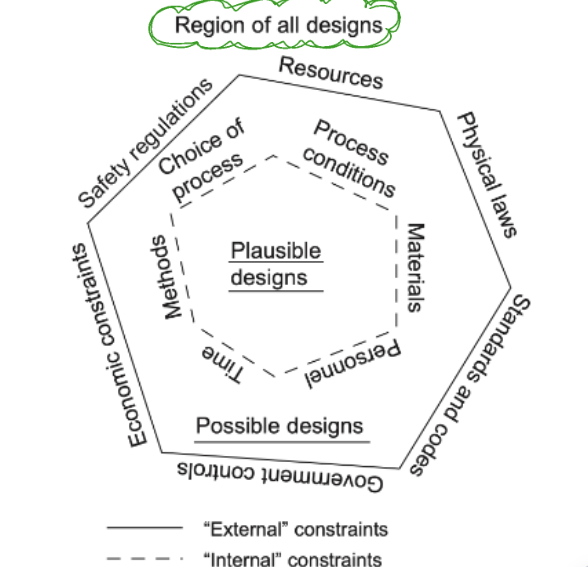
what are steps of design process
1) identify client needs
2) identify constraints
3) agree w clients on what success consists of
4) think thru possible options
5) identify what data u need and collect said data
6) pick leading contender
7) design, build, and test lead options
8) iterate and improve
9) document results
what are the different FEED stages?
feed = front-end engineering and design
1) FEL 1 (front end loading): conceptual phase
2) FEL 2 = feasibility phase
3) FEL 3 = definition phase
do final investment decision (FID) after FEL3
4) EPC
5) operate
what are the components of plant?
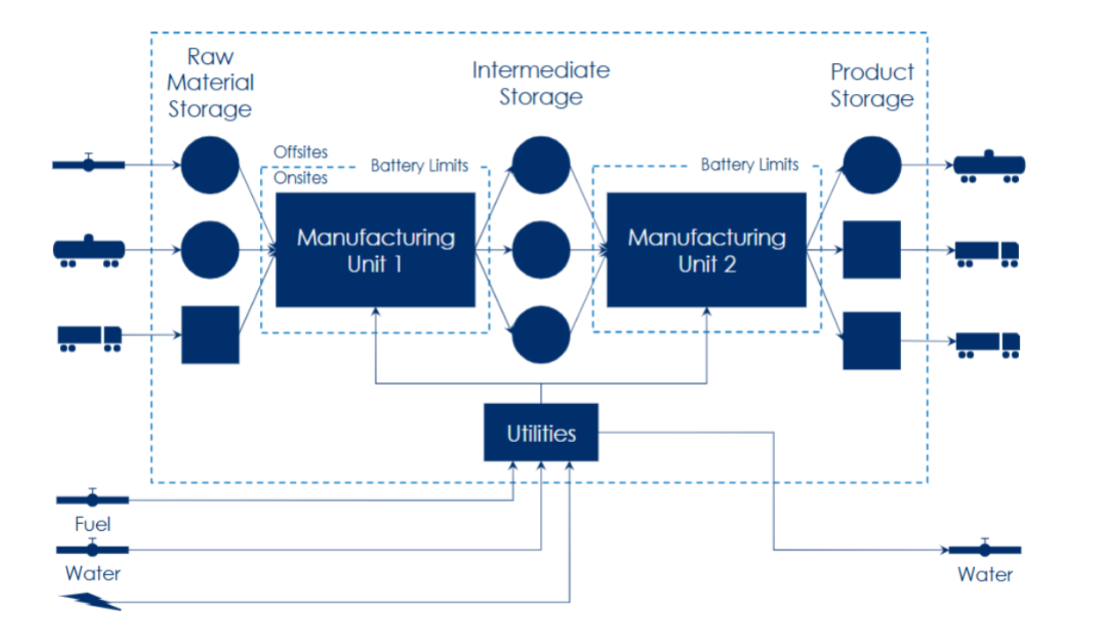
what does battery limits mean?
battery limit = a physical or virtual boundary that defines the scope of work, liability, and transfer of responsibility between different parties or process units in an industrial plant
things u have to consider inside/OH:
the pipe from the storage tank to the unit?
the electrical substation?
the cooling-water system?
the product transfer piping?
The wastewater treatment?
what is normally outside battery limits? what’s another name for this
aka offsites
Includes: Utility generation (steam, cooling water, power), storage tank farms, flare systems, product loading docks, interconnecting pipe racks, and administrative buildings.
what is normally inside battery limits? what’s another name for this
onsites
Includes: Reactors, distillation columns, heaters, pumps, compressors, and specific equipment directly tied to the primary production process
define supply chain + draw what it looks like in chem industry

what are mcglam pet peeves on BFD/PFDs
label streams / describe contents in stream table
what r things u need to triple check on synthesis questions
only use flash drum for super easy separations (H2/methane from other materials) - for all else u have to use tower
recycle H2 anytime you can + u have to compress recycle hydrogen
good to have a heat exchanger before reactors (don’t necessarily need on recycle stream)
typically have condenser before distillation bc if u feed pure vapor to distillation tower it all just goes out the top
use a furnace when dealing with T>350C (600F) superheated steam max temp is ~350C so u can only use HX to that high
should write CW on condensers/coolers (or just label whatever the utility is)
should have urge stream for all h2 recycle
label every piece of equip
remember u may need reboiler and condenser unless told otherwise
generally mix into one inlet stream and input instead of multiple inlets
what is point of piping isometric diagram
shows you lengths/heights of pipe runs

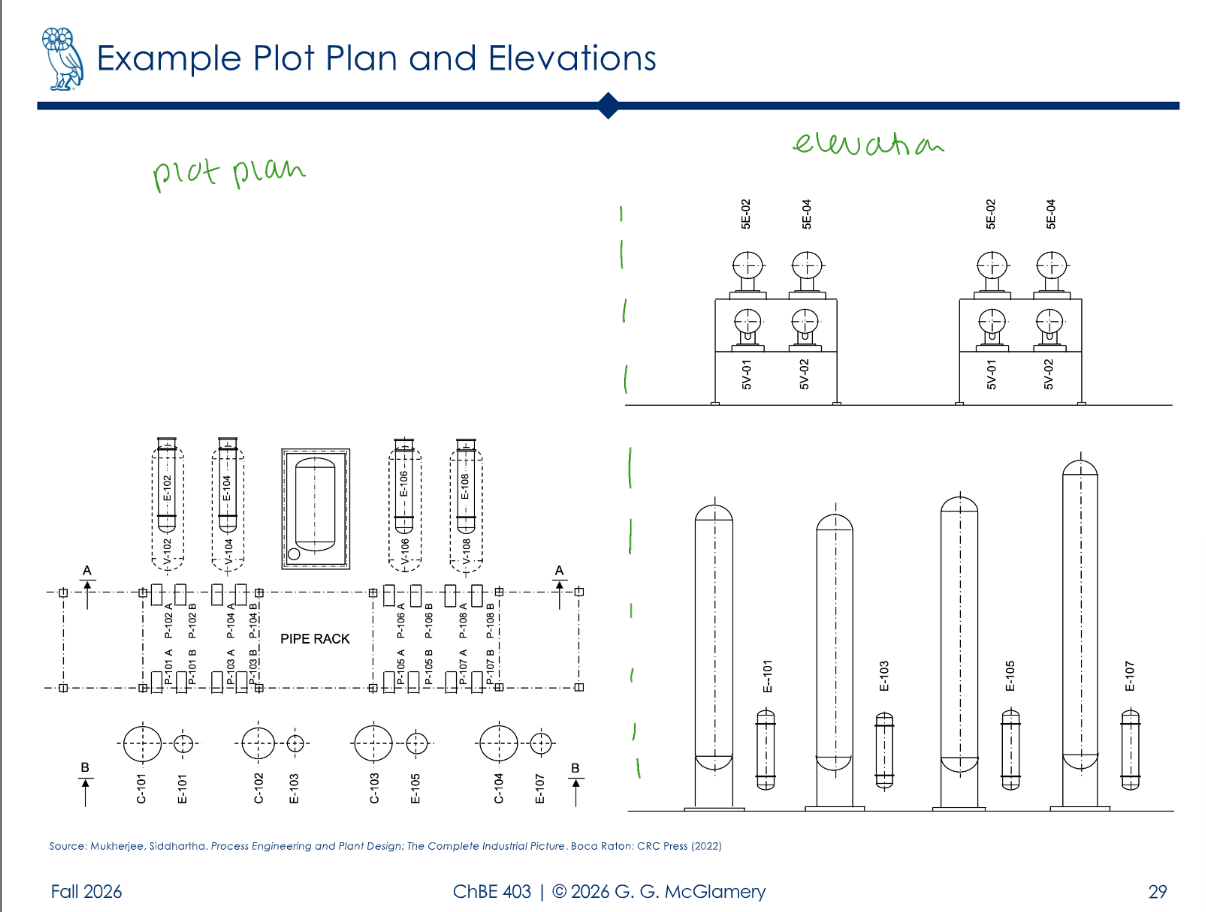
what does mcglam call GAs
plot plans
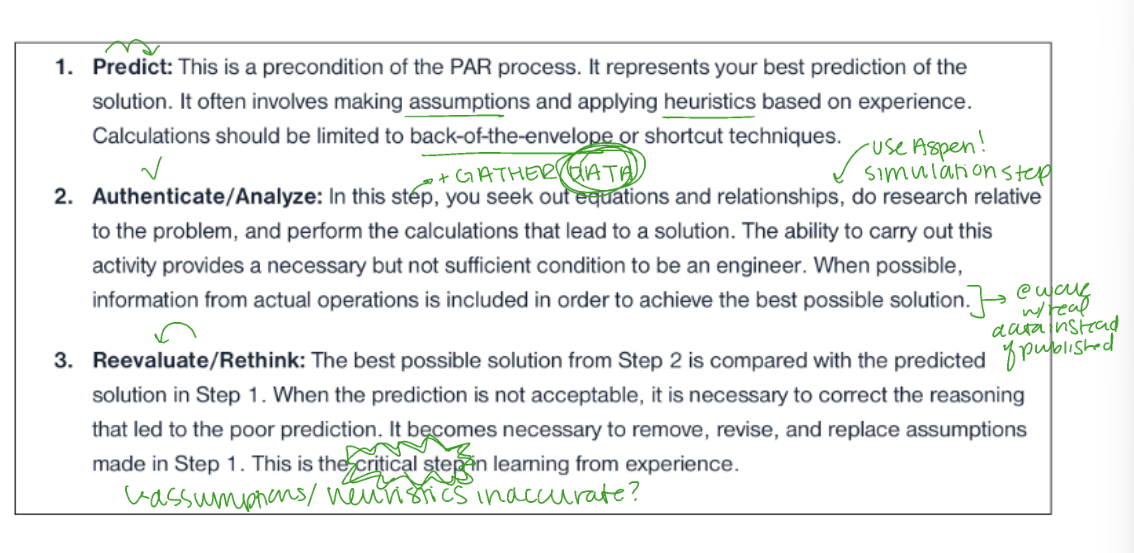
what does PAR stand for
predict, authenticate/analyze, re-evaluate/re-think
define coproduct
“item for sale that is not the basis for the plant’s capacity”
market or customer (internal or external) exists for coproduct
usually sold or transferred internally
USEFUL de
define byproduct
not useful
any material w/out significant market or customer
usually disposed as waste or used as substitution for fuel
can sell, but u can’t rlly ctrl how much you sell it for - no one rlly wants it so the buyer tells you how much they’ll pay for it
what are key steps for process synthesis
decide batch/cts
determine input/output structure
determine recycle process
figure out separation
optimize energy structure
why is batch favorable?
good @ low volume
need accountability and track where stuff comes from
if ur making different versions or formulas and need to switch between them [flexible use of equipment]
good for seasonal stuff
easier to deal w if it breaks down bc u can take down that part without ruining entire process [“tolerance for processing inefficiency”]
good for slow rxn rates bc don’t have to use a rlly long large container to have enuf time - just let it sit in same place for a while
better @ dealing w fouling
just clean in between batches instead of having to do massive shutdown and cause issues elsewhere
what are 3 reasons u would want to remove a feed impurity
1) it’s reactive and there’s a lot of it (might consume reactant that u need for main rxn and makes unwanted byproduct instead, reduces yield)
2) is catalyst poison or creates catalyst poison (catalyst super expensive)
3) inert + there’s a lot of it ($$ infrastructure)
when is it fine to leave feed impurities in feed?
1) it’s inert + easier to separate from product than feed
2) inert + in a gas feed (gas separations are $$)
3) in liquid feed + part of product/byproduct (helps u make $)
4) azeotrope w reactant (more work than it’s worth to separate)
what are all the options for type of product streams
1) primary prod
2) coprod
3) byprod
4) recycle and purge
5) recycle to extinction
6) fuel gas
7) fuel liquid
8) liquid waste
9) solid waste
10) gaseous waste
11) vent
what are you allowed to vent
Nitrogen, oxygen, CO2 (eh), water, argon [anything in air]
what compounds do u normally send to fuel gas
H2, CO, methane, ethane, propane (light hydrocarbons) [sometimes butanes and ehtylene/propylene]
what is the general guideline for weight of materials u recycle as vapor
stuff lighter than propylene
if heavier than propylene u should condense and recycle as liquid (able to condense bc Tc_prop > T_ctw so CTW is sufficient to condense it)
what attributes r u looking for in excess reactant (if A+B —> C)
1) if B is rlly hazardous and u need to get rid of it then make A the excess to u def get rid of B
2) add a ton of A if reactant B might also react with C and BC is undesirable
3) add a lot of A if B is hard to separate from C so u def only have C and don’t have to separate B from C
4) add a lot of A if it has to diffuse, increasing partial pressure will make diffusion better
5) add a lot of A if you might have coking - helps fill the pores
6) fine to add a ton of A if it’s benign and safety lreleased (like if u feed in a bunch of O2 that’s fine bc can just leave in vent)
7) favor liquids bc easier to recycle [compressors $$]
8) or just don’t have excess if u don’t need it
how can u adjust equilibrium conversion?
1) adjust pressure
2) use diluet gas
3) remove ur product quickly so ur always pushing forward in effort to balance
4) remove coproduct (same rationale as above)

what are penalities for keeping inert in feed
Increased equipment size
Need for separation to remove the inert
Decreased equilibrium conversion and/or reaction rate
what are some general rules for recycle streams
1) u wanna recycle unreacted feed to save $ esp if feedstock is $ - pricier feed justifies less purge and more recycle
2) recycle as close to rxn as possible
3) must recycle gas and liquid sep bc pump only work for liq and compress only work for vap
4) gas only lighter than propylene
5) pumps cheaper than compressor so pump when u can
6) consolidate like-phases whenever possible
do u want product in top or bottom and why
want in top bc bottom = liq so it fouls a lot and introduce contaminants
what are bounds for temp and pressure for target operating conditions
40C < T < 400C
_> 40C bc CTW at 30C so if u want to be able to cool u need hotter than CTW
> 400C bc starts screwing w tensile strength above carbon steel and other materials
1 bara < P < 10 bara = 14.5 psia < P < 145 psia
whats typical P and T of HPS
40-50 barg, 250-265C (but u can get up to 100barg steam @ 310C heating)
why would you make exceptions to upper T design limit and what does that impact
why:
favor equilibrium for endothermic, increase rxn rate, improve selectrivity, keep gas phase
what impact:
pay for furnace and need special MOC
why would you make exceptions to lower T design limit for reactors and what does that impact
why:
good for exo rxn + considerate of temp-sensitive materials (heyo bio) + improved selectivity + can keep stuff in liq phase
impact:
refrigeration is $ + special MOC
why would you make exceptions to lower T design limit for separators and what does that impact
why:
condensing is a V/L separation options, u can crystallize at low T
impact:
$ refridg and special MOC
why would you make exceptions to upper P design limit for reactors and what does that impact
why:
help w equil conversion, increase rxn rate, lets u keep liquid phase
impact:
thicker walls and pricier to fabricae
what are cons of going below design P lower limit
need larger equip bc larger vol at low P
can have air leaks which are dangerous
at what pressure ratio do u worry about ur compressors? what r consequences and how do u mitigate
P_out/P_in > 3
requires high shaft work, seal damage from high outlet temp, lubricant decomposes
soln:
break into multiple compressor stages
what are common places to see exergy losses?
deltaT_logmean > 100C on HX
P_out/P_in > 3 for compressors
high inlet T on compressors
big deltaP across valve
mixing streams w big diff in T and P
what is the only sep tech that can have high recovery and high purity
distillation
like if u input A and B u can get a distillate that’s 99.9% A and contains ~ 99% of the A you had in the feed (not lose A along the way)
unlike membrane where u can recover a lot of A (get most of it thru the membrane) but if u do that it’s less pure bc less stringent membrane will also allow other stuff thru
when use gas adsorption / strip
absorb low concen species from gas into liq
strip low concen from liq into gas
when use LLE
if have close BP but are chem dissimilar
sep ionic from nonionic
sep temp-sensitive materials
when use membranes
purify liq from solutions contains salt or high MW organics
separate light gas from heavy gas based on diffusion rate
when use crystallization
separate two solids or precipitate solid from liqwhat
what is leaching sep. tech
remove solid from solid mixture by dissolution in a liquid

what does MSA stand for
mass separating agent
these are annoying bc u have to recycle and regenerate them and have to have some makeup stream bc some will get lost in purge
how do you determine what you want to remove first in a series of separation steps
1) REMOVE NONCONDENSABLE GASES
2) remove hazardous or corrosive materials
3) remove large product stream
4) remove stuff w high heat of vap (reduces future reboiler duties)
5) do easiest separation steps first so when u get to the pt of doing hard sep steps ur working w lower volumes
want products in the top
what are algorithm options in process sim
1) sequential modular (solve each unit op 1 @ a time and keep iterating - most popular)
2) simultaneous modular (solve whole thing @ 1x with a big set of nonlinear eqn, hard to set up but converges easily)
3) simultaneous nonmodular (dont worry ab this one)
what info do u have to specify if ur working w component not in database
1) vapor pressure + liquid density
2) critical T & P
3) use ridel eqn and corresponding states

when do you use EOS instead of activity coefficient models? what are common EOS
good for gas or supercritical
good for hydrocarbon
NOT good for polar
common:
SRK and Peng Robinson
what is design spec? how is it different than parameter?
defn spec: “performance metric to be achieved by a unit operation”
defn param: “attributes of a unit operation THAT CAN BE CHANGED to meet design spec”
ex: to hit spec of 53% outlet mole frac ethylene, ur design parameter to hit that would be 5 column trays
what’s an example of a design parameter?
feed composition, # trays, HX SA
what are the usual parameters for adiabatic flash / what are typical specs
params:
feed flow rate
feed composition
specs:
T&P
overhead and bottoms flow
what specifications does mcglam recommend using on V/L separations
a) overhead flow rate and reflux ratio
b) reflux rate and boil-up rate
above are better than:
overhead flow rate + purify
overhead and bottoms flow rates
formula for single-pass conversion

formula for overall conversion

defn product selectivity

defn product yield
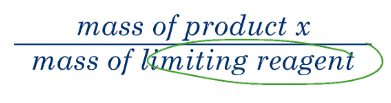
defn component purity

defn component recovery

what’s the difference between design and rating
design = equip doesn’t exist —> given xyz design specs, what parameters wil meet them
rating = equip does exist and ur adjusting —> given xys design parameters, what specs can u hit? [given reactor vol, what is outlet concentration]
what organization has commonly used boiler and pressure vessel codes
ASME (american society of mechanical engr)
what is the minimum threshold for ASME pressure vessel codes to apply to
must be at least 15 psig (1 bar)
what symbol is important on ASME code stamp name plates
U
tells u that the vessel has been designed, inspected, and certified by ASME certified individual (like PE signoff)

is design pressure higher or lower than max operating pressure
higher - u do all DESIGN calcs and material decisions based on DESIGN pressure, which has to be able to withstand max operating pressure
how do you determine design pressure?
design pressure = 1.1 x max operating pressure (psia)
OR
design pressure = max operating pressure + 0.33 bar [5psi]
^^ whichever one gives larger design P
what is the minimum design pressure
1 barg or 15 psig (including hydrostatic head)
ASME VIII only covers stuff above this pressure and it’s good to show ur stuff is certified, so want to be able this minimum
what is MAWP
max allowable working pressure = rating of the materials / vessel you’re using
changes w time bc stuff wears down
how does MAWP compare to design pressure
MAWP >= design P > max operating P > normal operating P
bc MAWP is a function of the vessel and may only come in standard thicknesses. these must have limits that exceed design P
ex: code calculation might say you need a 0.41 inch wall, but plate comes in standard thicknesses, so you buy 7/16 inch

do pressure relief settings change with time? what do they depend on?
yes, changes with MAWP
what is design P for vessels operating at vacuum?
1 barg / 15 psig AND full vacuum
what are possible sources of vacuum
vacuum operation
autorefrigeration during pressure relief that causes condensation
pumping out liquid w/out good vent
in hx, is shell or tube higher P
tube (easier to design smaller tubes to withstand high P than making entire shell suitable for high P)
what are design specs for pressure rating shell of shell/tube HX
a) put rupture disk on shell
b) shell design pressure = (10/13) tube prssure
c) hydrotesting is done at 1.3x shell design pressure (ensures it can def handle what’s thrown @ it)
what is relationship between design T and max operating T
design T = 25C/50F + max operating T wha
what is CET
lowerst temp which vessel will be subjected to ocnsidering
lowest operating temp
operational upset
autorefrig upon depressure
lowest atmospheric temp
what is MDMT
minimum design metal temp
must be lower than CET bc should be able to handle all worst case scenarios
similar idea to MAWP where this is a rating of the equipment
how do u calculate distillation tower vapor velocity and diameter
@ 80% flood
how do u determine pump or pipe capacity
= 110% of basis stream-day rate
how compute tensile strength
= 300% of that @ design P
how air dew point impact cooling tower design
cooling tower design based on 90%tile air dew point
what is typical aspect ratio of cylindrical vessels?
2-4:1 height:diameter
when are horizontal vessels useful?
good for phase sep that require low velocity for settling
easier to clean internals
what vessel head shape is best at high T
hemispherical
what P range is ellipsoidal vessel head good for
P>15barg
what P do you use torispherical for
cheapest for P<15barg
is flat or hemispheirical head thicker
flat
what is tangent line
where curve begins
what type of support do u use on tall vessels
skirt (not beam or leg)
what is the main application of ceramics
used in high T high corrosition
used in reactor and furnace @ low P , can also use for gasket and seal
what’s diff btween thermoplastic and thermoset
plastic softens as T increase, set hardens as T increase
what are most common thermoplastic resins
PVC or HDPE
when do you use thermoplastics and thermosets
used for low T low P piping and storage vessels
most common thermoset resins
GRP
glass reinforced polymer
what do u use elastomers for
gaskets, seals, tank liningss, pneumatic hoses
what are the most common metals
carbon steel + 304SS + 316SS
what utilities are outside of process design
electrical gen
fuel gas dist
plant/intrument air
fire supression
safety flare
defn wet bulb temp
Wet bulb temperature is the lowest temperature that air can cool itself down to purely through the evaporation of water into it.
formula for cooling water approach
T_CW - T_WB (want CW > WB bc WB needs to be able to remove heat from water)

what is minimum cooling W approach temp
5F (but usually closer to 15F) =15C
approach temp directly impact tower size
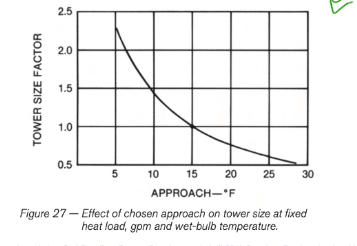
formula for cooling tower range + what’s typical value
T_hw = T_cw = T(water entering cooling tower) - T(water leaving coolng tower once heat is removed)
usually 5-20F, assume 10F