ECON 101: Principles, Demand, Supply, and Equilibrium Flashcards
 Call Kai
 Learn
Learn Practice Test
 Spaced Repetition
 Match
Match Flashcards
 Knowt Play
1/35

Earn XP
Description and Tags
Vocabulary flashcards covering core principles of economics, demand, supply, and equilibrium.
Name | Mastery | Learn | Test | Matching | Spaced | Call with Kai | Chat |
|---|
No analytics yet
Send a link to your students to track their progress
36 Terms
Cost-Benefit Principle
A decision-making principle stating that an action should be taken if and only if the extra benefits from taking it exceed the extra costs.
Willingness to Pay (WTP)
The maximum dollar amount a buyer would be willing to pay to receive a specific benefit or good.
Economic Surplus
The net value created by a decision or transaction, calculated as total benefits minus total costs.
Opportunity Cost Principle
A principle stating that the true cost of something is what you give up to do it, measured as the value of the next best alternative.
Sunk Cost
A cost that has already been incurred and cannot be recovered, which should be ignored when making economic decisions.
Production Possibility Frontier (PPF)
A graphical model displaying the different combinations of outputs an individual or economy can produce given fixed available resources and technology.
Marginal Principle
A decision-making rule stating that quantity decisions should be made by evaluating the incremental benefit and cost of doing one additional unit of an activity.
Marginal Benefit (MB)
The change in total benefit derived from consuming or producing one additional unit of a good or activity.
Marginal Cost (MC)
The additional cost incurred from producing or undertaking one additional unit of a good or activity.
Interdependence Principle
A principle stating that your best economic choice depends on your other choices, choices made by others, developments in other markets, and expectations about the future.
Individual Demand
The quantity of a good or service that a single consumer is willing and able to purchase at various prices, ceteris paribus.
Law of Demand
The economic principle stating that, ceteris paribus, as price increases, quantity demanded decreases (P↑⟹QD↓), giving the demand curve a downward slope.
Ceteris Paribus
A Latin phrase meaning holding everything else constant, used to isolate the effect of a single economic variable.
Rational Rule for Buyers
The decision rule stating that a consumer should buy more of a good as long as the marginal benefit is greater than or equal to price (MB≥P).
Diminishing Marginal Benefit
The property that as a consumer buys more units of a good, the marginal benefit derived from each additional unit decreases.
Market Demand
The total quantity demanded by all consumers in a market at various prices, derived by horizontally summing individual demand curves.
Horizontal Summation
The process of adding up the quantities demanded or supplied by all individual market participants at each given price level.
Normal Good
A good for which demand increases when consumer income increases (Income↑⟹Demand↑).
Inferior Good
A good for which demand decreases when consumer income increases (Income↑⟹Demand↓).
Substitutes (in Consumption)
Goods that replace each other, such that an increase in the price of one increases demand for the other (PX↑⟹DemandY↑).
Complements (in Consumption)
Goods consumed together, such that an increase in the price of one decreases demand for the other (PX↑⟹DemandY↓).

Network Effects
Phenomena where a good or service becomes more valuable to an individual user as more people use it (e.g., social media).
Congestion Effects
Phenomena where a good or service becomes less valuable to an individual user as more people use it (e.g., toll roads).
Perfectly Competitive Market
A market structure with many buyers and sellers, standardized/identical products, and no market power, making all participants price takers.
Price Taker
A buyer or seller that takes the market price as given because they have no ability to influence price individually.
Individual Supply
The quantity of a good or service that a single producer is willing and able to offer for sale at various prices, ceteris paribus.
Law of Supply
The principle that, ceteris paribus, as price increases, quantity supplied increases (P↑⟹QS↑), resulting in an upward-sloping supply curve.
Rational Rule for Sellers
The decision rule stating that a firm should sell an additional unit as long as the market price is greater than or equal to marginal cost (P≥MC).
Diminishing Marginal Product
The economic principle whereby marginal cost increases (MC↑) as output quantity increases.
Market Supply
The total quantity of a good supplied by all producers in a market at each price level, calculated via horizontal summation.
Substitutes in Production
Alternative goods a seller can produce using similar resources, where a price increase in one causes supply of the other to decrease.
Complements in Production
Goods produced together, where a price increase in one causes supply of the other to increase.

Market Equilibrium
The price (P∗) and quantity (Q∗) at which quantity supplied equals quantity demanded (QS=QD).
Absorbing State
A characteristic of market equilibrium where, if market price is disrupted away from (P∗,Q∗), prices naturally adjust back to equilibrium.
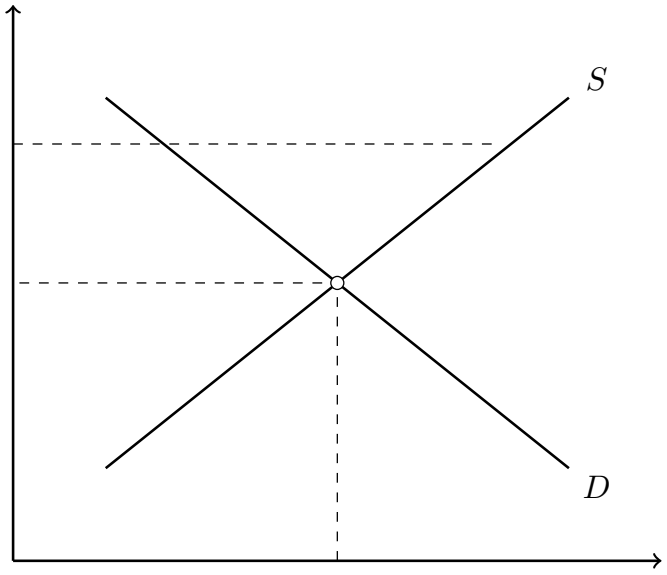
Surplus
A condition occurring when price is above equilibrium (P>P∗), causing quantity supplied to exceed quantity demanded (QS>QD).

Shortage
A condition occurring when price is below equilibrium (P<P∗), causing quantity demanded to exceed quantity supplied (QD>QS).