Musculoskeletal - Exam 3: Breaking my Bones
 Call Kai
 Learn
 Practice Test
 Spaced Repetition
 Match
 Flashcards
 Knowt Play
1/421

There's no tags or description
Looks like no tags are added yet.
422 Terms
What part of the joint provides a low friction, load-bearing surface for joints?
Articular cartilage
What are the three unmineralized zones of articular cartilage?
Superficial zone
Transitional zone
Deep zone
Which layer of articular cartilage has the highest cell density?
Superficial/tangential zone
What separates unmineralized from calcified cartilage?
Tide mark
What type of collagen predominates at the surface of articular cartilage?
Type 2
Why does articular cartilage have a limited ability to heal?
Avascular and denervated
Fibrocartilage forms following vascularization of a defect, mainly consisting of what type of collagen?
Type 1
What are the two classifications of arthritis?
Inflammatory and non-inflammatory
What are the three types of non-inflammatory arthritis?
Osteoarthritis
Traumatic arthritis
Coagulopathic arthritis
What is the most common type of osteoarthritis, due to an inciting cause like joint laxity?
Secondary osteoarthritis
What four things predispose to OA?
Genetics
Age
Obesity
Reproductive status (if fixed too early)
What tissues of the joint are affected by OA?
All of them
What part of the joint is the origin of pain from OA?
Synovium
What is the main sign of OA in dogs?
Lameness/pain (highly variable amounts)
T/F: Radiographic signs do not always correlate with clinical signs
True
What is the most valuable and cost-effective option to assess the stage of OA?
Arthroscopy
What changes from normal synovial fluid would you expect on a fluid analysis of a joint with OA?
Increased total cell count (slight)
Decreased percent of mononuclear cells (slight)
Increased percent of neutrophils (maybe)
What are the five multimodal treatments of OA?
Weight management
Exercise modulation
Nutritional supplements
Drugs
Surgery
T/F: Decreasing caloric intake involves calculating the Resting Energy Requirement for their current body weight
False, for ideal body weight
T/F: Exercise modulation should be regular, moderate, controlled, and high impact
False, low impact
What nutritional supplement lowers the production of inflammatory prostaglandins?
Omega-3 fatty acids
What is the most common drug to treat OA?
NSAIDs
What is the non-COX inhibiting prostaglandin receptor (PGE4) antagonist?
Grapiprant
What are the inflammatory forms of arthritis?
Immune mediated (erosive vs. nonerosive)
Infective
Crystal induced
What is the most common cause of bacterial infective arthritis?
Direct inoculation (trauma or surgery)
What is the most common bacterial isolate in dog joints?
Staphylococcus spp.
What clinical signs are associated with bacterial arthritis?
Severe, single limb lameness and joint swelling
What cell is increased greatly in the synovial fluid of bacterial arthritis?
Neutrophils (90 - 100%)
T/F: 95% neutrophils on fluid analysis is a definitive diagnosis of bacterial arthritis
False, could be immune mediated
What is the main treatment of bacterial arthritis?
Systemic antibiotics (C&S)
What tick borne disease can cause bacterial arthritis in dogs?
Rickettsia
How might signs differ from rickettsial joint infection versus bacterial arthritis?
Rickettsial is systemic, affecting multiple joints
What is the treatment of Rickettsia?
Doxycycline (3 weeks min)
T/F: IMPA usually involves single limb lameness, but multiple joints are often affected
True
Hypersensitivity of what is common with IMPA?
Vertebrae
What signs on synovial fluid analysis indicate IMPA?
High total cell count, with variable amounts of mononuclear cells and neutrophils
About half of non-erosive Type 1 IMPA cases are idiopathic, and most commonly affect what joints?
Carpal/tarsal
What is the treatment of type 1 IMPA?
Steroids +/- other immunosuppressives
Type II - IV IMPA are secondary to what?
Any chronic inflammatory disorder
II - infection remote
III - GI disease
IV - neoplasia
What breed of dog more commonly present with drug-induced IMPA?
Doberman
What are the three components of the orthopedic exam?
Gait analysis
Standing exam
Recumbent exam
What gait abnormalities are concerning for a neurologic condition?
Ataxia
Paresis
Hypermetria
Knuckling
What is the footfall for a walk?
LH - LF - RH - RF
What is the footfall for a trot?
LF + RH - RF + LH
T/F: A walk has 2 feet on the ground at any one time, while a trot only has 1
False, walk is 1, trot is 2
What is the best gait to consistently ID most lameness?
Trot
What two joints are indicated in a failed sit test?
Tarsus and stifle
How should a dog normally sit?
In a square
What is the best way to identify asymmetry on a standing exam?
Palpate symmetrically
What four joints are most noticeable when there is effusion?
Carpus, tarsus, stifle and elbow
What are the three landmarks for evaluating coxofemoral alignment?
Iliac crest, ischiatic tuberosity, and greater trochanter
T/F: The affected limb should be evaluated first
False, last
What should be evaluated on the recumbent exam?
Crepitus
ROM
Effusion
Pain
Instability
Thickening
CREPIT
How is crepitus described (aka how does it feel?)
Crunchy
Should the joint be extended or flexed when performing a collateral instability test?
Extended
T/F: Feet pics are important
True (in vet med)
What is the purpose of performing the biceps test?
Assess for bicep pain (bicipital tenosynovitis)
What three things must be done to perform the biceps test?
Flex shoulder
Extend elbow
Palpate bicipital groove
What is the purpose of the Campbell's test?
Assess for medial compartment pain (elbow dysplasia)
What is the main step in performing the cambell's test?
Rotate the antebrachium and flex the elbow
T/F: A positive Ortolani test is not normal in a dog, while a negative test can rule out hip dysplasia
False, negative does not rule out
What is the purpose of the tibial thrust test?
Assessing cranial cruciate ligament integrity
Once your hands are placed correctly, how do your perform the tibial thrust test, and what are you feeling for?
Slow, sustained flexion of the tarsus
Feel for cranial translation of the tibia
What is the purpose of the cranial drawer test?
Assess cranial cruciate ligament
What are the four landmarks for the cranial drawer test?
Patella
Fabella
Tibial tuberosity
Fibular head
T/F: Cranial drawer should be assessed in flexion and extension
True
What is a caution for cranial drawer testing?
Juvenile drawer
T/F: The absence of a positive thrust/drawer indicates a normal CCL
False
What grade patellar luxation: out of groove, but can be manually reduced?
3
What grade patellar luxation: in groove, will spontaneously luxate with range of motion?
2
What grade patellar luxation: Out of groove, cannot be reduced?
4
What grade patellar luxation: in groove, can be luxated with stifle in extension?
1
A disorder of endochondral ossification resulting in cartilage necrosis is what?
Osteochondrosis
What addition to osteochondrosis (OC) makes osteochondrosis dessecans (OCD)?
Cartilage flap
What is the inciting event that leads to failure of endochondral ossification and thus OC?
Disruption of vasculature
What is the typical signalment for OC(D)?
Male, large/giant breed dogs under 1 year
What is the most common site affected by OC(D)?
Caudal aspect of the humeral head
What is the most common site affected by OC in the elbow?
Medial aspect of the humeral condyle
What is the most common site affected by OC in the hock?
Medial trochlear ridge of the talus
What is the most common site affected by OC in the stifle?
Medial aspect of the lateral femoral condyle
What radiographic feature is diagnostic of OC?
Flattening of the affected bone
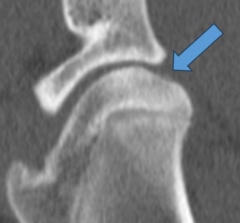
What are the goals of surgical management of OC?
Remove source of inflammation
Permit healing
Prevent onset of OA
OC has a fair to poor prognosis in most joints except for which?
Shoulder (excellent)
What is the typical signalment of Hypertrophic Osteodystrophy (HOD)?
Young (2 - 6 months)
Rapid growing
Large+ breeds
Male
What is the pathogenesis of HOD?
Disrupted metaphyseal trabeculae parallel to the growth plate
What breed is predisposed to HOD?
Weimaraners
What is the main etiology of HOD in most dog breeds (not Weimaraners)?
Infection
What is the main clinical sign of HOD?
Bilateral swelling of metaphysis
What bones are most commonly affected by HOD?
Ulna, tibia, and distal radius
What is a radiographic sign of HOD?
Lucent line parallel to the physis (double physis)
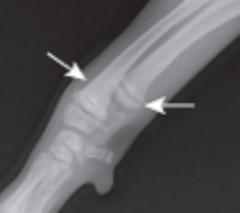
What is the mainstay of treatment for HOD?
Supportive care (self-limiting)
What is the pathogenesis of panosteitis (PO)?
Inflammatory disease of bone marrow leading to increased intraosseous pressure and remodeling
What is the typical signalment of PO?
Large+ breeds
6 - 12 months
Males
What two signs are indicative of PO?
Pain on palpation and shifting leg lameness
Which limbs are more likely to be affected by PO?
Thoracic
What are the radiographic signs of PO?
Increased in medullary opacity (later stages)

What is the mainstay of treatment for PO?
Supportive care (self-limiting)
What is the prognosis of PO?
Good to excellent (possible recurrence)
What is the pathogenesis of Legg-Calve-Perthes (LCP)?
Necrosis of the femoral head, leading to fragmentation and re-ossification
What is the typical signalment of LCP?
Small/toy breed dogs