H13: Brain
 Call Kai
 Learn
Learn Practice Test
 Spaced Repetition
 Match
Match Flashcards
 Knowt Play
1/42

There's no tags or description
Looks like no tags are added yet.
Name | Mastery | Learn | Test | Matching | Spaced | Call with Kai | Chat |
|---|
No analytics yet
Send a link to your students to track their progress
43 Terms
cerebrum
Largest part of the brain consisting of 2 hemispheres

sulci (sulcus, singular)
grooves on the surface of the cerebrum
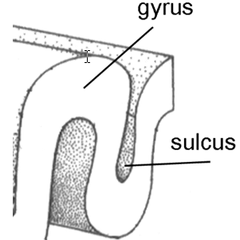
Gyri (gyrus, singular)
elevated ridges
convolutions of the cerebrum separated by sulci

longitudinal fissure
occupied?
deep groove that separates cerebral hemispheres
occupied by the falx cerebri

transverse fissure or sulcus
occupied by?
separates the cerebrum and cerebellum and is occupied by the tentorium cerebelli

lateral fissure or sulcus
Separates the temporal lobe from the rest of the cerebrum superior to it

central sulcus
separates the precentral(motor) and postcentral (sensory) gyri
NOT FISSURE

4 major sulci(or fissures) are: _________________
1. longitudinal fissure
2. transverse fissure or sulcus
3. lateral fissure or sulcus
4. central sulcus
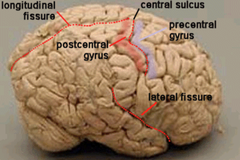
four main lobes of cerebrum
frontal, parietal, temporal, occipital

fifth lobe of cerebrum
insula
lies within depths of lateral sulcus

insula
cerebral lobe located deep within lateral sulcus

primary motor cortex
pre-central gyrus
lies anterior to central sulcus
stimulated when you decide to move a structure

primary sensory cortex
post-central gyrus
lies posterior to central sulcus
when you feel something, this is stimulated

homonculus

basal nuclei (ganglia)
constitute?
control?
diseases?
constitute the central gray matter of the cerebrum
control of movement and posture
Diseases involved disturbances in voluntary muscular control, eg. Parkinson's disease, Huntington's Chorea

diseases of basal nuclei
Diseases involved disturbances in voluntary muscular control, eg. Parkinson's disease, Huntington's Chorea
thalamus
purpose?
sends?
location to it what?
most important sensory relay center of the brain
sends incoming impulses from the receptors of the body to the cerebral cortex
posterior to the thalamus is the pineal gland (pineal body)

pineal gland (pineal body)
secretes?
posterior to the thalamus
secretes melatonin, involved in sleep wake cycle

hypothalamus: what does it lie between and is associated with
it lies between and is associated with the:
A. optic chiasma
B. mamillary bodies
C. pituitary gland
hypothalamus: functions
functions in the regulation of visceral activity
1. Body temperature
2. Carbohydrate and lipid metabolism
3. Sleep, sexual activity and emotions
optic chiasma
the crossing of the optic nerves, CNII, from the two eyes at the base of the brain

mammillary bodies
part of?
sensory synaptic station part of limbic system

pituitary gland
projects from where?
projects inferior from the hypothalamus and secretes many hormones

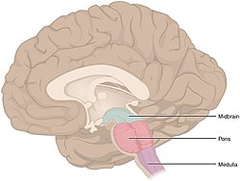
brainstem
3 parts from superior to inferior:
midbrain
pons
medulla oblongata
midbrain
contains:
anterior?:
posterior?:
contains the cerebral peduncles anteriorly and the tectum (or roof) of the corpora quadrigemina posteriorly
cerebral peduncles
located in the midbrain

corpora quadrigemina
located in the midbrain
consists of 4 elevations that are arranged as two pairs:
Superior colliculi
Inferior colliculi

superior colliculi
involved in pathway of vision
in corpora quadrigemina in the midbrain
(eyes are higher than ears)

inferior colliculi
involved in the pathway of hearing
in corpora quadrigemina in the midbrain
(eyes are higher than ears)

pons
what does it do?
what does it connect?
acts as a bridge connecting the right and left cerebellar hemispheres
relays impulses from the cerebral cortex to the cerebellum

medulla oblongata
part of the brain that is _________ with the spinal cord
contains most of the ____ and ____ of the spinal cord
represents an area where ______ lie, called the ______.
An area inferior to this is where the ________ cross or decussate over to the ______ side. This is called the __________
Other tracts can cross either in the ____ or in the _____itself
part of the brain that is directly continuous with the spinal cord
contains most of the ascending and descending tracts of the spinal cord
represents an area where pyramidal tract fibers lie, called the PYRAMIDS.
An area inferior to this is where the pyramidal tracts cross or decussate over to the contralateral side. This is called the pyramidal decussation.
Other tracts can cross either in the spinal cord or in the brain itself

pyramidal decussation
The pyramidal decussation marks the border between the spinal cord and the medulla oblongata.
where the pyramidal tracts cross or decussate over to the contralateral side
WITHIN THE MEDULLA OBLONGATA

pyramids of medulla oblongata
pyramidal tract fibers

other than the pyramidal decusation where can tracts cross?`
spinal cord or brain itself
medulla oblongata contains several nuclei involved in:
regulation of vital body activities: respiratory, cardiac (heart rate), and vasomotor (blood pressure)
B = Breathing → respiratory center
H = Heart rate → cardiac center
B = Blood pressure → vasomotor center
cerebellum: SUMMARY
little brain
It connects with the midbrain, pons, and medulla oblongata via the superior, middle and inferior cerebellar peduncles
It consists of two hemispheres separated by a median vermis
Its outer cortex contains folia separated by fissures, folia means leaves, just like the brain, how it has gyri separated by sulci, we say that the cerebellum has folia separated by fissures.
internally presents white matter branching in the form of a tree, called arbor vitae
functions: coordination of muscular activity, regulation of muscle tone, maintenance of equilibrium

cerebellum connects with ______ via _____
It connects with the midbrain, pons, and medulla oblongata via the superior, middle and inferior cerebellar peduncles

peduncles of cerebellum
superior, middle, inferior

median vermis
Connects the two hemispheres of the cerebellum
cerebellum outer cortex contains
folia separated by fissures, folia means leaves, just like the brain, how it has gyri separated by sulci, we say that the cerebellum has folia separated by fissures.

cerebellum internally presents _____
internally presents white matter branching in the form of a tree, called arbor vitae

functions of cerebellum
1. coordination of muscular activity
2. regulation of muscle tone
3. maintenance of equilibrium
A = muscular Activity
T = Tone of muscles
E = Equilibrium → balance
arbor vitae
white matter of the cerebellum
