Unit 2 Quiz 2: Carbohydrates, Lipids, and the Digestive System Quiz 9/24/26
 Call Kai
 Learn
 Practice Test
 Spaced Repetition
 Match
 Flashcards
 Knowt Play
1/89

There's no tags or description
Looks like no tags are added yet.
90 Terms
Carbohydrate
biomolecule that is made of sugars.
Sugar
compound that has carbon, hydrogen, and oxygen in ratio of 1:2:1
Monosaccharide
simple sugar (ex. glucose, fructose, and galatose)
Dissaccharide
two monosaccharides combined together (ex. sucrose, table sugar, lactose, etc.)
Functions of Carbohydrates
energy supply, structure and support, and cell recognition
Elements that carbohydrates contain:
Carbon (C), Hydrogen (H), Oxygen (O).
Monomers
single molecules that can link together to form polymers. Monosaccharides are the monomers of polysaccharides can join together to form disccharides or polysaccharides
Disaccharides
created when two monosaccharides link together in dehydration synthesis reaction
Dehydration Synthesis:
removal of a water molecule to create longer molecules
Hydrolysis
addition of a water molecule to break bonds, forming shorter molecules. Ex: glycogen is broken down into glucose in this way. Glucose can then be used in respiration to release energy
Polysaccharides
long chains of monosaccharides linked together by glycosidic bonds. Als
Digestive System
group of organs that do three things: digestion, absorption, and elimination
Digestion
process of the digestive system breaks down food into useful nutrients
Absorption
nutrients move into blood stream
Elimination
leftover waste is removed from the body
Large intestine and small intestine
organs that allow nutrients to be absorbed
Rectum
which organ stores and compact waste before it is eliminated
Mouth and pharynx
Which organs help to break food down mechanically
Large intestine
this organ absorbs water and vitamin k from digested food
Pancreas
this organ produces enzymes that break down nutrients
Capillaries
these tiny blood vessels transport absorbed nutrients
Parietal Cells
these cells produce hydrochloric acid (HCL)
Chief Cells
these cells produce pepsin which breaks down proteins
Esophagus
Muscular tube lined with mucus. In process of peristalsis, muscles contract to move food from one end to another.
Small Intestine
Long, folded tube in your abdomen that connects your stomach to your large intestine. Duodenum: The short, wide first section where food mixes with digestive juices to neutralize stomach acid. [1, 2]
Jejunum: The middle section where the body absorbs most of the nutrients. [1]
Ileum: The final section that absorbs remaining nutrients, such as vitamin B12 and bile acids, before passing waste on. [1]
Stomach
a hollow, muscular organ in the upper left abdomen that stores, mixes, and breaks down food using strong acids and enzymes
Galblabber
is a small, pear-shaped organ located beneath the liver that stores and concentrates bile to help your body break down dietary fats
Lymphatic vessels
a network of thin-walled tubes that collect excess fluid from body tissues and return it to the bloodstream
Salivary gland
specialized organs in your head and neck that produce saliva to help with chewing, swallowing, digestion, and oral hygiene
Fatty Acids
key component of lipids. consist of carboxyl group joined to a hydrocarbon chain of variable length. can be saturated or unsaturated
Saturated
No Carbon bonds (C=C) SINGLE BOND, straight
Unsaturated
At least one carbon bond (C=C) DOUBLE BOND, bent
Trans unsaturated
Has at least ONE double bond, straight
Lipids
Type of macromolecule that are insoluble in water. Found in fats, oils, waxes, hormones, and other important molecules
Structure of Triglycerides:
———Fatty Acids
Glycerol———Fatty Acids
- ——-Fatty Acids
Formation of Triglycerides
Glycerol + 3 Fatty Acids yields Triglyceride + 3 water molecules (Dehydration Synthesis)
Function of Triglycerides
Used as long term store of energy, they are stored in the body as fat which is good for insulation in cold habitats. The long hydrocarbon tails store a lot of energy that is released when they are broken down. Good for storage since they are insoluable in water so they don’t affect a cells water potential.
Phospholipids
a major class of lipids that form the structural foundation of all biological cell membranes
Functions of phospholipids
Make up the cell/plasma membrane of cells . Form a bilayer with the hydrophobic tails facing inwards and the hydrophilic heads facing outwards. Due to the polar nature of the tails, most water soluble molecules cannot pass throught. In this way, the cell membrane controls what can enter and exit the cell.
Structure of phospholipids
Phosphate Group ——Fatty Acid
PO4———-Glycerol ———Fatty Acid
Amylase
Enzyme that breaks down starches into simple carbohydrates
Peristalsis
Muscular contractions that push food through the digestive system
Duodenum
Upper section of the small intestine
Anus
Opening through which wastes are eliminated
Pepsin
Enzyme that starts to digest proteins in the stomach
Lymphatic vessel
Transports absorbed fatty acids to the bloodstream
Pancreas
Organ that produces a variety of digestive enzymes
Bile
Chemical that breaks up large fat droplets
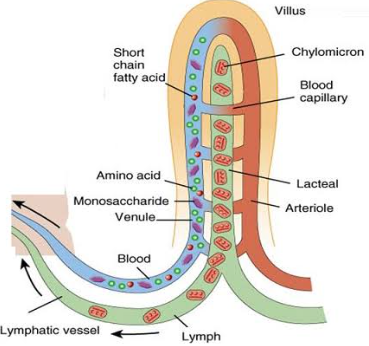
Villus
tiny finger like projections in the wall of the small intestine sends nutrients to either the capillaries or the lymphatic vessel.
Three types of monosaccharides
fructose, galactose, and glucose
Malatose
(glucose + glucose) disaccharide
Lactose
(glucose + galactose) disaccharide
Sucrose
(glucose + fructose) disaccharide
What is maltose made out of
two glucose
What is lactose made out of
one glucose and one galactose
what is sucrose made out of
one glucose and one fructose
Polysaccharides
Long chains of monosaccharides linked together by glycosidic bonds. Also form by dehydration synthesis reactions.
Disaccharides
Form when two monosaccharides link together in a dehydration synthesis reaction. Different monosaccharides are used to build different disaccharides
Amylopectin
Example of a polysaccharide. It is a long branched chain its side branches let glucose get released quickly. It is found in plants.
Amylose
Example of polysaccharide. A long unbranched chain it is coiled like a cylinder, making it compact and good for storage. Found in plants.
Cellulose
Example of a polysaccharide. The long straight chains can form hydrogen bonds. This makes it good for providing support e.g. in the cell wall. Found in plants.
Glycogen
Example of a polysaccharide. A highly branched structure with many side branches. This allows very quick release of glucose for animals. Very compact. Found in animals.
Monomers
single molecules that can link together to form polymers.
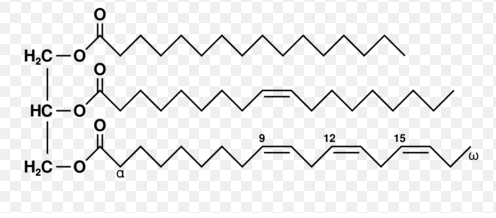
What type of structure is this
Triglyceride (Lipid)
Ester Bond
-0=C=O (found in triglycerides)
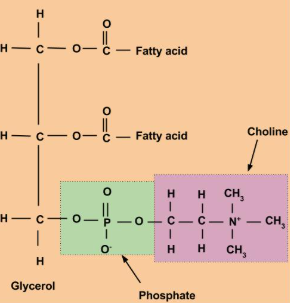
What type of structure is this?
Phospholipid (Lipid)

What type of structure is this?
saturated, trans unsaturated, cis saturated (ALL lipids)
What does the villus do?
It absorbs nutrients and delivers them to the lymphatic vessel or capillaries
Catabolic
break down large, complex molecules into smaller, simpler ones, which releases energy
Anabolic
build larger, more complex molecules from smaller units, which requires an input of energy
All life revolves around which element?
carbon
Give a food example for each of the types of carbohydrates
monosaccharide (fruit), disaccharide (milk), polysaccharide (bread)
What size must a carbohydrate be to enter into a cells and which one can fit
monosaccharide (glucose)
What are the two functions of polysaccharides
energy storage (starch in plants and glycogen in animals) and structural support (cellulose helps form plant cell wallsIf yo
If you eat a carbohydrate but do not use it within a 24 hour period what happens to it?
turn into a fat or lipid
What are functions of lipids
makes cell membrane
What does it mean that lipids are nonpolar molecules
all electrons are even do not build polymers no charge
Saturated fat
no C=C bonds, pack tighter, thus allowing it to stay solid at room temperature
Trans unsaturated
at least one C=C bond, hydrogen atoms are on opposite sides of the double bond, straight usually stays compact solid or semi solid
Cis unsaturated
At least on C=C is bent, does not pack tightly, making it a liquid
The head of a phospholipid is:
hydrophilic
The tail of a phospholipid is:
hydrophobic
Waxes
Are long chain hydrocarbons. They are very water repellent and are solid at room temperature. Plants use waxes in their leaves to prevent water loss. Some animals use waxes to clean and protect the ears. Bees use wax to build honeycomb.
Steroids
Has a basic structure of 4 rings of carbon atoms. They are still hydrophobic and insoluble in water. Steroids make up the basis of many hormones including testosterone and estrogen. They are also used to make neurotransmitters.
Cholesterol
A type of steroid and is a key component of cell membranes. However, too much “bad” cholesterol can damage the body.
LDL Cholesterol
Low-density lipoprotein= BAD cholesterol
HDL Cholesterol
High-density lipoprotein= GOOD cholesterol
What happens to you if you have too much LDL Cholesterol?
High levels of LDL cholesterol causes fatty deposits to build up in the arteries, increasing the risk of heart disease and stroke. To reduce cholesterol, diets should be low in saturated fats and trans fats.
Building block of Carbohydrates:
monosaccharides
Building block of Lipids:
made of fatty acid chains and glycerol.