ECOL 182R Quiz 5
0.0(0)
Studied by 0 people Call Kai
 Learn
 Practice Test
 Spaced Repetition
 Match
 Flashcards
 Knowt Play
Card Sorting
1/148

There's no tags or description
Looks like no tags are added yet.
149 Terms
1
New cards
What are the five defining characteristics of animals?
- Multicellular
- Heterotrophic
- Lack cell walls; possess an extracellular matrix (ECM)
- Self-propelled movement during some stage of their life cycle
- Neurons and muscle cells (except sponges)
Flashcard 2
2
New cards
What does heterotrophic mean?
Obtaining energy and nutrients by consuming other organisms or organic matter.
Flashcard 3
3
New cards
What is the extracellular matrix (ECM)?
A substance outside animal cells composed of proteins and glycoproteins that provides structural support.
Flashcard 4
4
New cards
What are the functions of the extracellular matrix?
Provides structural support, forms hard structures such as bone and cartilage, and forms soft barriers and filters around cells.
Flashcard 5
5
New cards
Do all animals need to be capable of movement as adults?
No. They only need to demonstrate self-propelled movement at some point in their life cycle.
Flashcard 6
6
New cards
What animal group lacks neurons and muscle cells?
Porifera (sponges).
Flashcard 7
7
New cards
What are the functions of neurons and muscle cells?
Neurons transmit electrical signals to other cells, while muscle cells contract to change the shape of the body.
Source: Lecture slides 4–6. 14_Animal Diversity-1.pdf
Part 2: Animal phylogeny and classification
Flashcard 8
8
New cards
What are the major animal groups in the simplified animal phylogenetic tree?
- Porifera
- Cnidaria
- Ctenophora
- Protostomes (Lophotrochozoans and Ecdysozoans)
- Deuterostomes
Flashcard 9
9
New cards
What are the two major groups of protostomes?
Lophotrochozoans and Ecdysozoans.
Flashcard 10
10
New cards
How do Lophotrochozoans grow?
Incrementally, by adding to their skeletal elements, where present.
Flashcard 11
11
New cards
What three phyla of Lophotrochozoans were covered in lecture?
- Platyhelminthes — flatworms
- Annelida — segmented worms (earthworms)
- Mollusca — snails, oysters, etc.
Flashcard 12
12
New cards
How do Ecdysozoans grow?
Through molting, which involves shedding their outer covering to allow further growth.
Flashcard 13
13
New cards
What two phyla belong to Ecdysozoans in our lecture?
- Nematoda — roundworms
- Arthropoda — insects, spiders, crustaceans, etc.
Flashcard 14
14
New cards
What skeletal characteristic is associated with deuterostomes in the lecture?
Internal skeletons.
Flashcard 15
15
New cards
What two phyla of deuterostomes were covered?
- Echinodermata — sea stars, etc.
- Chordata — humans and other vertebrates, among others.
Flashcard 16
16
New cards
Draw the simplified classification of protostomes and deuterostomes.
Mnemonic: PAM–NA–EC
- PAM: Platyhelminthes, Annelida, Mollusca
- NA: Nematoda, Arthropoda
- EC: Echinodermata, Chordata
Source: Lecture slides 8–12. 14_Animal Diversity-1.pdf
Part 3: Porifera (sponges)
Flashcard 17
17
New cards
What does basal mean in a phylogenetic tree?
A lineage that originates near the root of the phylogenetic tree.
Flashcard 18
18
New cards
Which animal group is basal in our lecture's phylogenetic tree?
Porifera (sponges).
Flashcard 19
19
New cards
What type of cellular organization do sponges possess?
Cellular organization rather than true tissue organization. Different cells perform specialized functions.
Flashcard 20
20
New cards
What are porocytes?
Specialized sponge cells that allow water to enter the sponge.
Flashcard 21
21
New cards
What are choanocytes?
Flagellated cells that generate water currents, capture food particles and engulf them.
Flashcard 22
22
New cards
What type of feeding do sponges perform?
Heterotrophic suspension feeding. They capture food particles suspended in water.
Flashcard 23
23
New cards
Do sponges perform intracellular or extracellular digestion?
Intracellular digestion. Food particles are engulfed and digested inside individual cells.
Flashcard 24
24
New cards
What are spicules, and what are they made of?
Hard skeletal structures that provide support to sponges, composed of calcium carbonate or silica.
Flashcard 25
25
New cards
What provides flexible structural support in sponges?
Collagen and spongin.
Flashcard 26
26
New cards
How do sponges satisfy the animal requirement of self-propelled movement?
Their larvae can swim and disperse away from the parent before settling.
Flashcard 27
27
New cards
What does sessile mean?
Permanently attached or anchored to a surface, without free locomotion.
Flashcard 28
28
New cards
Which life stages of sponges are mobile and sessile?
Larvae are mobile; mature adult sponges are sessile.
Flashcard 29
29
New cards
How do sponges reproduce asexually?
Through budding and regeneration, producing genetically identical clones of the parent.
Flashcard 30
30
New cards
How do sponges reproduce sexually?
Through sperm and eggs, allowing genetic recombination. Choanocytes of other sponges can capture released sperm.
Flashcard 31
31
New cards
What is a hermaphrodite?
An individual capable of producing both male (sperm) and female (egg) gametes. Many sponges are hermaphrodites.
Flashcard 32
32
New cards
Do sponges possess a nervous system?
No. They lack neurons and a nervous system but possess genes encoding proteins associated with neuronal function.
Flashcard 33
33
New cards
Can sponges respond to environmental stimuli without neurons?
Yes. Their cells communicate during feeding, and larval cilia can respond to light.
Flashcard 34
34
New cards
What two major characteristics distinguish Porifera from other animals in the lecture?
- Lack true tissues.
- Lack body symmetry (asymmetrical).
Flashcard 35
35
New cards
What experiment demonstrates that sponges lack true tissue organization?
Sponge cells can be completely separated, strained through a filter and reassemble into a functioning sponge within weeks.
Source: Lecture slides 14–23, including the annotated diagrams of porocytes, choanocytes and sponge reproduction. 14_Animal Diversity-1.pdf
Part 4: Evolution of symmetry
Flashcard 36
36
New cards
What are the three major types of animal body symmetry?
Asymmetry, radial symmetry and bilateral symmetry.
Flashcard 37
37
New cards
What is asymmetry, and which group demonstrates it?
No plane can divide the organism into two equal halves. Example: Porifera.
Flashcard 38
38
New cards
What is radial symmetry?
Multiple planes passing through the central axis can divide the organism into equal halves.
Flashcard 39
39
New cards
Which animal groups demonstrate radial symmetry according to the lecture?
Cnidaria and Ctenophora.
Flashcard 40
40
New cards
What is bilateral symmetry?
Only a single plane divides the organism into two equal, mirror-image halves.
Flashcard 41
41
New cards
Which major animal groups evolved bilateral symmetry in the lecture's phylogenetic tree?
Protostomes and deuterostomes.
Flashcard 42
42
New cards
What is cephalization?
The evolutionary trend toward developing a head, with sensory organs and nervous tissue concentrated toward the anterior end.
Flashcard 43
43
New cards
What are the evolutionary advantages of bilateral symmetry?
- Establishes a front, back, top and bottom.
- Promotes cephalization.
- Concentrates sensory organs toward the front.
- Associated with a central nervous system and brain.
- Facilitates forward movement.
Flashcard 44
44
New cards
Why is bilateral symmetry advantageous for mobile animals?
Sensory organs concentrated at the anterior end allow animals to detect stimuli in the direction they are moving.
Source: Lecture slides 24–29. 14_Animal Diversity-1.pdf
Part 5: Cnidaria
Flashcard 45
45
New cards
What are examples of Cnidaria?
Corals, sea anemones and many jellyfish.
Flashcard 46
46
New cards
What are the defining characteristics of Cnidaria?
- Radial symmetry
- Two tissue layers
- Extracellular digestion
- Mouth but no anus
- Polyp and medusa body forms
- No coelom
Flashcard 47
47
New cards
What are the two body forms of Cnidaria?
Polyp (sessile) and medusa (mobile).
Polyp
Sessile — coral, anemone
Medusa
Mobile — jellyfish
Flashcard 48
48
New cards
What is a polyp?
The sessile body form of Cnidaria, such as corals and sea anemones.
Flashcard 49
49
New cards
What is a medusa?
The mobile body form of Cnidaria, such as jellyfish.
Flashcard 50
50
New cards
What major evolutionary innovations are associated with Cnidaria?
Radial symmetry, true tissue organization and extracellular digestion.
Flashcard 51
51
New cards
How does digestion in Cnidaria differ from digestion in sponges?
Cnidaria perform extracellular digestion in a digestive cavity, whereas sponges digest food within individual cells.
Flashcard 52
52
New cards
How many digestive openings do Cnidaria possess?
One. The mouth serves as the opening for food intake and undigested waste removal. There is no separate anus.
Flashcard 53
53
New cards
How many tissue layers do Cnidaria possess?
Two layers of tissue.
Source: Lecture slides 29–32. 14_Animal Diversity-1.pdf
Part 6: Ctenophora (comb jellies)
Flashcard 54
54
New cards
What are Ctenophora commonly called?
Comb jellies.
Flashcard 55
55
New cards
What are the major characteristics of Ctenophora?
- Radial symmetry (as classified in the lecture)
- Extracellular digestion
- Sticky tentacles in some species
- Mouth and anus
- No coelom
Flashcard 56
56
New cards
How do some Ctenophora capture prey?
Using sticky tentacles.
Flashcard 57
57
New cards
What major digestive innovation is associated with Ctenophora?
One-way digestion with separate openings for the mouth and anus.
Flashcard 58
58
New cards
What characteristics do Cnidaria and Ctenophora share?
Radial symmetry, extracellular digestion, tissue organization and absence of a coelom.
Flashcard 59
59
New cards
What is the major difference between Cnidaria and Ctenophora?
Cnidaria possess only a mouth, whereas Ctenophora possess both a mouth and an anus.
Source: Lecture slides 33–36. 14_Animal Diversity-1.pdf
Part 7: Evolution of the coelom
Flashcard 60
60
New cards
What is a coelom?
A body cavity completely lined by mesoderm, located between the digestive tract and the body wall.
Flashcard 61
61
New cards
What is an acoelomate?
An animal that lacks a coelom.
Flashcard 62
62
New cards
What are examples of animals that lack a coelom?
Sponges, Cnidaria, Ctenophora and flatworms (Platyhelminthes).
Flashcard 63
63
New cards
What is a coelomate?
An animal possessing a true body cavity completely lined by mesoderm.
Flashcard 64
64
New cards
Which major animal groups possess a coelom according to the lecture?
Some protostomes and all deuterostomes.
Flashcard 65
65
New cards
What is the structural difference between an acoelomate flatworm and a coelomate?
An acoelomate flatworm has solid mesoderm between the gut and body wall. A coelomate has a fluid-filled cavity surrounded by mesoderm.
Flashcard 66
66
New cards
What are the two major coelomic subdivisions discussed for humans?
Thoracic and abdominal cavities.
Flashcard 67
67
New cards
How is the coelom organized in earthworms?
A coelom is present in each body segment.
Flashcard 68
68
New cards
What are the four major evolutionary advantages of a coelom?
- Cushions and protects internal organs.
- Can function as a simple circulatory system.
- Provides hydrostatic skeletal support.
- Allows internal organs to grow independently of the body wall.
Flashcard 69
69
New cards
What is a hydrostatic skeleton?
A support system in which fluid pressure within a body cavity provides rigidity and structural support. Example: earthworms.
Flashcard 70
70
New cards
How does the coelom allow greater internal organ complexity?
Organs can grow independently of the external body wall, allowing structures such as long, coiled intestines to develop.
Flashcard 71
71
New cards
How does a coelom protect organs from surrounding muscles?
It cushions organs, allowing muscles to contract without significantly deforming the internal organs.
Source: Lecture slides 37–42. 14_Animal Diversity-1.pdf
Part 8: Protostomes vs. deuterostomes
Flashcard 72
72
New cards
What distinguishes protostomes from deuterostomes?
Their early embryonic development, particularly the developmental fate of the blastopore.
Flashcard 73
73
New cards
What is a blastula?
An early embryonic stage consisting of a hollow ball of cells.
Flashcard 74
74
New cards
What is a gastrula?
An embryonic developmental stage following the blastula in which tissue layers begin organizing and the blastopore forms.
Flashcard 75
75
New cards
What is the blastopore?
An opening formed during gastrulation that develops into the mouth or anus in the simplified developmental model.
Flashcard 76
76
New cards
What does the blastopore develop into in protostomes?
The mouth (mouth first).
Flashcard 77
77
New cards
What does the blastopore develop into in deuterostomes?
The anus (mouth second).
Mnemonic: Proto = first mouth. Deutero = second mouth.
Flashcard 78
78
New cards
Are humans protostomes or deuterostomes?
Deuterostomes, belonging to the phylum Chordata.
Flashcard 79
79
New cards
Are earthworms, flatworms, snails, roundworms and insects protostomes or deuterostomes?
Protostomes.
Flashcard 80
80
New cards
Are sea stars and humans more closely related to each other than humans and insects?
Yes. Sea stars and humans share a more recent common ancestor within the deuterostomes.
Source: Lecture slides 43–44 and the simplified phylogenetic tree. 14_Animal Diversity-1.pdf
Part 9: High-yield cumulative flashcards
These are particularly important because your handwritten notes emphasize drawing the animal phylogenetic tree on slide 35.
Flashcard 81
81
New cards
Draw the complete simplified animal phylogenetic tree, including the major evolutionary innovations.
Flashcard 82
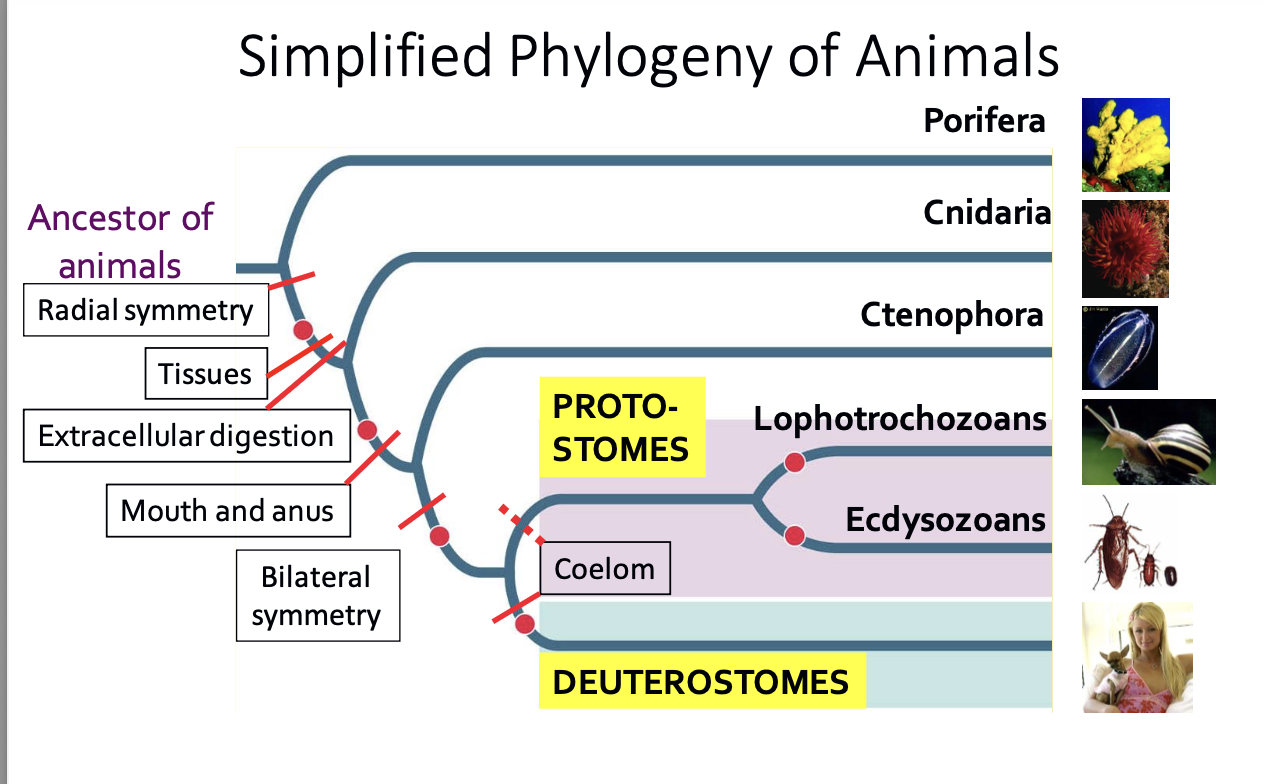
82
New cards
Which animal group lacks true tissues, symmetry and a nervous system?
Porifera.
Flashcard 83
83
New cards
Which animal group introduced true tissue organization and extracellular digestion in our lecture's phylogeny?
Cnidaria.
Flashcard 84
84
New cards
Which animal group introduced one-way digestion in our lecture's phylogeny?
Ctenophora.
Flashcard 85
85
New cards
Which evolutionary innovation is associated with cephalization?
Bilateral symmetry.
Flashcard 86
86
New cards
Does possessing a mouth and anus necessarily mean an animal possesses a coelom?
No. Ctenophora possess both a mouth and an anus but lack a coelom.
Flashcard 87
87
New cards
Does bilateral symmetry necessarily mean an animal possesses a coelom?
No. Flatworms are bilaterally symmetrical but lack a coelom.
Flashcard 88
88
New cards
Does being multicellular necessarily mean possessing true tissues?
No. Sponges are multicellular but lack true tissue organization.
Flashcard 89
89
New cards
Can an organism perform extracellular digestion without an anus?
Yes. Cnidaria perform extracellular digestion despite possessing only one digestive opening.
Flashcard 90
90
New cards
Do all protostomes possess a coelom?
No. Only some protostomes possess a true coelom.
91
New cards
1.
92
New cards
What are the major characteristics of Cnidaria?
Radial symmetry, two tissue layers, extracellular digestion, nematocysts and a mouth without a separate anus.
2.
93
New cards
What are the five classes of Cnidaria?
- Anthozoa — corals and anemones
- Scyphozoa — swimming jellyfish
- Staurozoa — stalked jellyfish
- Cubozoa — box jellyfish
- Hydrozoa — hydroids and siphonophores
3.
94
New cards
What are the two body forms of Cnidaria?
Polyp (sedentary) and medusa (mobile).
4.
95
New cards
What body form predominates in corals?
Polyp.
5.
96
New cards
What are nematocysts?
Specialized organelles that function like miniature harpoons and can release toxins.
6.
97
New cards
How does a nematocyst work?
Foreign chemical stimulus → trigger activated → harpoon released → prey penetrated → toxin delivered.

98
New cards
What are the three major functions of nematocysts?
Capturing prey, defending against predators and defending territories.
8.
99
New cards
How do Cnidarians reproduce sexually and asexually?
- Asexually: Budding from polyps.
- Sexually: Fertilized eggs develop into mobile, planktonic offspring.
9.
100
New cards
What is the evolutionary advantage of planktonic offspring?
They can disperse away from their parents and colonize new environments.
Slides 5–10 and 15. 15_Animal Diversity-2.pdf
15_Animal Diversity-2.pdf
Part 2: Corals and mutualism
10.