painting study guide
 Note
 Call Kai
 Learn
 Practice Test
 Spaced Repetition
 Match
 Flashcards
 Knowt Play
1/31

There's no tags or description
Looks like no tags are added yet.
32 Terms

1. Cave Paintings, Lascaux, France
Artist: Unknown prehistoric artists
Style: Paleolithic
3 Important Facts:
Created approximately 17,000 years ago during the Upper Paleolithic period.
Depicts animals such as bulls, horses, and deer using natural pigments.
Theories about their purpose include religious rituals, hunting-related beliefs, and symbolic communication, but their exact purpose is unknown.

2. Nebamun Hunting Birds
Artist: Unknown Egyptian artist
Style: Egyptian
3 Important Facts:
Created around 1350 BCE as part of a tomb decoration in ancient Egypt.
Shows Nebamun hunting birds in marshes with his family and a cat.
Uses Egyptian conventions, including hierarchical importance, composite views of the body, and stylized figures.

3. Mosaic of Theodora
Artist: Unknown Byzantine artists
Style: Byzantine
3 Important Facts:
Created around 547 CE in the Church of San Vitale in Ravenna, Italy.
Depicts Empress Theodora surrounded by members of her court.
The gold background, frontal poses, and lack of realistic depth emphasize religious authority and imperial power.

4. Tribute Money
Artist: Masaccio
Style: Italian Renaissance
3 Important Facts:
Painted around 1425 as part of the Brancacci Chapel frescoes in Florence, Italy.
Depicts a biblical story in which Jesus instructs Peter to find a coin to pay a tax.
Uses linear perspective, naturalistic figures, and a synoptic narrative in which Peter appears multiple times.
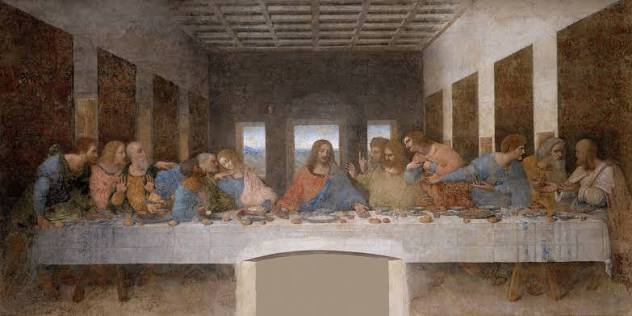
5. Last Supper
Artist: Leonardo da Vinci
Style: Italian Renaissance
3 Important Facts:
Painted around 1495–1498 on a wall in the Convent of Santa Maria delle Grazie in Milan.
Shows Jesus announcing that one of his disciples will betray him.
Uses linear perspective, with the lines of the room directing attention toward Jesus.
6. Mona Lisa
Artist: Leonardo da Vinci
Style: Italian Renaissance
3 Important Facts:
Painted around 1503–1519.
Famous for the subject’s ambiguous smile and Leonardo’s use of sfumato, which creates soft transitions between colors and tones.
Uses atmospheric perspective to make the distant landscape appear hazy and farther away.

7. Sistine Ceiling
Artist: Michelangelo
Style: Italian Renaissance
3 Important Facts:
Painted between 1508 and 1512 in the Vatican’s Sistine Chapel.
Depicts scenes from Genesis, including the famous Creation of Adam.
Uses monumental human figures, anatomical knowledge, and complex poses to communicate biblical stories.

8. Arnolfini Portrait
Artist: Jan van Eyck
Style: Northern Renaissance
3 Important Facts:
Painted in 1434.
Uses detailed oil painting techniques to represent textures such as fabric, wood, and glass.
Contains objects often interpreted symbolically, including a small dog, a convex mirror, and a single lit candle.

9. Judith and Holofernes
Artist: Artemisia Gentileschi
Style: Baroque
3 Important Facts:
Gentileschi painted her famous version around 1612–1613.
Depicts the biblical Judith killing the Assyrian general Holofernes to save her people.
Uses dramatic lighting, strong contrasts between light and darkness, and intense physical action associated with Baroque art.

10. Las Meninas
Artist: Diego Velázquez
Style: Baroque
3 Important Facts:
Painted in 1656 in the Spanish royal court.
Shows the Infanta Margarita, her attendants, Velázquez himself, and other figures.
Uses a mirror, complex spatial relationships, and the viewer’s implied position to explore looking, representation, and royal identity.

11. The Swing
Artist: Jean-Honoré Fragonard
Style: Rococo
3 Important Facts:
Painted around 1767.
Depicts a young woman swinging while a man watches from the bushes.
Uses pastel colors, playful movement, elaborate foliage, and flirtatious subject matter associated with Rococo art.

12. Snow Storm: Steam-Boat off a Harbour’s Mouth
Artist: J. M. W. Turner
Style: Romanticism
3 Important Facts:
Painted in 1842.
Depicts a steam-powered vessel struggling in a storm at sea.
Uses swirling brushwork, atmospheric effects, and dramatic natural forces to convey the power of nature.

13. Olympia
Artist: Édouard Manet
Style: Realism, often associated with the transition to Modernism
3 Important Facts:
Painted in 1863 and exhibited in 1865.
Depicts a nude woman looking directly at the viewer, accompanied by a maid and a black cat.
Challenged conventional academic depictions of the nude by presenting a contemporary woman with a direct, confrontational gaze.
14. Impression, Sunrise
Artist: Claude Monet
Style: Impressionism
3 Important Facts:
Painted in 1872.
Depicts the harbor of Le Havre, France, in the early morning.
Its title helped inspire the name Impressionism, a movement interested in light, atmosphere, and fleeting visual impressions.
15. A Sunday on La Grande Jatte
Artist: Georges Seurat
Style: Post-Impressionism, specifically Pointillism or Neo-Impressionism
3 Important Facts:
Painted between 1884 and 1886.
Shows people relaxing in a park beside the Seine River near Paris.
Uses small dots or marks of color placed next to one another to create optical color mixing.
16. The Starry Night
Artist: Vincent van Gogh
Style: Post-Impressionism
3 Important Facts:
Painted in 1889 while Van Gogh was staying at an asylum in Saint-Rémy, France.
Depicts a swirling night sky above a village.
Uses expressive brushwork, exaggerated movement, and intense colors to communicate an emotional interpretation of nature.

17. Still Life with Chair Caning
Artist: Pablo Picasso
Style: Cubism, specifically Synthetic Cubism
3 Important Facts:
Created in 1912.
Combines oilcloth printed with a chair-caning pattern, painted elements, and a rope frame.
Challenges the traditional distinction between painting and sculpture and is an early example of collage in modern art.
18. L.H.O.O.Q.
Artist: Marcel Duchamp
Style: Dada
3 Important Facts:
Created in 1919.
Alters a reproduction of the Mona Lisa by adding a mustache and goatee.
Challenges traditional ideas about artistic skill, originality, and the authority of famous artworks.
19. The Persistence of Memory
Artist: Salvador Dalí
Style: Surrealism
3 Important Facts:
Painted in 1931.
Features melting clocks in a strange, dreamlike landscape.
Uses recognizable objects in impossible situations to explore dreams, time, and the unconscious.

20. Number 27, 1950
Artist: Jackson Pollock
Style: Abstract Expressionism
3 Important Facts:
Created in 1950.
Uses energetic, layered drips and sweeping lines of paint.
Demonstrates Pollock’s action-painting approach, in which the physical process of applying paint becomes an important part of the artwork.
21. Marilyn Diptych
Artist: Andy Warhol
Style: Pop Art
3 Important Facts:
Created in 1962, following Marilyn Monroe’s death.
Repeats a publicity photograph of Monroe across two panels, one colorful and one mostly black and white.
Uses repetition and commercial printing techniques to explore celebrity, mass media, fame, and mortality.
22. Charles the First
Artist: Jean-Michel Basquiat
Style: Postmodernism, often associated with Neo-Expressionism
3 Important Facts:
Created in 1982.
References jazz musician Charlie Parker, whose nickname was Bird, and the history of jazz.
Uses text, crowns, expressive marks, and symbols to explore Black identity, artistic recognition, and cultural history.
23. Napoleon Leading the Army over the Alps
Artist: Kehinde Wiley
Style: Postmodernism, contemporary figurative painting
3 Important Facts:
Created in 2005.
Reinterprets Jacques-Louis David’s famous equestrian portrait of Napoleon crossing the Alps.
Replaces Napoleon with a contemporary Black man wearing modern clothing, challenging traditional representations of power, race, and historical leadership.
representational painting
art that depicts recognizable people, places, objects, or scenes- Mona Lisa
Abstract painting
Art that takes recognizable subjects and simplifies, distorts, or rearranges their appearance.- still life with chair
Non objective Painting
art that doesnt depict recognizable objects or figures from the visible world. color-field painting by Mark Rothko.
types of subjects commonly depicted in paintings
religious, mythological, historical, portraiture, self portraiture, landscape, seascape, still life, genre scene, allegorical, animal painting, nude.
narrative painting
Masaccio’s Tribute Money.
painting that features symbols
Jan van Eyck’s Arnolfini Portrait.
common painting media
Fresco, Tempera, Oil paint, Watercolor, Acrylic, Encaustic, Gouache, Pastel, Mosaic, Mixed media
linear perspective
Linear perspective is a method artists use to create the illusion of three-dimensional depth on a flat surface. Parallel lines appear to converge toward a vanishing point on the horizon. - Leonardo da Vinci last supper