Substance Use: Life Course Trajectories
 Call Kai
 Learn
Learn Practice Test
 Spaced Repetition
 Match
Match Flashcards
 Knowt Play
1/28

There's no tags or description
Looks like no tags are added yet.
Name | Mastery | Learn | Test | Matching | Spaced | Call with Kai | Chat |
|---|
No analytics yet
Send a link to your students to track their progress
29 Terms
Why is the life-course approach useful for understanding substance use?
Because there are distinct patterns of substance use across the lifespan that cannot be fully described by one transition or turning point.
What is a substance-use trajectory?
The pattern of substance use across a person's life.
Why is substance use useful for studying life-course trajectories?
Because substance use can start, increase, continue, stop, or relapse at different points in life.
What are the main stages that may occur in a substance-use trajectory?
Onset → Acceleration → Regular use → Cessation → Relapse
What does onset mean?
When substance use begins.
What does acceleration mean?
Substance use increases.
What does cessation mean?
Substance use stops.
What does relapse mean?
Substance use starts again after stopping.
What systems can interact with and impact substance-use trajectories?
Drug treatment, mental health, and criminal justice systems.
Why is examining substance-use trajectories useful?
It helps identify general user-group types and assess their frequencies, behaviors, and patterns of use.
Do all people follow the same substance-use trajectory?
No. Some use substances during adolescence and stop in adulthood, while others continue using.
What five cessation trajectories were found among people who inject drugs?
Early cessation, delayed cessation, late cessation, frequent relapse, and persistent injectors.
What does the life-course perspective focus on when studying substance use?
Patterns/trajectories across individuals' lives and how those patterns are shaped by broader historical context and social structures.
What can the life-course framework help identify?
Distinct drug-use trajectories, critical events/factors that contribute to persistence or change, and the ordering of events over the life course.
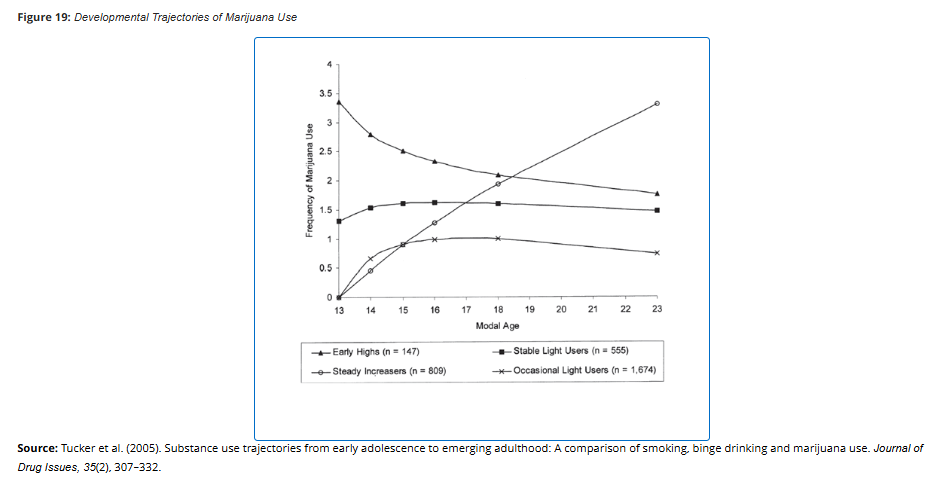
What does the marijuana-use figure demonstrate?
Different patterns of marijuana use can occur from adolescence into emerging adulthood: Early Highs, Stable Light Users, Steady Increasers, and Occasional Light Users.
What are prior risk exposures?
Exposures at earlier life stages that can increase the risk of substance use later in life.
Why does timing matter in substance use?
The life stage or age when an exposure occurs can affect later substance-use risk.
What did the study find about delaying the onset of nonmedical prescription-drug use?
The odds of developing lifetime prescription-drug dependence were about 2% lower with each year that onset was delayed.
In-utero exposure to smoking → ?
Increased risk of lifetime tobacco dependence.
Low family SES and marital-status changes during infancy → ?
Predicts early onset of smoking.
Childhood neglect and abuse → ?
Binge drinking in adolescence.
Maternal drug use in childhood → ?
Early onset of the same drug in children.
Adolescent drinking → ?
Influences alcohol dependence later in life.
Prior childhood/adolescent physical or sexual abuse → ?
Associated with multiple substance use.
Adults with low income → ?
Increased risk of substance-abuse disorders.
Why does the study of substance use require a comprehensive, multidisciplinary approach?
Because people who use substances tend to interact with multiple service systems, including drug treatment, criminal justice, mental health care, HIV prevention, primary health care, and welfare.
What can the life-course perspective contribute to this multidisciplinary approach?
It considers the time and timing of treatment and use of services.
What should public-health interventions consider when using a life-course perspective?
The specific needs of different user groups at different stages of their substance-use trajectories and what interventions could be used at different points to prevent or treat substance-use problems.
So when using the life-course framework, don't just ask:
“Does this person use substances?”
Ask:
“When did it start, what happened before it, how has it changed over time, and what social systems or experiences shaped that path?”