Hlth Assmt - Exam 4
 Call Kai
 Learn
 Practice Test
 Spaced Repetition
 Match
 Flashcards
 Knowt Play
1/221

There's no tags or description
Looks like no tags are added yet.
222 Terms
Cranial nerve assessment of CNI:
Olfactory
Test with familiar scents; the person shoudl identify the odor on each side with eyes closed
Cranial nerve assessment of CNII:
Optic
Tests visual acuity using the Snellen chart (far distance) and Jaeger card (close up)
Cranial nerve assessment of CNIII, CNIV, and CNVI:
Oculomotor (III), trochlear (IV), and abducens (VI) - all tested at ones
PERRRLA = Pupil Equal Round Regular Reactive to light Accommodations (III/IV)
Accommodations = ability to adjust when focus to something close (finger to nose, eyes constrict/follow finger inward)
Assess for extraoccular movement by diagnostic position test/six cardinal positions of gaze (follow finger without moving your head)
What are abnormal findings of the eyes?
Ptosis (eye drooping)
Dilated, non-reactive pupils (increased ICP)
Strabismus (cross-eyed)
Nystagmus (rapid, uncontrolled eye movements)
Loss of visual field
Papilledema (swelling of the optic disks)
Cranial nerve assessment of CNV:
Trigeminal
Motor: palpate temporal and masseter muscle when clenching jaw
Sensory: light touch on forehead, cheek, and chin using a cotton swab
Cranial nerve assessment of CNVII:
Facial
Motor: tests mobility and symmetry of the face (smile, frown, squeeze eyes shut, raise eye brows, show teeth, and puff up cheeks)
Sensory: assesses taste and salvation but we don’t typically test this one
Cranial nerve assessment of CNVIII:
Vestibularcochlear/acoustic
Tests for hearing acuity with normal conversation and a whispered voice test (whisper 3 words behind your patient and ask them to repeat them)
Cranial nerve assessment of CNIX/CNX:
Glossopharyngeal
Motor: depress the tongue then observe for pharyngeal movement while patient is saying “ahhh”; uvula/soft palate should rise midline and there should be an intact gag reflex/ability to swallow (if not, there’s a risk for aspiration)
Sensory: assists with taste but we don’t test it
Cranial nerve assessment of CNXI:
Accessory
Checks for sternomastoid and trapezius size/strength
Rotate head and shrug shoulders against resistance
Cranial nerve assessment of CNXII:
Hypoglossal
Inspect for tongue wasting/tremors
When stick out tongue, it should be midline
Assess lingual speech by having patient say “light, tight, dynamite” (tests nerve/tongue intervention)
How do we assess the motor system?
Size/symmetry
Strength
Tone (use passive ROM on extremities to ensure tone maintained)
Involuntary movements
What tests do we use to assess cerebellar function?
Ones that assess coordination and balance
Rapid alternating movements
Finger-nose-finger
Heel-to-shin
Gait assessment
Tandem walking
Romberg test
Describe rapid alternating movements test:
The patient should be lipping/patting knees with hands quickly and rhythmically
Test thumbs-to-fingers movements
Describe the finger-nose-finger test:
Patient should be able to touch the examiners finger then their own nose
Describe the heel-to-shin test:
Have the patient put their heel on their shin and move in from the knee down to the ankle midline
Describe the gait assessment:
Have your patient take 10-20 steps, stop, turn, and then return
Tests for balance
Describe the tandem walking test:
The patient should walk heel-to-toe
It accentuates coordination issues and tests for balance
What’s the Romberg test?
It’s when you stand with your feet together and close your eyes; you should maintain balance and posture
What side of the brain controls the right side of the body?
Left
Sensory system assessment: PAIN
Sharp vs. dull
Both sides of body; hands and feet
Sensory system assessment: LIGHT TOUCH
Cotton swab is applied randomly on the skin
Sensory system assessment: VIBRATION
A tuning form is used on bony prominences
Sensory system assessment: POSITION
Passive movements of fingers/toes; patient will identify direction
How do you check position/kinesthesia?
Have the patient identify if you are pushing a finger/limb up or down
How do you check stereognosis?
Place familiar/easily recognizable small objects in your patients palm with their eyes closed and have the identify the objects
How do you check graphesthesia?
By drawing letters/numbers not easily mixed up in your patients palm
What are the locations of deep tendon reflexes (DTR)?
Biceps, brachioradialis, triceps, quadriceps, and achilles reflexes
Compare symmetric body parts
What does clonus mean?
An abnormal response that involves involuntary/rhythmic contractions (hyperreflexia)
What is the grading scale for DTR?
0 = no response/absent
2+ = normal/average response
3+ = may indicate disease; brisk, exaggerated reflexes
4+ = hyperactive/clonus reflexes indicating disease
Describe what happens with overactive reflexes (hyperreflexia):
The simple reflex pathway is no longer controlled by the brain as usual
When do you tend to see people with overactive reflexes?
Damage to upper motor neurons (stroke)
Muscle weakness
Stiffness
Abnormal Babinski sign
Describe what happens with under-active reflexes (hyporeflexia):
There’s an issue with the lower motor neurons
When do you tend to see people with under-active reflexes?
Spinal cord injuries
Muscle weakness
Atrophy
Muscle twitching
What are the two major divisions of the nervous system?
Central nervous system (CNS)
Peripheral nervous system (PNS)
What is the CNS composed of?
The brain and spinal cord
What is the function of the CNS?
Process information to coordinate body functions/responses
What is PNS composed of?
Cranial nerves, spinal nerves, etc. (everything but the brain/SC)
What is the function of the PNS?
Controls autonomic functions (things outside of conscious control that govern the organs/vessels)
Send messages to and away from the brain
Sensory/afferent: PNS —> CNS
Motor/efferent: CNS —> PNS —> muscle/glands
What’s the function of the frontal lobe?
Personality
Behavior
Emotions
Intellectual function
What does the frontal lobe contain?
Pre-central gyrus that initiates voluntary movement (motor)
Broca’s area, which mediates motor speech
What does the parietal lobe contain?
The post-central gyrus that serves as the primary center for sensation
What is the function of the temporal lobe?
Auditory reception
Hearing
Taste
Smell
What does the temporal lobe contain?
Wernicke’s area, which is responsible for language comprehension
What’s the function of the occipital lobe?
Processes visual information
What happens when you damage the Wernicke’s area?
Receptive aphasia
You can speak clearly, but you don’t understand
Gibberish/word salad
What happens when you damage the Broca’s area?
Expressive aphasia
You can understand/know what want to say, but you struggle to say it
What’s the function of the basal ganglia?
Initiate/coordinate movement
Controls autonomic associated movements
What’s the function of the thalamus?
Main relay station/integration center
Crucial to emotion/creativity
What’s the function of the hypothalamus?
Major respiratory center controlling temperature, appetite, sex drive, heart rate, BP, sleep, and stress response
What’s the function of the cerebellum
Coordinates motor movements (doesn’t control/initiate, but it smooths it)
Maintains equilibrium/balance
Controls muscle tone
What regions make up the brainstem?
Medulla = regulates vital autonomic functions (RR/HR)
Pons = contains the respiratory control centers and sensory/motor tracts
Midbrain = crucial for motor control and sensory relay
What are subjective questions to ask for neurologic problems?
Frequency, location, associated factors, loss of consciousness duration, memory of event, onset, triggers, warning signs, motor activity, generalized or local, balance problems, etc.
What response/description to a headache requires an emergency referral?
When a patient says “this is the worst headache of my life”
What’s the difference between dizziness and vertigo?
Dizziness = lightheadedness
Vertigo = the room is spinning/your spinning around the room
What are the functions of the musculoskeletal system?
Support and movement
Organ protection
Hematopoiesis (production of RBCs)
Mineral storage
What are subjective questions/data used for musculoskeletal assessment?
Pain, stiffness, swelling, heat/redness, limitations of movement, muscle pain, deformities, accidents/traumas, back pain, or any problems with ADLs
What are some patient-centered care considerations for the musculoskeletal system?
Occupations hazards
Exercise/nutrition (calcium/VitD for bone health)
Medications (review for adverse effects)
Lifestyle factors (address smoking for bone loss and alcohol abuse for fall risk)
Psychosocial impact
How do you examine the musculoskeletal system?
Head-to-toe
Proximal-to-distal
Compare sides for symmetry
Proper draping, support, and relaxation for assessment
Use firm support/gentle movement
What do you examine in the musculoskeletal system?
Muscle size (compare for bilateral symmetry)
Muscle tone (whether it’s present/symmetric)
Muscle strength (use push-pull method to assess against resistance)
Involuntary movements (if present, document their location, frequency, and rate)
What does swelling indicate?
Excess joint fluid (effusion)
Synovial lining thickening
Soft tissue inflammation
Bony enlargement
Define fracture:
Break in a bone
Define dislocation:
Complete loss of bone contact
Define subluxation:
Partial dislocation, but bones remain connected
Define contracture:
Muscle shortening, which limits ROM
Define ankylosis:
Joint stiffness/fixation
Define crepitation:
An audible/palpable crunching with movement when articular surfaces are roughened (example = cracking your knuckles)
What is the difference between active and passive ROM?
Active ROM = the patient performs the movement independently
Passive ROM = the examiner performs the movements for the patient
What are the guidelines for ROM assessment?
Stabilize the body area proximal to the joint being moved
Little resistance is ojay, but don’t go beyond point of pain
What are skeletal muscle movements?
Flexion/extension
Abduction/adduction
Circumduction
Rotation
Supination/pronation
Dorsiflexion/flexion
Inversion/eversion
Opposition
Elevation/depression
Protraction/retractions

What deformity is shown in the picture?
Knock-knees

What deformity is shown in the picture?
Bow legs
What are the normal spinal curvatures?
Cervical spine = concave
Thoracic spine = convex
Lumbar spine = concave
Sacral spine = convex
Define scoliosis:
A spinal abnormality where there is an S-shaped lateral curvature

Define lordosis:
A spinal abnormality where there is an exaggerated normal concave curvature
“Sway back” - leans back/exaggerated good posture

Define kyphosis:
A spinal abnormality where there is an exaggerated normal convex curvature
“Hunchback) - leans forward

What are the paranasal sinuses?
Frontal, maxillary, ethmoid, and sphenoid
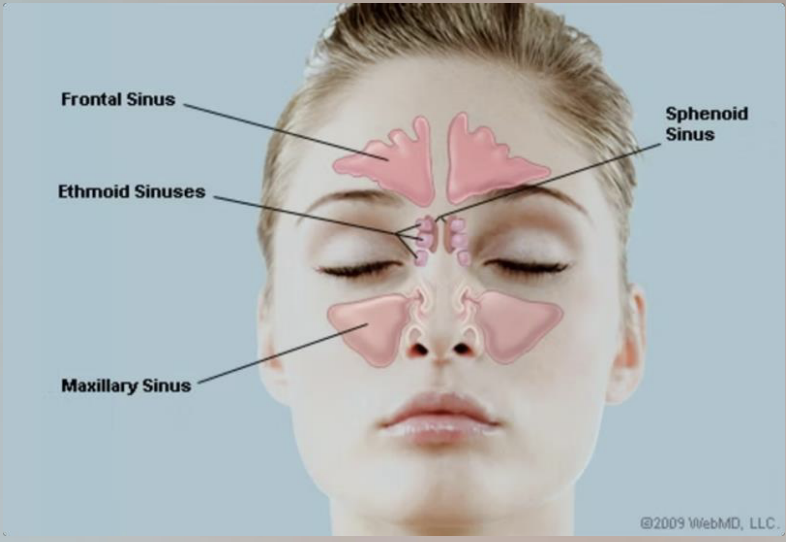
What’s the function of sinuses?
Air filled = lighten the skull weight
Serve as sound resonators
Provide mucus drainage
What happens when the sinuses occlude
Sinusitis (sinus infection) and/or pressure build up
What sinuses are present at birth?
Maxillary (full size after obtain all permanent teeth)
Sphenoid (minute at birth; develop after puberty)
Ethmoid
What’s the function of the nose?
Primary entry for respiration
Warming, moistening, and filtering inhaled air
Houses sense of smell
Where do nosebleeds commonly occur?
Kiesselbach’s plexus
What’s the frenulum?
A structure that anchors the tongue to the floor of the moth
What’s the rough dorsal surface on the tongue?
Papillae
What are the three salivary glands?
Parotid, submandibular, and sublingual glands
Describe the parotid gland:
The largest gland located within the cheeks from the arch to jaw angle
What structure is connected to the parotid gland?
Stensen duct
Located near the second molar
Secretes saliva
Describe the submandibular gland:
Walnut-sized gland located beneath the mandible at jaw angle
What structure is connected to the submandibular gland?
Wharton duct
Found beside the frenulum
Secretes saliva
Describe the sublingual gland:
Smallest
Located under the tongue in the mouth floor
What is the order of the pharyx?
Nasopharynx
Oropharynx
Laryngopharynx
What structure is located in the oropharynx?
Tonsils
What are subjective questions regarding the nose?
Ask questions about nasal discharge, UTIs, sinus pain, chronic postnasal drip, nasal drip, nosebleeds, or altered smell
Define rhinorrhea:
A constant nasal drop that occurs with colds, allergies, sinus infection, or trauma
Define epistaxis:
Nosebleed
What are some subjective questions about the mouth and throat?
Ask about sores/lesions (duration, single/multiple, associations, treatment, etc.)
Sore throat (frequency, onset, associated symptoms, etc.)
Bleeding gums/toothache (duration of bleeding, tooth sensitivity)
Hoarseness/dysphagia (duration, sensation, voice overuse, etc.)
Dental care patterns (daily habits, last exam, dentures, etc.)
What are most sore throat infections?
Viral/short-lasting
What indexes general health?
Teeth
What are symptoms of obstructive sleep apnea?
Loud snoring
Breathing stops
Daytime fatigue
Overweight/obesity
Hypertension
CVD/metabolic disease risk
What does tobacco use cause?
Tooth loss
Cancer risk
How do you prepare a student for an objective nose, mouth, and throat assessment?
Sit them upright with head at your eye level
If patient wear dentures, offer paper towel and ask to remove them