Deeper Drivers of Growth - Institutions
 Call Kai
 Learn
 Practice Test
 Spaced Repetition
 Match
 Flashcards
 Knowt Play
1/23

There's no tags or description
Looks like no tags are added yet.
24 Terms
Limitations of Proximate Determinants of Growth I
What does the neoclassical growth model according to Solow assume and not explain?
The neoclassical growth model according to Solow assumes competitive output and input markets.
This assumption implies that labor and capital get their respective shares of output based on marginal products.
This model does not explain rising inequality between and within countries (predicts convergence)
The model also predicts growth to be a smooth and gradual process of factor accumulation.
It limits the role of the state to enabling/supporting competitive markets for an efficient resource allocation
Limitations of Proximate Determinants of Growth II
What does the neoclassical growth model according to Solow assume and not explain?
Most importantly, the neoclassical model does not explain difference across countries in proximate growth factors
The Solow model also treats technology as non-rival and non-excludable growth factor available to all (a global public good)
Development economists argue that investment and productivity growth should be considered as outcomes of economic development, not necessarily drivers of growth
Similarly, population growth may not be an exogenous growth factor as the neoclassical model suggests
Question: what then are fundamental (deeper) drivers of economic growth?
In other words, why are capital per worker and productivity much lower in poor countries?
Limitations of Proximate Determinants of Growth III
In other words, the basic neoclassical growth theory has limited relevance for developing countries where:
Poverty and unemployment rates are high and in some cases persistent.
Growth tends to be episodic rather than smooth and continuous.
A substantial part of the economy is informal.
The economy has dual structure: modern vs. traditional, formal vs informal, etc.
The role of Economic and Political Institutions I
Economic institutions are considered to be _____ _______ of economic outcomes in a society.
What do economic institutions shape?
Economic institutions are considered to be fundamental determinants of economic outcomes in a society.
They include private property rights, contract enforcement mechanisms, and frameworks that define markets and their competitiveness (both for inputs and outputs).
As such, economic institutions shape the Incentive Structure for economic agents: individuals, households, firms, and government.
Without property rights, for instance, firms and households will have less incentive to invest in physical and human capital, and to engage in innovation.
The role of Economic and Political Institutions II
Economic institutions also effect:
Economic institutions also effect:
Resource allocation across economic agents
The abilities of economic agents to exercise their preferences
Countries with economic institutions that incentivize capital accumulation (physical, human) and innovation, and facilitate their efficient allocation would prosper.
Cross-country difference in per capita income can thus be traced to difference in the quality of economic institutions (see graph)

Key Question: What Explains Variation in Economic Institutions?
Graph shows that countries with good institutions have higher standards of living.
Since institutions are endogenous (chosen by society or parts of it), why some countries are poorer than others is closely related to why some countries have bad economic institutions than others.
Until recently, there has been no satisfactory theoretical models that explain difference in equilibrium economic institutions across countries.
Difference in Quality of Institutions I
Acemoglu, Johnson and Robinson (2005) were among the first to provide a theoretical frameowork to explain differences in institutions:
What is there view on the origin of institutions?
They argue that current economic institutions affect:
Current economic performance
Future distribution of resources
Because institutions determine future distribution of resources, there is inherent conflict of interest over the choice of economic institutions.
Who wins this conflict depends on who has political power.
Acemoglu et al. (2005) argue that prevailing economic institutions and policies reflect the preferences of the group holding political power. They call this the Social Conflict View of the origin of institutions.
Difference in Quality of Institutions II
This leads to another question: why do the political elite in some countries choose economic institutions that may undermine growth and poverty reduction?
Acemoglu et al. (2005) offer two reasons:
Groups holding political power cannot commit not to use it for their own benefit at the expense of others (the commitment problem).
Addressing distributional inequality in a credible manner cannot be achieved without changing economic institutions, which in turn requires political power (inseparability of efficiency & distribution).
Improving economic efficiency (hence growth) through good economic institutions has Distributional Consequences, which could in turn undermine the political power of the elite.
Where does political power come from? I
Two sources of political power (Acemoglu et al., 2005):
Two sources:
Political institutions (t): de jure political power(t) coming from the constitutions and related legal documents.
Distribution of resources (t) de facto political power (t+1)
Although political institutions are slow to change, they too are endogenous. Political power today affects political institutions in the future:
Political power (t) & political institutions (t+1)
Political institutions tend to be persistent because those holding political power today(t) chose political institutions that would keep them entrenched in power.
Where does political power come from? II
Why do, like political institutions, the distribution of resources tend to be persistent?
How can persistence in political institutions and distribution of resources be disrupted?
Like political institutions, the distribution of resources (economic inequality) also tends to be persistent.
This is because wealthier groups exercise their de-facto political power to influence economic institutions in their favor (de-facto political power may also come from military capabilities)
However, persistence in political institutions and distribution of resources can be disrupted through:
Exogenous technological change that increase the economic fortunes of a group (hence their de facto political power)
Domestic political unrest by well coordinated groups with a common interest (overcoming the coordination problem)
International events (both economic and political)
Empirical evidence on the role of institutions
Acemoglu et al. (2005) provide two sets of evidence on the primacy of economic institutions for long run growth:
Given the endogeneity of institutions, it is challenging to provide evidence on a causal relationship between quality of institutions and long-run growth.
Two sets of evidence on the primacy of economic institutions for long-run growth:
The Reversal of Fortune
European Colonization: Natural experiment on institutional change
Empirical Evidence on Role of Institutions:
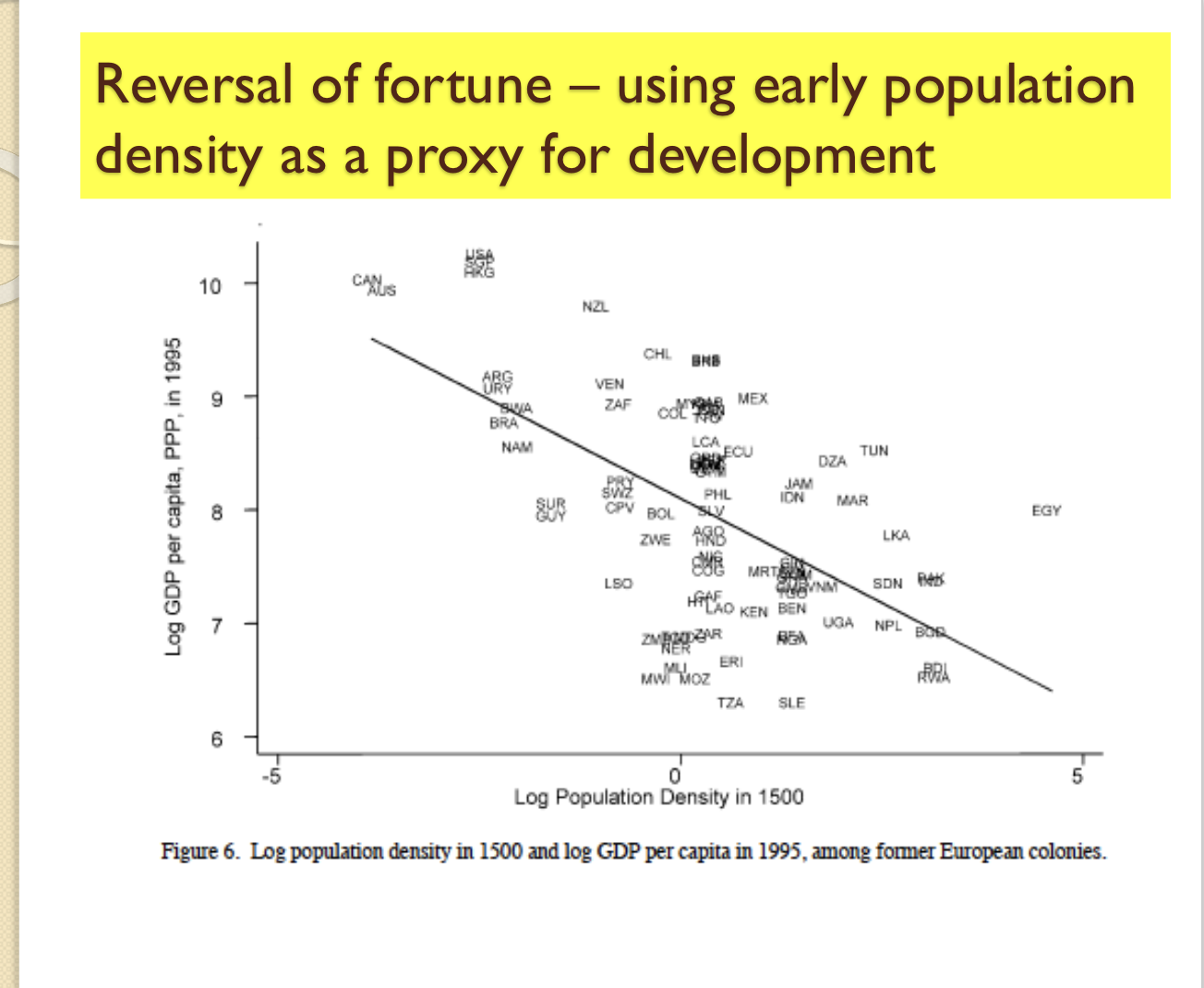
Reversal of Fortune
Using early urbanization as a proxy for development:
See trend of countries highly urbanized before 1500 tend to have bad quality institutions
Colonies that were richer at the onset of colonialization are now lower income.
Reversal has more to do with the quality of institutions and whether they were conducive for the investment and technological opportunities created by the industrial revolution.
Reversal of Fortune among British Colonies:
In 1600, previously low urbanized (and low population density) countries dramatically surpass urbanized (growth correlated with industrial revolution in 1800s).
See that RF is not sensitive to the identity of the colonizer
Among former British colonies, economic outcomes differ greatly (i.e., U.S. vs India)
Excluding colonies with sizeable current white population does not change the RF pattern.
Empirical Evidence on Role of Institutions:
European Colonization as a Historical Natural Experiment
Relies on econometric analysis
See a positive correlation between contemporaneous economic institutions & income per capita across countries.
Regression of per capita income on quality of institutions
The regression results show statistically and economically significant coefficients on the proxy for quality of economic institutions (protections against expropriation)
The size of the coefficient on institutions declines as other growth factors are taken into account.
However, this regression table shows only correlations, not necessarily causal relationships.

Empirical Evidence on Role of Institutions:
European Colonization as a Historical Natural Experiment
Concerns about causal inference based on OLS results of per capita income on quality of institutions:
Rich countries may have strong preference for (or can afford) high quality economic institutions relative to poor countries — this is the Reverse Causality problem
The estimated relationship could be a result of unobserved factors that drive both institutions and per capita income (institutions may not influence growth) — this is Omitted Variable Bias.
Quality of institutions is likely to be Measured With Error leading to a biased coefficient (even if institutions may affect growth, the true effect is hard to determine).
Empirical Evidence on Role of Institutions:
European Colonization as a Historical Natural Experiment
Solution to concerns about causal inference:
Instrumental Variable (IV):
Economists use Instrumental Variable approach to address the econometric problems that undermine a causal interpretation of the coefficient on quality of institutions.
A good instrument would explain cross-country difference in quality of institutions but does not currently affect current economic performance.
Acemoglu et al. used the Mortality of European Settlers more than a century ago as IV for quality of modern institutions
How does settler mortality affect quality of economic institutions?
For the IV approach to work, settler mortality should explain quality of institutions while having no direct effect on current economic performance.
Europeans did not have immunity to tropical diseases (particularly Malaria and Yellow Fever) and experienced higher mortality rates in tropical as compared to temperate colonies.
In tropical colonies, Europeans established extractive institutions that do not respect human and property rights for broader sections of society.
In temperate regions, Europeans established settler colonies with good institutions similar to those in Europe.
The higher the settler mortality rate → the more extractive, bad institutions now.
Theories of the Origins of Economic Institutions
Having seen evidence on the reversal of fortune and regression results on the economic effects of institutions, we still need to have a theoretical framework that addresses:
Why some countries have bad economic institutions?
Why economic institutions, good or bad, tend to persist?
Acemoglu et al. propose the Social Conflict Theory as an explanation.
According to this theory, economic institutions are not always chosen by the entire society — they are decided by groups holding political power.
Theories of the Origins of Economic Institutions
The Efficient Institutions View
The social conflict view differs from the relatively older “Efficient Institutions View (EIV)”
Under EIV, economic institutions emerge from negotiations between rational economic agents who will ultimately choose efficient institutions to resolve conflicts of interest.
Political institutions do not affect quality of economic institutions according to this perspective.
The EIV, however, cannot explain why some countries have growth stifling institutions since all countries are supposed to have efficient institutions that promote growth.
Theories of the Origins of Economic Institutions
The Historical Incidents View (HIV)
The Social Conflict View is also different from the “Historical Incidents View (HIV)” which argues that economic institutions are not chosen. They are unintended consequences of historical accidents or other social interactions.
According to the HIV, some countries happen to be colonized by Britain and inherited the Common Law, while others became French colonies and inherited the Civil Law tradition.
The argument is that the Common Law offers better security of private property rights than Civil Law. Colonies that inherited the common law would achieve better economic performance.
Although HIV explains difference in economic institutions and their growth implications, the fact that the reversal of fortune holds even among British colonies implies that the identity of the colonizer may not be as important as the HIV claims.
The Social Conflict View (SCV)
The SCV asserts that the Efficiency and Distributional consequences of economic institutions are inseparable (different from the EIV)
This inseparability arises from the lack of commitment on how future political power will be exercised (because political power influences economic institutions, which in turn influence de-facto political power).
The commitment problem arises because there is no independent third party (between the political elite and contending groups) that can guarantee compensation for potential losers from institutional reforms that could improve economic efficiency.
Reforming economic institutions may increase the economic fortunes of investors who, in the future, may want to contest political power to better protect their wealth.
In view of this, the incumbent political elite will carefully evaluate the consequences of any institutional change.
They may choose inefficient institutions if a reform program compromises political power and hence economic rents.
Comparative Statics (predictions) based on the SCV of Economic Institutions (4)
Constraints and checks on political power are conducive for the emergence of better economic institutions.
Economic institutions protecting the property rights of a broader cross-section of society are more likely to arise when political power is in the hands of a relatively broad group of people with access to investment opportunities.
Good economic institutions are more likely to arise and persist when there are only limited rents for the political elite to extract.
Institutional reforms that do not threaten the power of incumbent politicians are more likely to succeed.
Interpreting the colonial experience from the SCV perspective
The 2nd comparative static:
The 2nd comparative statics suggests that in former colonies where Europeans were able to settle in large numbers (in temperate regions), they became the majority, controlled political power and opted for institutions that protect property rights for the wider public.
In colonies with high mortality rates among European colonizers (tropical regions), they did not choose good institutions that protect property rights because doing so would undermine their goal of resource extraction from the colonies.
The same colonizer would put in place different institutions across colonies based on settler mortality.
Interpreting the colonial experience from the SCV perspective
The 1st comparative static:
The 1st comparative statics highlights why political institutions without checks and balances were crucial for extracting economic rents from colonies and why they are persistent.
In colonies where the Europeans couldn’t settle but have a large native population, they concentrated political power in the hands of the elite.
In colonies where political power was unchecked and unconstrained, the extractive institutions persisted after independence.
The opposite happened in initially less populated colonies where the Europeans themselves settled in large numbers. Political structure was established with checks and balances.
Interpreting the colonial experience from the SCV perspective
The 3rd and 4th comparative statics:
The 3rd and 4th comparative statics explain why bad economic institutions tend to persist because changing those may undermine the economic benefits of the incumbent political elites.
Countries with natural resource rents that can easily be appropriated by the political elite are thus more likely to have extractive institutions that are hard to reverse.
Ghanian example: the threat of being a political loser led to inefficient economic institutions → threat to socialist power.