Intro to the Skeletal System
 Call Kai
 Learn
Learn Practice Test
 Spaced Repetition
 Match
Match Flashcards
 Knowt Play
1/68

There's no tags or description
Looks like no tags are added yet.
Name | Mastery | Learn | Test | Matching | Spaced | Call with Kai | Chat |
|---|
No analytics yet
Send a link to your students to track their progress
69 Terms
Functions of the skeletal system
1) support the body 2) protection of the soft organs 3) movement due to attached skeletal muscles 4) storage of minerals (Ca & P) and fats 5) hematopoiesis-formation of cells of the blood
Types of Bone Tissue- dense, hard outer layer of bone
compact bone
Types of Bone Tissue- porous; has small needle-like pieces of bone (trabeculae)
spongy bone
Types of Bone Tissue- soft, gelatinous tissue found in hollow spaces in a bone
bone marrow
how can bones be classified
shape
long bones contain what type of tissue?
compact bone, ex. femur
what’s the classification of short bones & what are they made of
cube-shaped, spongy bone, ex. carpals
examples of flat bones
skull, ribs, sternum
how are irregular bones shaped?
irregular shape, ex. vertebrae
gross anatomy of long bone-epiphysis
the knobby ends of the bone
whatś epiphysis composed mostly of and what does it have
spongy bone, red bone marrow
gross anatomy of long bone-spongy bone
porous, filled with red bone marrow
whats the epiphyseal plate
growth plate
gross anatomy of long bone-articular cartilage
thin sheet of hyaline cartilage that covers the epiphysis
what does articular cartilage do in a long bone
reduces friction as bones move
gross anatomy of long bone-diaphysis
is the shaft of the bone
gross anatomy of long bone-diaphysis contained a space called
medullary cavity
medullary cavity
contains red marrow in infants, changes to yellow marrow as adults
what does yellow marrow contain
adipocytes (fat cell storage)
what does red marrow make
red blood cells, white blood cells, and platelets (forms clots in the blood)
periosteum
outside covering of the diaphysis, fibrous connective tissue, vascular & rich w/ nerves
nutrient foramen
a small hole for blood vessels to enter/exit

study (i will quiz you in the upcoming sildes)
study (i will quiz you in the upcoming sildes)


what´s number one?
proximal epiphysis


whatś 2
endosteum


whatś 3
yellow marrow
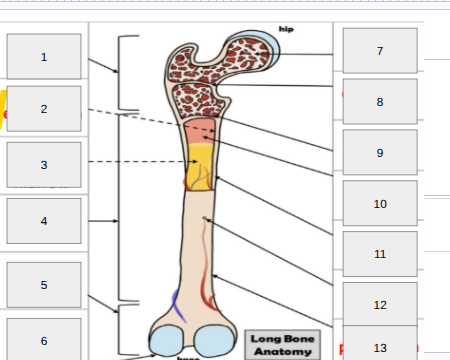

whatś 4
disaphysis


5?
distal epiphysis
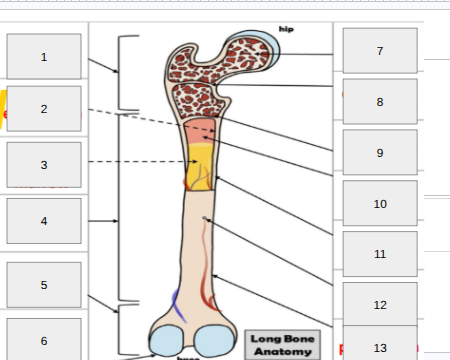

6?
articular cartilage


7?
spongy bone


8?
epiphyseal plate

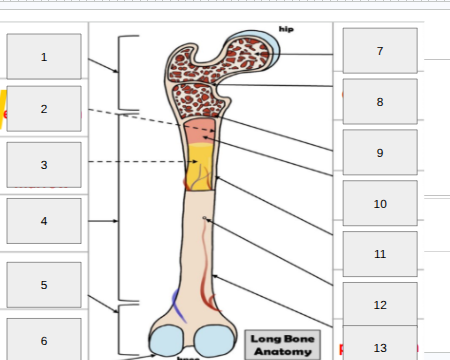
9
red marrow


10
medullary cavity


11?
compact bone
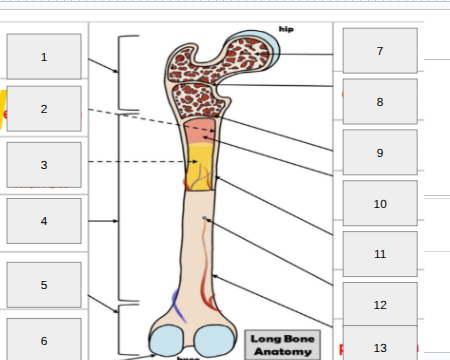
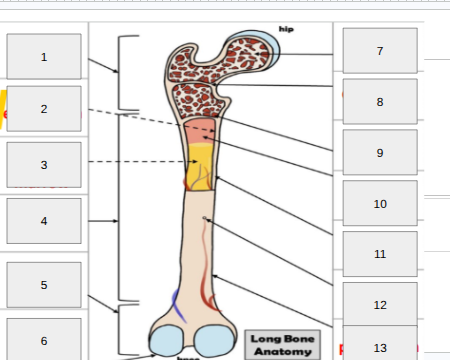
12
nutrient foramen

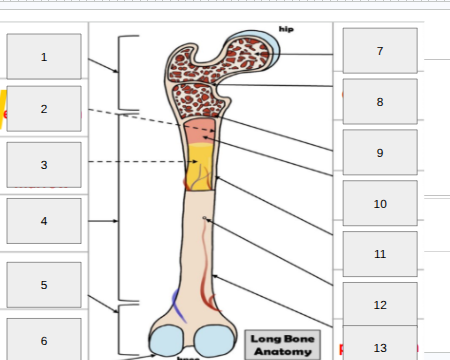
13
periosteum

what are bone markings?
usually sites for tendons & ligaments to attach or a passageway for nerves or vessels.
what can the bone markings look like
bumps, depressions, holes, curves, etc
what are the 2 categories of bone markings
projections (processes) and depressions (cavities)
projections for ligament & muscle attachment-crest
narrow ridge of bone

projections for ligament & muscle attachment-epicondyle
raised area on or above a condyle
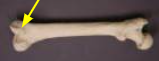
projections for ligament & muscle attachment-tuberosity
large rounded or roughened projection

projections for ligament & muscle attachment-trochanter
very large, blunt projection (only on femur)


projections that help to form joints- condyle
rounded articular projection

projections that help to form joints-head
bony expansion on a narrow neck

projections that help to form joints-facet
smooth nearly flat articular


projections that help to form joints- ramus
armlike bar of bone

Depressions and openings
allow blood vessels or nerves to pass through
Depressions and openings- meatus
a canal or tube

Depressions and openings- sinus
cavity within a bone; filled with air and lined with mucous membranes

Depressions and openings- foramen
round or oval opening

Depressions and openings- fossa
shallow basin

Depressions and openings-fissure
narrow, slit-like opening

Depressions and openings-sulcus, groove
a shallow depression

memory trick
all the terms beginning with T are projections, and the terms beginning with F (expect facet) are depressions
types of bone cells-osteoblasts
cells that form new bone matrix
types of bone cells-osteocytes
adults bone cells that maintain bone structure
types of bone cells-osteoclasts
cells that breakdown bone matrix (releases Ca & P)
compact bone histology-bone matrix
the raw material to build bone, organized fibers of collagen with hardened Ca & P
compact bone histology-osteon
the structural unit within bone matrix (haversian system)
parts of osteon
central (haversian) canal, lamellae, lacunae, canaliculi
central (haversian) canal
contains blood & lymphatic vessels + nerves
lamellae
concentric rings of collagen
lacunae
cavities containing osteocytes
canaliculi
tiny canals radiating out of central canal- a transport system to nourish osteocytes
ossification
a process of bone formation
cartilaginous skeleton
(fetus has them) hyaline
endochondral ossification
long bones and most other bones gradually form throughout development and for years after birth
epiphyseal plates
allow for growth of long bones during childhood, new cartilage is formed at the growth plate, cartilage on the diaphysis side changes to bone which elongates the bone