Lesson 89: Hepatotoxicity
 Call Kai
 Learn
 Practice Test
 Spaced Repetition
 Match
 Flashcards
 Knowt Play
1/28

There's no tags or description
Looks like no tags are added yet.
29 Terms
Phase I reactions
Conducted by cytochrome P450 (mixed-function oxidase system) enzymes in hepatocyte smooth endoplasmic reticulum (SER) → Involve oxidation of xenobiotics
Phase I reactions and zone harm
Important for detoxification but toxic intermediates can sometimes be produced, which can harm hepatocytes in Zone 3
Periportal hepatocytes (Zone 1) are more susceptible to direct-acting toxins such as metal salts
Phase II reactions
Enzymes are found in the cytosol
Involves conjugation of metabolites from phase I reactions
Acute cytotoxic hepatotoxic injury
Damage to hepatocytes manifesting mainly as centrilobular necrosis
Acute cholestatic hepatotoxic injury
Injury to parts essential for bile flow
Clinically: dullness, anorexia, neurologic signs due to hepatic encephalopathy
Hepatotoxic agents
Blue-green algae, Pyrrolizidine alkaloid-containing plants
Aflatoxin, Poisonous mushrooms
Chemicals, Metals, Drugs
Chronic hepatotoxic injury
Characterized by chronic inflammation, nodular regeneration, and fibrosis
Clinically: jaundice, photosensitization, hepatic encephalopathy, etc.
Blue-green algae: Cyanobacteria – obtain energy by photosynthesis
Algal blooms in late Summer lead to accumulation of algal toxins, such as microcystin (ponds, lakes, etc.)
Ingestion can cause lethal poisoning of livestock; less commonly, dogs and cats
Gross appearance of liver in blue-green algae hepatotoxicity
hemorrhagic gastroenteritis and a red, swollen, necrohemorrhagic liver with centrilobular to massive lobular necrosis → acute liver failure
Pyrrolizidine alkaloid
Found in many plant families that occur throughout the world(Senecio, Cynoglossum, Amsinckia, Crotalaria, Echium, Trichodesma, Heliotropium)
Usually avoided by grazing animals, but may be eaten more frequently during drought
Pyrrolizidine alkaloid hepatotoxicity
Pigs are most susceptible; cattle and horses less so; sheep and goats are least susceptible
Most cases arise from chronic, long-term intoxication(months to years)
Leading to clinical signs of chronic liver failure such as anorexia, weight loss, jaundice, recumbency, and death.
Gross finding in pyrrolizidine alkaloid hepatotoxicity
If acute, enhanced lobular pattern (centrilobular necrosis) when large amounts are ingested(unusual)
If chronic, diffuse hepatic fibrosis and variable nodular regeneration
Microscopic finding in pyrrolizidine alkaloid hepatotoxicity
Centrilobular zonal hepatocellular necrosis → enhanced reticular pattern (acute)
Fibrosis, nodular regeneration, and biliary hyperplasia with enlarged hepatocytes - megalocytes (chronic)
The toxic effect leads to prevention of cellular division (antimitotic)
Chronic pyrrolizidine hepatotoxicity
A. Hepatic fibrosis and distortion of the liver, cow
B. Fibrosis between portal tracts, liver, horse
C. Bile duct hyperplasia(arrows) in fibrotic portal tracts.
D. Greatly enlarged hepatocytes(asterisks) with enlarged nuclei-megalocytes.
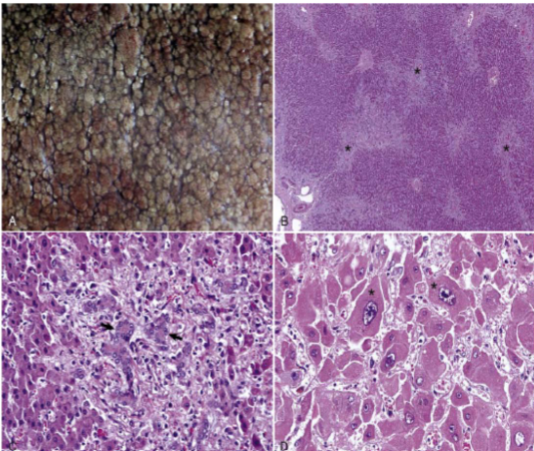
Aflatoxin: Aspergillus flavus is the most important source of aflatoxin
Toxin and carcinogen
Pigs, dogs, horses, cattle, and ducks are all susceptible; sheep are somewhat resistant
Aflatoxin in feed
accumulates during storage of fungus-contaminated feed, particularly in humid conditions
Corn, peanuts, cottonseed, etc. which may be incorporated into feed mixtures in commercial pet foods
Aflatoxicosis
Aflatoxins are converted by hepatic cytochrome P450 enzymes into toxic reactive intermediates
Acute aflatoxicosis in dogs results in?
centrilobular to massive hepatocellular necrosis with steatosis and biliary hyperplasia
Chronic exposure may lead to hepatocellular carcinoma
Amanita sp. and other mushrooms can cause?
acute fatal liver necrosis
Amanita phalloides (aka “Death Cap”)
Produces a very potent cyclopeptide toxin → Fatal in very small doses
Death from liver failure may occur 3-4 days after onset of clinical signs
Characterized by severe centrilobular to massive hepatocellular necrosis
Xylitol: Artificial sweetener used in many foods
Acutely toxic to dogs
Severe centrilobular to massive necrosis
White phosphorus: historically used as a rodenticide
Causes periportal necrosis
Implies cytochrome P450 toxic metabolite formation is not required
Direct-acting chemical
Copper toxicity can occur in ruminants and dogs due to dietary excess, molybdenum deficiency, or genetic disorders of copper metabolism and may present as:
Acute intravascular hemolytic anemia in ruminants
Chronic hepatic injury and end-stage liver disease in dogs and cats
Iron toxicity (aka iron overload or hemochromatosis)
May occur with over-supplementation in piglets, dogs, cats, or foals
Inherited condition reported in people, Salers cattle, and horses
Some known hepatotoxic drugs:
NSAIDS (acetaminophen, carprofen), Phenobarbitol, Long-term, high-dose corticosteroids
Lomustine, Danazol, Androgenic anabolics, Thiacetarsamide, Primidone, Phenytoin, Trimethoprim-sulfadiazine, Halothane
Tetracyclines, Diazepam, Gresiofulvin, Ketoconazole, Mebendazole
Cats are more susceptible to drug hepatotoxicity because they are relatively deficient in hepatic glucuronyl transferase (GT enzyme) activity:
GT enzyme plays a protective role in the liver by forming conjugates between toxic drug metabolites and glutathione (an important antioxidant), thereby reducing oxidative injury.
For example, cats are more susceptible to acetaminophen toxicity because of relative GT enzyme deficiency
Idiosyncratic toxicity
All therapeutic drugs have the potential to be idiosyncratic toxin → only affect a small minority of patients by unknown mechanisms
Suspected causes of idiosyncratic hepatotoxicity
Inherited or spontaneous genetic enzyme deficiencies
Atypical immune reactions to drug metabolites
Examples of idiosyncratic hepatotoxicity
Carprofen is occasionally hepatotoxic in certain dog breeds, such as Labrador retrievers
Diazepam (Valium) can cause acute hepatic injury in a small percentage of cats
Chronic anticonvulsant therapy (Primidone, Phenytoin, Phenobarbital) causes hepatic failure in a small proportion of dogs