Memory & Cognition Exam 4
 Call Kai
 Learn
 Practice Test
 Spaced Repetition
 Match
 Flashcards
 Knowt Play
1/47

There's no tags or description
Looks like no tags are added yet.
48 Terms
What are the parts of the 3-stage model?
Input/encoding
Storage
Output/recall
What are the two types of memory?
Declarative/Explicit
Non-declarative/Implicit
What are the 2 types of Explicit memory?
Episodic —> Personal events
Semantic —> Factual information/knowledge
What are the 3 patterns for memory impairment?
Alzheimer’s —> v input, v storage, v recall
Subcortical process —> ^ input, ^ storage, v recall
Depression/anxiety —> v input, ^ storage, variable recall
What are the 3 mimics of dementia in older adults?
Delirium
Depression (“pseudo-dementia”)
Medication effect
What is the pathway for visuospatial function?
Eye —> Optic nerve —> Optic chiasm —> LGN (thalamus) —> Optic radiations —> V1
What are the 3 problems that could happen with visuospatial function?
Vision loss —> disruption along visual pathway
Visuoperceptual deficits —> things look too small, big, far, close, etc.
Cortical blindness —> present as blind, but eyes work (damage to V1); could still interpret movement
How does Balint’s Syndrome occur, and what are the symptoms? (3)
Damage to parieto-occipital junction bilaterally
Optic ataxia: inability to coordinate reaching for objects
Ocular apraxia: cannot shift vision/gaze despite motor function and cranial nerves intact
Simultagnosia: Lack of ability to integrate parts of an image
What is visual agnosia?
Perceive something, but meaning is detached
What is constructional apraxia, and how does it occur?
Lose ability to draw, copy, build despite intact motor function
Right parietal lobe lesion
What is the prevalence, onset, course, pathology, and symptoms of Alzheimer’s?
60%
65 years old
Insidious (slow, gradual, progressive)
Hippocampal damage, Acetylcholine decrease, plaques and tangles (malformed proteins)
Poor short term memory, behavioral changes (wandering, hostility/happiness)
What is the prevalence, onset, course, pathology, and symptoms of Vascular dementia?
~20%
65 years old
Stepwise
Stroke, small vessel disease, or both
Memory tends to be spared early on; decline in processing speed, attention, executive functioning
What is the prevalence, onset, course, pathology, and symptoms of Frontotemporal dementia?
~5%
~50s
Unusual; progressive but highly unstable
Degeneration of frontal lobe, temporal lobe, or both
Symptoms depend on area of degeneration (there are variants)
What is the prevalence, onset, course, pathology, and symptoms of Lewy Body dementia?
~10%
60s
Progressive but visual hallucinations/cognitive decline often present first; motor decline follows (Parkinsonism)
Presence of Lewy Bodies (malformed proteins, different from plaques and tangles)
Fluctuation in cognition, hallucinations, Parkinsonism
Lateralization of Visuospatial Functioning (Left vs Right)
Left —> involved in details/organization
Right —> involved in Gestalt (whole) of images
What is executive functioning involved in? (3)
Social functioning
Purposeful behavior
Survival processes/adaptation
What types of damage can impact executive function, and how can they occur?
Direct damage to frontal lobe
- TBI, stroke, tumor, substance use, frontotemporal dementia, Alzheimer’sDamage to frontal-subcortical loops
- Small vessel disease, stroke, tumor
What are the 3 regions of prefrontal cortex?
Dorsolateral PFC
Medial PFC
Orbitofrontal PFC
What are the 4 types of hallucinations, and how do they originate?
Visual —> Neurologic
Auditory —> Neurologic (buzzing), Psychiatric (words)
Olfactory — Neurologic
Sensory/Tactile —> Neurologic, Psychiatric, Substance use/medication
Lateralization of Frontal Lobe Damage (Left vs Right vs Diffuse)
Left —> Depression
Right —> Mania
Diffuse —> Paramnesias
What are the 4 types of bedside assessment?
Motor Function
Drawing
Impulse Control
Abstract Reasoning
What are 3 types of motor function assessments?
Thumb/index finger
Motor sequencing
Rapid alternating movements
What are 2 types of drawing assessments?
Clock
Ramparts (Square —> Triangle —> Square —> Triangle)
What are 2 types of impulse control assessments?
“Don’t shake my hand”
Go/No-go task
What is one abstract reasoning assessment?
Similarities task (apple and banana, table and chair)
What can damage to the dorsolateral PFC cause? (Dysexecutive Syndrome) (6)
Impaired problem solving
Impaired decision making
Impaired judgement/insight
Perseveration
Stimulus-bound behavior
Amotivation
Which region of the PFC is most likely to be damaged?
Dorsolateral PFC
What can damage to the medial PFC cause? (Akinetic Syndrome) (3)
Loss of movement despite body function (akinesia)
Urinary incontinence
Impaired memory with confabulation
What can damage to the orbitofrontal PFC cause? (Disinhibited Syndrome) (5)
Disinhibition
Impulsivity
Lability (extreme mood state fluctuations)
Personality changes (Like Phineas Gage)
Impaired smell
Also called Pseudopsychopathic Syndrome
What is reduplicative paramnesia, and how can it occur?
Delusion that person or place has been duplicated
Diffuse damage to frontal lobe, leading to a disconnect between attention, memory, and visuospatial function
What are 3 different variants of reduplicative paramnesia, and what are their characteristics?
Subjective Doubles Syndrome: Patient themself has been duplicated but acts independently from them; may have a similar or different personality/behavior
Fregoli Syndrome: Someone the patient knows is shapeshifting into another person/animal
Capgras Syndrome: Person or place the patient knows has been duplicated (“Imposter Syndrome”)
What is diffuse damage, and what can diffuse damage to frontal lobe cause?
“Broad”
Deficits in self-awareness and behavior/personality changes
Reduplicative amnesia
Where does the frontal-subcortical loop pass through?
Frontal —> Subcortical areas —> Parietal —> Frontal
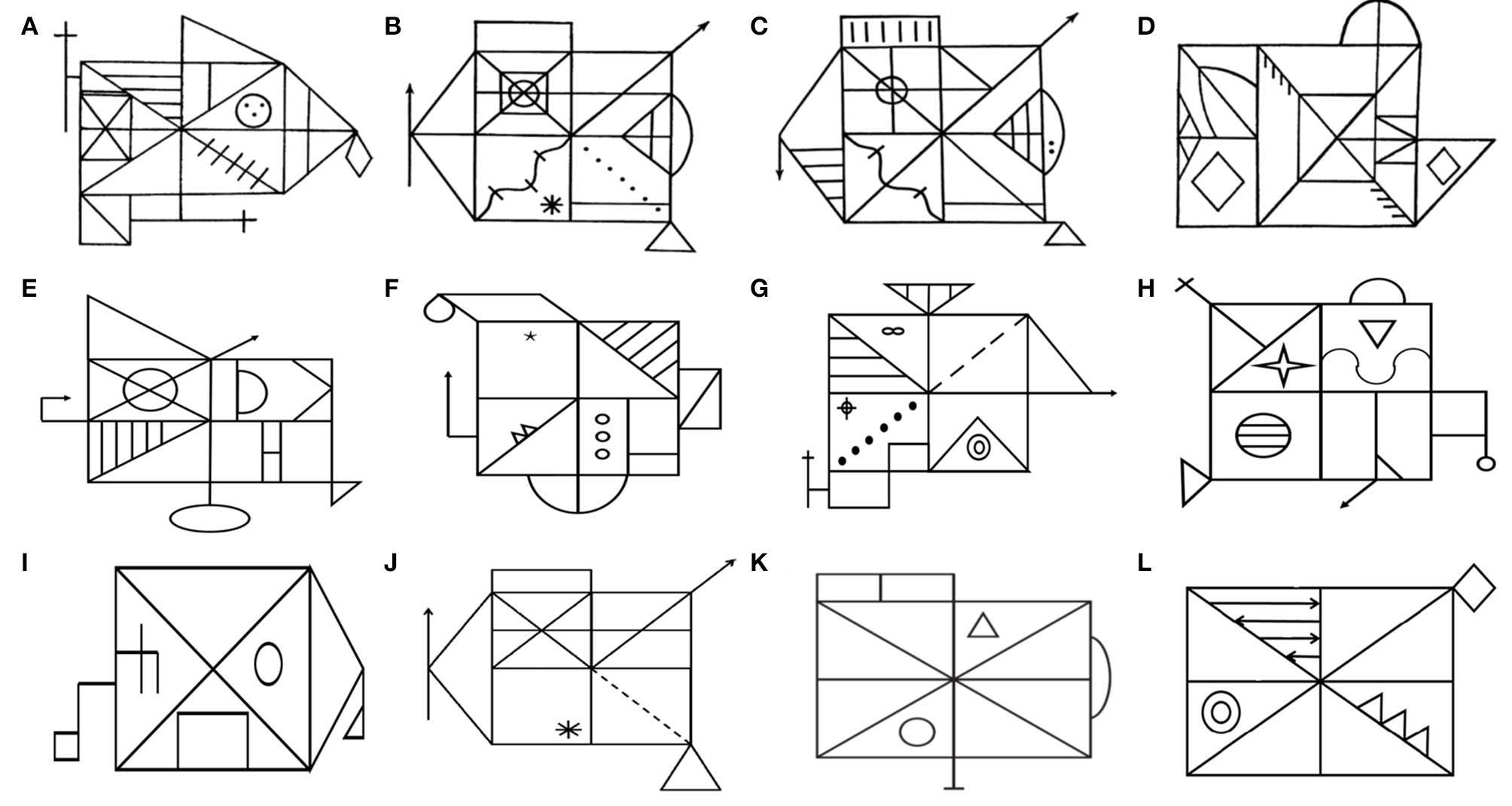
What does the Rey-O test entail?
There is a complex group of shapes; you must replicate it by hand
What does explicit memory entail, and where is it located in brain?
Talking about something / declaring something
Hippocampus, Frontal lobe
What does implicit memory entail, and where is it located in brain? (3)
Cannot explicitly talk about it; memory of unconsciously learned things
Skills/procedures (riding a bike, using a fork, driving a car)
Classically conditioned info (phobias, food aversions)
Basal ganglia, Cerebellum
What regions of the brain are involved in storage? (2)
Hippocampus
Frontal Lobe (to some extent)
What regions of the brain are involved in retrieval?
No singular region; interconnected like a web
Priming can be useful
What are the diagnostic differences between Mild Cognitive Impairment and Dementia?
MCI:
Evidence for some cognitive decline on objective testing
Independent in activities of daily living (ADLs/IADLs)
Dementia:
Substantial cognitive decline on testing
Dependent in ADLs and especially IADLs
If someone has a Mild Cognitive Disorder, what is their chance of developing Dementia?
10%
What is the role and travel path of the Dorsal Stream?
The “where” (sees cat —> “cat jumped onto the table”)
V1 —> parietal lobe
What is the role and travel path of the Ventral Stream?
The “what” (sees cat —> “it’s a cat”)
V1 —> temporal lobe
What are the 8 aspects of Executive Function?
Working memory
Response inhibition
Cognitive function
Planning/organization
Problem solving
Self-monitoring
Emotional regulation
Task initiation
How can Frontal Lobe damage affect mood/emotional functioning? (3)
Direct damage can result in symptoms
Adjustment to damage/diagnosis
Both
What test is used for working memory?
Digits backwards test
What test is used for response inhibition?
Stroop task (words and colors)
What test is used for cognitive function?
Trails B (1A, 2B, 3C, etc.)
What test is used for planning/organization and problem solving?
Wisconsin card sorting test