PCB 4843 Exam 3 Bales FSU
 Call Kai
 Learn
 Practice Test
 Spaced Repetition
 Match
 Flashcards
 Knowt Play
1/61

There's no tags or description
Looks like no tags are added yet.
62 Terms
Function of the olfactory receptor neuron (ORN) (olfactory epithelium cell type)
Detect odor, cilia extend into mucus
Function of Bowman’s glands (olfactory epithelium cell type)
Make mucus that traps odorants and protects against viruses
Function of supporting cells (olfactory epithelium cell type)
Contain enzymes that break down harmful chemicals
Function of basal cells (olfactory epithelium cell type)
Stem cells that regenerate ORNs
Olfactory Transduction
Odorant binds GPCR
Golf activated
Adenylyl cyclase activated
cAMP produced
cAMP opens cyclic nucleotide-gated cation channels (Na+ and Ca2+ depolarize cell)
Ca2+ opens Ca2+ activated Cl- channels (amplification)
True or False: Each ORN expresses only one receptor type
True
Where do odors generate a receptor potential?
In the cilia → action potential triggered
Puffing odor onto cell body does NOT produce strong response
What is the population code?
One odorant activates many receptors at different affinities
Odor identity = combination of activated receptors
Explain labeled line coding
Many, very specific sensors (requires immensely large number of highly specific receptors)

Population coding
Roughly labeled lines, large numbers of broadly tuned neurons

Which taste cells release serotonin and which release ATP?
Serotonin = Sour
ATP = sweet/bitter/umami/SALT
Salt transduction mechanism
Na+ enters through ENaC channel
Na+ depolarizes membrane and activates voltage-gated sodium channels
Na+ enters and generates action potential
Action potential opens ATP-permeable channels and releases ATP
Two sour transduction mechanisms
Protons can block/close K+ channel (net depolarization by decreasing K+ permeability)
wwDirect passage through a proton channel which has a net depolarizing effect on the cell
Bitter/sweet/umami transduction
Tastant binds to GPCR
Activated Phosphlipase C
Increases IP3 synthesis
Triggers Ca2+ release
Na+ enters
Voltage-gated Na+ channels open → action potential
CALHM1/3 channel opens → ATP diffuses
NKCC
Active transporter that moves sodium, potassium, and chloride in the same direction (Na, K, Cl Co-transporter)
How is odor information encoded in the olfactory bulb across a population of glomeruli?
Each glomerulus reflects the input from one olfactory receptor type
Odorants evoke activity in distinct spatial patterns of glomeruli
Which GPCR combination functions as sweet tastants receptor for mammals?
T1R2 + T1R3
Which cranial nerve provides primary taste innervation to the anterior two-thirds of the tongue?
Facial nerve (CN VII)
Which tastants bind to T1R1 and T1R3?
L-amino acids (like glutamate)
Where does olfactory sensory transduction physically take place within olfactory receptors neurons?
Across cilia surface
What expression pattern governs the distribution of odorant receptor proteins across mature olfactory receptor neurons?
One receptor type per neuron
Each individual mature ORN = 1 functional odorant receptor gene from one allele (One neuron, one receptor)
Where do the unmyelinated axons of olfactory receptor neurons expressing the same receptor gene converge?
Axons of all ORNs expressing the same specific odorant receptor converge onto two symmetric glomeruli in each olfactory bulb
Which cell types are the main output neurons of olfactory bulbs in mammals?
Mitral and tufted cells
True or False: Primary olfactory information bypasses an obligatory thalamic relay to reach the cerebral cortex
True. Olfactory bulbs projection neurons project directly to primary olfactory cortex without synapsing in the thalamus
How does odor representation in the primary olfactory cortex differ from that in the olfactory bulb?
It discards spatial order for dispersed overlap
Piriform cortex lacks chemo topic map; individual cortical pyramidal neurons receive diffuse, overlapping inputs from multiple glomeruli
What functional role does temporal coding play during odor identification in olfactory bulb circuits?
Locking action potentials to respiratory cycles
Mitral cell spike timing is locked to specific phases of the respiratory cycle
Hairy vs. glabrous skin
Hairy = lower receptor density, larger receptive field
Mechanoreceptor cell types
Meissner’s corpuscle, Merkel’s disk, Ruffini’s ending, Pacinian corpuscle
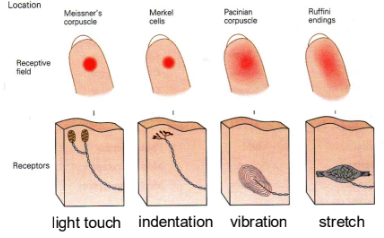
How is mechanical force converted into a neural signal in sensory afferents?
Membrane stretch or tether deformation opens cation channels, causing depolarizing sodium and calcium influx
Where do primary afferent axons carry information from and to?
From somatic receptors through dorsal root ganglia
What are the types of axons from the skin and which sensory receptors do they deal with?
A alpha mediates proprioception
A beta mediates touch perception
C mediate temperature, pain, itch

What are dermatomes?
Skin segments innervated by the dorsal root of a single spinal segment
- 1 dermatome:1 spinal segment
Contrast slowly adapting and rapidly adapting afferent responses in touch
Slowly adapting afferents keep firing during sustained pressure
Rapidly adapting afferents go silent during constant pressure and fire at onset/offset
Higher order somatic areas (1,2, 3a, 5/7)
1 = texture, 2 = shape, 3a = body position, 5/7 = object perception
Astereognosia
Can’t recognize object by touch, though vision works
Hemispatial neglect
Fails to perceive stimuli on one side of the body or of objects generally
Which mechanoreceptor is rapidly adapting and possesses a small, well-defined receptive field in glabrous skin?
Meissner corpuscle
Which mechanoreceptor is most sensitive to high-frequency mechanical vibrations between 200 and 300 Hz
Pacinian corpuscle
What happens to the physiological adaptation rate of a Pacinian corpuscle if its multilayered capsule is stripped away?
It adapts slowly to sustained mechanical displacement
(Normally absorbs steady forces to enforce rapid adaptation, stripping it leave the bare neurite behaving like a slowly adapting receptor)
Which peripheral axon group transmits discriminative touch and vibratory sensations from the skin?
A-beta fibers
Which mechanoreceptor is slowly adapting, located deep in the dermis, and responds selectively to lateral skin stretch?
Ruffini endings
Which cranial nerve carries tactile mechanosensory signals from the face, teeth, and anterior two-thirds of the tongue into the brainstem?
Trigeminal nerve (CN V)
After death, muscles become stiff (rigor mortis) as ATP runs out. Based on the sliding-filament model, why?
Myosin heads cannot detach from actin without ATP binding
As an odorant's concentration rises, how can the neural code change?
Additional lower-affinity receptors join the activated population, changing the code
Where are nociceptors expressed?
In branching, unmyelinated free nerve endings
Hyperalgesia
Reduced threshold for pain following tissue damage
What substances do damaged tissues release that trigger inflammation and modulate nociceptor responsiveness?
Bradykinin: directly depolarizes nociceptors
Prostoglandins: increase sensitivity of nociceptors to painful stimuli
Substance P + GPCR: causes swelling of capillaries, triggers histamine release from mast cells → depolarizes nociceptors
Which gene mediates heat nociception?
TRPV1
What activated TRPV1?
Temp >43°C
Capsaicin
Protons (Anaerobic metabolism results in buildup of lactic acid which builds up H+ in extracellular fluid)
What are the other candidate receptors that detect nociceptive stimuli?
TRPA1 and ASIC3
What are the nociceptive cell-specific voltage-gated Na+ and K+ channels
Nav1.7 and Nav1.8
Which two axons carry nociceptor signals?
A-delta and C fibers
Does nociception enter the brain more slowly or quickly than touch?
More slowly
Referred pain
Referred pain is pain you feel in a part of your body that is different from its actual source or site of injury
Which nociceptive pathway is analogous to dorsal-column medial-lemniscus pathway for somatic touch?
Spinothalamic pathway
How do the touch and pain pathways differ in the senses they carry?
Touch: Fine touch, vibration, position sense
Pain: pain, Temp, crude touchH
How do the touch and pain pathways differ in their fiber types?
Touch: A-beta fibers
Pain: A-delta (fast pain) and C (slow pain) fibers
How do the touch and pain receptors differ in the places they deccusate?
Touch: medulla (lower brainstorm)
Pain: Spinal cord
How do touch and pain receptors differ in spinal ascent?
Touch: Ipsilaterally first
Pain: Contralaterally immediately
gate theory of pain
Mechanical stimulation could activate interneurons that inhibit the spinothalamic tract
Concurrent activation of somatic and nociceptive neuron leads to reduced nociceptor response
Which endogenous chemicals bind to opioid receptors in the PAG?
Endorphins, enkephalins, and dynorphins