RBL Exam Prep
 Call Kai
 Learn
Learn Practice Test
 Spaced Repetition
 Match
Match Flashcards
 Knowt Play
1/211

There's no tags or description
Looks like no tags are added yet.
Name | Mastery | Learn | Test | Matching | Spaced | Call with Kai | Chat |
|---|
No analytics yet
Send a link to your students to track their progress
212 Terms
Ethics (dimension of professionalism)
Conduct based on moral philosophy and behavioural ethics — doing the "right" thing and pursuing moral excellence.
Responsibility (dimension of professionalism)
Conduct that fulfils a company's responsibilities to its stakeholders and optimises stakeholder value.
Sustainability (dimension of professionalism)
Conduct that balances social, environmental and economic value, restoring value over time through the triple bottom line.
Descriptive question
Asks "What is happening?" — states the facts, no judgement involved.
Causal question
Asks "Why is it happening?" — looks for the cause behind the facts.
Normative question regarding ethical behavior
Asks "What ought we do?" — about values and what is the right thing to do.
Strategic question
Asks "What can/should this actor actually do?" — about realistic, feasible action.
Living wage
The pay for a standard workweek that lets a worker afford a decent standard of living for themselves and their family (GLWC, 2022).
Living wage gap (2025)
The average gap between legal minimum wages and living-wage benchmarks across major garment-producing countries was about 41% in 2025, down from 49.5% in 2024.
Does raising wages destroy jobs? (evidence)
A German minimum-wage study found wages rose without lowering employment; after the Rana Plaza collapse, Bangladeshi garment wages rose 10% and working conditions improved by 0.8 standard deviations.
Global warming (2025 data)
Observed global warming reached +1.39°C above 1850-1900 levels in 2025; about +1.37°C of that is estimated to be human-caused.
Paris Agreement target
Hold the rise in global average temperature to well below 2°C above pre-industrial levels, while pursuing efforts to limit it to 1.5°C.
NDCs (Nationally Determined Contributions)
Each country's own climate action plan under the Paris Agreement, stating its commitments to reduce emissions.
Climate skepticism — 3 common arguments
1) Uncertainty: models are imprecise, but that doesn't mean the effect is zero 2) "Climate changes naturally": true, but humans have added substantially on top 3) CO2 benefits (more plant growth), but the net effect on agriculture is still negative.
Corporate net-zero commitments (stat)
63% of Forbes Global 2000 companies have a net-zero target; 69% of those have a published implementation plan; only 7% meet minimum integrity criteria.
SDGs (Sustainable Development Goals)
17 goals set by the United Nations to end poverty, protect the planet, and ensure prosperity for everyone by 2030.
SDG goals/targets vs indicators
Goals and targets describe WHAT should be achieved; indicators measure HOW FAR we currently are from achieving it.
SDG 12 — Responsible Consumption & Production
Ensuring sustainable consumption and production patterns — one of the root causes of the "triple planetary crisis" (climate change, biodiversity loss, pollution).
Sustainable development
Development that meets the needs of the present without compromising future generations' ability to meet their own needs (Brundtland Report, 1987).
Triple bottom line (TBL)
Measuring business performance across three "Ps" together: Profit, People, and Planet — not financial results alone.
Social capital
Value embodied in people: knowledge, skills, health, values, plus the shared culture and trust built inside groups.
Environmental capital
The stock of renewable and non-renewable natural resources and the services nature provides.
Economic capital
Tangible and intangible business assets that can be expressed in money terms (machines, brand value, cash flow).
Elkington's rule for using the TBL
A valid TBL claim requires progress on at least two of the three pillars (profit/people/planet), while the third stays unaffected — not sacrificed.
Strong sustainability viewpoint
View that different types of capital (natural, social, economic) cannot fully replace each other — some natural resources must be protected no matter what.
Weak sustainability
View that different types of capital can substitute for each other — using up nature is fine if it's compensated with enough man-made capital.
Sustainability characteristics (Hahn, 2022)
Sustainability is:
1) multifaceted (many different aspects)
2) systemic (parts affect the whole)
3) complex and non-linear (small causes can have big, unpredictable effects).
Sustainability definitions — 3 dimensions (Lankoski)
1) Scope: broad (environment+social+economic) vs narrow (environment only) 2) Substitutability: strong vs weak 3) Goal orientation: absolute vs relative performance.
The Grand Acceleration
A dramatic post-1950s surge in human activity and resource use across almost every economic and environmental indicator at once.
Quadruple squeeze
Four converging pressures on sustainable development: Human growth, Ecosystems (biodiversity loss), Climate, and Surprise (unpredictable shocks). (Rockström & Karlberg, 2010)
Planetary boundaries framework
9 Earth-system processes (e.g. climate change, biosphere integrity, freshwater use, ocean acidification) whose combined limits define a "safe operating space" for humanity.
Planetary boundaries — 2025 finding
A 2025 study found 60% of the world's land area now lies outside the safe operating zone for biosphere integrity, with 38% in the high-risk category.
Modern slavery (stat)
In 2016, an estimated 35.8 million people worldwide were in modern slavery; the average global price of a slave was around $90.
Quintuple P framework
An expanded version of the triple bottom line: People, Planet, Prosperity, Peace, and Partnering.
Circular economy
An economic system designed to eliminate waste by keeping resources in use as long as possible, instead of the old "take-make-dispose" model.
Narrowing loops
Circular design strategy: using fewer resources per product (higher resource efficiency).
Slowing loops as a Strategy
Circular design strategy: extending or intensifying how long a product stays in use before disposal.
Closing loops
Circular design strategy: recycling materials so they flow from post-use back into new production.
Jevons Paradox (rebound effect)
When a more resource-efficient technology leads to so much extra consumption that it cancels out the expected environmental savings.
System-level innovation needs
For a circular economy to beat business-as-usual, it needs supportive policy:
1) legislation & regulation
2) market incentives
3) financing
4) knowledge & innovation
5) international cooperation.
Life-cycle assessment (LCA)
A method for measuring a product's environmental, social, and economic impact across its whole life, from raw material to disposal.
LCA — the 4 stages
1) Goal & scope: define why and what's included 2) Inventory: collect and calculate inputs/outputs 3) Impact assessment: judge real-world significance 4) Interpretation: turn results into action.
Ecological footprint & biocapacity
Ecological footprint = the biologically productive land/sea needed to meet
demand.
Biocapacity = the amount actually available to regenerate what's used. Goal: footprint ≤ biocapacity.
Earth Overshoot Day
The date each year when humanity has used up all the resources Earth can regenerate that year — currently using nature about 73% faster than it regenerates (1.73 Earths).
Organisational/sustainability paradox
A persistent contradiction between two things that are both necessary and connected, but seem to conflict (e.g. profit vs people/planet).
Either/or vs both/and thinking
Either/or forces a choice between profit OR sustainability. Both/and looks for ways to achieve profit AND sustainability together.
Managing paradoxes — 3 strategies
1) Acceptance: hold both sides in tension and live with it 2) Synthesis: find a new approach that satisfies both sides at once 3) Separation: address each side at a different time or place.
Coca-Cola case — problematic responses
Ambivalence (launch healthier options while still defending the old ones), Avoidance/denial (blame consumer choice), Reframing (redefine the issue, e.g. "it's about an active lifestyle," not sugar).
Responsibility (recap)
Conduct fulfilling stakeholder responsibilities and serving stakeholder value optimisation.
Three approaches to responsible management
1) Instrumental: responsibility as a tool for profit (e.g., cutting plastic use to save production costs)
2) Political: responsibility as engagement with society (e.g., working with governments to set industry standards)
3) Ethical: (e.g., making business decisions because it’s the “right thing to do”)
Carroll's CSR Pyramid
Four levels, bottom to top:
1) Economic (be profitable)
2) Legal (obey the law)
3) Ethical (do what's right, even beyond the law)
4) Discretionary/Philanthropic (voluntary good citizenship).

Agency problem
A conflict arising when managers (who control the company) don't act in the best interest of shareholders (who own it) — a separation of ownership and control.
Fiduciary duty
A manager's obligation to act in the best interests of shareholders and not waste their invested capital on value-reducing actions.
Shareholder theory (Friedman)
The business's only social responsibility is profit, earned through open and fair competition.
Executive philanthropy spends shareholders' money without their consent, so helping other stakeholders is only justified if it increases profit.
Stakeholder theory (Freeman)
Stakeholders are any group or individual who can affect or is affected by the business; all stakeholders are intrinsically valuable, and managing them well means finding win-win solutions.
Shareholder model vs stakeholder model of the firm
Shareholder model: inputs flow in from various groups, but value flows out only to shareholders.
Stakeholder model: the firm sits at the centre of a network, exchanging value with every stakeholder group. (Donaldson & Preston, 1995)
Uber case — the core tension
Stakeholder theory says drivers' legitimate stakes (fair pay, autonomy) can't be overridden by customer and investor interests alone — yet Uber has often prioritised the latter.
Uber case — why balance matters
Ignoring driver interests can backfire (e.g. drivers gaming or sabotaging the app), showing that balancing stakeholder interests can also protect the company's own interests.
Grand challenges / wicked problems
Global-scale problems with three defining features (Ferraro et al.):
1) Complex (many interacting causes)
2) Uncertain (hard to predict how they evolve)
3) Evaluative (people disagree on what "success" looks like).
Governance structures (3 sectors)
Public sector (governmental, non-profit, public goods)
Civil society (non-governmental, non-profit, public goods)
Private sector (non-governmental, for-profit, private goods) — plus "club goods" in between (e.g. cinema, satellite TV).
Partnership portfolio mapping
A tool for analysing a company's cross-sector partnerships across 5 dimensions:
1) Size
2) Diversity
3) Density (ties between partners)
4) Dynamics (change over time)
5) Portfolio map (the full picture).
Materiality (in a CSR context)
How important a specific issue is, both to the company and to its stakeholders — the basis for deciding what to prioritise.
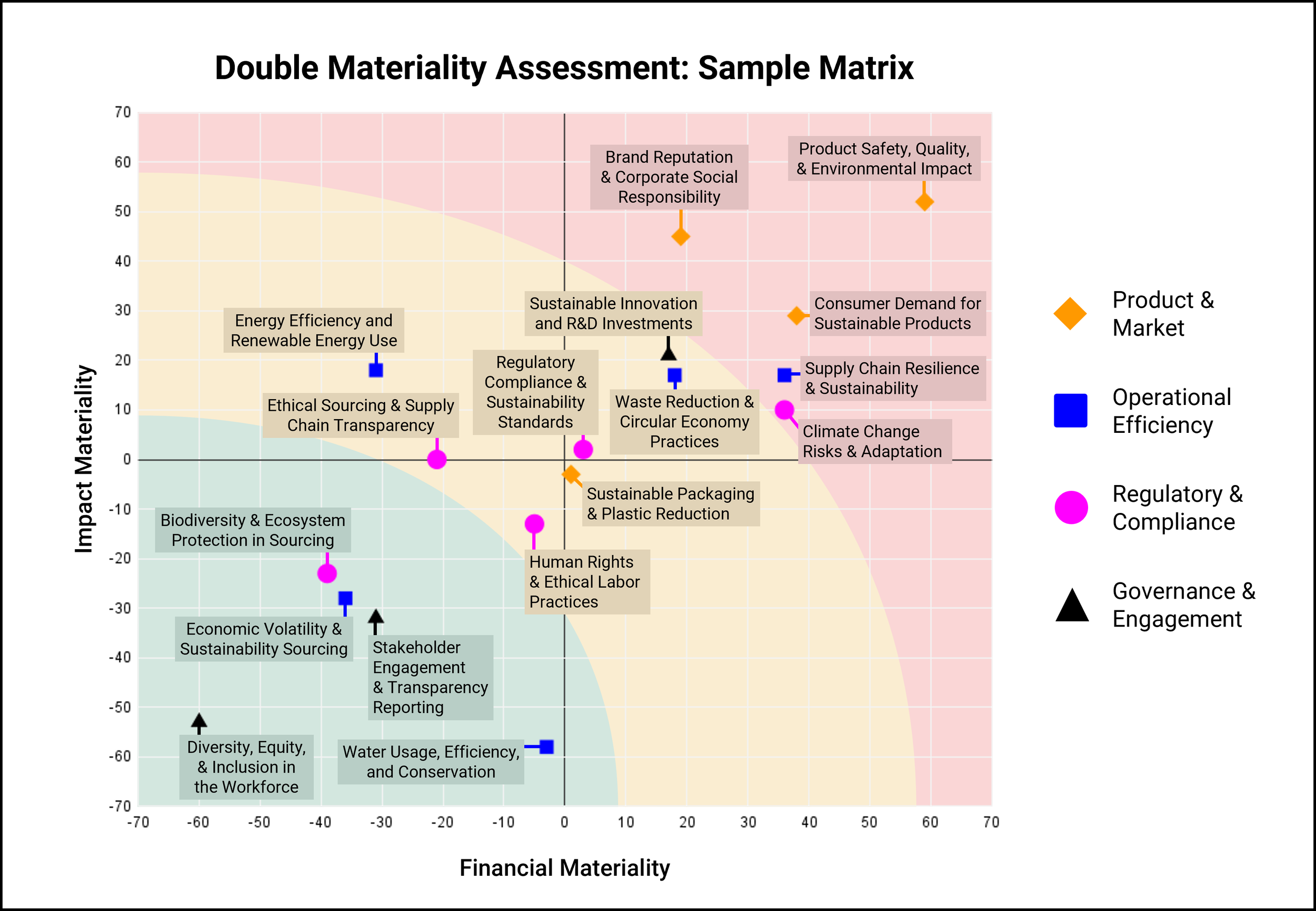
Materiality matrix
A chart plotting issues by importance-to-stakeholders against importance-to-company, used to decide what to focus on and report.
Responsibility and profitability (meta-analysis)
A meta-analysis of 251 studies found only a small positive overall correlation (~0.13) between CSR and financial performance — strongest for observer perceptions and philanthropic donations.
CSR → Reputation → Financial performance
Responsible activities (especially philanthropy, if properly communicated) build reputation; a strong reputation then improves financial performance through willing stakeholders, price premiums, and investor confidence.
CSR for Business Innovation
Closer stakeholder relationships and internal learning from CSR activities can fuel innovation, better product differentiation, and ultimately higher profits.
Why the business case for CSR may not always hold
Newer research shows the CSR-profit link isn't guaranteed: ESG ratings vary wildly between agencies, and some studies even find lower expected returns for "green" stocks than "brown" ones.
Externality
A cost or benefit to a third party caused by an economic activity, not reflected in that activity's price (e.g. pollution costs left out of a product's price).
True price
A product's normal retail price plus its true social and environmental costs, calculated using damage costs and/or abatement costs.
GRI (Global Reporting Initiative)
A widely used voluntary standard for companies to publicly report their impacts on the economy, environment, and people.
CSRD (Corporate Sustainability Reporting Directive)
An EU law requiring certain companies to report on their sustainability impacts and how sustainability affects their business.
ESRS (European Sustainability Reporting Standards)
The detailed standards that establish exactly what and how companies must report under the CSRD.
Double materiality
Reporting both how sustainability issues affect the company financially, AND how the company's own activities affect people and the environment — required under CSRD.
Entrepreneuring & 4 things It encompasses
The process and practice(s) of creating new valuable realities (Laasch, 2023). It encompasses:
Needs as opportunities (addressing people’s needs and challenges as opportunities)
Novel economic relationships (expanding them)
Resources (bringing them together)
Shared value (creating it over time and space)
Entrepreneurial personality traits
High need for achievement (propensity to take responsibility for outcomes)
High risk-taking propensity (seeking opportunities despite the risks)
Internal locus of control (belief you can influence outcomes)
High self-efficacy (goal orientation and building the competence to reach goals)
High extraversion (positive energy invested in relationships)
5 Dimensions of entrepreneurial practice (Behaviors anybody can practice)
Autonomy
Risk-taking
Proactiveness
Innovativeness
Competitive aggression
Dark Triad
Psychological precursors to fraud (Harrison et al., 2018; e.g., Sam Bankman-Fried/FTX):
Narcissism (feeling superior, expecting admiration and service without reciprocation)
Machiavellianism (cynical, self-interested, little concern for others)
Psychopathy (callous, no remorse, sees others as prey)
Narcissistic CEOs (statistic)
Up to about 18% of CEOs may be narcissists, up to 3x more prevalent than in the general population (Larcker et al., 2021).
Value creation vs value capture
Value creation (society's total utility rises after accounting for opportunity costs; productive motive)
Value capture (the actor appropriates part of the value created; unproductive when it extracts value and externalizes costs)
A social enterprise maximizes value creation and minimizes value capture.
Causation
Selecting among given means to reach a predetermined goal — managerial, deductive, inside-out
Effectuation
Imagining possible new goals from a given set of means — entrepreneurial, inductive/abductive, outside-in
Bricolage
Creatively making do with the resources available.
Entrepreneur earnings (statistics)
Own-business entrepreneurs (earn about 36% more than salaried workers; Levine & Rubinstein, 2013)
Self-employed (earn about 16.5% less on average)
Switching from salary to self-employment (18% more per hour, 29% more per year)
Top 1% of earners (are entrepreneurs; Smith et al., 2019)
Entrepreneur happiness (statistics)
Blackman (2021, WSJ) (yes, higher job satisfaction; for men where teamwork is high, for women where creativity is high)
Stephan et al. (2023) (meta-analysis of 93 studies in 82 countries: higher positive well-being, the same negative well-being, strongest where the rule of law is good)
Obelisk consulting model
AI automates junior consultant tasks, creating leaner firms with three key roles (Duncan et al., 2025):
AI facilitators (trained in the latest AI tools and data pipelines)
Engagement architects (lead projects, define problems, interpret AI outputs)
Client leaders (build trusted relationships with senior executives)
AI literacy is a key entrepreneurial competency.
Social economy in Europe (textbook)
About 2 million social economy enterprises (about 10% of all businesses) employing over 11 million people, about 6% of EU employees.
New business venturing
Creating a new organization to realize an opportunity and create value, led by a (co)founder (e.g., TOMS Shoes).
Intrapreneurship
An organizational member acting from the inside to tackle internal change or use organizational resources for a new external opportunity (e.g., Paul Polman's Unilever Sustainable Living Plan).
Institutional entrepreneurship
Entrepreneuring from any role to create or change taken-for-granted practices into a new normal (e.g., Greta Thunberg's movement).
Embedded agency
Trying to change the rules of the game while being bound by the same rules you are trying to change (Laasch, 2023).
The three steps of institutional entrepreneurship:
Positioning (being seen as legitimate among diverse stakeholders)
Theorizing (creating alternative practices through discussion and political means)
Institutionalizing (making them the new normal by linking them to stakeholders' routines and values)
Calculating shrewdly
Intrapreneurial practice of framing change in terms of aligned businesses incentives rather than “correct” ideals, staying aware of corporate realities.
Apocalypse fatigue
Constantly scaring people makes them stop listening.
To actually get people to care about a cause, keep the vibe constructive, give them realistic next steps, and back the specific people who are willing to lead the charge."
Social vs hybrid vs ecological entrepreneurship
Social (social enterprise for social entrepreneurs; e.g., Ashoka)
Hybrid (viable business with both commercial and social value; e.g., Kobo360)
Ecological (ventures for ecological and social change; e.g., Commonland)
Social entrepreneurship (4 necessary characteristics)
An essentially contested concept (Choi & Majumdar, 2014) requiring:
Social and economic value creation
Social value not secondary to economic value
Commercial activities instrumental to a social objective
Creative combination of resources
3 Schools of social entrepreneurship
Social Innovation (innovative activities that create social value)
Earned Income (commercial activity earns income to support social activities)
Positive Externalities (sustainable solutions to neglected problems; Santos, 2012)
Integrated social entrepreneurship
The business and the social mission are the same thing: how the company makes money is how it helps people.
The target group is at the core of the business model. (I.e., Customers are those who receive benefit)