Biology exam 4 K-101 Dr. Marrs, IUI
 Call Kai
 Learn
 Practice Test
 Spaced Repetition
 Match
 Flashcards
 Knowt Play
1/106

There's no tags or description
Looks like no tags are added yet.
107 Terms
Who discovered the doubl-helical model for DNA
James Watson and Francis Crick
Chargaffs rule
A=T and C=G
Alfred Hershey and Martha Chase
Determined that genetic DNA, not protein, was the genetic material using experiments about bacteriophages ( the warning blender experiment
Dr. Rosalind
Biology's most famous images

Watson, Crick, and Maurice
Structure for deoxyribose nucleic acid
Bas pairing and base sequences =
How DNA is replicated and inherited
Note that two strands of DNA are —— with respect to eachother
Anti parallel
The name, for eukaryotic cells, where DNA is combined with proteins
Chromatin
First of the elaborate multisystem of packing for chromosomes
DNA (2nm)
Second of the elaborate multisystem of packing for chromosomes
Histones move to DNA
Third of the elaborate multisystem of packing for chromosomes
Histones bunch to form a nucleosome (10nm)
Fourth of the elaborate multisystem of packing for chromosomes
Nucleosomes form a 30-nm fiber
Fifth of the elaborate multisystem of packing for chromosomes
30-nm fibers form looped domains (300nm fiber)
Sixth of the elaborate multisystem of packing for chromosomes
Looped domains create a chromatid (700nm)
Seventh of the elaborate multisystem of packing for chromosomes
Chromatids form a replicated chromosome (1400 nm)
Unwinds parental double helix at replication forks
A - Helicase

Binds to and stabilizes single-stranded DNA until it can be used as a template
B - Single-strand binding protein

Relieves "overwinding" strain ahead of replication forks by breaking, swiveling, and rejoining DNA strands
Topoisomerase

synthesizes an RNA primer at 5' end of leading strand and at 5' end of each Okazaki fragment of lagging strand
D - Primase

Unsing parental DNA as a template, synthesizes new DNA strands by adding nucleotides to and RNA primer or pre-existing DNA strand
C - DNA Pol III

Removes RNA nucleotides of primer from 5' end and replaces them with DNA nucleotides
F - DNA pol I
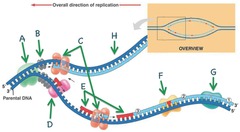
Joins Okazaki fragments of lagging strand; on leading strand, joins 3' end of DNA that replaces primer to rest of leading strand DNA
G - DNA Ligase

Small fragments of DNA produced on the lagging strand during DNA replication, joined later by DNA ligase to form a complete strand
E - Okazaki fragments

Telomeres
Repeated DNA sequences at the ends of eukaryotic chromosomes.
Telomerase
An enzyme that catalyzes the lengthening of telomeres in eukaryotic germ cells.
What happens when telomerase stops being built (chromosomes getting shorter)
Aging
How do you maintain telomeres length
Sleep and lowering stress and anxiety
Elizabeth H. Blackburn, Carol W. Greider, and Jack W. Szostak
Discovery of how chromosomes are protected by telomeres and the enzyme telomerase
Why do cells have repair enzymes
To maintain integrity of their genetic code by correcting errors and damage that occur to DNA molecules
What does it mean to say that DNA synthesis is semi-conservative
Each new DNA strand consists of one original strand and a newly synthesized one
How can telomerase be connected to cancer
Telomerase cause growth, if it becomes unchecked the cell will grow indefinitely
DNA is ___ into RNA (in the nucleus)
Transcribed
RNA is ___ into protein (in the cytoplasm)
Translated
mRNA
A type of RNA, synthesized from DNA, that attaches to ribosomes in the cytoplasm and specifies the primary structure of a protein.
tRNA
transfer RNA; type of RNA that carries amino acids to the ribosome
rRNA
ribosomal RNA; type of RNA that makes up part of the ribosome
RNA processing and splicing
splicesomes remove introns and put together exons, 5' cap and PolyA tail are added
Translation
Process by which mRNA is decoded and a protein is produced
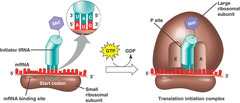
How is translation initiated
Two ribosomal subunits bind to the mRNA transcript.

First step of the elongation cycle of translation
TRNA with amino acid attached occupies the A site while a polypeptide chain occupies the P site
Second step of the elongation cycle of translation
The enzyme peptidyltransferase detached the aa at the P site and joins it to the aa at the A site (aa = amino acid)
Third step of the elongation cycle of translation
The ribosome shifts down the mRNA, moving the protein chain into the P site, and the empty tRNA enters the E site and exits the chain
Stop codons
UAG, UAA, UGA
first step of the termination of translation
Ribosome reaches a stop codon on mRNA
Second step of the termination of translation
Release factor promotes hydrolysis, tRNA and polypeptide seperate.
Third step of the termination of translation
Ribosomal subunits and other components dissociate (To go from the second to first step turn GTP into GDP and Pi)
Gunther Blobel
discovered signal sequences
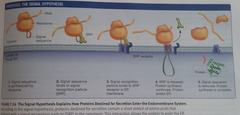
The signal hypothesis
Signal peptides bond to SRP(signal recognition particle), then together attach to the translocation complex. Finally SRP separates and the signal peptide is left if the rER and the rest dissociate.
Mutant Hemoglobin DNA
CAT, the sickle cell hemoglobin has a valine instead of a glutamic acid
silent mutation
Change in nucleotide has o affect on aa (wobble) EX. GGC to GGU = both are gly.
missense mutation
Change in nucleotide specifies a new amino acid
Missense mutation - sickle cell disease
GAA(glu) to GUA(Val)
Missense mutation - achondroplasia
GGA(gly) to AGA(arg)
nonsense mutation
Change in nucleotide creates a premature stop codon, truncating protein
Nonsense mutation
Phenylketonuria UGC(cys) to UGA(stop)
Frame shift causing immediate___
Nonsense
Frame shift causing immediate nonsense example
BRCA1 - a 2-bp deletion at codon 22 causes a stop, resulting in a loss of this tumor suppressor protein
Frameshift causing Missense ___
Insertions
Frameshift causing Missense insertions example
Huntingtons and Fragile X
Insertions and/or deletions example
DMD(Duchenne muscular dystrophy)
Insertion of deletion of three nucleotides example ( no from a shift but extra or missing amino acids)
Epigenetics
The inheritance of traits no directly involving nucleotides
Transcriptional regulation
The mechanisms that collectively regulate whether or not transcription occurs.
TATA box
A promoter DNA sequence crucial in forming the transcription initiation complex.
RNA polymerase II
transcribes mRNA
Methylated chromatin
heterochromatin "off"
Histones acetylation
Makes chromatins less condensed so that proteins and enzymes can access gene for transcription. Vice versa when acetyl groups (-COCH3) aren't present "on"
Exon shuffling
The variation in the patterns by which RNA may produce diverse sets of exons from a single gene.

Ubiquitination
targets a protein for degradation by a proteasome

First step of Post-Transcriptional regulation of gene expression by microRNA's (miRNAs) and Dicer
The miRNA precursor folds back on itself
Second step of Post-Transcriptional regulation of gene expression by microRNA's (miRNAs) and Dicer
An enzyme called Dicer cuts RNA into shorter segments
Third step of Post-Transcriptional regulation of gene expression by microRNA's (miRNAs) and Dicer
One strand of RNA is degraded; the other strand (miRNA) associates with the RISC complex of proteins
Fourth step of Post-Transcriptional regulation of gene expression by microRNA's (miRNAs) and Dicer
The bound miRNA can base-pair with any target mRNA that contains the complimentary sequence
Result of Post-Transcriptional regulation of gene expression by microRNA's (miRNAs) and Dicer
The miRNA-protein complex prevents gene expression either by degrading the target mRNA or blocking its translation
Chromatin modification
promotes the formation of heterochromatin in certain regions blocking transcription
Capsid
Outer protein coat of a virus
Viral genome
either DNA or RNA but never both
Viral envelope
= host glycoproteins
The lytic cycle
a viral reproductive cycle in which copies of a virus are made within a host cell, which then bursts open, releasing new viruses
Step one of the lytic cycle
attachment
Step two of the lytic cycle
Entry
Step three of the lytic cycle
Synthesis
Step four of the lytic cycle
Self-assembly
Step 5 of the lytic cycle
release
What are ways bacteria can protect themselves
Restriction enzymes and CRISPR - cas
The lysogenic cycle
Temperate phage only, genome integrates into bacterial chromosomes as prophage
Adenovirus
(dsDNA) no envelope, common cold; respiratory virus; tumor causing viruses
Pappilomavirus
(DsDNA) no envelope, warts, cervical cancer - HPV
Polyomavirus
(DsDNA) no envelope, tumors
Herpesvirus
(DsDNA) yes envelope, Herpes simplex 1 and 2; varicella zoster(shingles, chicken pox); Epstein-Barr virus
Parvovirus
(SsDNA)no envelope, B19 parvovirus (mild rash)
Reovirus
(DsRNA)no envelope, rotavirus (diarrhea); Colorado tick fever
Picornavirus
( ssRNA)no envelop, Hepatitis A, Polio, common cold
Coronavirus
(ssRNA+), yes envelope, severe acute respiratory syndrome
Flavivirus
(SsRNA+) yes envelope, Hepatitis C, Yellow fever, Dengue fever, west Nile
Togavirus
(SsRNA+) yes envelope, Rubella (German measles)
Filovirus
(ssRNA -), yes envelope, Ebola
Orthomyxovirus
(SsRNA-) yes envelope, influenza virus
Paramyxovirus
(SsRNA-) yes envelope, measles and mumps
Rhabdovirus
(SsRNA-) yes envelope, rabies