Anatomy Classification of Tissues
 Call Kai
 Learn
Learn Practice Test
 Spaced Repetition
 Match
Match Flashcards
 Knowt Play
1/31

There's no tags or description
Looks like no tags are added yet.
Name | Mastery | Learn | Test | Matching | Spaced | Call with Kai | Chat |
|---|
No analytics yet
Send a link to your students to track their progress
32 Terms
Tissue
Groups of cells that are similar in structure and function
Epithelium
Lines body cavities and covers the body’s external surface, anchors and packages organs, cells may absorb, protect, or form a filtering membrane
Muscular
Pumps blood, flushes out urine, allows one to swing a bat, major function is to contract
Nervous
Transmits waves of excitation, most involved in regulating body functions quickly, forms nerves
Connective
The most durable tissue type, abundant nonliving extracellular matrix
Simple layer structure
Single layer of cells

Stratified layer structure
Multiple layers of cells

Squamous
Flattened like fish scales

Cuboidal
Cube shaped like dice
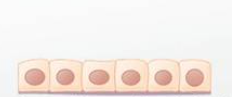
Columnar
Shaped like columns

Simple Squamous
Diffusion and filtration, secretion in serious membranes, located in the air sac walls of the lungs

Simple Cuboidal
Secretion and absorption; ciliated types propel mucus or reproductive cells, found in the kidney tubules

Simple Columnar
Secretion and absorption; ciliated types propel mucus or reproductive cells, found in the small intestine

Stratified Squamous
Protection, lining of the esophagus, skin epidermis, all body openings such as mouth, ear, urethra, anus and vagina
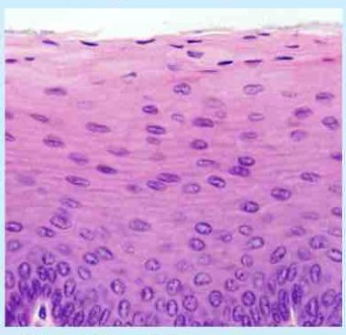
Stratified Cuboidal
Protection, these tissues are rare in humans, lining of sweat ducts, testes tubules, ovarian follicles

Stratified Columnar
Protection, Secretion, lining of male urethra, salivary glands and mammary glands

Transitional
Protection; stretching to accommodate distension of urinary structures, lines the ureter, urinary bladder and urethra
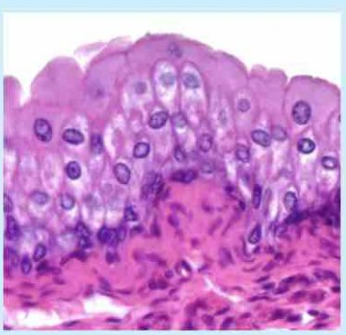
Simple Columnar Microvilli
Secretion, absorption; lining of gastrointestinal tract
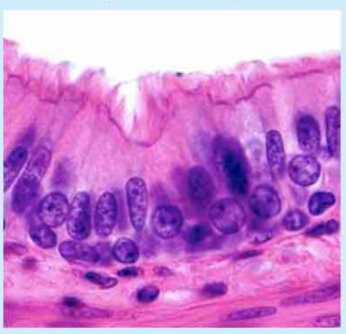
Pseudostratified Columnar
Secretion, movement; lining of the trachea and upper respiratory tract, male reproductive ducts
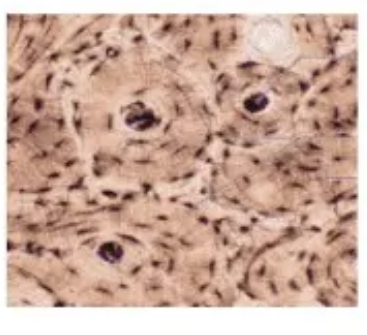
Bone (osseous tissue)
Consists of osteocytes sitting in lacunae cavities surrounded by layers of a very hard matrix with very few cells
Hyaline Cartilage
Abundant fibers hidden by a rubbery matrix with a glassy appearance; it forms the trachea, attaches the ribs to the breastbone and it covers bone ends at joints

Fibrocartilage
Forms cushion-like discs between the vertebrae of the spinal column

Dense fibrous connective tissue
Collagen fibers are the main matrix element between fibroblasts; it forms tendons and ligaments which connect bones to bones at joints and skeletal muscles to bones

Areolar Connective Tissue
It is soft and cobwebby, and it surrounds body organs, protects them and keeps them in place, composes basement membranes

Adipose Connective Tissue
Fat tissue that insulates the body and surrounds some organs like the kidneys; fat is stored in the hips, breasts and belly for fuel if needed

Reticular Connective Tissue
It forms the stroma or internal framework of an organ, it can support free blood cells, usually white blood cells in organs like the lymph nodes, spleen or bone marrow

Blood
Vascular tissue that consists of blood cells surrounded by blood plasma; blood is the transport vehicle for the cardiovascular system, carrying nutrients, waste, respiratory gases, white blood cells and other things

Skeletal Muscle
Packaged by connective tissue sheets and attached to the skeleton; these muscles are controlled voluntarily, when they contract they pull on bone or skin which causes the body limbs or face to move; the cells are long and cylindrical and they have striations

Cardiac Muscle
Is only found in the heart wall, it pumps blood through the blood vessels; it has striations, a single nucleus and intercalated discs; this organ is under involuntary control

Smooth Muscle
No visible striations, the cells have a single nuclei and they are tapered on both ends; it’s found in the walls of the stomach, uterus and blood vessels

Peristalsis
A wavelike motion that keeps food moving through the small intestine which is a typical activity of a smooth muscle
Nervous Tissue
Made up of neurons that are irritable and can conduct electrochemical impulses; their cytoplasm is drawn out into long processes as long as three feet which allows a single neuron to conduct an impulse that reaches a distant body location
