PHGY mod 4
 Call Kai
 Learn
 Practice Test
 Spaced Repetition
 Match
 Flashcards
 Knowt Play
1/164

There's no tags or description
Looks like no tags are added yet.
165 Terms
What are the three major muscle types?
Skeletal
Cardiac
Smooth
Describe the 5 levels of skeletal muscle structural organization
Muscle
Made up of individual muscle fibres that run the entire length of the muscle
Muscle Fibre
Fibres run parallel to each other and are surrounded by connective tissue
Myofibrils
along the length of a muscle fibre
cell is divided into myofibrils
Myofibril - side view
Pattern of light and dark bands
striated pattern
Myofibril - cross section
highly organized cytoskeletal pattern of thick and thin filaments
thick = myosin
thin = actin
Describe a single muscle fibre
single muscle cell
multinucleated
very larger number of mitochondria
Identify each feature of a myofibril
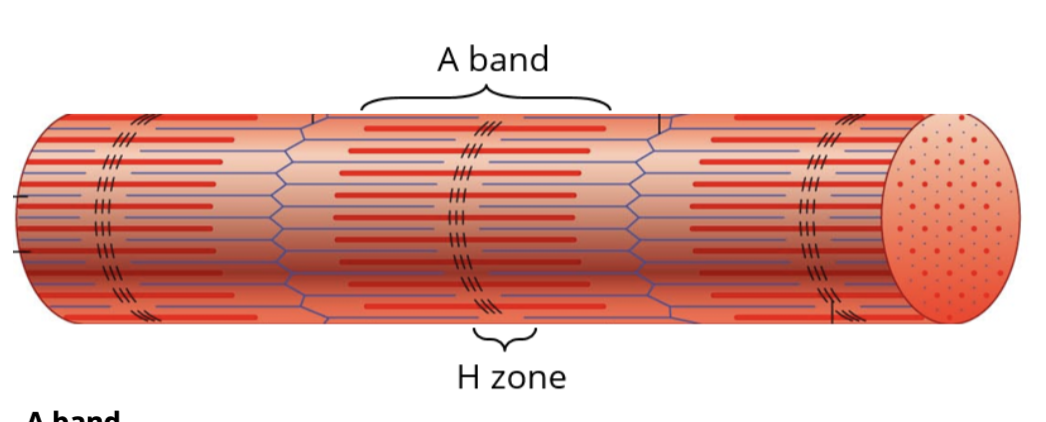
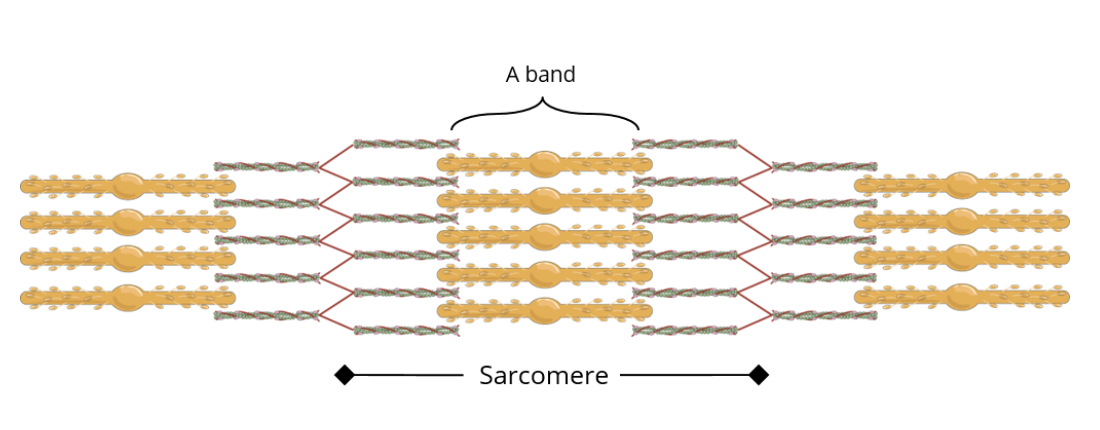
A band
I band
H zone
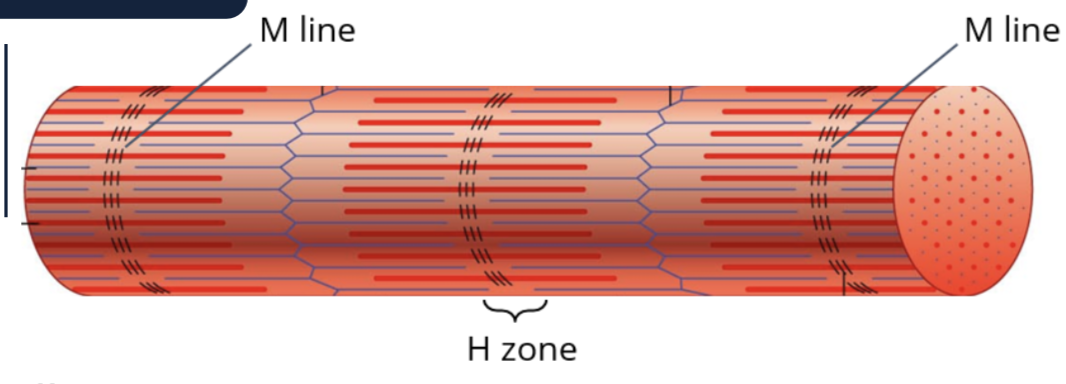
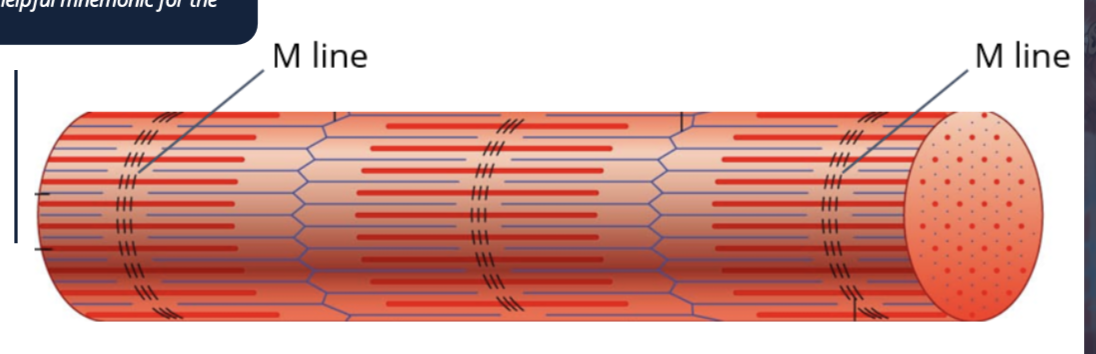
M line
Z line

Describe the A band of the myofibril
“Dark bands”
made up of parallel stacked thick and thin filaments
borders defined by length of the thick filaments
Why is the middle of the A band of myofibril slightly lighter
Thin filaments do not reach the middle from the ends
Also called the H zone

what is the thick filament and what is the thin filament in myofibril
Thin = actin (blue)
Thick = myosin (red)
Describe the I band of the myofibril
Light band
Made of thin filaments
Middle of the I band is the Z line

Describe the H zone of myofibril
Slightly ighter portion of the A band
only contains the heavy chains of myosin
Only contains proteins that hold the thick filaments and myosin together in a stack
What is myosin composed of
2 heavy chains
2 light chains
Describe the M line
Proteins that hold the thick filaments together in a stack
runs down the centres of the H zone
Describe the Z line
Found in the middle of the I band
What is a sarcomere
distance from one Z line to the next Z line
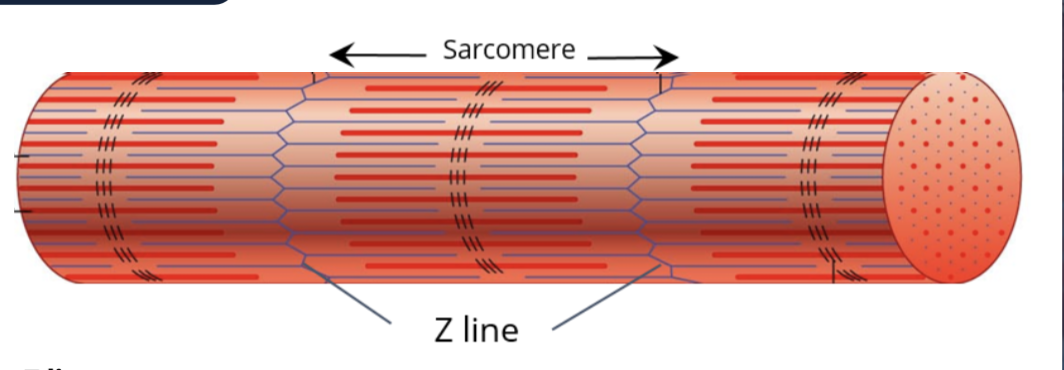
What is the functional unit of skeletal muscle
Sarcomere
When relaxed, what is the width of a sarcomere
2.5 um in width
What happens when muscles are growing?
They extend the length of the muscle fibre by adding new sarcomeres onto the ends
What is the thick filmanet composed of
Myosin protein
What is myosin
Motor protein
uses ATP to move along actin filaments
Describe what myosin looks like
Dimer of two subunits
each subunit looks like a golf club

What happens when two myosin dimers come together
“Shaft” or tail portions wrap around each other in a tail-to-tail formation
stack up with other myosin molecules
The heads stick out and contain two important sites
actin binding site
myosin ATPase site
what is the thin filament made up of?
actin
tropomyosin
troponin
main structural component is 2 actin filaments
Actin filaments
what its made up of
what it forms
Made up of Individual speherical actin molecules
forms a double helix structure

Describe tropomyosin
structure
role
Structure
thin double helix protein
lies end to end along actin helix structure
Role
regulatory protein
covers active binding sites, preventing interaction of actin and myosin
Troponin
Regulatory protein complex made of three polypeptides
one binds to tropomyosin
one binds to actin
one binds to Ca2+
What are cross bridges? what is its purpose?
Forms the basis of the sliding filament mechanism which brings about muscular contraction

Where do cross bridges form?
Between the myosin head and actin
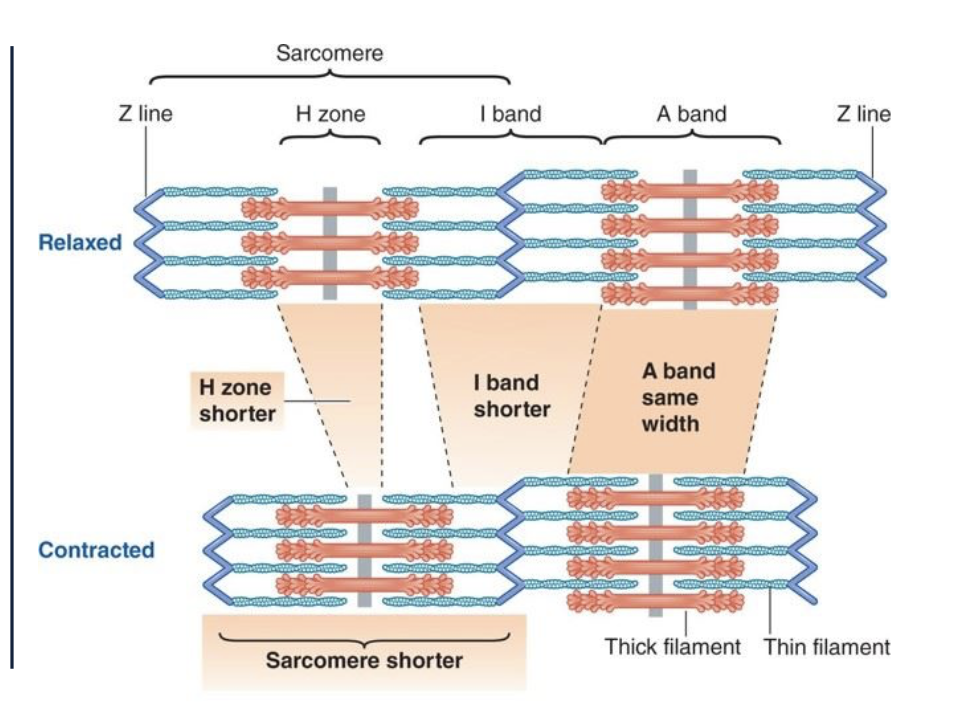
What happens when a sarcomere contracts
thin filaments move inwards over the thick filaments
Z lines move closer together
occurs simulataneously along the entire fibre
all sarcomeres shorten to the same degree
What is concentric contraction
Sarcomere contracts
when whole muscle shortens
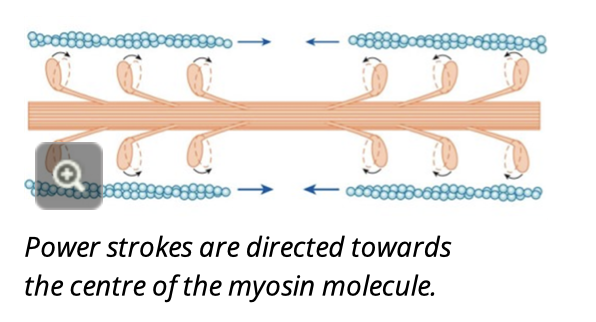
What is the power stroke
interaction betweemn myosin + actin that leads to a shortening of the sarcomere
When does the power stroke occur?
when cross-bridge bends
pulling the thin myofilament inward toward the centre of the thick filament
Step by step of the cross-bridge cycle
Binding: Myosin cross bridige binds to actin molecule
Power stroke: myosin head bends, pulling the thin myofilament inward
Detachment: Cross-bridge detaches at end of power stroke and returns to original conformation
Binding: cross-bridge binds to more distal actin molecules; cycle repeats

what is the result of a power stroke
Actin molecules being pulled closer to the centre of myosin molecules
What happens during successive cross-bridge cycles?
Actin is pulled progressively further toward the centre

How many actin filaments surround each myosin filament? How does this work towards muscular contraction?
6 actin molecules on each end
all of which are pulled inward simultaneously in muscular contraction

Are all cross bridges actively pulling actin simulteanously?
No
some pull
some hold actin in position
and others prepare for the next power stroke
How many heads does each myosin molecule have?
2 heads
act independently
only one can attach to actin at a time
Where do the power strokes get the energy to shorten sarcomeres?
Excitation-contraction coupling
What is excitation-contraction coupling
process of converting an electrical signal into an actual contraction
Skeletal muscles have two membrane structures that help transmit what signal? How does it occur?
Action potential
Acetylcholine is released into the neuromuscular junction
causes permeability changes → initiates action potential across entire muscle membrane
What are the two membrane structures that skeletal muscles use to help conduct action potentials?
Sarcoplasmic Reticulum
T-tubules
What is the sarcoplasmic Reticulum?
membranous structure
runs parallel to fibres
At its end, the lateral sacs of the SR are in close proximity to T-tubules

What is the role of the Sarcoplasmic Reticulum
acts as the endoplasmic reticulum in non-muscle cells
Storage site for Ca2+
What are Transverse -tubules (T-tubules)
invaginations of the plasma membrane
At the junction of A and I bands, they dip into the fibre and run perpendicular to the fibres

What happens when the plasma membrane depolarizes?
wave of depolarization spreads across the plasma membrane
Spreads deeper into the cells by spreading down the T-tubules
electrical signal transmitted from T-tbules to the Sarcoplasmic reticulum
what are dihydropyridine receptors? what does it do?
Found on surface of T-tubules
voltage-sensors
Senses wave of depolarization as it makes it way down the T-tubule
What is immediately opposite to dihydropyridine receptors?
Ryanodine receptors (Found on the Sarcoplasmic reticulum)
Describe in detail what happens when a wave of excitation enters T-tubules
Sensed by dihydropyridine receptors on t-tubules
Dihydropyridine receptors Influences ryanodine receptors of the SR to undergo conformational change
Ryanodine receptors form a Ca2+ channel
When activated, they open, and Ca2+ enters the cytoplasm
Why is Calcium release important?
Primary trigger to allow skeletal muscles to contract
Relaxed muscle vs excited muscle
Relaxed muscle
no contraction because tropmyosin + troponin positioned to prevent cross-bridging formation
blocks myosin binding site on actin molecules
Excited muscle
Ca2+ enters muscle fibre
Ca2+ binds to troponin → causes confromational change
Leads to: tropomyosin being moved out of the way
myosin binding site on actin is exposed
what is the cause of muscle relaxation? In detail
Decreased nerve activity at neuromuscular junction
Ach no longer released
action potential not generated
therefore, SR cannot release stored Ca2+
Ca2+ is actively taken into SR by Ca2+-ATPase pump
torponin-tropomyosin complex cover actin molecules
result: muscle lengthening + relaxation

What does exposure of the actin binding site lead to?
ATP-powered cross bridge cycling
How does cross-bridge cycling work?
Step 1: “loading the gun” ; ready to fire
The ATPase binding site of the myosin head causes ATP hydrolysis (ATP → ADP + Pi)
energy transferred to myosin cross bridge
Step 2: Calcium presence
Ca2+ present (excitation)
Troponin-tropomyosin complex exposes the actin molecules so cross-bridge can bind. Causing the power stroke. Moves on to step 3
Step 3: Ca2+ absent
no contraction occurs
Cycle ends
Step 4: Power stroke
During power stroke Pi released
After power stroke ADP is released
Final product:
ATPase site empty
cross bridge still bound to actin
Step 5: Binding of a new ATP molecule
Cross-bridge detaches + returns to its original shape
Step 6: After death, Rigor mortis
Ca2+ concentration increases in cell
muscles will start contracting until ATP runs out, after which they remain contracted
after several days, sufficient muscle proteins decay and relaxation occurs again

What is the relationship between an action potential and a muscle twitch?
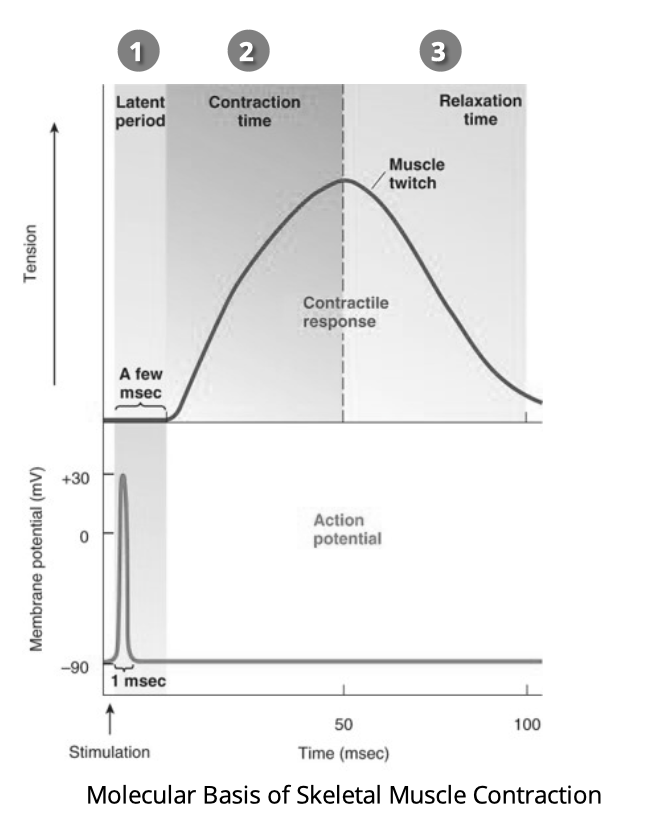
The action potential occurs first.
The muscle twitch (contraction and relaxation) follows.
The electrical signal triggers the mechanical response.
What happens when a muscle is activated and required to produce less than its maximum tension?
The muscle begins to shorten.
It produces only the amount of force required rather than its maximum possible force.
Temporal relationship between the action potential and resulting mechanical action
The three phases
Latent period
Contraction time
Relaxation time
What is the latent period?
Delay period between the action potential and the start of muscle contraction
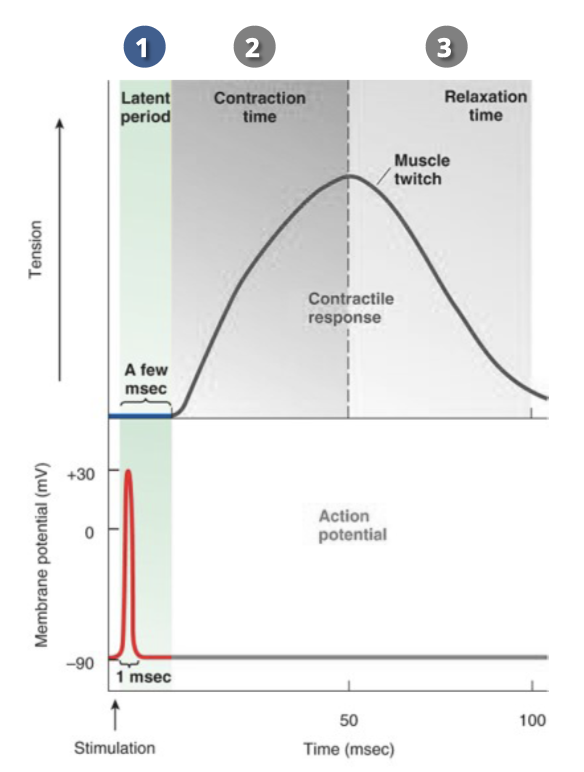
What happens during the latent period?
Cross-bridge cycling begins
What is Contraction time?
Period when muscle tension increases as actin slides along myosin
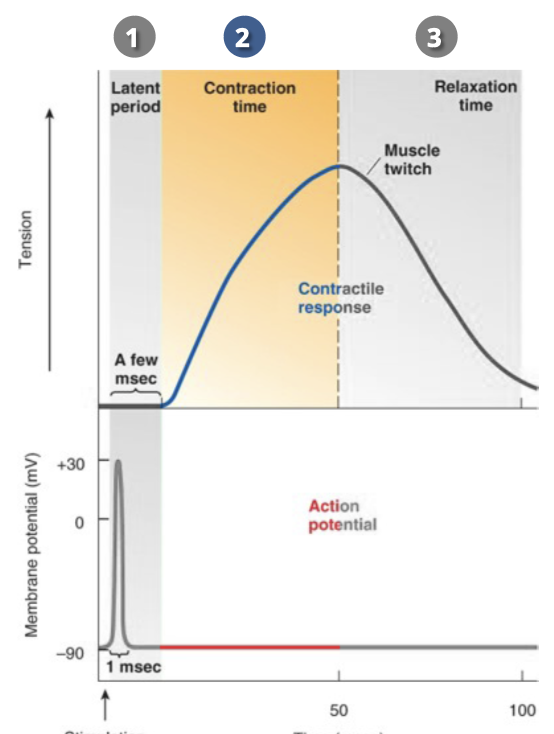
What factors affect contraction time?
Muscle fibre type (fast vs. slow twitch)
muscle location
What is the relaxation time?
Period when muscle tension decreases after peak tension
Ca2+ removal from cytoplasm
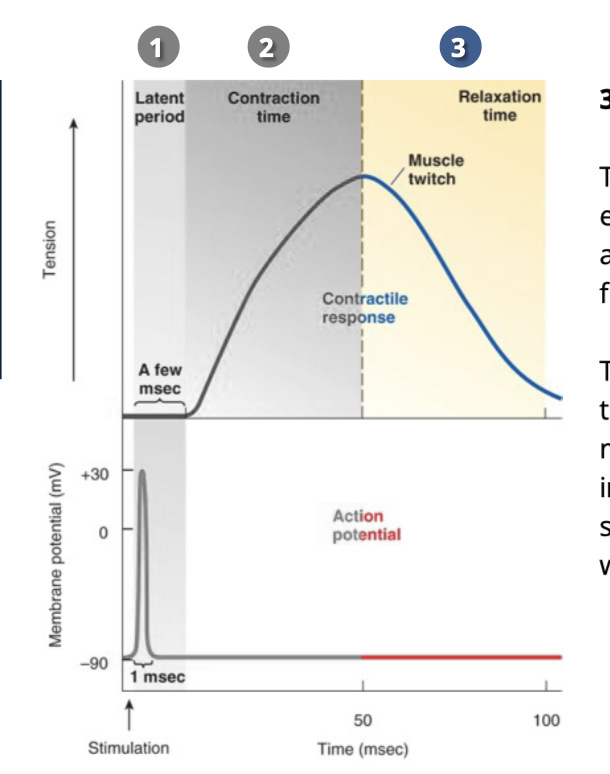
What are the three phases of a muscle twitch and how long does each last?
1. Latent period:
Action potential lasts 1-2 miliseconds
Contraction:
Tension increases to peak (40-20msec)
Relaxation:
Ca2+ removal (50-200msec)
In order for a muscle to develop tension, more fibres need to twitch. This can be accomplished in what two ways?
Motor unit recruitment
Frequency of stimulation
What happens when more muscle fibres are recruited to contract?
The greater the number of recruited muscle fibres, the greater the muscle tension.
What is a motor unit
One motor neuron + all the muscle fibres it innervates
What happens when a motor neuron is activated?
It causes all the muscle fibres within its motor unit to contract.
Are the muscle fibres belonging to one motor unit adjacent to each other?
No. They are spread throughout the entire muscle.

How does the body produce a stronger muscle contraction through motor unit recruitment?
By recruiting (activating) multiple motor units, causing more muscle fibres to contract and increasing muscle tension.
one motor unit causes a weak contraction
How does the body prevent muscle fatigue during sustained contractions?
By selectively rotating motor unit activation, allowing some motor units to rest while others take over.
Can skeletal muscle fibres undergo multiple action potentials during one contraction? Why?
Yes
Skeletal muscle action potentials are shorter in duration compared to muscle contraction
membrane potential recovers quickly
Describe what happens if a muscle fibre is restimulated after it has completely reelaxed
Second twitch is the same magntidue as the first twitch
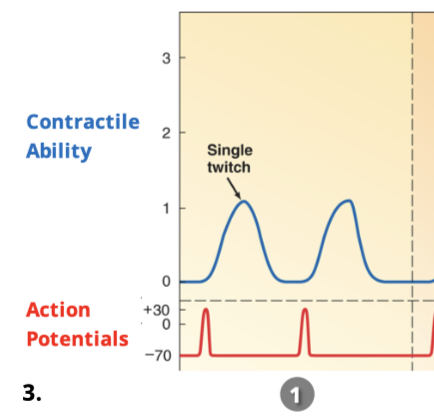
Describe what happens if a muscle fibre is restimulated before it has completely relaxed
second twitch is added onto the first twitch → twitch summation

Describe what happens if a muscle fibre is stimulated rapidly
twitches overlap → tetanic conraction occurs
strongest single-unit twitch in muscle contraction → TETANUS
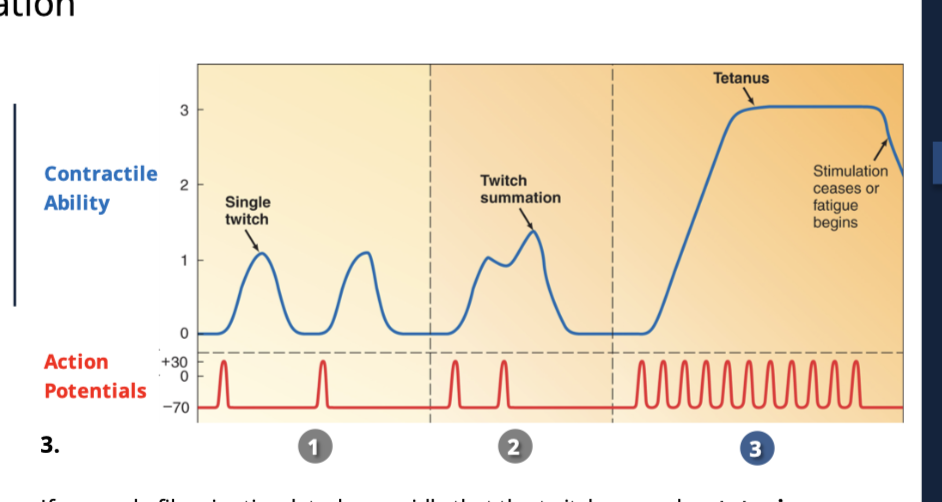
The amount of tension that can be generated at tetanus is greatly dependent upon what?
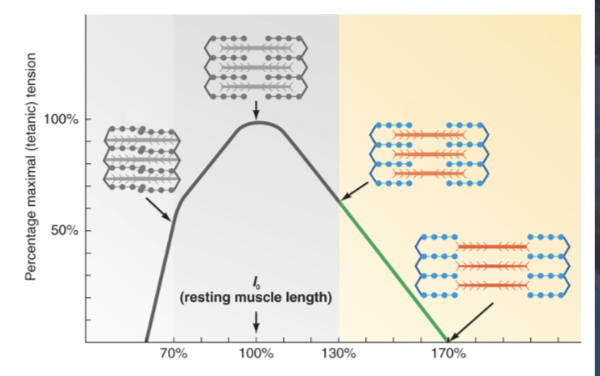
Length of muscle at the onset of contraction
What is the length-tension relationship
Every fibre has an ideal or optimal length at which maximal force can be generated
What happens if the fibre length is less than optimal
Thin filaments overlap thick filament without cross-bridges
efficiency of contraction + tension decreases
If shortening continues:
thin filaments from opposite side of the sarcomere overlap
thick filaments come in contact w/Z-lines

What happens if the fibre length is optimal
Maximal number of cross-bridge binding
thin filaments dont overlap central region of the thick filaments (dont have cross-bridges)
When are muscle fibres generally at optimal length?
At rest
achieve maximal contraction when needed
What happens if the fibre length are greater than optimal length
Distance between z-lines increase
amount of overlap of thick and thin filaments decrease
less cross-bridges available
less tension develop
At about 30% increase of optimal length (Lo) how much of optimal tension can be generated
50%
What happens at 70% longer than optimal length (Lo)
Sarcomere length can be increased so much that there is no overlap between thick and thin filaments so contraction cannot occur at all
most muscles are attached to what?
two bones around a joint
How are tendons formed? what are they important for?
Formed:
Connective tissues surrounding the muscles form the tendons
Important for:
muscle-to-bone attachment
What is the benefit of muscles connecting on either side of a joint?
allows movement of the bones by contraction or relaxation of the muscles

What contracts when you flex? what contracts when you extend?
Flex: Bicep
Extend: tricep
what happens for a muscle to shorten during contraction?
it must exceed the forces that oppose the movement of the bone
Provide an example of muscle tension with a load
When an external load is applied to the biceps, the muscle must contract to overcome (1) force exerted by the triceps and (2) the external load to move the weight
For example, if the man's bucket is empty, it will take very minimal effort to overcome the force exerted by the triceps and the load. However, if the bucket is full of stones, the generation of tension in the biceps will be much more difficult because the load is much greater.
How does muscle soreness (myalgia) occur?
Athletes often experience myalgia due to overexertion and improper rest, which can result in injury
What percentage of athletic injuries are of a shearing nature?
90%
What does shearing nature include?
Contusion
Strain
Laceration
describe how contusion occurs
Occurs when a muscle is subject to sudden heavy intrinsic compressive force
Describe how strain occurs
occurs when the muscle fibres are exposed to an excessive force caused by intrinsic tension
Describe mild vs severe strain
Mild: delayed onset muscle soreness (DOMS)
Severe: muscle fibres and connective tissues (ie. blood vessels) are ruptured
Describe laceration
this occurs from a deep cut or tear of muscle
At the level of the motor unit, what are the two types of contractions?
Isotonic Contractions
muscle fibre tension remains constant as it changes length
Isometric contractions
muscle fibre tension increases as it remains at the same length (static muscle contraction)
At the level of the whole muscle, what are the two types of contractions when lifting a load?
concentric dynamic contractions
produce tension while the muscle shortens
lifting of the object by biceps
Eccentric dynamic contractions
produce tension while muscle lengthens
controlled lowering of the object using bicep
What does concentric and eccentric dynamic contractions require?
Work/Effort
3 ways ATP is important in the contraction relaxation process
Splitting of ATP to provide energy for power stroke
Binding of new ATP to myosin head to release the cross-bridge
Active transport of Ca2+ back into the SR
What is fatigue
when contractile activity cannot be maintained and tension in a muscle declines
2 types of fatigue
Central fatigue
Muscle fatigue
When does central fatigue occur?
CNS decreases its activation of motor neurons
may be a pyschological origin