Supply Decision
 Call Kai
 Learn
 Practice Test
 Spaced Repetition
 Match
 Flashcards
 Knowt Play
1/23

Earn XP
Description and Tags
Econ127 L3
24 Terms
Types of cost in production
Fixed cost - will not change whatever you make
Variable cost - changes depending on how much you make
Cost can make a difference in the short term vs the long term
What is the law of diminishing returns?
When one or more factors are held fixed, there will come a point beyond which the extra output from additional units of the variable factor will diminish.
As u add more fixed factors, as consequence less output.
(Production in the short run)
What are some short-run costs
Total cost - TC = TFC + TVC
Total Fixed Cost (TFC) - total doesn’t change, independent to how much the output is.
Total Variable Cost (TVC) - varies on how much is made. (TVC and the law of diminishing returns)
Average cost - (TC/Q) = AFC + AVC
Average Fixed Cost (AFC) = TFC/Q
Average Variable Cost (AVC) = TVC/Q
Marginal Cost = deltaTC/deltaQ
Total, average and marginal cost for a firm table
MC is offset - there is a £10 difference between making 0 units to 1 unit.
Marginal Cost - how much the cost would change in increasing the unit.

The relationship between Average and Marginal Costs
X - diminishing marginal returns set here. After this point, the difference increases between adding one extra unit, costing a lot more money, to increase.
Y - the intersection of MC and AVC - minimum of AVC line.
Z- intersection of MC and AC, minimum value of AC line. Keeping Total Cost down the most.

What are long-run costs in production
Returns to scale - how much output getting based on how much the input is changing
constant
increasing
decreasing
Economies of scale (examples) - more efficient at a bigger scale
specialisation and the division of labour
indivisibilities
container principle
greater efficiency of large machines
by-products
multi-stage production
spreading overheads
financial economies
economies of scope
Diseconomies of scale
External economies of scale
External diseconomies of scale
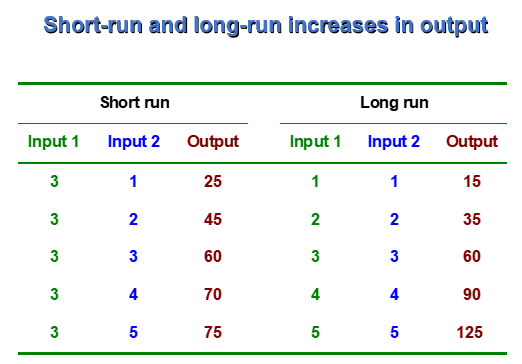
Table example of short run and long run.
Short run
Input 1 - eg. Machine
Input 2 - eg. Employing more people
Long run
Both inputs can change
As you add more inputs into production, the output difference increases - therefore increasing returns to scale.
Big chances that you will increase the input but the difference between the outputs is decreasing - decreasing returns to scale ( smaller output gain)
Long term average cost - some assumptions behind the curve
factor prices are given
state of technology and factor quality are given
firms choose least-cost combination of factors
equi-marginal principle
Graph for long run average cost - Economies of scale
More efficient to make more items, cost would decrease

Graph for long run average cost - Diseconomies of scale
The opposite of economies of scale

Graph for long run average cost - Constant cost

A typical long-run average cost curve
Economies of scale at a lower output, then constant, then diseconomies of scale

What is the relationship between long-run average and marginal costs - Economies of scale
Both decline, gap decreases as you make more output.

What is the relationship between long-run average and marginal costs - Diseconomies of scale
Flipped, LRMC is above, as you make more output - it will be more costly. Diverging lines.

What is the relationship between long-run average and marginal costs - Constant costs
Overlap with each other.

What is the relationship between long-run average and marginal costs - Initially economies of scale and then diseconomies of scale


Deriving long-run average cost curve - factories of fixed size example.
If u were to increase from 1 factory to 5, each factory has its own short-run average cost. Can smooth out the bottom side of the curve and that would be the long-run average cost.

Equations for Total, Average, Marginal revenue
Total Revenue (TR) = P x Q
Average Revenue (AR) = TR/Q
Marginal Revenue (MR) = deltaTR/deltaQ

When the firm is price-taking.
a is the entire market. Pe is the equilibrium which sets the price. The b individual firm uses the market as an idea to set the price. Therefore it dictates the demand of the firm.
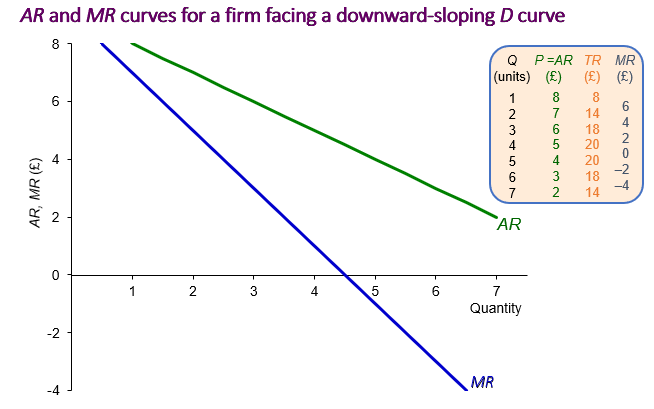
When the price varies with the output - so what happens when you make more items. What does the price do. What happens to AR and MR.
Average revenue is declining
As demand rising so price would decrease.
If make too much, price will decline too much.
Business not doing well when MR becomes negative
No point making too many items.
The elasticity of a firm facing a downward sloping AR.
Intersection with x axis, draw line to AR Elasticity = -1
Left =Elastic demand
Right = Inelastic demand

When is maximum profit for a firm
When Marginal Revenue = Marginal Cost
Maximise revenue but minimise the cost. This point. If u scale up production, it can be more costly to run. Can’t set P as high as u want as the demand would not be sufficient.

Using AR and AC to measure profit per unit
At 7 units, Total revenue is already lower than selling 4-5. This is due to the demand in the market. Too many items in market so price would be lower.
Marginal revenue starts to become negative as it is more costly to produce more. Cost also increases as u increase production, (pay more people, machine etc)
AC = TC/Q
T = TR - TC
A = AR - AC
Most money = Total Profit = 4 when making 3 hats
Profit max = MR = MC if this is not the case, the business can be doing better.
MR > MC can scale up production to make more profit
MC < MR can do better
Graph - Equib at e, intersection = best thing for company
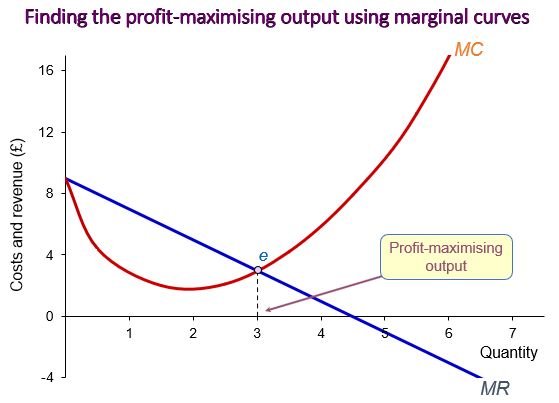

The graph of measuring max profit
At equib of MR and MC, go up to AC and AR. Total profit is the shaded blue area.