West and Central asia

0.0(0)
Studied by 0 people
call kaiCall Kai
learnLearn
examPractice Test
spaced repetitionSpaced Repetition
heart puzzleMatch
flashcardsFlashcards
GameKnowt Play
Card Sorting

1/10

encourage image

There's no tags or description

Looks like no tags are added yet.

11 Terms

1
New cards
<p>The Kabba</p>

The Kabba

631–632 C.E.

Granite masonry, covered with silk curtain and calligraphy in gold and silver-wrapped thread

The Blackstone (Al-Hajar al-Aswad), which is said to have been given to Ibrahim by the archangel Gabriel) is the only remaining portion of the original Kaaba, and is encased in its eastern corner.

<p>631–632 C.E.</p><p>Granite masonry, covered with silk curtain and calligraphy in gold and silver-wrapped thread</p><p>The Blackstone (Al-Hajar al-Aswad), which is said to have been given to Ibrahim by the archangel Gabriel) is the only remaining portion of the original Kaaba, and is encased in its eastern corner.</p>
2
New cards

Dome of the rock

Jerusalem, Palestine. Islamic, Umayyad. 691–692 C.E., with multiple

renovations.
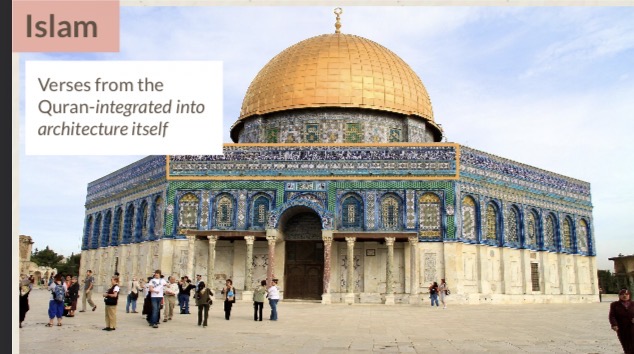
<p>Jerusalem, Palestine. Islamic, Umayyad. 691–692 C.E., with multiple</p><p>renovations.</p>
3
New cards

Great mosque

isfahan iran Islamic 700 C.E

<p>isfahan iran Islamic 700 C.E</p>
4
New cards

Folio from a qur’an

Arab, North Africa, or Near East. Abbasid. c. eighth to ninth century C.E. Ink, color, and gold on parchment.

<p>Arab, North Africa, or Near East. Abbasid. c. eighth to ninth century C.E. Ink, color, and gold on parchment.</p>
5
New cards

Basin (Baptistère de St. Louis).

1320–1340 C.E. Brass inlaid with

gold and silver

<p>1320–1340 C.E. Brass inlaid with</p><p>gold and silver</p>
6
New cards

The ardabil carpet

Maqsud of Kashan. 1539–1540 C.E. Silk and wool.

<p><span>Maqsud of Kashan. 1539–1540 C.E. Silk and wool.</span></p>
7
New cards

Bahram gur fights the karg

Great Il-Khanid Shahnama. Islamic; Persian, Il’Khanid.

c. 1330–1340 C.E. Ink and opaque watercolor, gold, and

silver on paper

<p>Great Il-Khanid Shahnama. Islamic; Persian, Il’Khanid.</p><p>c. 1330–1340 C.E. Ink and opaque watercolor, gold, and</p><p>silver on paper</p>
8
New cards

The court of gayumars

Shah Tahmasp’s

Shahnama. Sultan Muhammad. c. 1522–1525 C.E. Ink, opaque

watercolor, and gold on paper.

<p>Shah Tahmasp’s</p><p>Shahnama. Sultan Muhammad. c. 1522–1525 C.E. Ink, opaque</p><p>watercolor, and gold on paper.</p>
9
New cards

Buddha

Bamiyan,

Afghanistan. Gandharan. c.

400–800 C.E. (destroyed in

2001). Cut rock with plaster and

polychrome paint

<p><span>Bamiyan,</span></p><p><span>Afghanistan. Gandharan. c.</span></p><p><span>400–800 C.E. (destroyed in</span></p><p><span>2001). Cut rock with plaster and</span></p><p><span>polychrome paint</span></p>
10
New cards

Jojo rinpoches

Believed to have been brought to Tibet in 641 C.E. Gilt metals with semiprecious stones, pearls, and paint; various offerings

<p><span>Believed to have been brought to Tibet in 641 C.E. Gilt metals with semiprecious stones, pearls, and paint; various offerings</span></p>
11
New cards

Petra, Jordan : treasury and great temple

Nabataean Ptolemaic and Roman. c. 400 B.C.E.–100

C.E. Cut rock

<p><span>Nabataean Ptolemaic and Roman. c. 400 B.C.E.–100</span></p><p><span>C.E. Cut rock</span></p>



