[LEC] Urinary System
 Call Kai
 Learn
 Practice Test
 Spaced Repetition
 Match
 Flashcards
 Knowt Play
1/7

There's no tags or description
Looks like no tags are added yet.
8 Terms
What are the general functions of the urinary system?
Acts to balance blood plasma, especially pH levels
Removes various ions from salts
Removes nitrogenous wastes from blood plasma
Helps maintain water balance throughout cells and tissues
Helps maintain electrolyte and ion balances like potassium (K+) and sodium (Na+)
Aids in the production of red blood corpuscles; erythropoiesis
Helps maintain blood pressure
Helps maintain blood volume
Helps maintain blood composition
Produces and eliminates urine

Describe the kidneys
Functions are the same as the urinary system
Helps regulate blood pressure via renin
stimulates widespread vasoconstriction, causing increased blood pressure
stimulates the adrenal cortex to secrete aldosterone, which promotes Na+ and H20 retention
Reduces water loss in the kidneys
Helps regulate hemopoiesis via erythropoietin; hormone secreted by the kidney that stimulates erythrocyte development

Describe the ureters
Originate at the renal pelvis, exit through the renal hilum, and extend to the urinary bladder
Function to transport urine from the kidney to the urinary bladder via peristalsis
Are approximately 10 inch long narrow muscular tubes lined with transitional epithelia. The lumen is very narrow, so it can be easily obstructed by kidney stones

Renal calculi
Hard granule of calcium, phosphate, uric acid, and protein that form in the renal pelvis
Are usually small enough to pass unnoticed in urine
Some grow to several centimeters in size and block the renal pelvis or ureter, which can destroy nephrons and cause pressure to build in the kidney
Causes include:
hypercalcemia
dehydration
pH imbalances
frequent urinary tract infections
an enlarged prostate gland causing urine retention
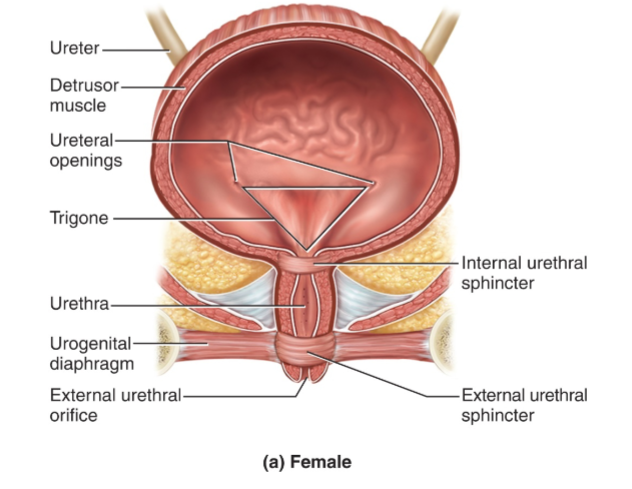
Describe the urinary bladder
Located on the floor of the pelvic cavity
Structure consists of a distensible muscular bag lined with transitional epithelium
Contains detrusor muscle; smooth muscle within urinary bladder wall that has three layers
Functions to collect and store urine until released as a result of a micturition reflex
Highly distensible, and expands superiorly as it fills
Contains rugae which flatten and causes the walls to become quite thin
Micturition stimulus occurs at approximately 200 ml
Maximum capacity is approximately 700 to 800 ml

Trigone [Structures Of The Urinary Bladder]
A triangle formed by the openings of the two ureters and the urethra on the urinary bladder floor
Common site of urinary bladder infections
Urethra [Structures Of The Urinary Bladder]
Eliminates urine from the urinary bladder following a micturition reflex
Female - 1.5 to 2 inch tube with internal and external sphincter muscles
completely separate from the reproductive system
Male - 8 to 10 inch long tube within the prostate gland
Internal urethral sphincters are involuntary
External urethral sphincters are voluntary
Nephron
The functional unit of the kidney