Neuropathic/Diabetic Foot Ulcers
 Call Kai
 Learn
 Practice Test
 Spaced Repetition
 Match
 Flashcards
 Knowt Play
1/74

There's no tags or description
Looks like no tags are added yet.
75 Terms
Diabetes, neuropathy (causes: chemo, alcohol, B12 deficiency), vascular disease, impaired ROM, foot deformities, mechanical stress, previous ulcer or amputation
List risk factors for neuropathic ulcers.
Diabetic foot ulcer
What is the MOST common type of neuropathic ulcer?
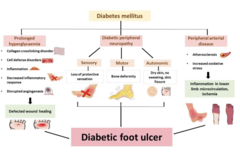
Hyperglycemia impairs ALL phases of healing:
1. Bacteria proliferate
2. Impaired production & migration of cells required for healing
3. Impaired epithelial cell migration
4. Further complicated by underlying decreased blood flow
Why is diabetes a risk factor for neuropathic ulcers?
Sensory, motor, autonomic
List the 3 types of diabetic neuropathy.
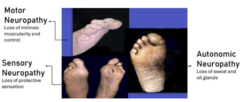
Usually, symmetrical; affects distal nerves first; severity increases w/ age, disease duration (~10 yrs), poor glucose control
What do all 3 types of diabetic neuropathy have in common?

Sensory
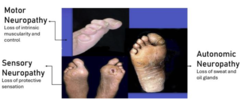
_______: type of diabetic neuropathy; poor awareness of trauma to the feet; occurs gradually; presents w/ paresthesias (burning, tingling, aching) that are painful and debilitating w/ false sense of protective sensation
Motor
_______: type of diabetic neuropathy; paralysis of foot intrinsics w/ increased plantar forces, hallux valgus, claw toe, hammer toe

Autonomic
_______: type of diabetic neuropathy; altered sweating, callus formation, blood flow (AV shunting, vasodilation)

Reduced blood flow --> poor oxygen and nutrient delivery, slowed inflammatory and proliferative phases of healing, increased risk of infection
Why is vascular disease a risk factor for neuropathic ulcers?
Hyperglycemia --> formation of products which stiffen collagen in tendons, ligaments, and joint capsules --> reduced ankle and toe mobility --> altered gait mechanics --> abnormal plantar pressures (esp. forefoot and toes) --> loss of protective sensation --> further abnormal gait pattern
Why is impaired ROM a risk factor for neuropathic ulcers?

Motor neuropathy affects the nerves that control the foot muscles --> muscle imbalance (esp. b/w flexors and extensors) --> deformities (ex: hammertoes, claw toes, prominent MT heads, high arches vs. flat feet, Charcot foot (neuroarthropathy)) --> altered gait pattern and subsequent pressures
Why are foot deformities a risk factor for neuropathic ulcers?
Unnoticed stresses (ex: tight shoes, foreign objects, blisters or minor injuries) --> repetitive trauma and skin breakdown --> limited joint mobility --> reduces ability of foot to absorb and adapt
Why is mechanical stress a risk factor for neuropathic ulcers?
HIGHLY RECURRENT!!
Why are previous ulcers or amputations a risk factor for neuropathic ulcers?
Lab values (FBG, HbA1C, albumin & pre-albumin), inspection of skin & toenails (may be dry and scaly w/ calluses), foot deformity, vascular (pulses, ABI), motor/ROM (MMT, flexibility, general gait & balance), sensory testing (monofilament), LE reflexes, LLD, CHECK OTHER FOOT
What should encompass a clinical exam?
Hallux Valgus = lateral deviation of the hallux (may have a medial prominence @ 1st MTP joint) w/ angle >15 deg
ID & define the foot deformity.

Abnormal foot mechanics, abnormal 1st MTP anatomy, joint hypermobility, genetic predisposition and inflammatory joint disease, ill-fitting footwear
What causes Hallux Valgus?
Bunion = prominences on the outer edges of the feet (bunion = big toe, bunionette = little toe)
ID & define the foot deformity.
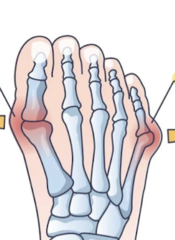
More prevalent in populations who wear shoes, 2x as common in women
What causes bunions?
Hammertoe = primarily affects the PIP joint, causing it to curl downward
ID & define the foot deformity.

Claw toe = involves a more complex bending pattern, w/ the toe bending UP @ the MTP and then DOWN @ PIP and DIP joints, thus resembling a claw
ID & define the foot deformity.

Mallet toe = primarily affects the DIP joint, causing it to curl downward
ID & define the foot deformity.

Plantar flexed first ray = 1st MT is positioned lower then the other MT bones
ID & define the foot deformity.

Pes equinus = DF is limited (usually due to a tight Achilles tendon)
ID & define the foot deformity.

Pes cavus = high arch
ID & define the foot deformity.

Pes planus = flat arch
ID & define the foot deformity.

Hallux limitus
ID & define the foot deformity. (note: there is LIMITED ROM)

Hallux rigidus
ID & define the foot deformity. (note: there is NO ROM)

Charcot arthropathy = "rocker bottom" deformity w/ twisted 1st MT bone, boney fragmentation, fused joints, etc.
ID & define the foot deformity.

Grade O
Label the Wagner.
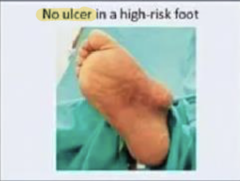
Grade 1
Label the Wagner.

Grade 2
Label the Wagner.

Grade 3
Label the Wagner.
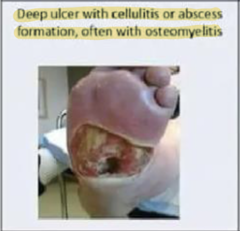
Grade 4
Label the Wagner.
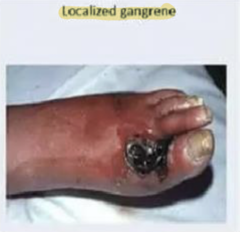
Grade 5
Label the Wagner.

Non-custom diabetic shoe (also known as therapeutic shoes or extra depth shoes) -- specifically designed to protect the feet of individuals w/ diabetes
ID & describe the shoe.
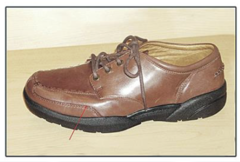
Extra depth and width, protective materials (soft, seam-free to prevent irritation and reduce the risk of blisters or sores forming), firm heel counter (provide stability and prevent excessive motion), non-binding uppers (designed not to constrict or bind the feet, ensuring proper circulation), shock absorption (extra cushioning to absorb shocks, reducing pressure)
What are the KEY features of non-custom diabetic shoes?

Custom diabetic shoes -- rocker soles can change the timing of your gait cycle and/or stride length and restore ROM lost in the foot or ankle due to injury or arthritis. help unload sensitive parts of the foot, reduce calluses, and prevent ulcers.
ID & describe the shoe.

Ankle joint rocker (customized rocker sole for a customized diabetic shoe) - inhibits demand for motion in the ankle joint
ID & describe the shoe.

Lisfranc rocker (customized rocker sole for a custom diabetic shoe) - reduces propulsive force to the midfoot
ID & describe the shoe.

Met-head rocker (customized rocker sole for a custom diabetic shoe) - reduces GRF to ball
ID & describe the shoe.

MPJ rocker (customized rocker sole for a custom diabetic shoe) - inhibits demand for DF of toes
ID & describe the shoe.
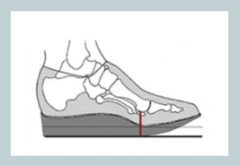
Heel rocker (customized rocker sole for a custom diabetic shoe) - elevations are useful to compensate for LLD
ID & describe the shoe.

Healing rocker (customized rocker sole for a custom diabetic shoe) - holds foot DF to off-load forefoot
ID & describe the shoe.

Custom diabetic insoles/orthotics
ID what this image is depicting.

Peg assist insole -- carefully remove the pegs beneath the marked area where the off-loading should take place (make sure this is larger than the wound itself)
ID what this image is depicting.

Post-op shoe (also called a surgical shoe) -- post op but also for diabetic/ general foot ulcers
ID & describe the shoe.

Pressure relief (redistribute BW across the foot and reduce pressure on the ulcerated area), immobilization (prevent further injury or irritation), accommodates dressings (deeper and wider than a regular shoe), prevention of further injury (rigid shoe helps prevent bending and twisting of the foot --> reduces risk of further injury), custom fit
What are the KEY features of post-op shoes?
Ortho wedge shoe
ID the shoe.
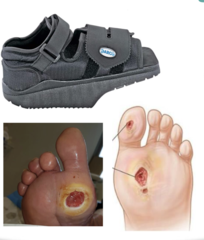
Total contact cast -- gold standard of care for offloading diabetic foot ulcers (customized w/ forced compliance); treats diabetic foot ulcers, Charcot foot, post-surgical recovery, foot fractures in diabetics
ID what this image is depicting.

Custom fit, rigid structure, seamless interior, frequent reapplication
What are the KEY features of a total contact cast?
Diabetic healing (DH) walker -- similar to a total contact cast BUT is not customizable and can be removed
ID & describe the orthotic.

Rigid sole (provides stability and prevents excess foot movement), adjustable straps (allows for a customized fit), rockered bottom sole (often curved to allow for a more natural gait), padded interior
What are the MAIN features of a DH walker?
Diabetic foot ulcers, post-surgical healing, Charcot foot
Which conditions are treated w/ a DH walker?
Wound healing sandal
ID the shoe.

Misc offloading pads
ID what this image is depicting.

Hyperglycemia impairs ALL phases of healing
Guiding question: Which phases of healing can diabetes delay and compound?
Hyperglycemia impairs ALL phases of healing by way of the following:
1. Bacteria proliferate
2. Impaired production & migration of cells required for healing
3. Impaired epithelial cell migration
4. Further complicated by underlying decreased blood flow
**INFLAMMATION, DECREASED INFLAMMATORY RESPONSE, DISRUPTED ANGIOGENESIS**
Guiding question: How can diabetes impair healing? Can you explain it?
Sensory (loss of protective sensation), motor (bone deformity), autonomic (dry skin, no sweating, skin fissure)
Guiding question: What three primary categories of nerves does tri-neuropathy (also simply known as neuropathy) affect?
Syndrome in patients who have peripheral neuropathy in the foot and ankle (note: patients may experience fractures and dislocations of bones and joints with minimal or no known trauma)
Guiding question: What is Charcot arthropathy? (aka Charcot neuroarthropathy or Charcot foot)
10-g monofilament testing (failure to feel the 10-g monofilament at >1 plantar site indicates loss of protective sensation; ADA and IWGDF guidelines both emphasize that even a single missed site is clinically significant)
Guiding question: How can we assess for loss of protective sensation? At what point do we consider the patient has indeed lost protective sensation and needs to perform daily self-foot screens?

Pain: painless
Appearance: well-defined, usually surrounded by callus, base can be pink/red and granulating if not infected
Temperature: warm w/ good pulses
Associated findings: evidence of neuropathy and/or foot deformities
Location: pressure points on the plantar surface of the foot
Guiding question: What are the characteristics of a neuropathic ulcer? Where are they typically located?
Grade 0 = no ulcer in high-risk foot
Grade 1 = superficial ulcer involving the full skin thickness but not underlying tissues
Grade 2 = deep ulcer, penetrating down to ligaments and muscle, but no bone involvement or abscess formation
Grade 3 = deep ulcer w/ cellulitis or abscess formation, often w/ osteomyelitis
Grade 4 = localized gangrene
Grade 5 = extensive gangrene involving the whole foot
Guiding question: Can you write down the Wagner scale from memory?
Offloading (pressure relief)
Guiding question: What is the most important treatment to effectively address the cause of neuropathic ulcers and without this, they will not heal?
Total contract casting (TCC)
Guiding question: What is the gold standard of care in treating neuropathic ulcers?
Co-morbidities (including poorly managed diabetes), duration of diabetes (~10 years), age, smoking & alcohol, diabetic complications, genetic predisposition
Guiding question: What are the risk factors for developing diabetic neuropathy?
1. Inspection of skin & toenails
2. Foot deformity
3. Vascular
4. Motor/ROM
5. Sensory testing
6. LE reflexes
Guiding question: What are the five primary components of a diabetic foot screen?
Pressure (vertical load/WB stress) & shear (horizontal/frictional force)
Guiding question: What two primary forces do we need to reduce as practitioners to heal neuropathic ulcers and protect the skin?
Lateral deviation of the great toe @ 1dt MTP joint --> alters push-off mechanics (less effective push-off w/ shift toward the lesser MTs), redistributes plantar pressure, reduces stability (may cause increased pronation), pain and compensation (may cause shortened stride length, avoidance of push-off, or ER of the foot)
Guiding question: What is hallux valgus? How might it influence gait mechanics?
Claw = hyperextension @ MTP + flexion @ PIP and DIP; may necessitate extra-depth shoes, soft, wide toe box, custom orthotics, protective padding
vs.
Hammer toe = flexion @ PIP joint; may necessitate wide and high toe box, cushioned insoles/MT pads
Guiding question: What is the difference between claw and hammer toes? How might they influence footwear design recommendations?
Dorsiflexion is limited -- typically due to a tight Achilles tendon
Guiding question: What is equinus and why does it occur typically?
Pes cavus = high-arched foot deformity
Etiology = neurologic conditions w/ muscle imbalances (intrinsic foots overpower the extrinsic toe flexors/ extensors and plantar fascia contracts)
**Ulcers occur on heel (posterior or plantar surface) and MT heads (esp. 1st and 5th); may also occur on the toe tips (from clawing) or dorsal PIP joints (friction against footwear)**
Guiding question: What is fixed pes cavus? Why does it occur? How might it influence ulcer development? Where would ulcers typically occur?
Hallux limitus = limited ROM
Hallux rigidus = no ROM
Guiding question: What is the difference between hallux limitus and hallux rigidus?
Offloading devices: custom accommodative insoles, extra cushioning, extra depth and wide toe box, rocker soles, shear-reducing liners and seamless interior, rigid soles and heel counter
Guiding question: What footwear features can enhance surface area contact, provide offloading for foot deformities, reduce shear, and reduce forefoot push-off pressures/shear?
Diabetes, neuropathy, vascular disease, impaired ROM, foot deformities, mechanical stress, previous ulcer or amputation
Guiding question: What are the primary contributing factors for development of a diabetic foot ulcer (neuropathic wound)?
Calluses are areas of thickened skin (hyperkeratosis) that formed in response to repetitive pressure and shear @ WB sites
They are problematic bc they mask underlying pressure injury, increase focal plantar pressure, serve as a precursor to ulceration, and harbor infection
Guiding question: Why do calluses develop? Why are they problematic for someone with neuropathy?