Development of Male Genital System
 Call Kai
 Learn
Learn Practice Test
 Spaced Repetition
 Match
Match Flashcards
 Knowt Play
1/23

There's no tags or description
Looks like no tags are added yet.
Name | Mastery | Learn | Test | Matching | Spaced | Call with Kai | Chat |
|---|
No analytics yet
Send a link to your students to track their progress
24 Terms
What embryonic germ layer and primitive ridge give rise to the male reproductive system?
intermediate mesoderm + urogenital ridge
urogenital ridge = lateral nephrogenic cord + medial gonadal cord

describe what happens in primordial germ migration?
Initially, the gonadal ridge is sterile. Primordial germ cells develop around the yolk sac/gut tube and migrate into the indifferent gonad to establish the germline


What three sets of embryonic kidneys develop sequentially from the nephrogenic cord?
Pronephros: Located in the cervical region
Mesonephros: Located in the thoracolumbar region
Metanephros: Located in the sacral region (forms the definitive adult kidney)
What genetic factor initiates male gonad differentiation, and which cells does it act upon first?
The SRY gene located on the short arm of the Y chromosome expresses Testis-Determining Factor (TDF)
TDF initiates testicular differentiation by driving primitive sex cords and somatic cells to differentiate into Sertoli cells
What THREE key histological changes occur in the developing testis around the 6th week of gestation?
Tunica Albuginea Formation → thickened mesothelial covering of the gonadal ridge
Testicular Cords: The central medullary region arranges into solid primary sex cords (testis cords) composed of primitive germ cells surrounded by Sertoli cells
Seminiferous Tubules: These solid testicular cords later acquire a lumen to form the seminiferous tubules

What are the two major endocrine cell types of the fetal testis, and what primary hormones do they secrete?
Sertoli Cells: Secrete Anti-Müllerian Hormone (AMH)
Leydig (Interstitial) Cells: Secrete androgens (testosterone)

How do the testis cords connect to the mesonephric (Wolffian) duct system?
Testis cords connect to the rete testis, which links to the efferent ductules
The efferent ductules develop from persisting mesonephric tubules and empty into the mesonephric (Wolffian) duct
What adult internal structures derive from the Mesonephric (Wolffian) duct under Leydig cell androgen stimulation?
Seminal vesicle
Ejaculatory duct
Epididymus
Ductus deferens
What is the fate of the Paramesonephric (Müllerian) ducts in a male embryo, and what hormone mediates this process?
AMH
cranial remnant → appendix testis
caudal remnant → prostatic utricle
What enzyme converts testosterone into Dihydrotestosterone (DHT), and which male structures strictly depend on DHT?
Enzyme: 5α-reductase
DHT-Dependent Structures: The prostate gland, bulbourethral glands, and external genitalia
What are the embryonic origins of the prostate gland?
Arises as endodermal epithelial buds from the prostatic urethra into the surrounding mesenchyme near the ends of the mesonephric ducts
What are the embryonic origins of the bulbourethral glands?
Arise as endodermal buds from the spongy (penile) urethra
What adult male external structures develop from the genital tubercle, urogenital folds, lateral tubercles, and labioscrotal swellings under DHT influence?

Where do the testes initially develop, and how do they descend into the scrotum?
Testes develop high on the posterior abdominal wall
Guided by the gubernaculum, they descend through the abdominal wall and inguinal canal into the scrotum in the last two months of gestation
Why is testicular descent into the scrotum physiologically necessary?
cooler environment for spermatogenesis
What is the Processus Vaginalis, and what is its normal fate following testicular descent?
it is an extension of the peritoneal cavity, it becomes the tunica vaginalis

What is Cryptorchidism, and what are its major long-term clinical complications and treatment?
Definition: Failure of one or both testicles to descend from the abdominal cavity/inguinal canal into the scrotum
Complications: Increased risk of infertility, testicular cancer, and testicular torsion
Treatment: Hormonal therapy / orchidopexy
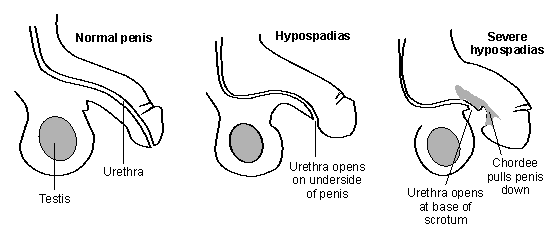
What embryological defect causes Hypospadias?
Incomplete or improper fusion of the urogenital (urethral) folds during foetal development
What embryological defect causes Epispadias?
Abnormal development and defective positioning of the genital tubercle
What clinical conditions arise from a Patent Processus Vaginalis?
Indirect Inguinal Hernia or a Communicating Hydrocele (serous fluid collection around the testis in the scrotum)

What is Persistent Müllerian Duct Syndrome (PMDS), and what is its underlying hormonal mechanism?
Presentation: A phenotypically normal 46,XY male found to have internal remnants of a uterus and fallopian tubes during surgery for undescended testes
Mechanism: Defective secretion of Anti-Müllerian Hormone (AMH) by foetal Sertoli cells or AMH receptor resistance, resulting in failure of the paramesonephric ducts to regress
A teenage male undergoing evaluation for obstructive azoospermia is found to have congenital bilateral absence of the vas deferens and seminal vesicles. Which embryonic duct failed to develop?
Mesonephric (Wolffian) duct
A 9-month-old male infant is brought in for a routine check-up, and the pediatrician notes an empty right scrotal sac with a palpable lump in the right groin. What is the diagnosis and recommended surgical procedure?
Diagnosis: Right-sided Cryptorchidism (undescended testis)
Procedure: Orchidopexy