8.7 Carbohydrates as Informational Molecules
 Call Kai
 Learn
 Practice Test
 Spaced Repetition
 Match
 Flashcards
 Knowt Play
1/4

There's no tags or description
Looks like no tags are added yet.
5 Terms
Using sugars as Information
→ oligosaccharides in glycoproteins & glycolipids can be used as recognition structures for INTERmolecular interactions:
protein targeting/sorting (ex. addition of phosphorylated mannose’s)
cell/cell interactions (specific oligosac may be recognized/bound by specific enzymes)
signalling
tissue development
→ oligosaccharides are a rich source of structural variation:
multiple monosac & derivatives
branched structures
glycosidic configuration variations
Lectins
Lectins = proteins that bind to carbs (oligosac) w HIGH specificity
found in all organisms
role: cell-cell recognition, signalling, adhesion processes, & INTRAcellular targeting of newly synthesized proteins
involve a protein/ligand interaction:
an equilibrium binding process
oligosac (or portions of them) interact w binding sites on protein
changing pH or the nature of the oligosac may interfere with binding interactions
→ lectin : carb binding interactions (Kd) are SENSITIVE to ionic strength & pH
changes in pH affect interaction
changes in nature of oligosac may interfere with binding interaction
Lectin: Specificity example (DONT NEED TO KNOW) - Galectin-2
binding of lactose (Gal(B1→4)Glc) to galectin-2:
H-bonds are expected in binding interaction
van der Waals interactions form b/w non-polar groups
glycoproteins w this sugar structure (lactose) as a part of a larger oligosac will also bind to galectin-2
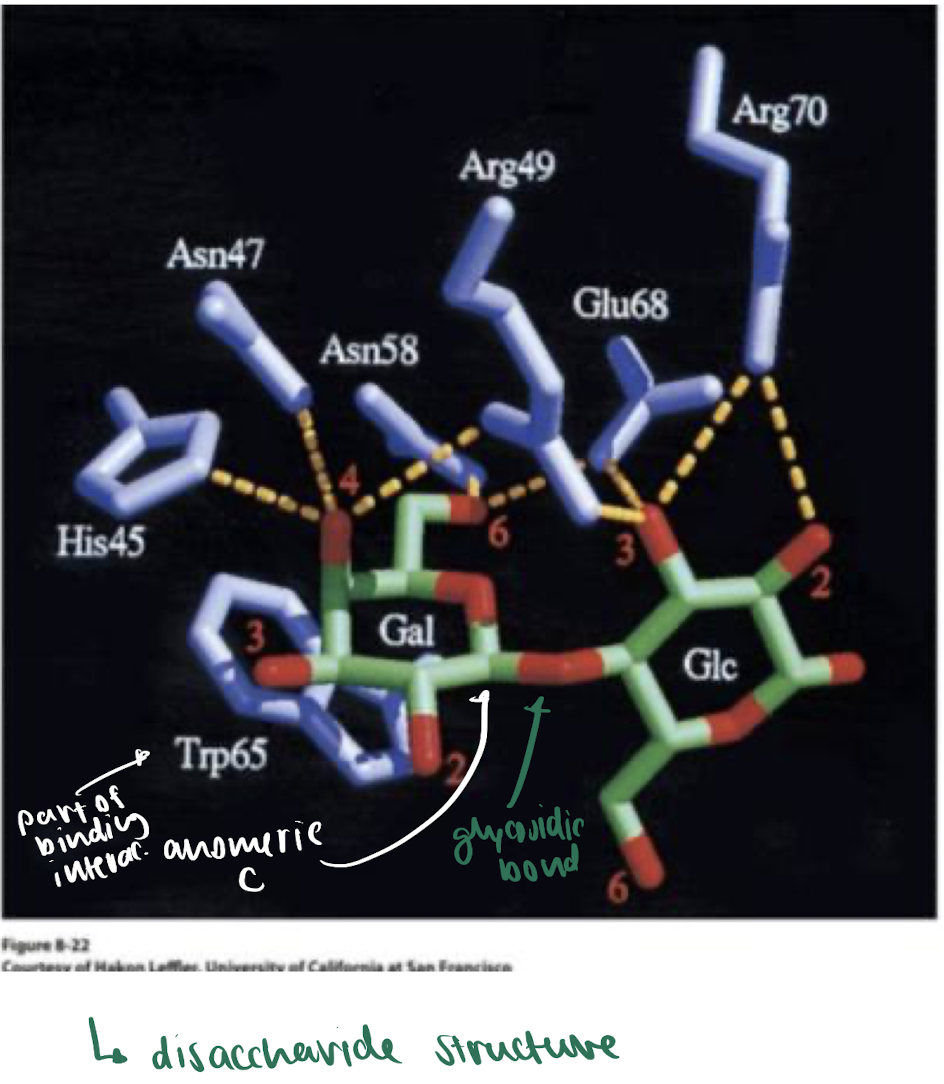
note: Kd could be impacted by change sin environment (may be part of its fxn)
ex. viruses entering cells impact binding interactions as part of their fxn
Q.

diff b/w Glc & Gal: Gal’s c4 OH is BELOW the ring
as a result of the new dissac containing Galactose whose C4 OH is below the ring, instead of above in Glc, its OH interferes w the H-bonds at c4 + it’s directed at the PHOBIC Trp65
THUS, breaks favourable interactions & forms unfavourable
result: affects interactions with His 45, Asn 47, Arg 49, & Trp 65
bc they’re all near the c4 OH

.