TUTORING Social Influence
 Call Kai
 Learn
 Practice Test
 Spaced Repetition
 Match
 Flashcards
 Knowt Play
1/38

There's no tags or description
Looks like no tags are added yet.
39 Terms
Social influence
The scientific study of the ways in which people’s thoughts, feelings and behaviours are affected by other people.
Types of conformity
Conformity is a type of social influence. It is defined as “yielding to group pressures”.
There are 2 types of conformity:
Compliance
Internalisation
Compliance
Conforming to gain approval/ avoid disapproval. Motivated by the desire to “fit in” with the group. So someone changes their views publicly but not privately.
Internalisation
When an individual conforms because they have accepted the group’s views. Therefore, the individual has changed their views publicly and privately.
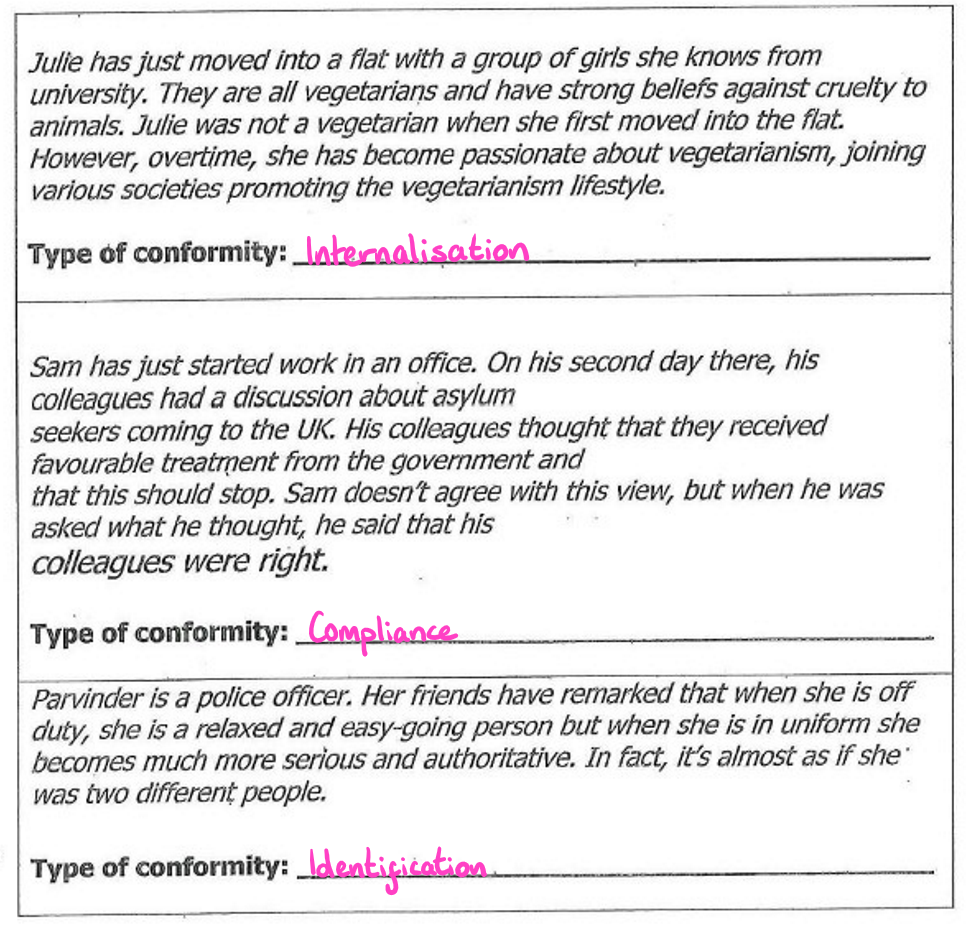
Real-life examples of conformity
See the image attached for real-life examples of the 3 different types of conformity
Explanations for conformity
Informational social influence
Normative social influence
Informational Social Influence
When someone conforms because they want to be right, so they look to others to have the right answer in a situation. They are motivated by the desire to be correct. When a person is unsure, they would look to others for information.
It usually leads to internalisation and occurs in situations where we do not have the knowledge or expertise to make our own decisions.
E.g. a person following the direction of a crowd in an emergency - even though the don’t know where they’re going, they assume that everyone else is going to the right place.
Evidence: Fein et al. asked participants to vote for a US presidential candidate after they saw others voting for somebody else. Most of the participants changed their mind because they wanted to be “correct”, thus demonstrating the impact of information social influence as a mechanism for conformity.
There is also evidence to support the role of informational social influence. For example, Lucas et al found that conformity to an obviously incorrect maths answer was greater when the question was more difficult and the participant rated their own maths ability unfavourably. This shows that individuals are more likely to turn to others when they lack the information to make their own informed decisions i.e. in an ambiguous situation.
Jenness (1932) asked students to guess how many beans there were in a jar. They were asked to discuss their estimates and, finally, asked individually to give their estimates again. Jenness found that estimates tended to converge to a group norm. This is an example of informational social influence as the students conformed because they wanted to be correct.
Normative Social Influence
When someone conforms because they want to be liked and to be part of a group. They are motivated by the need to fit in with the group.
It usually leads to compliance.
E.g. a person starting to smoke because they are surrounded by other people who smoke.
Evidence: There is evidence supporting the link between normative social influence and bullying, thus suggesting a real-life application with an increased understanding of the different types of conformity. Garandeau and Cillissen found that a boy can be manipulated by a bully into victimising another child because the bully provides a common goal for the boy’s group of friends, the goal is to victimise the other child, so the boy would most likely also victimise the child to avoid disapproval from his friends.
Asch also supports normative social influence - participants reported that they conformed to fit in with the group, so it supports the idea of normative influence, which states that people conform to fit in when privately disagreeing with the majority.
Normative Social Influence vs Informational Social Influence
NSI and ISI may not be mutually exclusive (means it may not be the case that they cannot exist at the same time)
For example, a dissenting confederate can provide social support, thus reducing the effect of NSI through providing the naïve participant with a supporting, similar view. Equally, this can also reduce the effect of ISI through the confederate proving the participant with an alternative source of information. This means that it may be more beneficial to look at NSI and ISI as complementary, as opposed to mutually exclusive mechanisms.
Internalisation is often linked to informational social influence whereas compliance is often linked to normative social influence.
Solomon Asch (1956) AO1
This is a dispositional example of conformity.
Aim:
To investigate conformity and majority influence.
Procedure:
123 male US undergraduates were tested. There were also confederates involved. They were seated around a table and were presented with three lines of different lengths and also a standard line. They were asked to state which of the three lines was the same length as the standard line and they took turns calling out their answer. The real participant was seated so that they would always answer second to last.
There were 18 trials, and on 12 of these trials (the critical trials), the confederates all gave the same incorrect answer. The correct answer was unambiguous.
Asch interviewed the real participant afterwards.
Asch also conducted a control experiment, without confederates giving wrong answers. This was to confirm that the lines were unambiguous.
Findings:
Conformity rate during the 12 critical trials was 33%.
25% never conformed.
50% participants conformed on 6 or more of the critical trials.
75% conformed at least once.
1 in 20 of the participants (5%) conformed on all 12 critical trials.
In a control trial, only 1% of responses given by participants were incorrect (which eliminates eyesight/perception as an extraneous variable, thus increasing the validity of the conclusions drawn).
When Asch interviewed his participants afterwards, he discovered that the majority of participants who had conformed has simply changed their public behaviour but privately they continued to trust their own perceptions and judgements. So, they conformed and gave incorrect answers to avoid disapproval from the others, therefore they showed compliance.
Variables affecting conformity (situational)
Asch repeated his original study, with changed variables, multiple times to determine which variables had the most significant effects on the level of conformity shown by the participants.
Group size
Unanimity
Task difficulty
DUG. Difficulty, Unanimity, Group size.
Group size/size of majority - Asch found that there was not a high level of conformity when the majority consisted of one or two confederates. However, with 3 confederates, the proportion of conforming responses rose to around 30%. Further increases in the number of confederates did not increase the level of conformity much, therefore the size of the group is important but only up to a point.
Point: An individual is more likely to conform when in a larger group.
Evidence: There was low conformity with group size of confederates were less than 3 - any more than 3 and the conformity rose by 30%
Explanation: a person is more likely to conform if all members of the group are in agreement and give the same answer, because it will increase their confidence in correctness of the group, and decrease their confidence in their own answer. Conformity does not seem to increase in groups larger than four so this is considered the optimal group size.
Link: This shows that the majority must be at least 3 to exert an influence, but an overwhelming majority is not needed in all instances to bring about conformity.
Unanimity - In the original study, all of the confederates were unanimous with their (incorrect) answers. So, did this unanimity of the majority affect levels of majority?
→ When the real participant was given the support of either another real participant (or a confederate that had been instructed to give the right answer), conformity levels dropped - the percentage of wrong answers given went from 33% to 5.5%.
→ When another real participant (or a confederate who had been instructed to do so) gave an answer different from the majority and the true answer, conformity rates dropped to 9%.
Therefore, Asch concluded that it was breaking the group’s unanimous positions that was the major factor in conformity reduction.
Point: An individual is more likely to conform when the group is unanimous i.e. all give the same answer, as opposed to them all giving different answers.
Evidence: When joined by another participant or disaffected confederate who gave the correct answer, conformity fell from 32% to 5.5%. If different answers are given, it falls from 32% to 9%.
Explanation: the more unanimous the group is, the more confidence the participant will have that they are all correct, and therefore the participant’s answer is more likely to be incorrect.
Link: Unanimity is vital in establishing a consistent majority view, which is particularly important by providing normative social influence through preventing any conflicting views arising.
Difficulty of the task - In one variation, Asch made the differences between the line lengths less obvious. Under these circumstances, the level of conformity increased. This is likely to be because when people are uncertain, they look to others for confirmation. Therefore, the more difficult the task, the greater the conformity.
Point: An individual is more likely to conform when the task is difficult
Evidence: For example, Asch altered the lines, making them more similar in length. Since it was harder to judge the correct answer conformity increased.
Evidence: When the task is difficult, we are more uncertain of our answer so we look to others for confirmation. The more difficult the task the greater the conformity.
Link: This suggests that informational social influence is a major mechanism for conformity when the situation is ambiguous and the individual does not have enough of their own knowledge or information to make an informed decision independently, and so has to look towards others.
Solomon Asch (1956) AO3
- Asch’s research may be a “child of its time” as it took place during 1956 when the US was in the period of McCarthyism. This was a strong anti-Communist period when people were scared to go against the majority in order to avoid severe punishment, therefore people during this time were more likely to conform. Some years later, Perrin and Spencer (1980) attempted to repeat Asch’s study in the UK. In their initial study, they obtained only one conforming response out of a total of 396 trials where a majority unanimously gave the same wrong answer. However, in a subsequent study, where they used youths on probation as participants and probation officers as the confederates, they found similar levels of conformity to those found by Asch. This suggests that conformity is more likely if the perceived costs of not conforming are high, which would have been the case during the McCarthy era in the US and therefore the study lacks temporal validity.
- /+ The confederates in Asch’s study may not have acted convincingly when giving the wrong answer, however, Mori and Arai (2010) overcome the confederate problem by using a technique where participants wore glasses with special polarising filters. Three participants in each group wore identical glasses and a fourth wore a different set with a different filter. This meant that each participant viewed the same stimuli but one participant saw them differently causing them to judge that a different comparison line matched the standard line. For female participants, the results closely matched those of Asch’s original study. This suggests that the confederates in the original study had acted convincingly, reinforcing the validity of Asch’s findings.
+ There was strict control over extraneous variables, such as timing of assessment and the type of task used. The participants did the experiment before without confederates to see if they actually knew the correct answer, thus removing the confounding variable of a lack of knowledge. This suggests that valid and reliable ‘cause and effect’ relationships can be established, as well as valid conclusions. This increases the study’s internal validity.
- A limitation of the study is that it lacks ecological validity. This is because the task involved participants judging the length of lines, which is an artificial and simplistic scenario. This does not reflect the complexity of real-life conformity, where decisions are often influenced by emotional, social, and contextual factors. In real-world situations, conformity can occur due to peer pressure, social norms, or fear of rejection - factors that are not captured in a controlled lab setting. Therefore, the study’s findings may not be applicable to real-world conformity, limiting its external validity.
- Lacks population validity due to sampling issues - For example, the participants were only American male undergraduates, and so the study was subject to gender bias, where it is assumed that findings from male participants can be generalised to females (i.e. beta bias).
Solomon Asch (1956) ethical issues
There was deception as participants were tricked into thinking the study was about perception rather than compliance so they could not give informed consent.
There could have been psychological harm as the participants could have been embarrassed after realising the true aims of the study.
The researchers breached the BPS ethical guideline of deception and consequently, the ability to give informed consent. However, the participants were debriefed.
Such issues simply mean that a cost-benefit analysis is required to evaluate whether the ethical costs are smaller than the benefits of increased knowledge of the field. They do not affect the validity or reliability of findings!
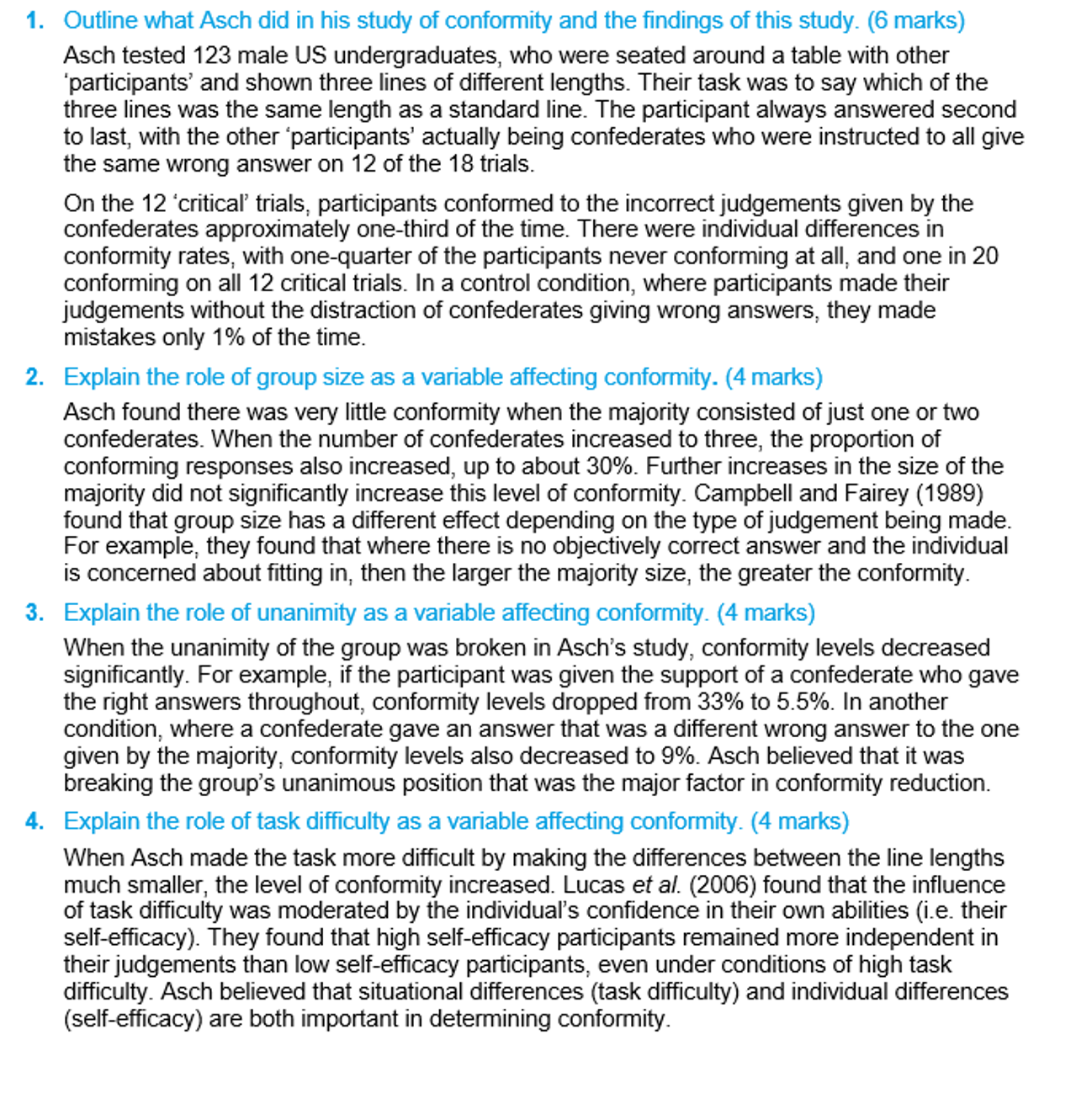
Solomon Asch (1956) Questions
See the image attached.
Milgram (1963) AO1
Aim:
To observe whether people would obey a figure of authority when told to harm another person i.e. evaluating the influence of a destructive authority figure.
Procedure:
40 male participants were used, aged between 25 and 50
Conducted in a psychology lab at Yale university
Participants were told it was a test on memory
There were two confederates: an authority figure (the experimenter) and a 47 year old man who was introduced as another volunteer participant.
The real participant and the fake participant drew lots to see who would be the “teacher” and who would be the “learner. The results were rigged so that the real participant would always be the teacher.
The teacher was instructed by the experimenter to test the learner on his ability to remember word pairs and every time he got an answer wrong, the teacher had to administer increasingly strong electric shocks, going up in 15 volt increments starting at 15 volts then going up to the maximum shock level of 450 volts (fatal).
The shocks were not actually real and the confederate was just acting but the participant did not know this.
The experimenter (dressed in a lab coat) had 4 prods to say each time participants refused to administer shocks, if the participant was unwilling after all 4 prods had been said then they could withdraw.
1) “Please continue/go on”
2) “The experiment requires that you continue”
3) “You have no other choice, you must go on”
4) “Although the shocks may be painful, they are not harmful”
After 300 volts were administered, the learner would stop screaming in pain and would go silent.
Findings:
65% of participants went up to 450V (despite the shock generator being labelled “Dangerous”)
All participants went to at least 300V
12.5% stopped at 300V
Situational variables affecting obedience
Milgram conducted variations of his study.
The factors affecting obedience: PUL
Proximity:
Participants obeyed more when the experimenter was in the same room. In the experimenter-absent variation, the experimenter left the room and gave subsequent orders over the telephone and obedience dropped to 20.5%. When the teacher and learner were seated in the same room and the teacher was able to see the reactions of the learner, obedience dropped to 40%. In the touch-proximity variation, the teacher was required to force the learner’s hand onto a shock plate and obedience dropped to 30%.
Location:
Participants claimed that the location (a psychology lab at Yale university) gave them confidence in the integrity of the people involved. So, in the different location variation, the experiment was conducted in a run-down office block in the town centre, rather than the prestigious Yale University lab. This caused obedience to drop slightly to 47.5%.
Uniform:
For Milgram, participants obeyed more when the experimenter wore a lab coat. Bushman (1988) carried out a study with a female researcher dressed either in police uniform, business executive attire or beggar clothes. She stopped people in the street and told them to give change to a male researcher for an expired parking meter. Findings showed that when in police uniform, 72% of the people obeyed whereas obedience levels were much lower otherwise (48% as a business executive and 5.2% as a beggar). When interviewed afterwards, the people said that they obeyed the woman in uniform because she appeared to have authority.
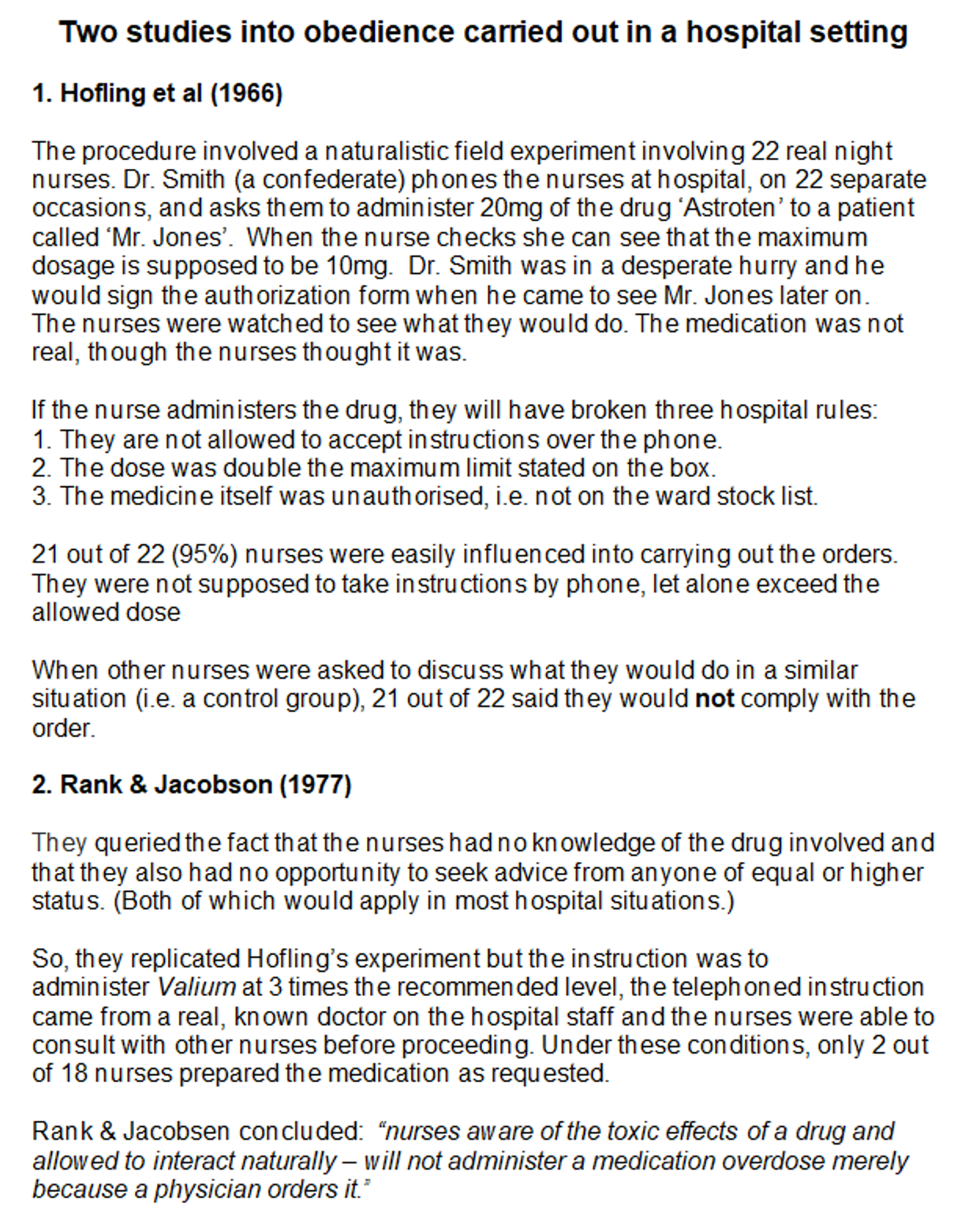
Two studies into obedience carried out in a hospital setting
See image attached.
Milgram (1963) AO3
+ Gina Perry reviewed the interview tapes and found that a significant number of participants raised questions about the legitimacy of the electric shocks. However, quantitative data gathered by Milgram directly suggested that 70% of participants believed that the shocks were real - these findings appear plausible when considering that 100% of the females used in Sheridan and King’s study administered real electric shocks to puppies. This suggests that although the findings were certainly surprising, they were also likely to be accurate therefore increasing internal validity. (See image attached for Sheridan and King’s study)
+ Hofling et al (1966) observed the behaviour of doctors and nurses in a natural experiment (covert observation). The researchers found that 95% of nurses in a hospital obeyed a doctor (confederate) over the phone to increase the dosage of a patient’s medicine to double what is advised on the bottle. This suggests that ‘everyday’ individuals are still susceptible to obeying destructive authority figures therefore increasing the external validity of Milgram’s study.
+ The procedure has been repeated all over the world, where consistent and similar obedience levels have been found. For example, in a replication of Milgram’s study using the TV pseudonym of Le Jeu de la Mort, researchers found that 85% of participants were willing to give lethal electric shocks to an unconscious man (confederate), whilst being cheered on by a presenter and a TV audience. Therefore the study highly replicable which increases the reliability of the findings.
+ The study has real life applications as it opened people’s eyes to the problem of obedience and so may reduce future obedience in response to destructive authority figures e.g. obedience has resulted in negative social change - the Nazis obeyed orders and as a result, Hitler managed to get what he wanted and what he wanted was not what the majority of people wanted. Such research also gives an insight into why people were so willing to kill innocent Jews simply when told to, and so highlights how people can easily be victims to such pressures. A general awareness of the power of such influences is useful in establishing social order and moral behaviours.
- The setting was in a lab and was thus artificial and additionally tasks given to participants are not like those anyone would encounter in real life e.g. shooting somebody in the face is different from flicking a switch, meaning that the methodology lacks mundane realism and thus the findings lack ecological validity
- Participants in psychological studies may have learnt to distrust experimenters because they know that the true purpose of the study may be disguised. Perry (2012) discovered that may of Milgram’s participants had been sceptical at the time about whether the shocks were real. Since Milgram was trying to measure the willingness of people to obey, if they participants did not believe that the shocks they were administering were real then they would have shown demand characteristics which decreases the internal validity of the study because it suggests that Milgram was not measuring obedience but rather the willingness of people to co-operate with an experiment.
Although the original study was conducted with males only, Milgram replicated the study with females and found exactly the same rates of obedience. In addition, Blass (1999) found there were no gender differences observed in 8 out of 9 Milgram replications, This increases the external validity of Milgram’s study because the findings relates to a wider population and therefore increases the ability to generalise them.

Milgram (1963) ETHICAL ISSUES
The participants were thoroughly and carefully debriefed on the real aims of the study, in an attempt to deal with the ethical breach of the guideline of protection from deception and the possibility to give informed consent.
Informed consent and deception - The participants were deceived about the true nature of the experiment and thus informed consent could not be attained. (Can be justified that this was done to minimise the presence of demand characteristics)
Protection from harm - there was psychological harm inflicted upon the participants as they showed signs of psychological and physiological distress such as trembling, sweating and nervous laughter. However, in a follow up study conducted a year later, 84% of participants were glad they were part of the study and 74% felt as if they learned something. This suggests that the study left little or no permanent or long-term psychological harm on participants.
Right to withdraw - The experimenter’s 4 prods could be seen as an interference to the participants’ right to withdraw.
Explanations for obedience
Explanations for obedience:
Agentic state and legitimate authority (situational)
Authoritarian personality (dispositional)
Explanations for obedience: Agentic state
In an autonomous state, a person sees themselves as responsible for their own actions.
In an agentic state, a person sees themselves merely as an agent carrying out the orders of an authority figure.
When a person shifts from an autonomous state (the state in which a person believes they will take responsibility for their own actions) to the agentic state, it is called an Agentic Shift.
Therefore, agentic theory is the idea that people are more likely to obey when they are in the agentic state as they do not believe they will suffer the consequences of those actions. This is because in agentic state, they feel no personal responsibility for their behaviour and actions as they regard themselves as a mere “agent”.
Agentic state is the opposite of an autonomous state.
2 marker outline what is meant by agentic state as an explanation for obedience: Agentic state is when someone shifts out of acting autonomously and carries out orders on an authority figure’s behalf. In this state, they feel no personal responsibility.
Binding factors
Binding factors are aspects of the situation that allow the individual to take away their own “moral strain” and ignore their damaging behaviour.
The presence of binding factors means someone is more likely to maintain the agentic state.
An example of a binding factor is social etiquette - someone may continue to carry out an order to avoid seeming rude by backing out and thus they remain in the agentic state.
Explanations for obedience: Legitimate authority
In order to shift into an agentic state, the individual must perceive the person giving orders to have authority over them, therefore the agentic state and legitimate authority are linked.
Legitimate authority suggests that someone is more likely to obey those they believe have authority over them due to holding a higher position of power within the social hierarchy.
This is why students are more likely to listen to their parents or teachers than other unknown adults. In Milgram’s study, the people saw the experimenter as legitimate as they knew he was a scientist and therefore is likely to be knowledgeable and responsible - this is called expert authority. This authority was legitimate (justified) because the researcher held the highest position within the social hierarchy of the experimental scenario.
Situational factors – These include the appearance of the authority figure, the location/ surroundings and proximity (and the role of buffers).
A person is more likely to obey someone wearing a uniform as it gives them a higher status and a greater sense of legitimacy.
A person is more likely to obey someone in a location linked to higher status and legitimacy.
A person is more likely to obey when they are less able to see the negative consequences of their actions and are in closer proximity to the authority figure. This is because it increases the pressure to obey and decreases the pressure to resist.
For example, a doctor has more legitimate authority when wearing medical attire in a hospital than when dressed casually in a restaurant.
Explanation for obedience: Agentic state and Legitimate authority AO3
- A weakness of agentic state and legitimate authority as explanations for obedience is that obedience may occur because of disposition rather than situational factors. For instance, some people may have an Authoritarian personality which is a personality pattern characterised by strict adherence to conventional rules and a belief in absolute submission to authority. Elms and Milgram conducted a study using participants from Milgram’s original study and found higher levels of authoritarianism in the “obedient” participant who originally continues to the maximum shock level. Therefore, people with Authoritarian personality would be more likely to obey due to their belief in following the rules rather than because of the situation.
+ A strength is that Tarnow (2000) provided support for legitimate authority as an explanation of obedience. This was done through a study of aviation accidents as Tarnow looked at data from a US NTSB review of all serious accidents in the US from 1978 to 1990 where a flight recorder was available and where the actions of the flight crew contributed to the crash. Tarnow found that there was excessive dependence on the captain’s authority and expertise, leading to tragic consequences. This therefore provides a real-life demonstration of the power of legitimate authority as the crew obeyed the captain due to his authority over them in the social hierarchy of the plane.
+ Agentic state and legitimacy of authority theories can be used to successfully explain several real-life examples of obedience towards destructive authority figures. Kilham and Mann put forward the example of the My Lai Massacres, whereby thousands of American soldiers pillaged through Vietnamese villages and murdered civilians. This can be explained in terms of agent state theory, where the soldiers were simply obeying orders from their Generals and so shifted responsibility for their actions onto them. This authority was legitimate (justified) due to their high position within the Army’s social hierarchy ranks. Therefore, this suggests that both theories are valid explanations of obedience.
+ Milgram’s study and Hoffling’s study both support the idea that obedience is likely when there is someone with legitimate authority giving orders (e.g. someone in uniform with a prestigious title) because people are more likely to shift into an agentic state in such contexts.
Dispositional explanation of obedience: Authoritarian personality
A distinct personality pattern characterised by strict adherence to conventional rules and a belief in absolute submission to authority.
The authoritarian personality is when you believe that people should completely obey or submit to their authority figures, and suppress their own beliefs. This means that they believe they should strictly submit to those higher in authority but those who are perceived as lower in the hierarchy than the individual should also submit to the individual.
The authoritarian personality can be measured using the F-scale (Adorno et al, 1950) which requires participants to rate the extent of their own agreement to certain statements. E,g. ”Respect for authority and parents are some of the most important values which a child can learn”.
Right-wing authoritarianism
Altemeyer (1981) refined the concept of Authoritarian personality by identifying a cluster of 3 of the original personality variables that he referred to as right-wing authoritarianism (RWA). So, according the Altemeyer, high RWA people posses three personality characteristics that predispose them to obedience:
Conventionalism - an adherence to conventional norms and values
Authoritarian aggression - aggressive feelings toward people who violate these norms
Authoritarian submission - uncritical submission to legitimate authorities
Altemeyer investigated the relationship between RWA and obedience: participants’ RWA scores were assessed and were then ordered to give themselves an increasing levels of electric shock when they made a mistake on a learning task. There was a significant correlation between RWA scores and the level of the shocks that the participants were willing to give themselves.
Elms and Milgram (1966)
Procedure:
The gathered 40 participants who had participated in one of Milgram’s previous experiments (20 obedient who had gone up to the maximum shock level and 20 defiant who had not)
Each completed a personality test and the Californian F-scale to measure levels of authoritarianism.
They were also asked questions about their relationship with parents and attitudes towards the experimenter and the learner in the original study
Findings:
Those classified as obedient were found to have higher levels of authoritarianism.
Although there were some exceptions, they found that the obedient participants were less close to their fathers during childhood and were more likely to describe them negatively (consistent with an authoritarian personality).
Obedient participant considered the experiment more admirable and the learner less so (consistent with an authoritarian personality as they treat those higher in the hierarchy better and those lower in the hierarchy with little respect).
Authoritarian personality AO3
- Research (e.g. Middendorp and Meloen, 1990) has generally found that less educated people are consistently more authoritarian than those who are well educated. Milgram also found that participants with lower levels of education tended to be more obedient than those with higher levels of education. This suggests that instead of authoritarianism causing obedience, it could be the case that a lack of education causes both authoritarianism and obedience. As a result, any apparent casual relationship between authoritarianism and obedience may be more illusory than real.
- Although Elms and Milgram’s research found that obedient participants had higher levels of authoritarianism, the research also presented some important differences in the characteristics of the Authoritarian personality and the characteristics of the obedient participants. For example, many of the fully obedient participants in the study reported having a very good relationship with parents rather than having grown up in the strict family environment associated with the Authoritarian personality. Additionally, it seems implausible, given the large number of participants who were fully obedient, that the majority would have grown up in a harsh environment with a punitive father. Therefore, it could be said that authoritarian personality as an explanation for obedience is limited and that there are likely other factors that cause obedience.
- A weakness of authoritarian personality as an explanation for obedience is that the questionnaire that measures authoritarian personality is flawed. This is because participants often lie when filling in questionnaires due to social desirability and so the F scale may result in invalid data. Therefore, there may have been acquiescence bias as the people who agree with the statements are not necessarily authoritarian but are merely people who tend to agree with everything.
- The Authoritarian Personality has little ecological validity because it cannot explain many real-life examples of mass obedience. For example, it is very unlikely that the whole German population during Nazi occupation had an Authoritarian Personality, but rather many shared the same struggles in life and displaced their fear about the future onto a perceived ‘inferior’ group of people, through the process of scapegoating. This means that such a theory is a limited explanation for some examples of obedience.
+ Altemeyer’s idea of RWA suggests that those who place themselves on the right of the political spectrum would be more likely to obey authority, Therefore, it should be the case that those on the left wing are less obedient and Begue et al (2014) conducted a replication of Milgram’s original experiment on a gameshow and found evidence for lower obedience in left wing participants. This therefore supports the idea that those on the right wing, who are more authoritarian, are more likely to obey.
Resistance to social influence
This refers to the ability of people to withstand social pressure to conform to the majority or to obey authority.
Explanations for resistance to social influence:
Social support (situational)
Locus of control/LOC (dispositional)
Explanations for resistance to social influence: Social support (situational) AO1
The presence of people who resist pressures to conform or obey can help others do the same. These people act as models to show others that resistance to social influence is possible.
Conformity - Asch:
Asch found that conformity reduced from 33% (with a unanimous majority) to 5.5% when one of the confederates gave a different answer to the rest of the group.
This was reduction in conformity was true even when the confederate’s answer was a different wrong answer than the other confederates.
∴ Social support breaks the unanimous position of the majority.
∴ Conformity is reduced by a dissenting peer
Obedience - Milgram:
Obedience dropped from 65% to 10% (going up to the maximum shock level) when a real participant was joined by a disobedient confederate.
Independent behaviour increased from 35% to 90% in the disobedient peer condition.
∴ People are more confident to resist obedience if they can find an ally who is willing to join them.
∴ The dissenter’s disobedience frees the participant to act from their own conscience
Social support AO3
+ In 1943, a group of German women protested in Rosenstrasse in Berlin where the Nazi police (Gestapo) were holding 2000 Jewish men. Despite the Gestapo threatening to open fire on them, the women’s courage prevailed and set the Jews free. This links to Milgram, who had found that the presence of disobedient peers gave the participant the confidence and courage to resist the authority’s orders, because the German women defied the authority of the Gestapo together as they were given courage by the collective action of their peers. This supports social support as an explanation for resistance to authority as it is a real-life application of the idea that support from a peer can cause someone to break free from the pressure of the group.
+ Rees and Wallace (2015) showed that the social support provided by friends helped adolescents resist conformity pressures from the majority. They found that individuals with a majority of friend who drank alcohol were significantly more likely to have engaged in drunkenness and binge drinking over the previous 12 months. However, they also found that individuals were able to resist pressures to drink alcohol when they had a friend or two who also resisted. This shows that social support can increase someone’s likeliness to conform to the pressures of a majority.
+ Gamson et al also gave support to the idea that larger groups provide a stronger social support system, which makes resisting obedience/social influence much easier. These researchers found that when participants where placed in groups, 88% resisted the pressure to conform to the same smear campaign which other confederates had developed. This also clearly demonstrates the significant influence of social support systems
+ Allen and Levine (1971) found independence increased with one dissenter in an Asch-type study. Even if the dissenter wore thick glasses and said he had problems with his vision. This suggests that resistance is not motivated by following what someone else says but that social support can allow someone to be free from the pressure to conform to the group.
Explanations for resistance to social influence: Locus of control (dispositional) AO1
The locus of control is a measurement of an individual’s sense of control over their lives, i.e to what extent they feel that events in their lives are under their own personal control, versus under the control of other external powers like fate.
It is measured along a dimension of high internal to high external.
People a higher internal locus of control/lower external locus of control believe that what happens to them is largely a consequence of their own ability and effort. They are more likely to display independence in though and behaviour. They rely less on the opinions of others and take more responsibility for their own actions, which means they are better able to resist social influence.
People with a higher external LOC/lower internal LOC tend to believe that what happens to them is determined by external factors, such as the influence of others or luck. They are likely to approach events with a more passive and fatalistic attitude than high internals, taking less personal responsibility for their actions and being less likely to display independent behaviour, therefore they are less likely to be able to resist social influence.
An example of a high internal locus of control thought: “I won the award because I worked hard for it.” or “ I didn’t win the award because I didn’t work hard enough”
An example of a low external locus of control thought: “I won the award because it was meant to be – it was my destiny” or “I didn’t win the award because it wasn’t meant to be”
Locus of control AO3
+ Avtgis (1998) carried out a meta-analysis of studies of the relationship between locus of control and different forms of social influence, including conformity. This showed a significant positive correlation for the relationship between scores of internality/externality and scores on measures of social influence. It showed that individuals who scores higher on external LOC tended to be more easily persuaded, more easily influenced and more conforming than those who scored as internal LOC. Therefore this supports the idea that having an external locus of control means someone is more susceptible to social influence.
+ Holland (1967) repeated Milgram’s study and measured whether participants were externals or internals. The findings showed that 37% of internals did not continue to the highest shock level and thus showed independence whereas only 23% of externals did not continue. Therefore, because those with an internal LOC showed greater resistance to social influence, this increases the validity of the LOC explanation.
- Twenge et al (2004) conducted a meta analysis and analysed data from American obedience studies from 1960-2002. The data showed that, over the time span, people became more resistant to obedience however people also became more external in terms of LOC. This contradicts the LOC explanation which suggests that having an external LOC should mean less resistance to social influence and therefore decreases the validity of the explanation. However, it could be the case that people became more external in terms of LOC due to a changing society where many things are increasingly outside of personal control.
Spector (1983) measured locus of control and predisposition to normative and informational influence in 157 undergraduate students. He found a significant correlation between LOC and predisposition to normative social influence, with externals being more likely to conform to this form of influence than internals. However, he found no such relationship for predisposition to informational social influence. He concluded that externals would conform more than internals in situations of normative pressure but would not conform in situations of informational pressure.
Minority influence: Moscovici et al (1969)
Aim:
To observe how minorities can influence a majority.
Procedure:
It was a lab experiment
Participants were in a group where there were two confederates (the minority) and four participants (the majority).
Everyone was shown 36 blue slides, each with a different shade of blue.
They were each asked to say whether the slide was blue or green.
Confederates deliberately said they were green on two-thirds of the trials, thus producing a consistent minority view.
The number of times that the real participants reported that the slide was green was observed.
A control group was also used consisting of participants only – no confederates.
Findings:
When the confederates were consistent in their answers about 8% of participants said the slides were green.
However, when the confederates answered inconsistently about 1% of participants said the slides were green. This shows that consistency is crucial for a minority to exert maximum influence on a majority.
Minority influence
With majority influence, people identify with the majority and try to “fit in” with their opinions. But minority influence creates a conversion process whereby people start to scrutinise the message itself as the majority want to understand why the minority hold a certain view. If conversion to the minority position does occur, it tends to be long lasting as people have internalised the minority’s view.
In order for this conversion process to occur, in their arguments minorities must be:
Consistent
Committed
Flexible
(Minority influence is a form of social influence where members of the majority group change their beliefs or behaviours as a result of their exposure to a persuasive minority)
Minority influence - Consistency
Moscovici’s study demonstrates the role of consistency in minority influence. The majority is more likely to be influenced by the minority when the minority is consistent in their views.
This is because it makes the opposition think that the views of the minority are real and serious enough to pay attention to (i.e. the augmentation principle*), if they are so determined to stay consistent.
There are two types of consistency:
Diachronic consistency is when the group remains consistent over time – they do not change their views over time.
Synchronic consistency is when the group is consistent between all the members of the group – everyone in the group has the same views, and therefore agree with and support each other
If all members share the same views (synchronic), then it can convince the majority that there is something worth agreeing with.
Remaining consistent over time (diachronic synchrony) forces the opposition to rethink their own views repeatedly over time and generates more doubt due to the conflicting views, which allows more opportunity to be influenced.
*The augmentation principle is going to extreme lengths to show commitment to a minority, so basically suffering for their views to be heard
Minority influence - Commitment
The majority is more likely to be influenced by the minority when the minority is committed, because when the minority have so much passion and confidence in their point of view, it suggests to the majority that their view must somehow be valid, and it encourages them to explore why; offering more opportunity to be influenced.
Minority influence - Flexibility
The majority is more likely to be influenced by the minority when the minority is flexible and willing to negotiate. Being too consistent can suggest that the minority is inflexible, uncompromising and irrational, making their argument less appealing to the majority. However, if they appear flexible, compromising and rational, they are less likely to be seen as extremists and attention seekers. They are more likely to be seen as reasonable, considerate and cooperative.
Minority influence AO3
Xie et al. (2011) discovered a “tipping point” where the number of people holding a minority position becomes sufficient to change the minority opinion. They developed computer models of social networks, with individuals free to chat with each other across the networks. Each individual held a traditional view, but the researchers also added some individuals representing an alternative point of view, which they expressed consistently. If the listener held the same opinion as the speaker, it reinforced the listener’s belief. If the opinion was different, the listener considered it and moved on to talk with another individual. If that individual also held the new belief, the listener adopted it. After a while, opinion suddenly began to shift. This study concluded that the percentage of committed opinion holders necessary to “tip” the majority into accepting the minority position was just 10% (this is the snowball effect).
+ Nemeth and Brilmayer (1987) provided support for the role of flexibility in a simulated jury situation. Group members discussed the amount of compensation to be paid to someone involved in a ski-lift accident. When a confederate put forward an alternative point of view and refused to change his position, this had no effect on other group members. A confederate who compromised, and therefore showed some degree of shift towards the majority, did exert an influence on the rest of the group. However, influence was only evident in those who shifted late in negotiations (showing flexibility) rather than those who shifted earlier (perceived as having “caved in” to the majority). This therefore suggests that flexibility is effective at changing majority opinion but not in every circumstance.
+ Martin et al (2003) found that people were less willing to change their opinion if they had listened to a minority group rather than if they were shared with a majority group. This suggests minority message had been deeply processed and had an enduring effect. In his study, one group heard the opinion of a minority group whilst the second group heard the opinion of a majority group. After both groups were exposed to an opposing opinion, the group who’d heard the minority view were significantly less likely to change their own views. This suggests that a minority is more powerful because it holds risk (the augmentation principle) and so forces the audience to reconsider their own views.
- Moscovici’s view is that people process the minority’s message more than they process a message from the majority, however Mackie (1987) argues that the views of the minority do not necessarily lead to greater processing, but rather it is the majority who are more likely to create greater message processing. This is because people tend to believe that the majority group members share similar beliefs to themselves and so if a majority expresses a different view from them, they must consider it carefully to understand the case. On the other hand, people tend not to waste time trying to process why a minority’s messages is different, suggesting that it is less influential and therefore contradicts Moscovici’s view.
- A key issue with Moscovici’s study is that it was a lab experiment meaning it relied on artificial tasks and stimuli. This means that such methodology lacks mundane realism because the tasks do not reflect the scenarios within which minority groups would act in real life. This also means that the findings are likely to lack ecological validity because the extent to which the results can be generalised is limited.
+ Nemeth (2010) argues that dissent, in the form of minority opinion, “opens” the mind. This is because as a result of exposure to a minority position, people search for information, consider more options, make better decisions, and are more creative. Dissenters liberate people to say what they believe and they stimulate divergent and creative thought even when they are wrong. This view is supported by Van Dyke and Saavedra (1996), who studied the role of dissent in work groups, finding that groups had improved decision quality when exposed to a minority perspective.
+ The emphasis of consistency, commitment and flexibility have a real-life application because they can inform minority groups about the best way to behave in order to exert a maximum amount of influence. However, it is worth considering that the majority is not only larger than the minority, but often has greater connections and more power. Therefore, the three techniques described above are not always enough to change the opinion of an audience.
- Whilst research emphasises the importance of minorities, it also suggests that people are often afraid of becoming a minority because of the negative associations, e.g. being narrow-minded and controversial, this means that majority views persist and the opportunities for innovative thinking associated with the minority influence are lost.
+ A real-world example of commitment is the suffragette movement, where women campaigned for the right to vote. The suffragettes showed high levels of commitment by engaging in protests, going on hunger strikes, and facing imprisonment. This extreme dedication made their message more powerful, as it showed they were willing to suffer for their beliefs. According to Moscovici, such commitment draws attention and causes deeper processing of the message by the majority. This supports the idea that commitment is a key factor in minority influence, as the suffragettes' actions helped bring about lasting societal change in the form of women's voting rights.