ERTH2003 Notes
 Call Kai
 Learn
 Practice Test
 Spaced Repetition
 Match
 Flashcards
 Knowt Play
1/278

There's no tags or description
Looks like no tags are added yet.
279 Terms
Sediments uses
topography, climatologists, resource sector, mining, builders, environmentalists, hydrogeologists, farmers, geomorphology, planners, engineers, archaeologists,
Information from Seds
Provenance- where did the rock come from?
Process- how was it transported and deposited?
Product- compostion, properties, uses
Seds over time
weathering, erosion, despoition, burial, diagenesis
mineral vs rock
mineral- inorganic element or compound, naturally occuring, regular crustal structure, solid
rock- naturally occuring, solid, aggregate of minerals or non-minerals
bowens reaction series

rules of relative time
principle of original horizontality, superposition, cross-cutting relationships, inclusions
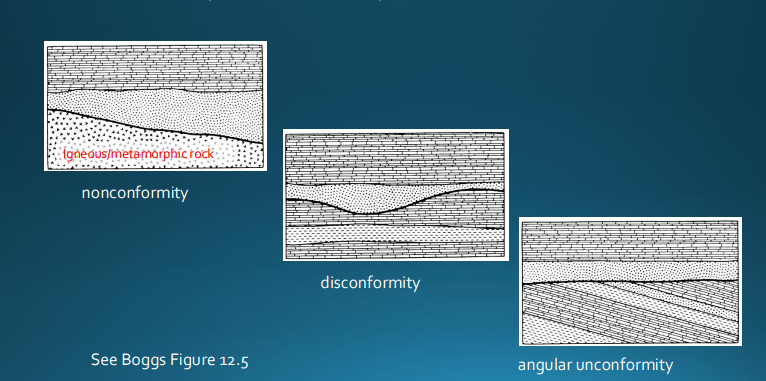
uncomformities
disconformity- time break with parallel strata above and below uncomformable contact
angular - time break with older strata dipping at an angle, relative to the overlying younger strata, which are parallel to the uncomformable contact
nonconformity- time break between igneous rock and overlying sediment
conformable deposited without a major breakdown in deposition, unconformable deposited with major breakdown, (with or without erosion)
cycles to note
atmospheric, hydrological, geologic rock cycle, plate tectonics
stability of minerals
clay, quartz, al hydroxides and fe oxides are the most resistant to weathering

erosion vs weathering
erosion- removing of material through a transport such as water, wind, ice
weathering- alteration of material (mechanical (disintergration) or chemical (alteration))
mass wasting
transfer of rock down slope due to gravity (land slide)
newtonian- water like
non-newtonian- viscosity changes with stress
bingham plastic- resists movement

mechanical weathering
root wedging, stress relief joints, frost wedging, quartz to sand
as the grain size decreases, surface to volume ratio increases, which can make chemical weathering faster
chemical weathering
minerals chemically react or dissolve
solvents or reactants (water and acids like carbonic and sulfuric)
climate and rate effect weatheing extent
dissolution vs dissociation
dissolution- quartz (sio2 + 2h2o—> h4sio4), calcite (caco3 + h2o + co2 —> ca2+ + 2hco3-)
dissociation- halite (nacl—> na + cl)
orthoclase
kaolinite + silica + ions
occurs through hydrolysis
clay
oxidation
iron pyroxene
olivine
these form hematite (rust)
oxyhydroxides can also form because of the water presence
oxyhydroxides and fe oxides are solids
common mineral weathering types
feldspar- hydrolysis
muscovite- hydrolosis
olivine- oxidation
quartz- dissolution
pyroxene- oxidation

solids vs ions
solids- form clasitc (detritus) sediments like sandstone
ions in solution- form oceanic salts and chemical sediments
dissolved silica—> chert
dissolved carbonate—> limestone
different cl and na in ocean vs rivers particularly
detrital/siliclastic sediment
clay, quartz, feldspar, rock fragments, muscovite
regolith
detritus that covers surface that is not removed by erosion or mass wasting, not soil as soil is water and organic matter with regolith
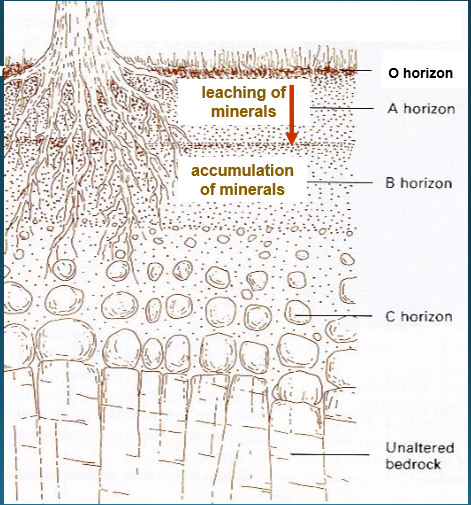
soil profile
o is organic layer, also varies by climate
granite vs basalt
granite- quartz, feldspar, mica, hornblende, lithic fragments, clay, minor fe oxides (na and k in solution rich)
basalt- plagioclase, olivine, pyroxine, clay, fe oxides (mg and ca solution rich), hematite
phi
a larger grain size will result in a smaller phi
the higher the peak, the better the sorting
grain size distribution doesn’t necessarily indicate a particular depositional environment
clastic sediment transport
fluid flow and sediment gravity flow
fluid flow examples
runoff, sheet flow, rills, channels
fluid density
mass per unit volume for water = approx. 1g/cm3
viscosity
relative ability of fluids to flow, rate dependent when carrying sediment loads
laminar vs turbulant flow
laminar- ray paths of fluid particles are parallel
turbulent- ray paths are irregular

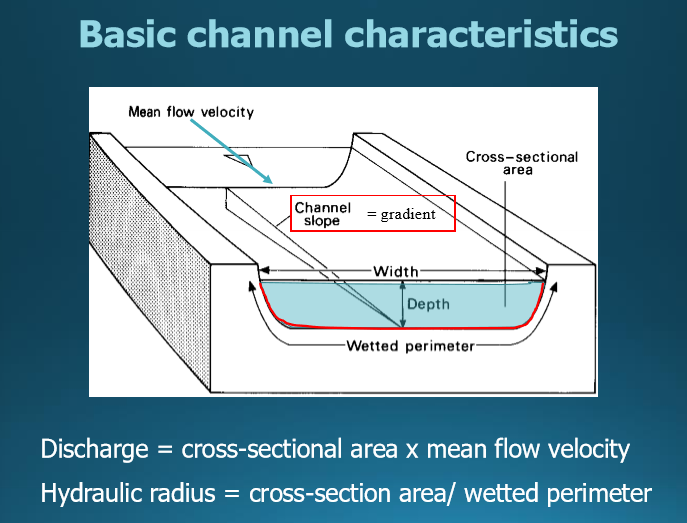
channel characteristics
stream flow velocity
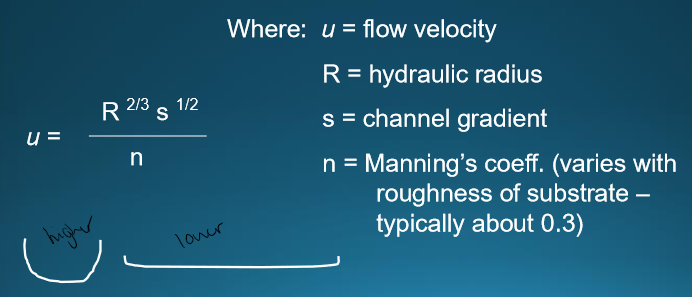
velocity of stream flow is influenced by the gradient, roughness and cross-sectional form of the channel
manning equation
estimate flow velocity
reynolds number
laminar or turbulent flow equation
500 or less- less velocity
2000 or more- high velocity
bernoulli lift
higher velocity over convex side leads to lower pressure there relative to underside producing lift

sediment flow transport types
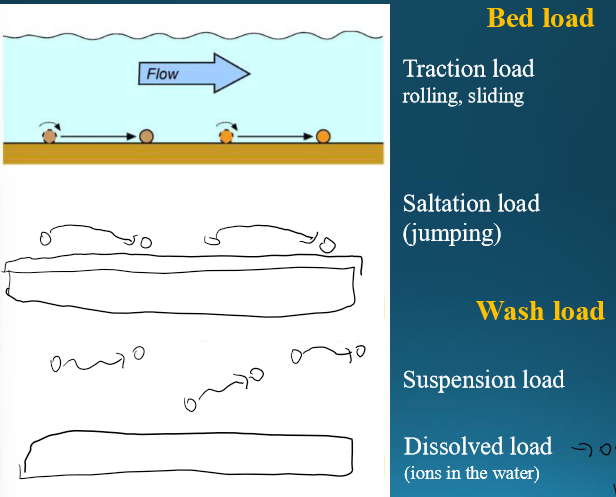
traction- rolling or sliding
saltation- jumping
suspension- floating in liquid
dissolved- ions in water
settling velocity
Steady rate of fall after grains are lifted and decelerated = ‘terminal fall velocity’
Settling Velocity < flow velocity (= f shear velocity) Then → transported in suspension.
Settling Velocity > flow velocity Then → deposition or bed load transport.
saltation at boundary
grains hydrualic equivalent if deposited at same time
competence vs capacity
competence- largest size of particle carried by flow
capacity- total amount of sediment that can be carried by flow
flow regime types
depth and grain size essential
increasing: ripples, dunes, plane, antidunes, chutes and pools
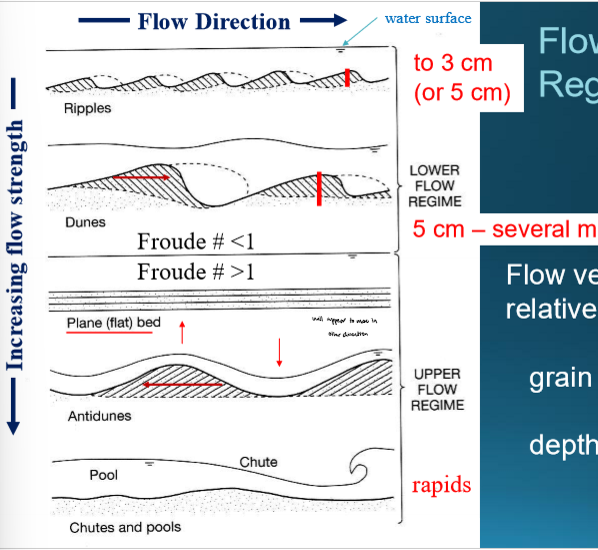
ripples and wave structure

trough vs planar stratification

wave diagram

air transport
bed load- traction saltation
suspended load- dust load

ice transport
plastic behaviour- suspended, deposition on melting, some bed load
rafting- dropstones
turbidity current/bed
large amounts of water, clasts are fluid supported, sediment deposited by flow wanes
sole marks at bottom, scoured base, fining up, waning flow
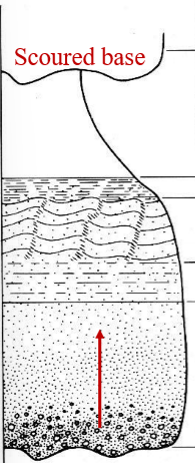
flow and their stratigraphy

sedimentary structures
large-scale internal and surficial features of sedimentary rocks generated by depositional, erosional or diagenetic processes, fabrics and geometries visible at outcrop and hand sample scale
use:
• interpretation of depositional environment
• determination of younging direction (which is up)
• palaeocurrent analysis
PRIMARY (at deposition) AND DIAGENETIC (after deposition)
bedding features
change of composition
change of size
change of shape
change of orientation
change of packing
lamination- smaller scale phenomenon within a bed
flow types in bedforms
unidirectional- leads predominantly to asymmetric bedforms (two- or three-dimensional) or plane beds ● Current ripples ● Dunes ● Plane beds ● Antidunes
oscillatory- waves, symmetrical
combined- both, low mounds
cross stratification
laminae not parallel to bedding, caused by ripples and dunes
has to scour downwards, it will swoop down

transport vs younging
transport= current direction
younging= which way is up (tangential only)
planar vs trough stratification
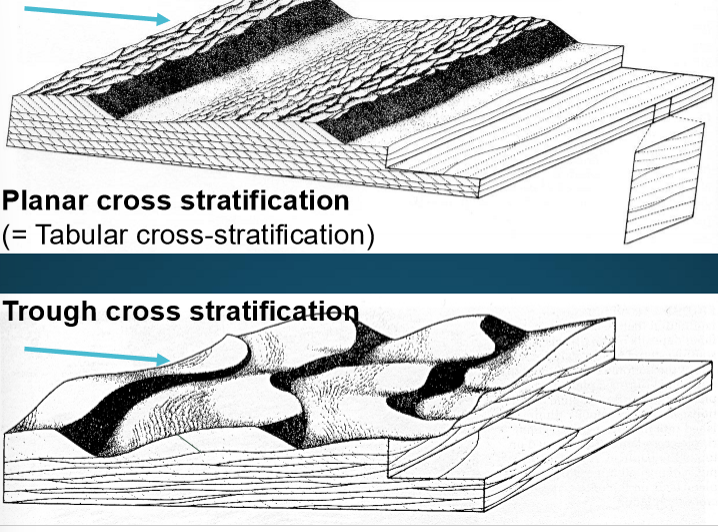
herringbone cross stratification
changes direction

climbing ripples
crest migrates down current, indicated waning flow, bed and suspension load

climbing ripple types
traction, traction and suspension, suspension

hummocky cross-stratification
storm waves, younging direction very hard, shallow marine to continental shelf

sand and clay bedding (intertidal)
flaser- sand with clay in troughs
wavy- alternation with sand and clay
lenticular- mostly shale with some sand

ripple marks
currents- asymmetrical
waves- symmetrical
concave surface up

interference ripples
multiple wave sets, includes ladder ripples

bedding plane erosion
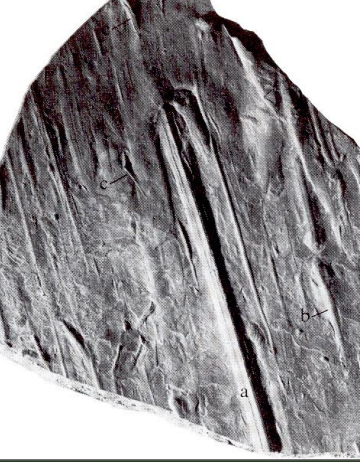
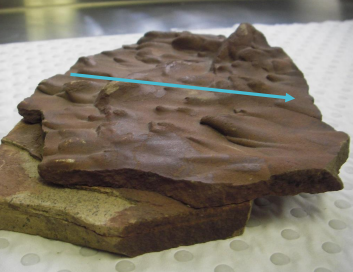
current and tool formed
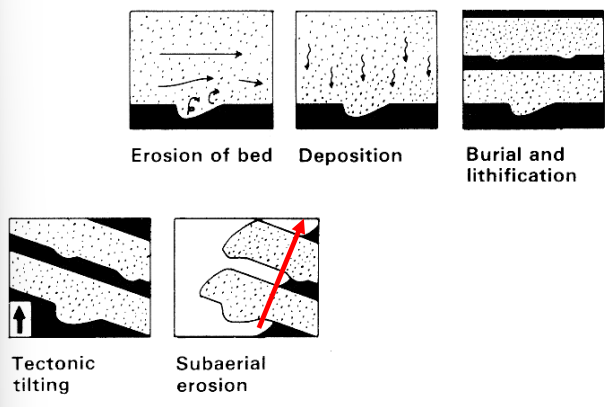
groove casts
infilling of trough left behind by dragged object, tool marks
flute casts
infilling of current generated scours, underside of bed
post depostional sedimentry structures
load, ball and pillow, flame

mudcracks
Polygonal cracks generated by subaerial desiccation of muds – cracks commonly filled by sandy material of succeeding flood or of eolian origin. caused by loss of water, wedge out downwards (protrude out)
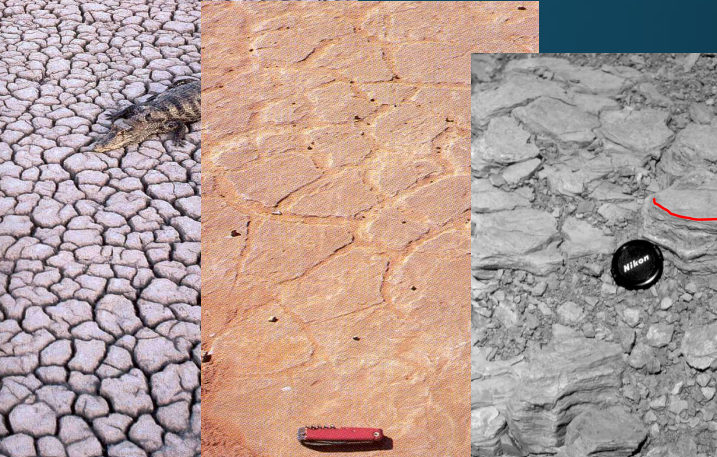
syneresis cracks
Similar to mudcracks but discontinuous & variable in shape. Subaqueous shrinkage cracks formed in clayey sediment by loss of pore water from loosely compacted clays or by shrinkage of swelling-clay minerals due to changes in salinity of the surrounding water.
clay mineral that is underground and dries out, doesn’t protrude out
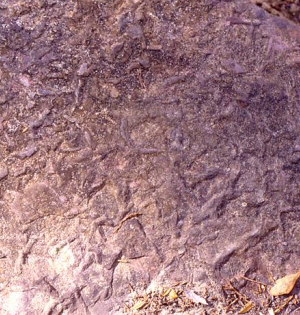
convolute bedding
soft sediment deformation, disturbed before lithification but after deposition

trace fossils
Traces of organisms or the activities of organisms not the organisms themselves. Uses: • Depositional environment • Oxygen levels, above & below sediment water interface • Traces of life where no organic matter preservation • Younging direction • Sedimentation rates • Biostratigraphy
they accumulate overtime which causes bioturbation
invertebrae trace fossils
locomotion traces, feeding, dwelling, resting, helps determine the location (bathymetric zonation)
meandering feeding trails and resting traces
low energy

skolithos burrows
high energy

tiering
depth to which different organisms burrow may be preserved, help determine sedimentation events
relationship between carbon, oxygen and bioturbation
more carbon means better preservation, less bioturbation and more fine sediments.
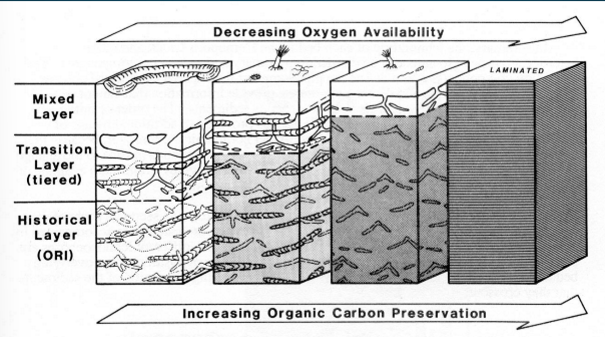
bioturbation stages
there is more likely to be bioturbation in a rock that has no new sediment depositon
regular, irregular, mottles, deposits

diagenetic sedimentary structures
concretions- mineral precipitation within the sediment
pseudofossils
cone in cone structures- mineral growth in shales during compaction during deeper burial
geopetal structures- sediment will fill in a structure at deposition angle, help determine younging direction
siliclastic rocks
mudrocks (50-60%) clay + silt grain sizes, non-laminated
Shale – laminated mudrock; clay and/or silt sized sediment. determined by oxygen and organic content
Siltstone – silt-size sediment.
Claystone – clay-size sediment.
siliclastic mudrocks
small grains
Textural classifications - proportions of silt and clay - relative hardness or induration - internal laminations – fissility
clay from chemical, silt from mechanical
current veolcities are low (deltas, deep sea, estuary) (lakes,rivers)
important for:
quarries (brocks, ceramics, fossils)
seal for petroleum
mudrocks colour meaning
black= high organic content, low oxygen
red= oxidising environment, terrestrial setting most likely
green=reducing environment, marine settings
sandstone (arenite)
lithified sediment, mostly sand sized, 25% of sedimentry rocks
transported grains: framework of large grains and matrix of small grains filling interstitial spaces
cement: chemical precipitation in pore spaces
formed in rivers, deltas, beaches, deserts
high perosity and permeability, good reservoir, good for silica and sand mining
matrix= over 10% is conscidered wacke
wacke (arenite)
sediment contains more that 10% mud sized particles between the sand grains
cement
- chemical precipitation in pore spaces - may be different or same composition to transported grains - if same composition may form overgrowths - may form very small (cryptocrystalline) to quite large crystals - usually
well-developed crystal faces
in position, while matrix is transported
pores
space between grains, commonly filled with a fluid or substance
QFL Diagram classification
practice with this

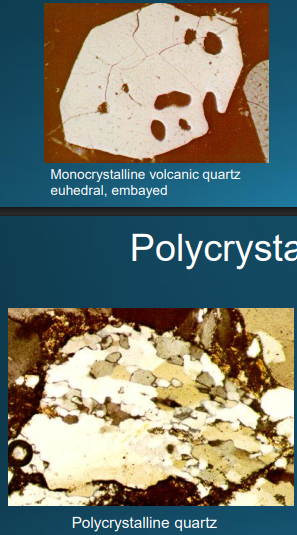
monocrystaline vs polycrystaline quartz
mono- straight extinction, quartz
poly- counted as lithic clast in sandstone classification, includes chert and quartzite
feldspar
plagioclase and orthoclase, clear cleavage,

lithic fragments

conglomerates and breccias
Epiclastic – breakdown of older rocks (normal type) Volcanic – pyroclastic or shattered volcanic rocks (breccia) Cataclastic – from faulting or land slide (breccia)
Solution – left after solution of surrounding rocks (breccia) Impact – shattered by meteorite (breccia)
Classified on combination of texture & composition of clasts.
- Angularity of clasts. - Proportions of gravel versus sand- and mud-sized material. - Whether clasts are derived from local reworking of underlying sediments or transported long-distance. - Whether clasts are of uniform or multiple lithologies
found in alluvial fans, mass wasting, rivers, beaches
orthoconglomerate
clasts in contact (clast/framework supported).
paraconglomerate
clasts “floating” in matrix (matrix-supported).
diamictite
Paraconglomerates where there are two distinct size fractions.
oligomict
single clast type
polymict
more than one clast type
quartzrose vs petromict
quartzrose if more than 90% quartz and chert
quartzrose orthoconglomerate/paraconglomerate…
petromict if less than 90% quartz and chert
sedimentry texture
grain size, grain sorting, rounding, grain shape, grain orientation
tells history and source of sediment, textural and mineralogical maturity
sphericity
degree to which a grain approaches a spherical shape (how compact a shape is)
may reflect source as micas and foliated metamorphic rocks are flat
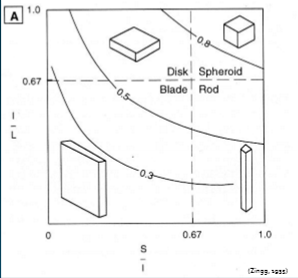
roundness
degree to which corners of a grain have been rounded off, how smooth or angular a shape is
controls
original sediment shape
length of time in transport (longer=more rounding)
hardness of material (softer=quicker rounding)
sediment size relative to transport mode (traction loads round fastest, wash not at all)
silt and clay generally dont round

fabric
orientation of grains relative to eachother
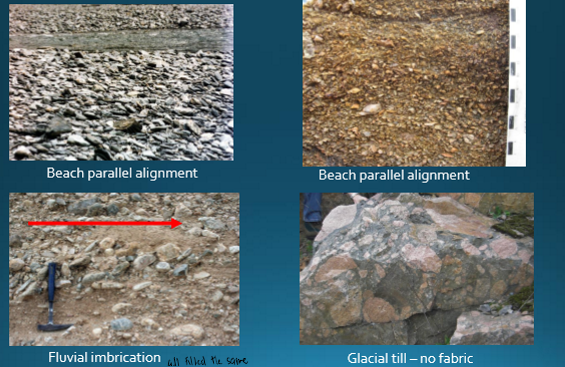
textural vs mineralogical sediment maturity
textural- sorting, rounding, transport history
mineralogical- mineral stability, source of sediment/time/climate (hot and wet is best erosion)
mineralogical maturtiy
immature is feldspar and biotite and lithic fragments, lithic are being formed in the active tectonic movements, more stable environments have quartz so are more mature, cube has high sphericity, cobbles round faster, grains with high angularity are not necessarily immature
diagenesis
processes that bring about physical/chemical changes to sediments between deposition and metamorphism or exhumation/erosion.
everything between deposition and metamorphism/erosion
final rock
lithification processes
Changes in sediment occur owing to: 1. Increasing pressure with burial 2. Increasing temperature with depth (geothermal gradient) 3. Changes in pore fluid chemistry 4. Changes in mineral stability as conditions change
3 stages of diageneis
eodiagenesis- shallow burial
mesodiagenesis- deeper burial
telodiagenesis- erosional

eodiagenesis
bioturbation, compaction (most important in muds and organic sediments), precipitation/dissolution of new minerals
clay has weak attractive forces so when they compact they cause grains to adhere and form shale
