Fish
 Call Kai
 Learn
 Practice Test
 Spaced Repetition
 Match
 Flashcards
 Knowt Play
1/64

Earn XP
Description and Tags
Year 2 Exotics
65 Terms
What are the 3 main categories of fish species?
jawless (Agnatha)
cartilagenous (Chondrichthyes)
ray-finned (actinopterygii)
How do fish survive in sub-zero waters?
they have antifreeze in their blood
What is required in a fish environment?
adequate water salinity depending on species
specific temperature
correct oxygen concentration depending on requirements
high water quality
territorial fish housed alone, shoal fish housed together
surface/substrate feed or live food
correct pH water
correct water hardness
enough space
What are the features of the Rainbow Trout?
purely freshwater forms and anadromous forms
can tolerate 0-25 degrees
need fast-flowing water
aggressive predator
What are the features of the Common Carp?
fresh water required
can tolerate 4-35 degrees
social
minimal aggression
over a metre long
Why are Rainbow Trout kept?
for laboratory research
Why are Common Carp kept?
for food, farming for angling and ornamental
What are the features of the Sea bass?
saltwater but can tolerate brackish
can tolerate 4-28 degrees
social
grow fast
Why are sea bass kept?
for food or racing
What are the features of the Mudskipper?
up to 25cm long
brackish water
spends most of time out of water
requires a humid environment to prevent desiccation
males are very aggressive
Why are Mudskippers kept?
in aquariums and occasionally as pets
Why does fish tank water need filtration?
fish release metabolic waste ammonia from their gills and urine which is very toxic, and their faeces will decay in the water
What are the 3 stages of water filtration?
mechanical
biological
chemical
What are the 4 main methods of mechanical filtration?
filter matts
swirl filters
sand filters
brushes
What is the purpose of biological filtration of fish tanks?
to encourage the growth of beneficial autotrophic bacteria which will break down toxic nitrogenous waste into a harmless form via nitrification
What is the purpose of mechanical filtration of fish tanks?
to physically trap and remove large debris
What is the process of nitrification of nitrogenous waste?
toxic ammonia is converted to nitrite by ammonia oxidising bacteria
nitrite is then converted to less toxic nitrate by nitrite oxidising bacteria
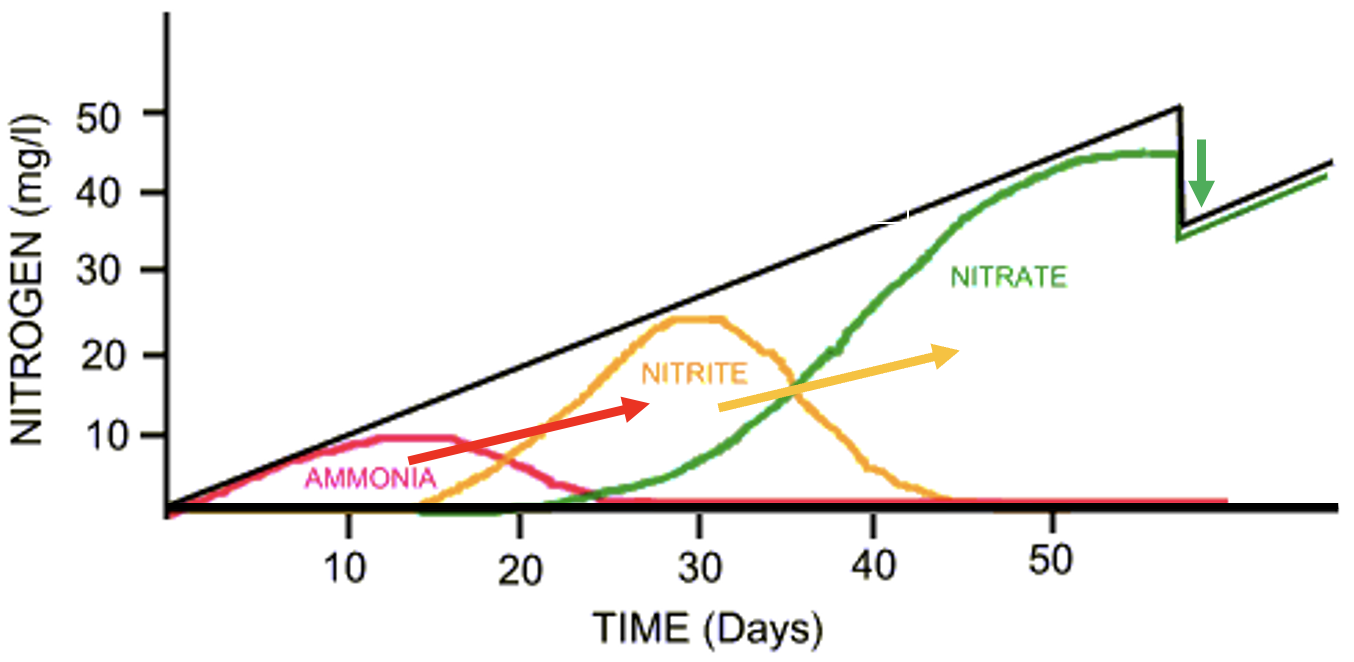
What does this diagram show?
the cycling of a fish tank:
ammonia levels increase and then decrease as ammonia is converted to nitrites, and then to nitrates
the sudden drop in the line is when the water of the tank is changed
What is the purpose of chemical filtration of fish tanks?
to remove specific undesirable substances from the water
What are the 3 main methods of chemical fish tank filtration?
carbon granules - remove colour from water
zeolite - removes ammonia from freshwater
phosphate removing granules - prevent algae growth
What are the 3 main management systems of fish?
open
semi-closed
closed
What are the features of an open fish management system?
caged environment in rivers, lakes, seas etc
rely on the natural system to maintain water quality
vary in density of fish kept and active feeding
Which fish tend to be kept in open systems?
sea bass and salmon
What are the features of a semi-closed fish management system?
inland aquaculture system which flows through raceways
has an inlet and outlet with fast continuous water flow which maintains a high water quality
can be fresh or brackish water
can house high densities of fish
requires active feeding and a continuous water source
Which fish are often kept in semi-closed systems?
trout, catfish and tilapia in freshwater
sea bass and sea bream in brackish water
What are the features of a closed fish management system?
minimal water and land use
water is reconditioned and recirculated
can be marine or freshwater
houses high fish densities
needs very controlled growth conditions
produces less waste water
needs very efficient biofiltration
expensive to set up and maintain
requires highly trained staff
produces more greenhouse gas emissions
What are the features of a good fish tank?
cover to prevent water evaporation and escape
lamp to provide light-dark cycle for fish and to control plant growth
filter - can be undergravel or external
food
enrichment
What are the external features of cartilagenous fish?
unpaired median fins
2 sets of paired lateral fins
pectoral fins act as hydrofoils
pelvic fins with claspers in males - act as intromittent organ for internal fertilisation
5 gill slits with 4 internal gill arhces
spiracle (in some)
lateral line organ of mechanoreceptors which detect water pressure changes on the body surface
What remnants of ears do fish have?
semicircular canals
What features of ears do fish not have?
outer ear
inner ear
cochlea
What are the external features of ray-finned fish?
lateral line
first and second dorsal fin
caudal fin
anal fin
pelvic fin
What are the external features of lobe finned fish?
unique supportive elements in skeleton of girdle and limbs
secondary reduction in some lungfishes
some air breathers (facultative and obligatory)
variable fins
How does breathing in water compare to air?
requires more energy for ventilation
more difficult to retain body heat
water contains much less oxygen so higher ventilation rates are required to meet the oxygen demand

A
spiny (dorsal fin)

B
soft-rayed (dorsal fin)
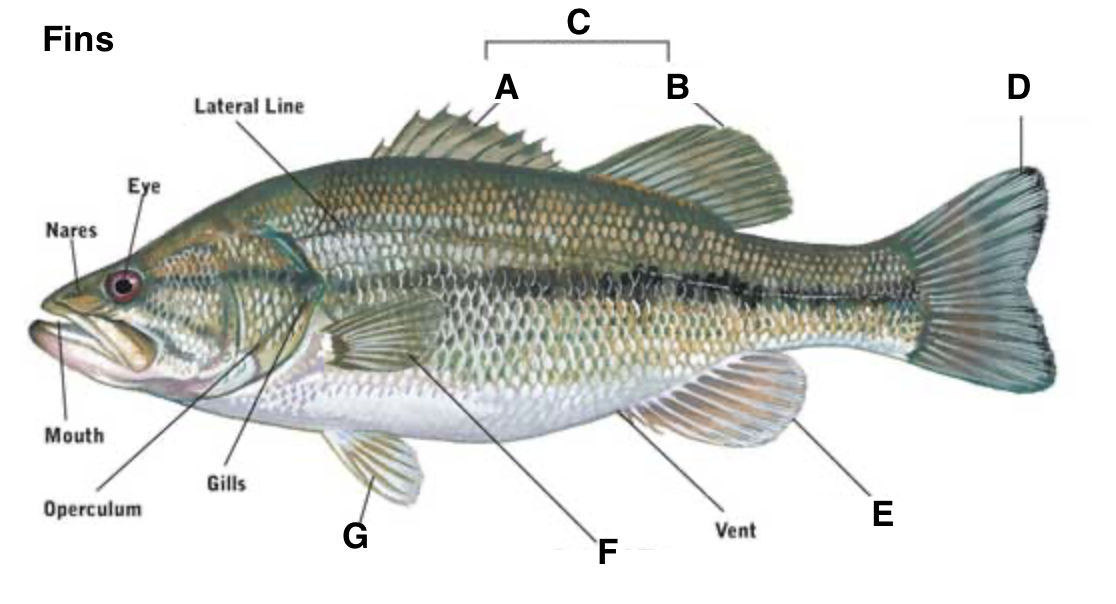
C
dorsal fin

D
caudal fin

E
anal fin

F
pectoral fin

G
pelvic fin
Which 3 things were facilitated by fish moving onto land?
highly active lifestyles
higher metabolic rates
endothermy
What are the features of a fish gill?
pressure pump
4 gill arches on each site
each gill arch has 2 rows of filaments
filaments contain hundreds of lamellae
Which direction does water flow through a fish during gas exchange?
into mouth through gills (unidirectional)
What are the adaptations of fish gills?
large surface area
highly efficient counter-current flow of water and blood
thin lamellae with short diffusion distance for respiratory gases
How can you tell the freshness of a dead fish from its gills?
gill colour - brighter red shows the fish died more recently and brown shows the fish is older due to haemoglobin breaking down
What features of a fish reduce drag caused by water?
rounded body
maximum diameter making up a quarter of the fish’s length
maximum diameter at 30-40% along the length of the body
reduced scale size
mucus cover
What are the different locomotion strategies used by fish?
movement type is either undulation (smooth movement up and down) or oscillation (rapid hitting up and down)
species can use their trunk/caudal fin/ dorsal fin/ anal fin/ pectoral fin for generation of power
What is enabled by fish who move using their dorsal/anal/pectoral fin?
precise hovering, manoeuvering and backing
What is enabled by fish who move via undulation using their trunk?
extreme flexibility in complex habitats
What is enabled by fish who move via undulation/oscillation using their trunk and caudal fin?
efficient fast start
What is enabled by fish who move via oscillation using their trunk and caudal fin?
continuous cruising

1
food

2
fish waste (ammonia)

3
excess food and decomposing plant matter (ammonia)
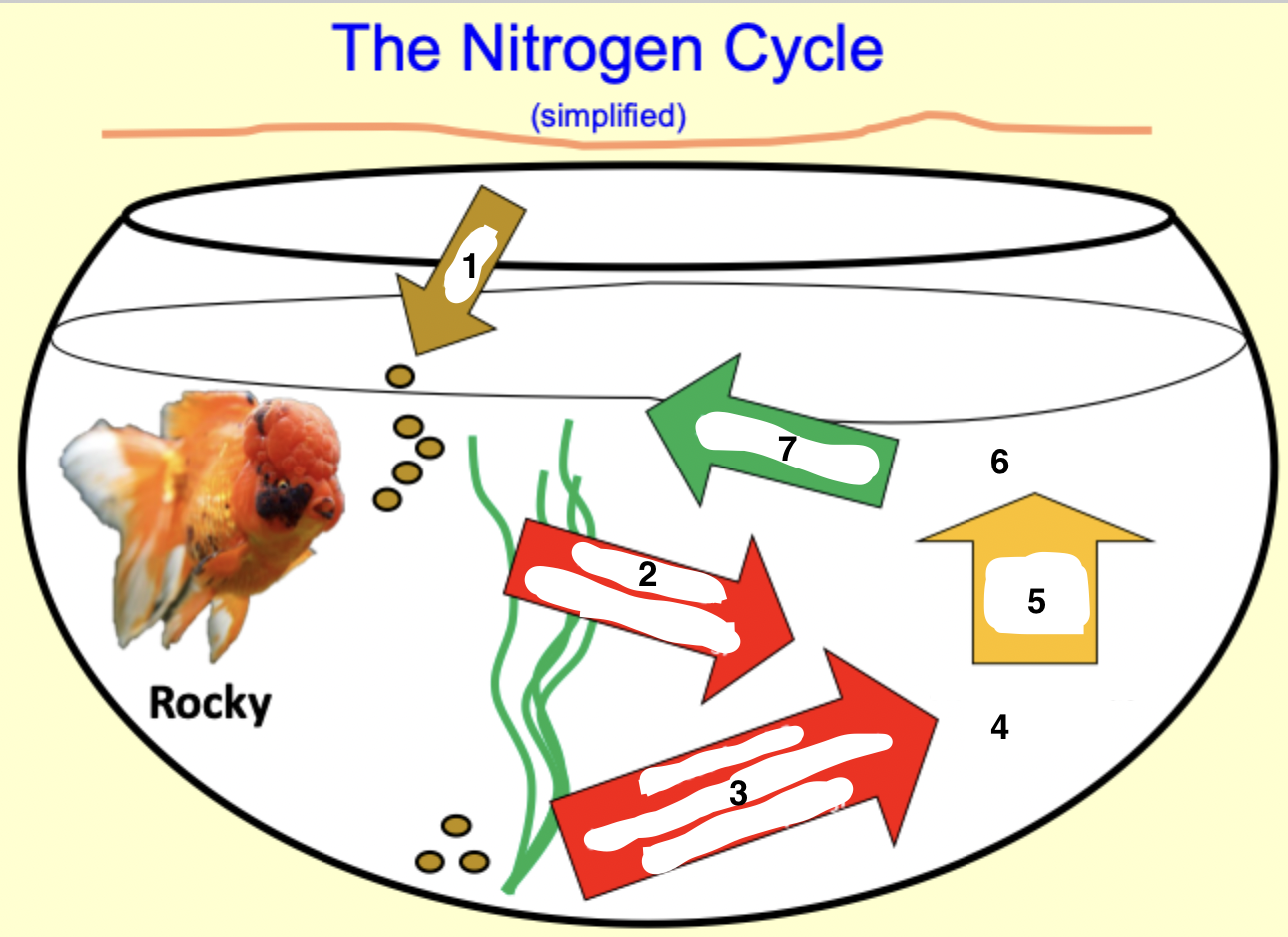
4
ammonia oxidising bacteria

5
nitrites (NO2-)

6
nitrite oxidising bacteria

7
nitrate ions (NO3-)
What role do gills have in excretion?
nitrogenous waste is excreted through the gills as ammonia (urea or uric acid as well in some species)
How does a saltwater fish osmoregulate?
water and salt ions enter fish through food and drinking seawater
salt ions are excreted from gills
water is lost through the gills and other parts of the body surface via osmosis
salt ions and small amounts of water are excreted via very small amounts of urine in kidneys
How does a freshwater fish osmoregulate?
water and some ions from food are taken in by the fish
salt ions are also taken up by the gills
water is gained through the gills and other parts of the body surface via osmosis
large amount of water are excreted in dilute urine produced by the kidneys
How does water retention behaviour differ between saltwater and freshwater fish?
saltwater fish actively drink a lot more water and produce a lot less urine than freshwater fish
How do fish thermoregulate?
most species are ectotherms, meaning that their body temperature is determined by the environmental temperature
many tuna species and some sharks are partial endotherms
How does partial endothermy in fish work?
counter-current vascular heat exchangers allow warm venous blood leaving working muscles to heat incoming cold arterial blood from the gills (occurs in muscles, liver, eyes and brain)
What system of circulation do fish use?
single loop
low pressure in the whole system
no blood pooling in lower appendages