Econ Pub Policy Midterm 2
 Call Kai
 Learn
 Practice Test
 Spaced Repetition
 Match
 Flashcards
 Knowt Play
1/72

Earn XP
Description and Tags
Ch 5-8 + special topics 3
73 Terms
Negative Production Externalities + eg.
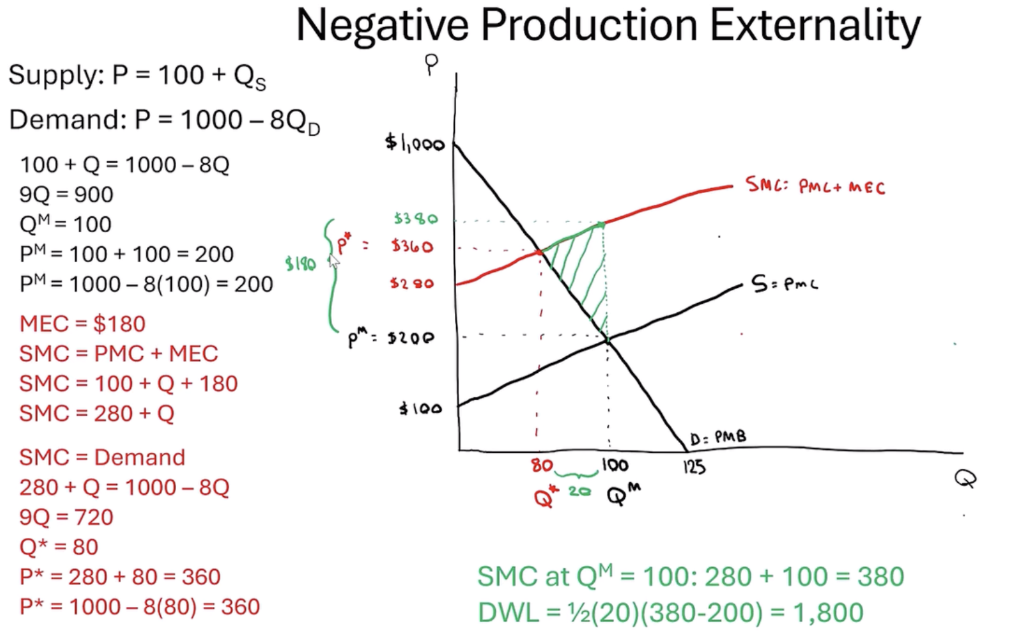
When a firm’s production reduces the well being of others who are not compensated by the firm (the market produces too much)
Pollution
Ppl working in paper mill is benefitting from the high wages, residents who dont work there only get the cost of foul smell and pollution, and no other benefits
Math of Negative Production Externality
Add Marginal External Cost to the supply equation
Negative Consumption Externalities + Eg.
When one person’s consumption reduces the well-being
smoking
Positive Production Externality + Eg.
When the production of a firm benefits others, but the firm is not being compensated by those others (market produces too little)
research &D, honey production
Private Marginal Cost (PMC)
Direct cost to producers of producing an add unit of the good
Positive Consumption Externality + eg.
When an individual’s consumption benefits others, but the individuals not compensated by those others
flu vaccines
education
Positive Consumption Externality Math
Social Marginal Cost (SMC)
private marginal cost + external marginal cost added tgt
External marginal cost (EMC)
The marginal cost per unit of production done to non-consenting 3rd party members
Tragedy of the Commons
The tendency for self-interested individuals to over-use open access resources
Public Solutions to Externalities
Pigouvian Tax
Pirgouvian Subsidy
Regulating Quantities
Pigouvian Tax
taxing an activity that causes a negative externality by the amount of marginal external cost
Pigouvian Subsidy
subsidizing an activity that causes a positive externality by the amount of the marginal external benefit
Regulating Quantities
problem is that requires the regulators to know the conditions of the firm, which is unlikely, and regulators can be corrupted in the process of learning that information to regulate the firms.
Coase Bargaining
so long as property rights are well-defined and there are sufficiently low transaction costs, bargaining in a situation involving an externality will lead to an efficient outcome regardless of the initial allocation of property.
When is Coase Bargaining possible
A. Private property rights have to be well-known
B. Transactions costs have to be low
Problems with Coase Bargaining
A. The assignment problem: climate change is not from a single source so who is responsible for it and assigning that
B. The holdout problem: shared ownership of the property rights give each owner power over all of the others:
eg. if a plant is polluting river costing 100 fisherman $1 each in reduced fish, so the coase solution would be for each fisherman to receive $1 in compensation. Last one of 99 can hold out bc they need him
C. Free rider problem: underinvest when personal cost but common benefit
D. Transaction costs have to be low: even if uk who is responsible, hard to negotiate if large # of firms on transaction
Four Incentives Created by Private Property Rights
Use property in ways that benefit others
Care for what they own
Make sure their property does not damage anybody else’s property
Conserve for the future
Private Proprty Rights can protect environment
Africa villagers who would sell hunting licenses to wealthy tourists (or tourism) increase bc they want to keep elephants alive.
Two sides of climate change debate
Left:
temps on earth increased due to greenhouse gases. few scientists who have explicitely rejected the position that climate change is caused by human activity
Right:
temp fluctuations have happened thru history, not necessarily bad. not all scientists have concluded humanity is the cause of climate change
Moral Approach
environmental degradation is bc of immoral human behaviour and those who prefer to help the environment at the expense of econ progress are good, while opposite are evil
Economic Approach (environmental policies)
explores environmental issues from the standpoint of competing preferences, cost benefit analysis, analytical models
Assimilative Capacity
The ability of the natural system to accept a certain amount of pollutants and render them benign or inoffensive.
There might be an optimal amount of pollution that is non-zero… especially given the earth’s assimilative capacity. (like getting plane crashes to zero)
(so environment too)
Emission Damage Function
the connection bw the residual emitted from a source or group of sources and the resulting damage
Ambient Damage Functions
Relationship bw the concentration of particular pollutants in the surrounding environment and the resulting damaged
all the past emissions
look at the damage caused by overall change in air quality
Abatement Costs
cost of reducing the quantity of residuals being emitted into the environemtn, or of lowering ambient concentrations
Marginal abatement costs
the added cost of reducing one unit of emission level or ambient concentration
Marginal Damage Costs (MDC)
The extra harm of a unit change in emissions or ambient concentration
What can shift the MDC
diff in population exposed (tokyo vs small town - more ppl affected)
diff time period/meterological activity
new scientific estimates of increased pollution impact
Total pollution cost
Total damage costs + total abatement costs
Enforcement costs (E)
the cost of resources that must be dedicated to enforcing abatement
private costs: such as record keeping by the polluters
public costs: various regulatory aspects for enforcement
Government allocate permits ways
Give permits to higher abatement costs (rewards dirtiest players)
Give permits to the newest firms (but usually they have tech and dont need them)
allocate permits thru auctions (bigger firms to buy)
Ways Cigarettes are negative externality
Increased Healthcare costs
Less productive works
Start fires
Dying earlier (positive externality)
Secondhand smoke
Negative Internality
Damage done to oneself through adverse behaviour that is not fully accounted for when decision in the adverse behaviour
Cigarette Smoking Problem (Gov)
Gov Action For
externalities
negative internality
Tools: 10% price increase = 5% decrease and info abt health risks of cigs
No gov action Againstnot an externality if market alrdy prices it in (insurers rasie price for smokers, employers adjust wages, smokers fire only hurt their own property)
earlier deaths = positive externality
Alcohol consumption
For gov action:
impaired driving 2019 30% of traffic death, 55% of violent crimes, 2/3 victims attakacked by partners attakcer had been drinking
age 21 before and after academic falls, work less, crime rise at 21
Against Gov action:
if you’re too young to drink, why can u vote, student loans, go to war (autonomy)
Drug Use
For gov action:
drug overdose risen, driven by fentanyl and opioids
Against Gov action:
some economists argue the negative external effects is BC DRUGS ARE ILLEGAL
Obesity
For gov action:
obse 13% from 1960 —> 40% in 2024
internal costs (heart, disease, diabetes) and external costs (higher healthcare costs)
policies: nutrition labels, decrease food deserts, sugar taxes
Alternative solutions
charge ppl for being obese
financial incentives (states and employers provide) to go to wellness programs
provide consumers options to size down
Against Gov action:
autonomy?
Costs of legalizing drugs & prostitution
drugs r easier to get, more ppl will use, less productive society
prostitution easier, more ppl use it, less productive society, increased human trafficking
Benefits of of legalizing drugs & prostitution
safer/less potent drugs, less crime, better use of police resources, less police corruption, increased tax revenue
safer prostitution, less crime/violence in prostitution trade, increased tax revenue, better use of police
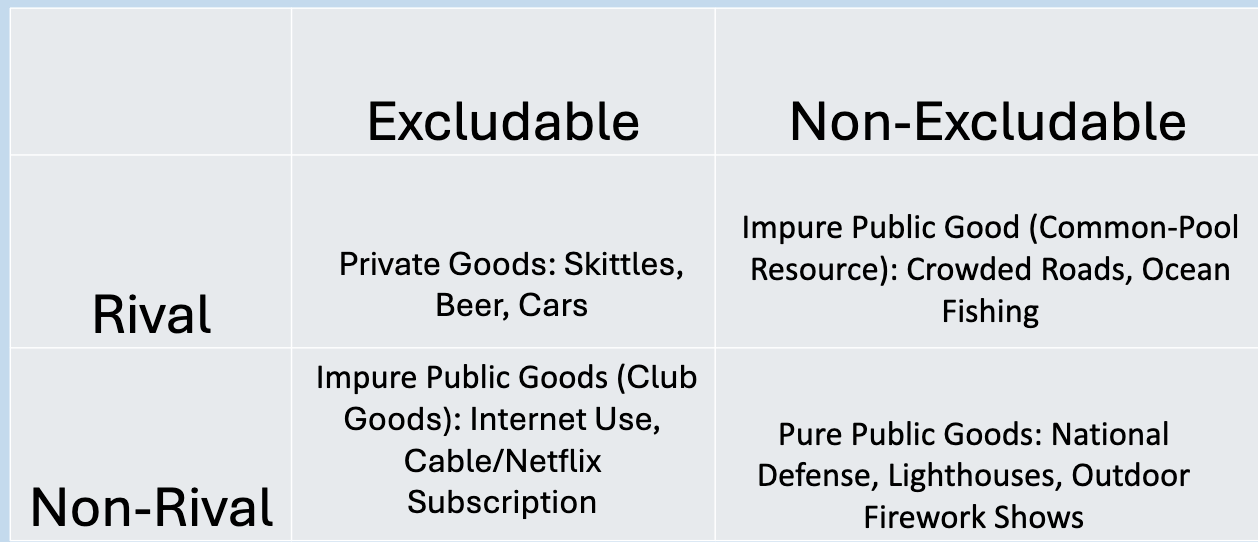
Public goods have to be
Non-rival in consumption
Non-excludable
Pure vs Impure Public goods
Private goods
goods that are both rival in consumption and excludable
Demand for private goods
Horizontal sum of all individual demand curves (quantities demanded at the same price)
Demand for public goods
Vertical sum of all the individual demand curves (sum of prices ppl r willing to pay at the same quantity received by everyone)
Free Rider Problem
when an investment has a personal cost but a common benefit, individuals will underinvest
eg. Met in NYC, firefighters in australia
Pure Public Goods:
both non-rival in consumption and non-excludable
eg. national defense
Impure public good
You can exclude ppl from using it, but one person using the internet does not stop
Lindahl pricing
An approach to financing public goods in which individuals honestly reveal their WTP and gov aggregates these preferences then charge that amount to finance the public good
Problems with Lindahl Pricing
ppl are incentivied to lie abt their WTP to try to free ride
even if they are honest, no idea how to value public good (Eg. national defense)
honest and knowledgeable, have to aggregate each individual —> social value
Private Provisions of Public Goods (fix free rider problem)
Coase Bargaining/ private agreements: a private contract that forces everyone to contribute (HOA)
- transaction costs have to be low and agreements have to be enforceablePublic good can be tied to a private good
- this is not always possible in every circumstanceIndi care more about providing public good than others
- unlikely to solve itAltruism: indi value benefits and costs to others in making their consumption choices (we know altruism exists).
Warm glow model: indi care abt both total amount of public goods and their particular contributions as well
Social Capital
The value of altuistic and communal behaviour in society
Obstacles to public provisions of public goods
Crowding out:
Lab evidence
Real world evidence
Government lacks the knowledge to provide the socially optimal quantity of the public good
- it is difficult to measure costs and benefits
- can’t measure preferences for public goods
Contracting out
Mix Private and public provision contracting out: provide good or service but hires a private sector firm to do it (incenties dont align and not competitive bc connections)
Opportunity Cost of Goods
The next best use for a good, besides using it on this project, is to sell it to someone else. So, the opportunity cost of using it for a project is the market price of the input. (in a competitive market equilibrium, price equals marginal social cost)
Discount Rate
7% is the avg rate of return of stock market
Measure Benefits of time saved
Producers
Consumers (market based vs survey based)
Market Based Measures to Value time
value of time at work can be measured as wage rate in a perf competitive labour market
cant freely trade leisure and hrs of work
non-monetary aspects of the job that cause ppl to value it diff than wage
Survey Based Measures to Value Time:
Asking individuals to value an option that they are not now choosing, do not have the opportunity to choose, or that is not yet available to them.
isolation of issue matters
order of issues matters
embedding effect
Using Revealed Preferences to Value Time:
Letting the actions of individuals reveal their valuation.
Economically measure the value of lives saved
lifetime wages
contingent valuation (ask indi what their life is worth)
Revealed preferences (how much paid to switch riskier job)
Common mistkaes in cost-benefit analysis
counting secondary benefits
counting labour as benefit (but it is cost)
double counting benefits (saving time —> other benefits)
ignoring unseen (secondary costs and effects)
Good Regulation
Railroad safety act: innovations like air brake, reduced injury and death, improving profitability
Bad Regulation
limit lease period for taxicab companies forced taxi companies to limit their lease periods from 24 —> 11 hrs. This resulted in lower profitability of taxi-cab industry, fewer cabs = lower service = increase # at fault accidents —> more assault bc cant get taxis
Minimum wage
paid more
increase unemployement, particular teenagers/underrepresented groups (= more crime)
American disabillities act
Helps to enforce accommodations for workers with disabilities, but
also resulted in a decline in employment of workers with disabilities among midsized companies who can’t or won’t pay for the accommodations. (like building an elevator they cant afford)
Occupational Licenses
Can increase quality and safety for the consumer, but often reduces competition.
Sunset provisions on regulations:
Causes a law or regulation to cease to be effective after a certain date unless further legislative action is taken to extend it.
A. Costs: potential for good laws to be amended to serve current administration, requires more taxpayer resources
B: Benefits: allows for the law or regulation to be reviewed using the info gained during the OG tme the law is in place