PEDS EXAM 5
 Call Kai
 Learn
 Practice Test
 Spaced Repetition
 Match
 Flashcards
 Knowt Play
1/189

There's no tags or description
Looks like no tags are added yet.
190 Terms
What major circulatory change occurs at birth regarding gas exchange?
Gas exchange is transferred from the placenta to the lungs.

What happens to pulmonary vascular resistance after the first breath?
Pulmonary vascular resistance decreases, leading to a marked increase in pulmonary blood flow.
List three clinical manifestations of heart failure in children.
Difficulty feeding, poor weight gain, and tachycardia.
What physical assessment finding in a child with heart failure indicates fluid overload in the organs?
Liver and spleen enlargement.
Name two examples of congenital heart defects classified as left-to-right shunting lesions.
Patent ductus arteriosus and ventricular septal defect.
Which congenital heart defect is categorized as an obstructive or stenotic lesion?
Pulmonary stenosis, aortic stenosis, or coarctation of the aorta.
What are the two main categories of cyanotic congenital heart lesions?
Cyanotic lesions with decreased pulmonary blood flow and cyanotic lesions with increased pulmonary blood flow.
Which condition is a classic example of a cyanotic lesion with decreased pulmonary blood flow?
Tetralogy of Fallot.
What are three warning signs parents should monitor for in a child with a heart condition?
Increased cyanosis, dehydration, and decreased nutritional intake.
What is infective endocarditis?
Inflammation resulting from infection of the cardiac valves and endocardium.
Which two organisms are most commonly associated with infective endocarditis?
Streptococcus and Staphylococcus aureus.
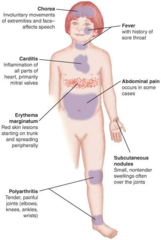
List three clinical manifestations of rheumatic fever.
Arthritis, carditis, and chorea.
What is Kawasaki disease?
An acute, febrile, exanthematous illness characterized by generalized vasculitis of unknown etiology.
What is a major long-term cardiac risk if Kawasaki disease is left untreated?
Coronary artery aneurysms (seen in 20-25% of untreated children).

Define dilated cardiomyopathy.
A disease of the heart muscle characterized by decreased contractility and dilation of the ventricles.
How is hypertrophic cardiomyopathy characterized?
Hypertrophy of the ventricles with impaired filling.
What threshold defines primary hypertension in children?
Average systolic or diastolic blood pressure that exceeds the 95th percentile.
Name three non-pharmacologic interventions for managing primary hypertension in children.
Weight reduction, physical conditioning, and dietary modification.
What constitutes dyslipidemia in the context of childhood preventative cardiology?
Elevated LDLs and cholesterol levels combined with decreased HDL levels.
What are three risk factors for high cholesterol in children and adolescents?
Obesity, family history, and type 1 or 2 diabetes.
What happens to systemic resistance at birth?
Systemic resistance increases.
What are common immobilizing devices used for children with musculoskeletal alterations?
Splints, casts, traction (skin and skeletal), external fixation devices, and halo traction.
Why is skeletal traction preferred over skin traction for some fractures?
Skeletal traction allows for greater pull and is more effective at reducing and immobilizing fractures.
What is a major potential complication associated with skeletal traction?
Osteomyelitis, due to the invasive nature of the procedure.
What does the acronym CSM stand for in neurovascular assessment?
Circulation, sensation, and motion.
How often should a neurovascular assessment be performed during the first 48 hours after injury or surgery?
At least every 2 hours.
What are the five Ps of ischemia used to assess neurovascular status?
Pain, pallor, pulselessness, paresthesia, and paralysis.
What clinical sign in a child with a cast or traction may indicate tissue ischemia?
Pain or a burning sensation.
Why are young children at an increased risk for fractures?
Increased mobility combined with inadequate motor and cognitive skills.

What are the two primary phases in the treatment of fractures?
Reduction (repositioning bone fragments into alignment) and retention (protecting the site with splints, casts, or fixators).
Define a sprain.
An injury where ligaments are stretched or torn.
Define a strain.
An injury involving the pulling, tearing, or rupturing of muscles or tendons.
What is a dislocation?
An injury where a joint is disrupted so that the articulating surfaces are no longer in contact.
What is osteomyelitis?
A bacterial infection of the bone.
What are the key components of nursing care for a child with osteomyelitis?
Assessment and documentation of status, pain control, and administration of antibiotics without iatrogenic injury.
List three common musculoskeletal developmental disorders.
Scoliosis, developmental dysplasia of the hip, and Legg-Calvé-Perthes disease.
What is the most common type of muscular dystrophy?
Duchenne muscular dystrophy.
What is the typical age range for the onset of Duchenne muscular dystrophy?
Ages 3 to 7 years.
What is the expected progression of Duchenne muscular dystrophy regarding mobility?
Progressive muscle atrophy and weakness, with the loss of walking ability by ages 9 to 12 years.
What is Juvenile Idiopathic Arthritis (JIA)?
An autoimmune inflammatory disease of the joints with no known cause.
What is the typical age of onset for Juvenile Idiopathic Arthritis?
Commonly between ages 2 and 4.
Is Juvenile Idiopathic Arthritis more common in boys or girls?
It is more common in girls.
What structures comprise the upper respiratory system?
The nares, pharynx (throat), larynx, and tonsils.
What structures comprise the lower respiratory system?
The trachea, bronchi, and lungs.
Where does gas exchange occur in the respiratory system?
Across the alveoli in the lungs.

What is the function of surfactant in a newborn's lungs?
It is a substance composed of phospholipids and proteins that lowers surface tension in the alveoli, allowing them to stay open and breathe easily.
When does surfactant production typically begin in a fetus?
Around 24-28 weeks of pregnancy.
What is the role of the epiglottis?
It acts as a flap that covers the larynx to prevent food from entering the lower respiratory system.
What is the function of cilia in the upper airways?
They move mucus and fluid away from the lower airway toward the pharynx to be removed by coughing, sneezing, or blowing the nose.
What is the primary function of the tonsils?
They are lymph tissues that help filter bacteria and foreign matter, playing a role in the immune system.
How do the right and left bronchi differ anatomically?
The right bronchus is shorter and wider than the left.
How many lobes do the right and left lungs have?
The right lung has three lobes, and the left lung has two.
What is the pleura and what is its function?
The pleura is a thin sac encasing the lungs containing pleural fluid, which aids in lung stability and expansion.
What are the two openings in an infant's heart that must close after birth?
The foramen ovale and the ductus arteriosus.
Why is the first cry of a newborn vital to respiratory development?
It helps ensure total inflation of the lungs and the expansion of the alveoli, which typically occurs within the first hour of life.
What does an arterial blood gas (ABG) test assess?
It investigates pulmonary function by assessing acid-base balances.
What do pulmonary function tests measure using spirometry?
They measure a patient's vital capacity and expiratory flow rate.
What is the ideal oxygen saturation level measured by pulse oximetry?
Above 95%.
What is transcutaneous monitoring used for?
It checks oxygen and carbon dioxide levels through electrodes placed on the patient's skin.
In which patients is end-tidal carbon dioxide monitoring particularly useful?
Patients who are intubated, under procedural sedation, or when evaluating asthma severity.
Why are infants at an increased risk for respiratory complications compared to adults?
They have smaller airways, underdeveloped cartilage, and produce less surfactant.
What is a common breathing pattern for newborns in their first few months of life?
They are nose breathers and may experience periods of apnea lasting up to 15 seconds.
Why do infants often exhibit abdominal breathing?
Because they have less developed intercostal muscles.
What are retractions in the context of respiratory distress?
They are inward movements of the chest wall that occur when a patient is struggling to breathe.
What is the function of goblet cells in the bronchi?
They secrete mucus to protect the innermost lining of the lungs from dust and bacteria.
What happens if cilia in the respiratory tract are damaged?
They cannot move mucus effectively, leading to a buildup of mucus and subsequent complications.
Why are children at a higher risk for middle ear infections compared to adults?
The eustachian tube in children is shorter and more horizontal than in adults.
Why is the larynx in children particularly susceptible to complications?
It is very flexible, making it prone to spasms.
Why do infants and young children exhibit abdominal breathing?
They have weak abdominal muscles and immature intercostal muscles.
What is the typical age of onset for allergic rhinitis?
It rarely occurs before the age of two.
What is the 'allergic salute'?
A crease across the bridge of the nose caused by repeatedly wiping the nose upward with the palm of the hand.
What are 'allergic shiners'?
Dark circles under the eyes caused by edema associated with allergic rhinitis.
What is the most effective treatment for allergic rhinitis?
Removing the allergen, or using antihistamines or intranasal corticosteroids if removal is not possible.
Why should antihistamines be administered at night?
They may cause drowsiness.
What is the recommended stance on using decongestants in children?
They are not recommended due to adverse side effects.
What is sinusitis?
Inflammation and infection occurring within the sinus cavities.
What are common signs of sinusitis in children?
Cold symptoms lasting longer than 10-14 days, low-grade fever, nasal congestion with purulent drainage, halitosis, and a cough that worsens when lying flat.
What are the preferred antibiotics for treating bacterial sinusitis?
Amoxicillin or amoxicillin-potassium clavulanate (Augmentin).
Why are antihistamines generally avoided for sinusitis treatment?
They tend to thicken secretions and impair sinus drainage.
What is pharyngitis?
Inflammation of the pharynx and surrounding lymph tissues.
Why does the incidence of tonsillitis decrease as a child ages?
Lymphoid tissues undergo a normal shrinking process as the child grows.
What is the only reliable method to diagnose a bacterial throat infection?
A throat culture or a rapid antigen test.
What is a peritonsillar abscess?
A unilateral abscess that displaces the uvula to the opposite side, often causing severe pain and difficulty swallowing.
What are the primary risks associated with a peritonsillar abscess?
Airway obstruction and dehydration.
What are some common viruses that cause pharyngitis?
Adenovirus, coronavirus, enterovirus, and respiratory syncytial virus (RSV).
What is the most common bacterial cause of pharyngitis?
Group A beta-hemolytic streptococcus (strep throat).
What is a serious potential complication of untreated strep throat?
Rheumatic fever, an inflammatory heart condition that can affect heart valves and pumping power.
What supportive care measures are used for pharyngitis and tonsillitis?
Antipyretics, gargling warm salt water, cool/bland foods and liquids, and warm compresses on the neck.
What is the purpose of a bedside humidifier for a child with sinusitis?
To help loosen secretions and ease breathing.
How can parents help relieve mucus buildup in infants with allergic rhinitis?
By using saline drops and a bulb syringe for suction.
How is the diagnosis of bacterial pharyngitis typically confirmed?
By utilizing a rapid antigen test (rapid strep test) and a throat culture.
Why should a throat culture be collected even if a rapid strep test is performed?
Because rapid tests have a 20% false negative rate.
How long are children considered infectious after starting antibiotics for strep throat?
Until 24 hours after antibiotics are started.
What is the standard antibiotic treatment for bacterial pharyngitis?
A 10-day course of antibiotics, usually from the penicillin family.
What are the clinical indications for a tonsillectomy?
Upper airway obstruction, peritonsillar abscesses, obstructive sleep apnea, or other serious problems.
What are the contraindications for performing a tonsillectomy?
Age under three years, active infection, and cleft palate.
What is the primary nursing responsibility regarding lab values before a tonsillectomy?
Assess bleeding studies and obtain a thorough history to identify potential bleeding disorders.
What is the recommended postoperative positioning for a child after a tonsillectomy?
Prone or side-lying position to facilitate drainage.
What does 'coffee ground emesis' indicate after a tonsillectomy?
It is common and represents the vomiting of old blood.
What is a sign of postoperative hemorrhage after a tonsillectomy?
Emesis that contains bright red blood.