bio quiz 17/18/pop. growth
 Call Kai
 Learn
 Practice Test
 Spaced Repetition
 Match
 Flashcards
 Knowt Play
1/34

There's no tags or description
Looks like no tags are added yet.
35 Terms
linear: growth rate formula and description
dN / dt = c
constant and independent of pop. size
unrestricted exponential: growth rate formula and description
dN / dt = rN
proportional to population size
logistic: growth rate formula and description
dN / dt = rN((K MINUS N) / K)
influenced by difference between k & pop. size
Compare the birth rate to the death rate during the lag, log, and stationary phases of logistic growth
lag: birth > death, but slow growth bc of small pop.
log: birth > death, but rapid growth bc of large pop.
stationary: birth = death, growth = 0
A fish farmer wishes to raise the population level by simply adding more fish to the pond. Will this work in the long term? Why or why not? What should he do instead
no if pop. already at carrying capacity
bigger pop. will decline towards k & become steady at old level
best to increase k & allow pop. to expand naturally to new higher level
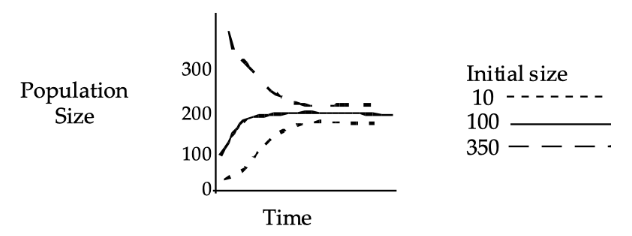
What seems to be the carrying capacity (K) in this case? How can you tell?
pop. size where pop. levels off (K = 200)
relationship between initial pop. size and c.c.
N/A (no affect)
how to distinguish limiting factor out of environmental factors
limiting factor affects k when the factor is changed

which graph is competition and which is predation and why
competion: A (species 2 is the loser, like data presented in lab)
predation: B (oscillations look like predator-prey data in lab)
all organisms are primarily composed of what 6 elements?
CHONPS
Carbon
Hydrogen
Oxygen
Nitrogen
Phosphorous
Sulfur
significance of CHONPS (provide examples)
building blocks of biological macromolecules
lipids: CHOP
carbohydrates: CHO
DNA, RNA: CHOPN
proteins: CHONS
unlike energy, matter is _ and how
recycled
limited amount of CHONPS
each element cycles in/out of living systems differently
primary reservoir
where the element is usually not part of an organism
PR for CHONPS
atmosphere and water
PR for C: CO2 in atmosphere
PR for N: N2 in atmosphere
PR for O: H2O molecules
PR for H: H2O molecules
sediment
PR for P & S: soil and ocean beds
cycling pattern of CHONPS
elements cycle between reservoirs and organisms
→ reservoir of element → incorporation → organisms → return →
why is CHO cycling important
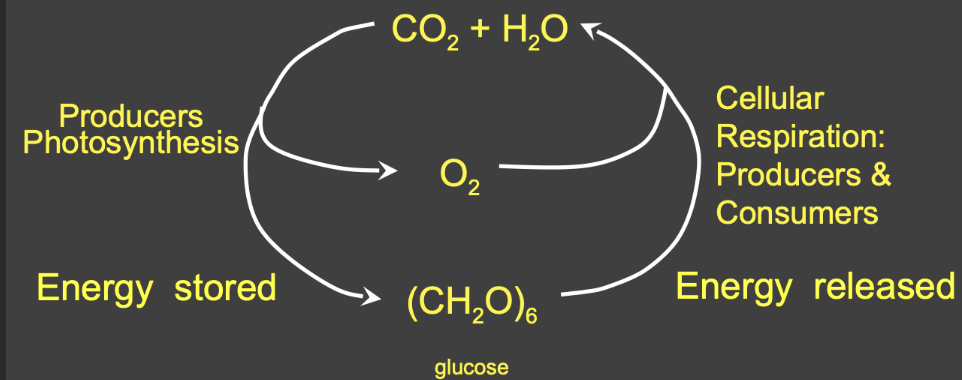
connects photosynthesis & cell res
critical components for all biological macromolecules
nitrogen
needed for proteins and nucleic acids
no shortage (atmosphere 80% N2)
problem: atmospheric N2 unusable for most organisms (very stable & unreactive)
nitrogen fixation
how nitrogen enters ecosystems from reservoir in atmosphere
nitrogen-fixing bacteria convert unusable inert N2 → reactive usable ammonia & nitrate
NFB live in soil & on roots of some plants

nitrogen recycling
Plants incorporate NH3 & NO3 into macromolecules
N containing MMs are taken up by consumers → taken up by decomposers
decomposers in soil convert nitrogen in MMs back into NH3 & NO3 (soil)

nitrogen sources
N recycling provides 95% of N needed for living things, N fixation provides 5%
N returned to air as N2 via denitrification (also done by bacteria)
nitrogen fixation in agriculture
global crop production supported by N-containing fertilizers (made by industrial nitrogen fixation)
indistrial scale production of N w/ fertilizers has doubled natural rate of N-fixation
1-2% of world’s energy supply used to fix N for use in fertilizers
phosphorus is important for
nucleotides (ex. ATP)
nucleic acid polymers (RNA/DNA)
phospholipids (plasma membranes)
phosphorus cycle
plants & other organisms incorporate P from sediment
consumers eat plants, decomposers eat each other
plants/consumers die & decomposers return P to sediment
plants incorporate it again & cycle restarts
sulfur important for
certain amino acids (proteins)
critical for protein folding
sulfur cycle
plants & other organisms incorporate S from sediment
consumers eat plants, decomposers eat each other
plants/consumers die & decomposers return S to sediment
plants incorporate it again & cycle restarts
reduction/oxidation (redox) rxns
when molecules gain/lose e-
OIL RIG
Oxidation is Loss (of e-)
Reduction Is Gain (of e-)
how are redox rxns coupled
as molecules gain e-, they are Reduced
so other molecules must lose e- and be Oxidized
redox rxns in cells: order
ordered sequence (e- pass from one molecule to next) in ETC
electron carriers in ETC
molecules that make up ETC
ECs accept e- (become reduced) and donate e- (become oxidized)
e- bind to redox center of ECs
redox potential of ECs in ETC and what are ECs/ETCs critical for
different ECs have different affinities for e-
first EC in ETC has lowest RP, each following EC has increasingly more RP, last EC has highest
ECs & ETCs critical to photosynthesis & cell res
photosynthesis and what is its efficiency of transfer (what does this mean)
sunlight + carbon dioxide + water → glucose (sugar) + oxygen
light energy powers glucose production (energy transferred)
efficiency of transfer 30%: 30% of photon energy stored as chemical energy in glucose
site of photosynthesis
chloroplasts
thylakoid membranes have pigments (chlorophylls) that capture light energy
stroma is where glucose is made
two parts to photosynthesis
light rxns (light-dependent): occur at thylakoid membrane
dark rxns (light-independent, (Calvin Cycle, Calvin-Benson Cycle): occur in stroma
light reactions requires/inputs and produces/outputs
inputs
light as energy source
water as e- source
ADP + Pi for ATP synthesis
NADP+ as e- carrier (oxidized form)
outputs
ATP (used in ATP hydrolysis to release G)
NADPH (e- carrier, reduced form)
O2 as byproduct
dark reactions requires/inputs and produces/outputs
inputs
carbon dioxide as carbon source
ATP from light rxns as energy source
NADPH from light rxns as e- source
outputs
glucose (energy storage molecule)
ADP + Pi (from ATP hydrolysis)
NADP+ (FROM NADPH oxidation)