GEN PSYCH - Exam 3
 Call Kai
 Learn
 Practice Test
 Spaced Repetition
 Match
 Flashcards
 Knowt Play
1/74

There's no tags or description
Looks like no tags are added yet.
75 Terms
Classical conditioning
A type of learning in which we learn to respond to a new stimulus that has been associated with another stimulus that normally produces the response
How did Pavlov study classical conditioning?
Pavlov studied digestion and noticed that dogs salivated at the mere sight of food dish—learned to associate dish with food
Unconditioned response
In classical conditioning, an unlearned, naturally occurring response to an unconditioned stimulus (US)
Unconditioned stimulus
In classical conditioning, a stimulus naturally and automatically triggers a response (UR) without prior conditioning
Conditioned response
in classical conditioning, a learned response to a stimulus that did not originally elicit the response

Conditioned stimulus
In classical conditioning, a previously neutral stimulus that now elicits a conditioned response due to its association with an unconditioned stimulus

Acquisition (in classical conditioning)
The initial stage in which the association between 2 stimuli (US and CS) is being learned
Generalization (in classical conditioning)
Conditioned response to stimuli that are not the conditioned stimulus, but are similar to it
Discrimination (in classical conditioning)
Conditioned response occurs only to a specific stimulus
Extinction (in classical conditioning)
The weakening/failure of a conditioned response because the conditioned stimulus no longer predicts the unconditioned stimulus
Spontaneous recovery
The reappearance, after a pause, of a weakened conditioned response
Second-order (higher-order) conditioning
New neutral stimulus becomes associated with previously conditioned stimulus—becomes new CS, and tends to be weaker than first-order conditioning
Conditioned aversion
Classically conditioned association between a CS and US that causes an unpleasant response
What are some examples of conditioned aversions in use (e.g., wolves and coyotes)?
Wolves and coyotes: Ranchers place sheep bait laced with illness-inducing compounds near pastures. The wolves and coyotes eat the bait and become ill, making them associate the sheep with nausea and avoid attacking herds
What was Watson and Raynor’s study with Little Albert?
Watson and Rayner presented a white rat and as Little Albert reached to touch it, they struck a hammer against a steel bar just behind the infant’s head. After seven repeats of seeing the rat and hearing the frightening noise, Albert burst into tears at the mere sight of the rat. Five days later, he reportedly generalized this startled fear reaction to the sight of a rabbit, a dog, and even a furry coat
What is counterconditioning (i.e., Mary Cover Jones’s study)?
Counterconditioning — Technique that replaces an unwanted emotional or physical reaction to a trigger with a new, opposite response
Mary Cover Jone’s “Little Peter” Study — Peter was afraid of rabbits, so Jones gave Peter his favorite snacks while the rabbit was across the room. Over several sessions, Jones moved the rabbit closer and eventually Peter stopped being afraid
Operant conditioning
A type of learning in which a behavior becomes more probable if followed by a reinforcer or less probable if followed by a punisher
What is Thorndike’s law of effect? What was Thorndike’s puzzle box?
Tendency of an organism to product a behavior depends on the effect the behavior has on the environment
Thorndike’s puzzle box was an experiment where a hungry cat was placed inside a box with food left outside of reach. Thorndike timed how long it took the cat to escape with each trial, and the cat progressively escaped faster
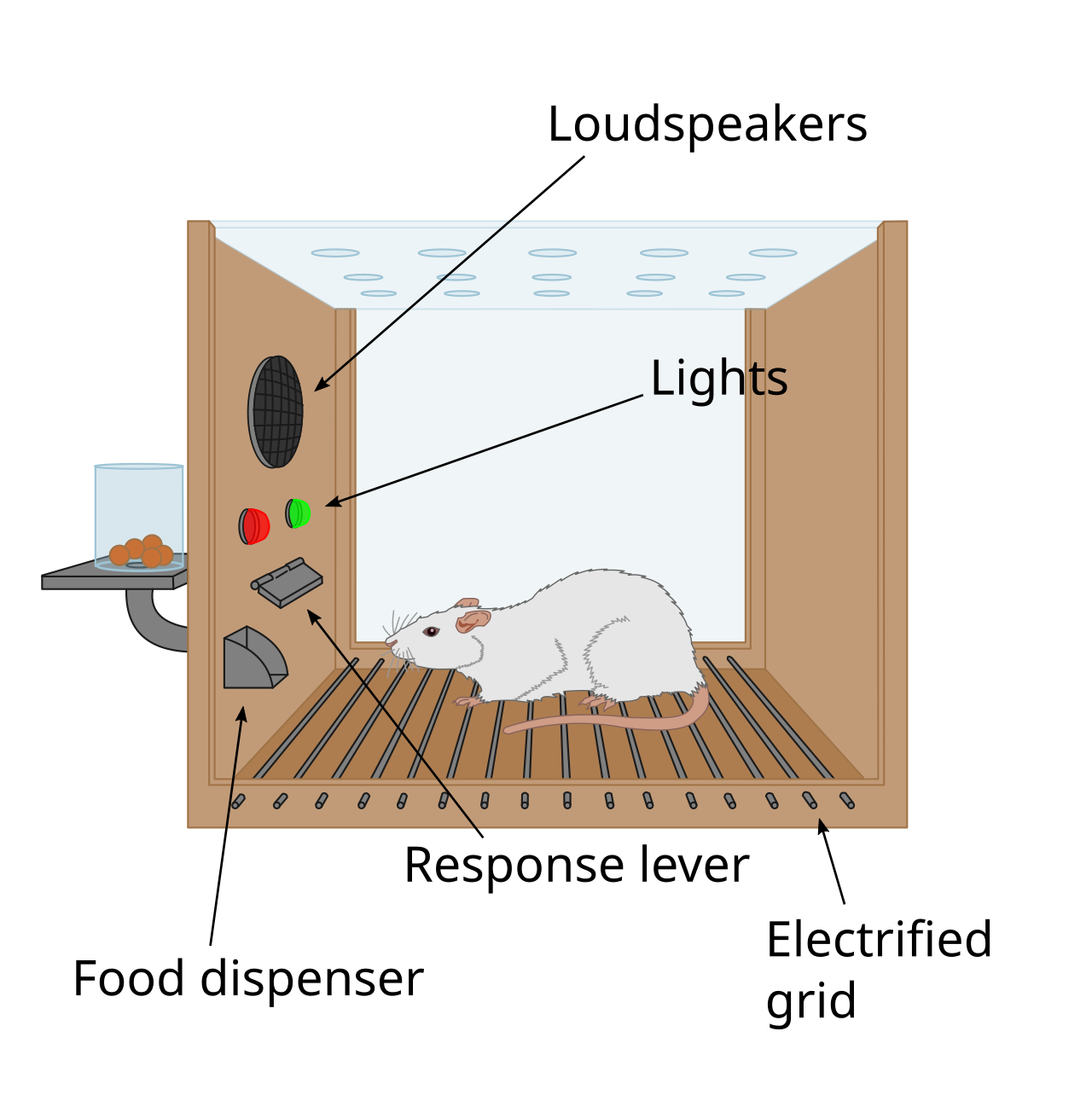
What is a Skinner box?
In operant conditioning research, a chamber containing a bar that hungry animal can manipulate to obtain a food or water (reinforcer); attached devices record the animal’s rate of bar pressing, which increases because they are getting food
What are reinforcements and punishments?
In operant conditioning:
Reinforcement — Consequence of behavior that increases the probability that the behavior will occur
Punishment — Consequence of behavior that decreases the probability that the behavior will occur
What is shaping? What are successive approximations?
In operant conditioning, shaping is a procedure that reinforces closer and closer approximations of the desired response. It uses successive approximations — responses that are increasingly similar to the desired response
Positive reinforcement
In operant conditioning: Presentation of a pleasant stimulus after a behavior, which increases probability of behavior
Negative reinforcement
In operant conditioning: Removal of an unpleasant stimulus after a behavior, which increases probability of behavior
Positive punishment
In operant conditioning: Unpleasant stimulus follows behavior, which decreases probability of behavior
Negative punishment
In operant conditioning: Removal of pleasant stimulus after a behavior, which decreases probability of behavior
Generalization (operant conditioning)
After a behavior is reinforced in one situation, it is performed in a different situation
Discrimination (operant conditioning)
A behavior that is reinforced in one situation is not performed in a different situation
Extinction (operant conditioning)
The weakening of a response after it is no longer enforced
Spontaneous recovery (operant conditioning)
The reappearance of a weakened conditioned response
What is continuous vs. intermittent (partial) reinforcement? Which is better for learning?
In operant conditioning:
Continuous reinforcement — Reinforcing a desired response every time it occurs
Intermittent (partial) reinforcement — Reinforcing a response only part of the time a behavior occurs
Partial reinforcement results in slower acquisition but much greater resistance to extinction. Continuous reinforcement results in quicker acquisition but less resistance to extinction
What are the schedules of reinforcement?
1) Fixed-ratio
2) Variable-ratio
3) Fixed-interval
4) Variable-interval
Fixed-ratio
Reinforcement for a fixed proportion of responses emitted
Variable-ratio
Reward for some percentage of responses, but unpredictable number of responses required before reinforcement
Fixed-interval
Reinforcement for responses after a fixed amount of time
Variable-interval
Reinforcement for responses after an amount of time that is not constant
What are some problems with punishment?
May be difficult to identify which behavior is being punished
Individual may come to fear person giving harsh punishment
Punishment may not eliminate existing rewards for the behavior
Harsh punishment can model aggression
What are intrinsic and extrinsic motivation? What is the overjustification effect?
Intrinsic motivation — Pursuit of activity for its own sake
Extrinsic motivation — Pursuit of goal for external rewards
Overjustification effect — Too much reward undermines intrinsic motivation
What is observational learning? What is modeling?
Observational learning — Learning by observing the behavior of others
Modeling — The process of observing and imitating others’ behavior
What was Bandura’s Bobo doll study?
Investigated whether social behaviors—-specifically aggression—can be acquired by children through observation and imitation of others. Children who observed aggressive behavior were more likely to imitate it
What are the implications of observational learning for aggressive and prosocial behavior?
People learn by watching others rather than relying solely on direct reward or punishment. Individuals who observe aggressive behavior are more likely to be more aggressive, and same for prosocial individuals
What are encoding, storage, and retrieval (Information-Processing Model of Memory)?
3 steps in the Information-Processing Model of Memory:
1) Encoding —The process of getting information into the memory system
2) Storage — The process of retaining encoded information over time
3) Retrieval — The process of getting previously encoded and stored information from memory
What are sensory, short-term, and long-term memory (Atkinson & Shiffrin’s Three-Stage Model of Information Processing)?
3 stages of memory formation:
1) Sensory memory — System that holds sensory information (e.g., visual, auditory) for a very brief time after the stimulus disappears
2) Short-term memory — For information that is available to consciousness for about 20-30 seconds
3) Long-term memory — Relatively permanent memory with unlimited capacity. Includes knowledge, skills, and experiences
What are iconic and echoic memory?
Iconic memory — Visual sensory memory
Echoic memory — Auditory sensory memory
How did Sperling study iconic memory? What were the results of his study?
Sperling flashed 12 letters for 1/20 seconds then signaled people to recall top, middle, or bottom rows. He compared to main procedures: 1) people were asked to recall as many as they could and 2) a sound was played after each row, and people were asked to recall the letters based on the sound
Results were that people have strong visual memory but it fades very fast, unless attention transfers the memory into short-term memory
What are explicit and implicit memory?
Explicit memory — Conscious recollection of material from long-term memory (declarative memory)
Implicit memory — Not brought to mind consciously, but expressed in behavior—including learned skills or classically conditioned associations (nondeclarative memory)
What are the 2 types of explicit memory?
1) Semantic — Memory of facts and general knowledge
2) Episodic — Memory of personally experienced events
What are the 3 types of implicit memory?
1) Procedural memory — Memory for the performance of skills
2) Priming — Prior exposure to a stimulus affects responses to a later stimulus, setting us up to perceive, remember, or respond to objects or events in certain ways
3) Classically conditioned associations
Recall
Producing memories using minimal retrieval cues, such as in a fill-in-the-blank test
Recognition
Knowledge of whether one has previously been exposed to information, such as on a multiple-choice test
Relearning
Memory demonstrated by time saved when learning material again, because learning occurs more quickly the second time it is learned
Chunking
Organizing information into smaller, meaningful pieces to facilitate memory; often occurs automatically
Mnemonics
Strategies and tricks for improving memory, such as acronyms or vivid imagery
What are maintenance and elaborative rehearsal?
Rehearsal — Repeating some information; no rehearsal makes material less likely to be remembered. 2 types:
1) Maintenance rehearsal — Rote repetition of material; learning to keep material in short-term memory
2) Elaborative rehearsal — Thinking about the meaning of the information; thinking deeply about material to keep it in long-term memory
What is Craik and Tulving’s (1975) levels of processing theory?
Information can be processed at different depths, from shallow to deep. The level of processing affects likelihood of recall (memory retention)
What are shallow and deep processing?
Shallow processing — Focuses on superficial features of a stimulus, such as physical appearance, than what it means
Deep processing — Focuses on the meaning of the stimulus, connecting it to existing knowledge, personal experiences, or broader context
Deep processing requires active mental effort so it creates long-lasting memories. Shallow processing requires weak mental effort, so memories fade quickly
What was Craik and Tulving’s study with CHAIR, etc.?
Elicited encoding depth by asking different types of questions after participants were shown a list of words such as CHAIR, brain, and doll:
1) Is the word in capital letters?
2) Does the word rhyme with train?
3) Would the word fit into the following sentence? “The child put the ______ on the table.”
The question that would make people most likely to remember the word is “Does it fit into this sentence?” because they are processing the meaning of the word
What are context-dependent and state-dependent memory?
Encoding specificity — Specific cues are encoded within the memory. Two types of contexts:
1) Context-dependent memory — Environment in which something is learned serves as a cue for retrieval
2) State-dependent memory — Physical or mental state in which something is learned serves as a cue for retrieval
Encoding failure
Memory fails to form due to lack of attention or processing
Retrieval failure
Stored memories cannot be accessed
Storage decay
After memory has been stored, may fade
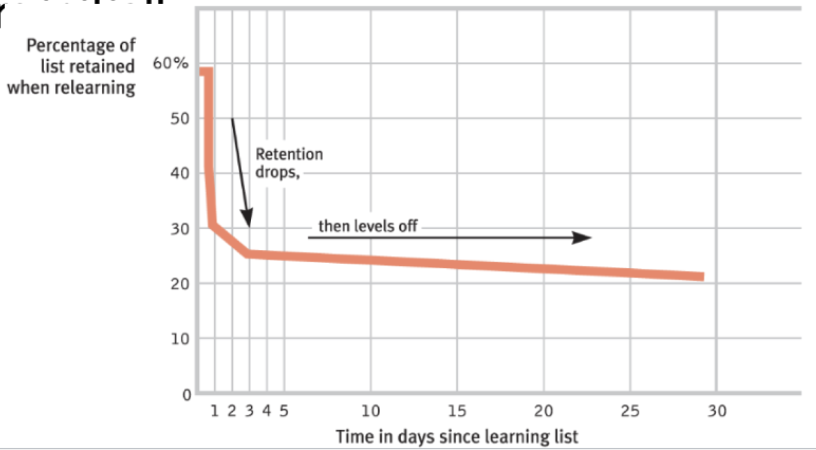
What is Ebbinghaus’s forgetting curve?
Model where after forming a memory, majority of forgetting occurs right after learning
What is the tip-of-the-tongue phenomenon?
A temporary state where you cannot recall something even though you are certain you know it. You often are able to remember it later on after you are not actively trying to recall it
What are anterograde and retrograde amnesia?
Anterograde amnesia — Memory loss for information encountered after head injury (inability to form memories)
Retrograde amnesia — Memory loss for information from before head injury (inability to remember the past)
What type of amnesia and memory impairment did H.M. experience?
H.M. had anterograde amnesia, so he was unable to form new memories. However, he was still able to form subconscious skill-learning memories (implicit memory)
Testing effect
Enhanced memory after retrieving, rather than simply rereading, information. Also sometimes referred to as a retrieval practice effect or test-enhanced learning
Spacing effect
The tendency for distributed study or practice to yield better long-term retention than is achieved through massed study or practice
Representativeness heuristic
Tendency to see someone or something as belonging to a particular group or category by evaluating how similar this person or thing is to a typical person or thing in that category; problem is the base-rate fallacy
What are base rates? What is the base-rate fallacy?
Base rates — Frequency with which given events or cases occur in the population
Base-rate fallacy — Using the representativeness heuristic means ignoring base rates
Availability heuristic
Strategy for making judgments based on how easily specific kinds of information can be brought to mind (if an event comes readily to mind, we assume it must be common even though the actual likelihood of the event is low)
Simulation heuristic (counterfactual thinking)
Imagining alternative version of actual events shapes emotional response
What are the outcomes of bilingualism?
Greater cognitive flexibility
Protection against cognitive decline
Higher academic achievement in upper grades
Better executive control
Additional area of brain activation
Perseverance effect (belief perseverance)
Beliefs tend to persist in the face of disconfirming information
Confirmation bias
Tendency to search for and use information that is consistent with our existing beliefs
What are the effects of stimulating and non-stimulating environments on intellectual abilities?
Healthy and stimulating environments support brain development and increases IQ. Non-stimulating environments lead to cognitive impairment
Is eyewitness testimony reliable? What was found in Loftus’s (1974) study (hit vs. smashed)?
Eyewitness testimony is not completely reliable because memory can be reconstructed. In Loftus’ study, participants who were asked about the car being “smashed” were more likely to remember a higher-speed crash than those who were asked about the car being “hit”—even if they saw the same car accident