B. CHROMATOGRAPHY
 Call Kai
 Learn
Learn Practice Test
 Spaced Repetition
 Match
Match Flashcards
 Knowt Play
1/67

There's no tags or description
Looks like no tags are added yet.
Name | Mastery | Learn | Test | Matching | Spaced | Call with Kai | Chat |
|---|
No analytics yet
Send a link to your students to track their progress
68 Terms
d. Chromatography
A procedure by which solutes are separated by a differential migration process in a system consisting of 2 or more phases
a. Gravimetry
b. Titrimetry
c. Spectroscopy
d. Chromatography
c. Stationary Phase
The component of chromatography that is a fixed bed of large surface area
a. Mobile Phase
b. Solute Mixture
c. Stationary Phase
d. Carrier Phase
c. Stationary Phase
The component of chromatography which may be a porous or finely divided solid or liquid coated in a thin layer of inert supporting material
a. Mobile Phase
b. Solute Mixture
c. Stationary Phase
d. Carrier Phase
a. Mobile Phase
The component of chromatography that is a fluid moving through the surface of the stationary phase
a. Mobile Phase
b. Solute Mixture
c. Stationary Phase
d. Carrier Phase
a. Mobile Phase
The component of chromatography that may be liquid or gas
a. Mobile Phase
b. Solute Mixture
c. Stationary Phase
d. Carrier Phase
b. Solute Mixture
The component of chromatography that must be in solution or vapor state
a. Mobile Phase
b. Solute Mixture
c. Stationary Phase
d. Carrier Phase
b. Solute Mixture
The relative affinity of the solutes for each of the phases must be reversible
a. Mobile Phase
b. Solute Mixture
c. Stationary Phase
d. Carrier Phase
BASED ON NATURE OF SP
BASED ON EQUILIBRIUM PROCESS
CLASSIFICATION OF CHROMATOGRAPHIC METHODS (2)
Normal Phase
Reverse Phase
[CLASSIFICATION OF CHROMATOGRAPHIC METHODS]
BASED ON NATURE OF SP (2)
ADSORPTION CHROMATOGRAPHY
PARTITION CHROMATOGRAPHY
ION EXCHANGE CHROMATOGRAPHY
PERMEATION CHROMATOGRAPHY / PENETRATION
AFFINITY CHROMATOGRAPHY
[CLASSIFICATION OF CHROMATOGRAPHIC METHODS]
BASED ON EQUILIBRIUM PROCESS (5)
a. ADSORPTION CHROMATOGRAPHY
[CLASSIFICATION OF CHROMATOGRAPHIC METHODS]
BASED ON EQUILIBRIUM PROCESS, Thin Layer Chromatography (TLC) is classified as
a. ADSORPTION CHROMATOGRAPHY
b. PARTITION CHROMATOGRAPHY
c. ION EXCHANGE CHROMATOGRAPHY
d. PERMEATION CHROMATOGRAPHY / PENETRATION
e. AFFINITY CHROMATOGRAPHY
a. ADSORPTION CHROMATOGRAPHY
[CLASSIFICATION OF CHROMATOGRAPHIC METHODS]
BASED ON EQUILIBRIUM PROCESS, Column Chromatography is classified as
a. ADSORPTION CHROMATOGRAPHY
b. PARTITION CHROMATOGRAPHY
c. ION EXCHANGE CHROMATOGRAPHY
d. PERMEATION CHROMATOGRAPHY / PENETRATION
e. AFFINITY CHROMATOGRAPHY
a. ADSORPTION CHROMATOGRAPHY
[CLASSIFICATION OF CHROMATOGRAPHIC METHODS]
BASED ON EQUILIBRIUM PROCESS, High Performance Liquid Chromatography (HPLC) is classified as
a. ADSORPTION CHROMATOGRAPHY
b. PARTITION CHROMATOGRAPHY
c. ION EXCHANGE CHROMATOGRAPHY
d. PERMEATION CHROMATOGRAPHY / PENETRATION
e. AFFINITY CHROMATOGRAPHY
a. ADSORPTION CHROMATOGRAPHY
[CLASSIFICATION OF CHROMATOGRAPHIC METHODS]
BASED ON EQUILIBRIUM PROCESS, Gas Chromatography (MS) is classified as
a. ADSORPTION CHROMATOGRAPHY
b. PARTITION CHROMATOGRAPHY
c. ION EXCHANGE CHROMATOGRAPHY
d. PERMEATION CHROMATOGRAPHY / PENETRATION
e. AFFINITY CHROMATOGRAPHY
b. PARTITION CHROMATOGRAPHY
[CLASSIFICATION OF CHROMATOGRAPHIC METHODS]
BASED ON EQUILIBRIUM PROCESS, Paper Chromatography is classified as
a. ADSORPTION CHROMATOGRAPHY
b. PARTITION CHROMATOGRAPHY
c. ION EXCHANGE CHROMATOGRAPHY
d. PERMEATION CHROMATOGRAPHY / PENETRATION
e. AFFINITY CHROMATOGRAPHY
d. Normal Phase
1. Normal Phase – SP is polar; MP is non-polar;
2. Reverse Phase – SP is non-polar, MP is polar;
[CLASSIFICATION OF CHROMATOGRAPHIC METHODS]
The chromatographic classification where SP is polar and MP is non-polar
a. Reverse Phase
b. Partition Chromatography
c. Adsorption Chromatography
d. Normal Phase
a. Reverse Phase
1. Normal Phase – SP is polar; MP is non-polar;
2. Reverse Phase – SP is non-polar, MP is polar;
[CLASSIFICATION OF CHROMATOGRAPHIC METHODS]
The chromatographic classification where SP is non-polar and MP is polar
a. Reverse Phase
b. Partition Chromatography
c. Adsorption Chromatography
d. Normal Phase
d. TLC
[CLASSIFICATION OF CHROMATOGRAPHIC METHODS]
An example of Normal Phase chromatography
a. HPLC
b. Gas Chromatography
c. Paper Chromatography
d. TLC
a. HPLC
[CLASSIFICATION OF CHROMATOGRAPHIC METHODS]
An example of Reverse Phase chromatography
a. HPLC
b. Gas Chromatography
c. Paper Chromatography
d. TLC
b. Adsorption chromatography
[CLASSIFICATION OF CHROMATOGRAPHIC METHODS]
Chromatography based on a solid-liquid or solid-gas equilibrium process in which the stationary phase is a solid and the sample is adsorbed.
a. Partition chromatography
b. Adsorption chromatography
c. Ion-exchange chromatography
d. Gel filtration chromatography
b. Adsorption chromatography
[CLASSIFICATION OF CHROMATOGRAPHIC METHODS]
Stationary phase is a solid in which the sample is adsorbed while the mobile phase may be a liquid or gas.
a. Affinity chromatography
b. Adsorption chromatography
c. Partition chromatography
d. Size-exclusion chromatography
b. Thin Layer Chromatography (TLC)
[CLASSIFICATION OF CHROMATOGRAPHIC METHODS]
Chromatographic technique in which the stationary phase is a solid adsorbent spread thinly on a glass or plastic plate.
a. Paper chromatography
b. Thin Layer Chromatography (TLC)
c. Gas chromatography
d. High-performance liquid chromatography (HPLC)
c. Silica gel
[CLASSIFICATION OF CHROMATOGRAPHIC METHODS]
Example of a stationary phase used in Thin Layer Chromatography (TLC).
a. Hexane
b. Ethyl acetate
c. Silica gel
d. Methanol
a. Alumina
[CLASSIFICATION OF CHROMATOGRAPHIC METHODS]
Example of a stationary phase used in Thin Layer Chromatography (TLC).
a. Alumina
b. Hexane
c. Acetone
d. Chloroform
a. Calcium carbonate (CaCO₃)
[CLASSIFICATION OF CHROMATOGRAPHIC METHODS]
Example of a stationary phase used in Thin Layer Chromatography (TLC).
a. Calcium carbonate (CaCO₃)
b. Ethanol
c. Benzene
d. Toluene
b. Organic solvent less polar than the stationary phase
[CLASSIFICATION OF CHROMATOGRAPHIC METHODS]
Mobile phase of Thin Layer Chromatography (TLC).
a. Solid adsorbent
b. Organic solvent less polar than the stationary phase
c. Ion-exchange resin
d. Distilled water
b. Hexane
[CLASSIFICATION OF CHROMATOGRAPHIC METHODS]
Example of a mobile phase used in Thin Layer Chromatography (TLC).
a. Silica gel
b. Hexane
c. Alumina
d. Calcium carbonate
c. Ethyl acetate
[CLASSIFICATION OF CHROMATOGRAPHIC METHODS]
Example of a mobile phase used in Thin Layer Chromatography (TLC).
a. Silica gel
b. Alumina
c. Ethyl acetate
d. Calcium carbonate
a. UV light
[CLASSIFICATION OF CHROMATOGRAPHIC METHODS]
Visualization method used in Thin Layer Chromatography (TLC).
a. UV light
b. Infrared light
c. Fluorescence microscopy
d. Polarimetry
a. I₂ chamber
[CLASSIFICATION OF CHROMATOGRAPHIC METHODS]
Visualization chamber used in Thin Layer Chromatography (TLC).
a. I₂ chamber
b. CO₂ chamber
c. N₂ chamber
d. O₂ chamber
a. Vanillin and H₂SO₄
[CLASSIFICATION OF CHROMATOGRAPHIC METHODS]
Spray reagent used in Thin Layer Chromatography (TLC).
a. Vanillin and H₂SO₄
b. Benedict's reagent
c. Fehling's solution
d. Biuret reagent
b. Retention factor (Rf)
[CLASSIFICATION OF CHROMATOGRAPHIC METHODS]
Thin Layer Chromatography (TLC) analysis is based on the determination of this value.
a. Partition coefficient
b. Retention factor (Rf)
c. Resolution factor
d. Selectivity factor
c. Rf = distance travelled by solute / distance travelled by solvent front

[CLASSIFICATION OF CHROMATOGRAPHIC METHODS]
The formula for Retention Factor (Rf) in TLC
a. Rf = distance travelled by solvent front / distance travelled by solute
b. Rf = distance travelled by solute × distance travelled by solvent front
c. Rf = distance travelled by solute / distance travelled by solvent front
d. Rf = distance travelled by solvent front + distance travelled by solute
d. Non-polar solute

[CLASSIFICATION OF CHROMATOGRAPHIC METHODS]
In Normal Phase chromatography, a higher Rf value indicates
a. More polar solute
b. Less polar solute with non-polar MP
c. Non-polar MP and polar SP
d. Non-polar solute
c. Polar solute
[CLASSIFICATION OF CHROMATOGRAPHIC METHODS]
In Normal Phase chromatography, a lower Rf value indicates
a. Non-polar solute
b. Non-polar SP
c. Polar solute
d. Non-polar MP
d. Column Chromatography
[CLASSIFICATION OF CHROMATOGRAPHIC METHODS]
The chromatographic method used to separate compounds from mixtures where MP is added to the top and flows down through the column
a. TLC
b. HPLC
c. Gas Chromatography
d. Column Chromatography
c. Solid adsorbent packed in a vertical glass column; ex. silica gel, alumina, CaCO3
same with TLC
[CLASSIFICATION OF CHROMATOGRAPHIC METHODS]
The stationary phase used in Column Chromatography
a. Water molecules bound to cellulose
b. Silica beads with non-polar functional group
c. Solid adsorbent packed in a vertical glass column; ex. silica gel, alumina, CaCO3
d. Solid adsorbent spread thinly on a glass or plastic plate
b. Column Chromatography
[CLASSIFICATION OF CHROMATOGRAPHIC METHODS]
Used to separate compounds from mixtures.
a. Thin Layer Chromatography (TLC)
b. Column Chromatography
c. Paper Chromatography
d. Gas Chromatography
b. Elution
[CLASSIFICATION OF CHROMATOGRAPHIC METHODS]
Process used to separate compounds from mixtures in column chromatography.
a. Adsorption
b. Elution
c. Filtration
d. Distillation
c. Eluent (Eluant)
[CLASSIFICATION OF CHROMATOGRAPHIC METHODS]
Term for the mobile phase in column chromatography.
a. Eluate
b. Chromatogram
c. Eluent (Eluant)
d. Adsorbent
b. Eluate
[CLASSIFICATION OF CHROMATOGRAPHIC METHODS]
Term for the separated fractions collected from the column.
a. Eluent (Eluant)
b. Eluate
c. Chromatogram
d. Stationary phase
c. Chromatogram
[CLASSIFICATION OF CHROMATOGRAPHIC METHODS]
Series or patterns of spots, bands, or peaks.
a. Elution
b. Eluate
c. Chromatogram
d. Mobile phase
b. Isocratic elution
[CLASSIFICATION OF CHROMATOGRAPHIC METHODS]
Type of elution in which the mobile phase composition remains constant.
a. Gradient elution
b. Isocratic elution
c. Reverse-phase elution
d. Normal-phase elution
b. Gradient elution
[CLASSIFICATION OF CHROMATOGRAPHIC METHODS]
Type of elution in which the mobile phase composition changes during the separation.
a. Isocratic elution
b. Gradient elution
c. Partition elution
d. Adsorption elution
a. Compound A

[CLASSIFICATION OF CHROMATOGRAPHIC METHODS]
In column chromatography, more polar compound retained longer on a silica gel column.

a. Compound A
b. Compound B
c. Both compounds
d. Neither compound
d. High Performance Liquid Chromatography
[CLASSIFICATION OF CHROMATOGRAPHIC METHODS]
The chromatographic method widely used and preferred for current assays of biological and pharmaceutical products
a. TLC
b. Column Chromatography
c. Gas Chromatography
d. High Performance Liquid Chromatography
d. Column packed with glass or plastic beads coated with silica derivatized with non-polar functional group
[CLASSIFICATION OF CHROMATOGRAPHIC METHODS]
The stationary phase used in HPLC
a. Solid adsorbent packed in a vertical glass column
b. Liquid pumped through the column with high pressure
c. Solid adsorbent spread thinly on a glass or plastic plate
d. Column packed with glass or plastic beads coated with silica derivatized with non-polar functional group
b. Liquid pumped through the column with high pressure
[CLASSIFICATION OF CHROMATOGRAPHIC METHODS]
The mobile phase used in HPLC
a. Solid adsorbent packed in a vertical glass column
b. Liquid pumped through the column with high pressure
c. Solid adsorbent spread thinly on a glass or plastic plate
d. Column packed with glass or plastic beads coated with silica derivatized with non-polar functional group
c. 5000 psi
[CLASSIFICATION OF CHROMATOGRAPHIC METHODS]
The pressure at which the mobile phase is pumped through the column in HPLC
a. 1000 psi
b. 3000 psi
c. 5000 psi
d. 10000 psi
a. Acetonitrile
c. Water and methanol
Reverse Phase: water, methanol, acetonitrile
Normal Phase: hexane, diethyl ether
[CLASSIFICATION OF CHROMATOGRAPHIC METHODS]
The mobile phase used in Reverse Phase HPLC
(Multiple answers)
a. Acetonitrile
b. Diethyl ether
c. Water and methanol
d. Hexane
b. Diethyl ether
d. Hexane
Reverse Phase: water, methanol, acetonitrile
Normal Phase: hexane, diethyl ether
[CLASSIFICATION OF CHROMATOGRAPHIC METHODS]
The mobile phase used in Normal Phase HPLC
(Multiple answers)
a. Acetonitrile
b. Diethyl ether
c. Water and methanol
d. Hexane
d. Gas Chromatography
[CLASSIFICATION OF CHROMATOGRAPHIC METHODS]
The chromatographic method used to analyze volatile substances with separation based on boiling point (in oven)
a. HPLC
b. Column Chromatography
c. TLC
d. Gas Chromatography
c. Chemically inert carrier gas such as helium or nitrogen
[CLASSIFICATION OF CHROMATOGRAPHIC METHODS]
The mobile phase used in Gas Chromatography
a. Either a solid adsorbent or a liquid on an inert support
b. Organic solvents less polar than SP
c. Chemically inert carrier gas such as helium or nitrogen
d. Hexane and diethyl ether
a. Either a solid adsorbent or a liquid on an inert support
packed inside a long coiled column
[CLASSIFICATION OF CHROMATOGRAPHIC METHODS]
The stationary phase used in Gas Chromatography
a. Either a solid adsorbent or a liquid on an inert support
b. Organic solvents less polar than SP
c. Chemically inert carrier gas such as helium or nitrogen
d. Hexane and diethyl ether
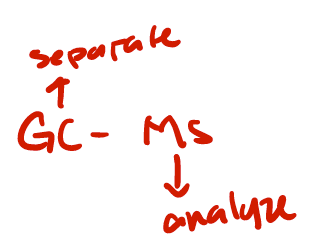
a. GC-MS
Gas Chromatography (GC)-Mass Spectrometry (MS)
[CLASSIFICATION OF CHROMATOGRAPHIC METHODS]
Technique that separates compounds while mass spectrometry analyzes them.
a. GC-MS
b. HPLC-UV
c. TLC
d. Paper chromatography
d. Partition Chromatography
[CLASSIFICATION OF CHROMATOGRAPHIC METHODS]
The chromatographic method based on partition between 2 immiscible solvents where both SP and MP are in liquid form
a. Adsorption Chromatography
b. Gas Chromatography
c. Normal Phase Chromatography
d. Partition Chromatography
d. Water molecules bound to the cellulose of the filter paper
[CLASSIFICATION OF CHROMATOGRAPHIC METHODS]
The stationary phase used in Paper Chromatography
a. Cationic exchanger or anionic exchanger
b. Non-polar or hydrophobic solvent
c. Chemically inert solid adsorbent
d. Water molecules bound to the cellulose of the filter paper
b.Non-polar or hydrophobic solvent
[CLASSIFICATION OF CHROMATOGRAPHIC METHODS]
The mobile phase used in Paper Chromatography
a. Silica gel on glass plate
b. Non-polar or hydrophobic solvent
c. Chemically inert solid adsorbent
d. Water molecules bound to the cellulose of the filter paper
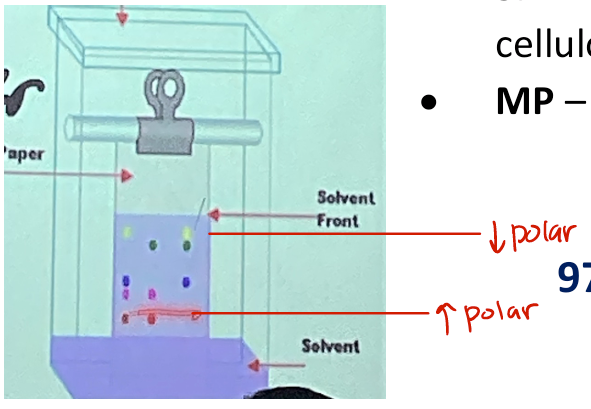
b. Most polar compound
[CLASSIFICATION OF CHROMATOGRAPHIC METHODS]
In paper chromatography, compound that travels the shortest distance from the origin.
a. Least polar compound
b. Most polar compound
c. Most volatile compound
d. Least soluble compound
a. Least polar compound
[CLASSIFICATION OF CHROMATOGRAPHIC METHODS]
In paper chromatography, compound that travels the farthest distance from the origin.
a. Least polar compound
b. Most polar compound
c. Most volatile compound
d. Least soluble compound
d. Ion Exchange Chromatography
[CLASSIFICATION OF CHROMATOGRAPHIC METHODS]
The chromatographic method used for the separation of charged molecules based on their binding to fixed charges on a support
a. Affinity Chromatography
b. Permeation Chromatography
c. Partition Chromatography
d. Ion Exchange Chromatography
d. Ion Exchange Chromatography
[CLASSIFICATION OF CHROMATOGRAPHIC METHODS]
The most effective method for water purification using chromatography
a. Affinity Chromatography
b. Permeation Chromatography
c. Gas Chromatography
d. Ion Exchange Chromatography
d. Ion Exchange Chromatography
[CLASSIFICATION OF CHROMATOGRAPHIC METHODS]
Use in separation of amino acids
a. Affinity Chromatography
b. Permeation Chromatography
c. Gas Chromatography
d. Ion Exchange Chromatography
a. Cationic exchanger or anionic exchanger

[CLASSIFICATION OF CHROMATOGRAPHIC METHODS]
The stationary phase used in Paper Chromatography
a. Cationic exchanger or anionic exchanger
b. Non-polar or hydrophobic solvent
c. Chemically inert solid adsorbent
d. Water molecules bound to the cellulose of the filter paper
c. Permeation Chromatography / Penetration
[CLASSIFICATION OF CHROMATOGRAPHIC METHODS]
The chromatographic method where molecules are separated according to their size by their ability to penetrate a sieve-like structure
a. Ion Exchange Chromatography
b. Affinity Chromatography
c. Permeation Chromatography / Penetration
d. Partition Chromatography
d. Size Exclusion Chromatography
[CLASSIFICATION OF CHROMATOGRAPHIC METHODS]
Another name for Permeation Chromatography / Penetration
a. Ion Exchange Chromatography
b. Affinity Chromatography
c. Partition Chromatography
d. Size Exclusion Chromatography
d. Affinity Chromatography
[CLASSIFICATION OF CHROMATOGRAPHIC METHODS]
The chromatographic method that utilizes highly specific interactions between one kind of solute molecule and a second molecule covalently attached to the SP
a. Ion Exchange Chromatography
b. Permeation Chromatography
c. Partition Chromatography
d. Affinity Chromatography
d. Protein affinity chromatography
separation of antigens and antibodies
[CLASSIFICATION OF CHROMATOGRAPHIC METHODS]
An example of Affinity Chromatography
a. Separation of amino acids
b. Water purification
c. Separation of volatile substances
d. Protein affinity chromatography