Active Care
 Call Kai
 Learn
 Practice Test
 Spaced Repetition
 Match
 Flashcards
 Knowt Play
1/109

There's no tags or description
Looks like no tags are added yet.
110 Terms
Cervical flexion
60 deg
Cervical extension
80 deg
Cervical rotation
80 deg
40 from upper cervical
40 from lower cervical
Cervical lateral flexion
45 deg (lower 35 deg)
Lateral flexion is coupled with
rotation
When we laterally flex in the lower cervical spine, the spinous process deviates towards
OPPOSITE side of lateral flexion
When we laterally flex in the upper cervical spine, the spinous process deviates towards
SAME side of lateral flexion
Flexion and extension are coupled with
translation + rotation
What happens when we flex - facets
superior facet moves upwards and forwards (OPENING)
What happens when we flex (shopping cart sign) - foramen + spinal canal
increase in size
What happens when we flex - discs
anterior compression
posterior protrusion
What happens when we flex - nerve roots, dura, spinal cord
tensions
What happens to the foramen size with rotation
ipsilateral side increases size
contralateral side decreases size
During protrusion
upper cervicals = extension
lower cervicals = flexion
During retraction
upper cervicals = END RANGE flexion
lower cervicals = MID RANGE extension
What deep cervical muscle acts as a dynamic anterior longitudinal ligament to prevent hyperextension injuries (supports curve against weight of head)
longus colli
What are the MC cervical trigger points
trapezius + SCM
Costanza method of spinal rehab
do the opposite of what you find
General recommendations for introducing posture-based exercises
isometric hold for 3-5sec
5-10 reps
every 15-20 minutes
What cervical mobility exercise uses controlled articular rotations
CARs
Cervical towel SNAGs (sustained natural apophyseal glides)
towel around C1
actively rotate through full ROM + use towel to assist w/further rotation
intended to increase upper cervical joint rotation
What type of dysfunction is MC in the thoracic spine
mobility restrictions
What is the primary muscle/driver of exhalation
elastic recoil = pleura + costal cartilage
What is NOT a primary muscle in the core container
QL
Most mobility exercises will also help improve thoracic stability when performed
actively to end range with breathing involvement
Bear hugs facilitate thoracic extension b/c
weight is being held anteriorly
What is the strongest predictor of LBP
increased lumbar spine instability
What is the one of the most common characteristics of LBP
recurrence
Temporary tissue deformation (creep) begins at ____ of sitting with sustained posture
20min
Core stregthening and stability with the BIG FOUR + DEAD BUG
front bridge (anterior chain stability)
side bridge (lateral chain stability)
curl up ( anterior chain stability)
bird dog (posterior chain stability)
deadbug
Addressing hip mobility exercises
90/90 shinbox
CARs + PAILs/RAILs
PNF/MET stretching
full ROM loaded exercises
Pelvic tilt progressions (for hip hinge)
supine + prone pelvic tilt (supported)
quadruped pelvic tilt (suspended)
half kneeling/seated pelvic tilt (stacked)
standing pelvic tilt
How long to do self myofacial release
30-120sec per muscle group (or to tolerance)
During CARs, pt actively moves through ROM and utilizes usable ROM under muscular and neurological control rather than just holding a
static stretch
PAILs
PROGRESSIVE angular isometric loading
RAILs
REGRESSIVE angular isometric loading
PAILs explained
stretch a muscle/joint to end range → contraction of AGONIST muscle 10-20sec
RAILs explained
contraction of ANTAGONIST then actively pull further into a new ROM
ELDOA method
longitudinal osteo-articular decompression stretching
ELDOA method is commonly used as an
active spinal decompression treatment
Neuromobilization (Nerve flossing)
places tension on N distally then proximally in an ALTERNATING pattern
Composition of a nerve
80% connective tissue
20% axoplasmic fluid
Trigger point is
myoNEURAL
Sliders (Nerve flossing)
place tension (elongating) on ONE END of the nerve and reducing tension (shortening) on the other end
Tensioners
place tension (elongating) BOTH ENDS of the nerve simultaneously
Taut band
group of tense muscle fibers extending from trigger point at muscle attachments
Spasm
increased tension with or without shortening of a muscle due to non-voluntary motor nerve activity
Contracture
sustained intrinsic activation of contractile elements of muscle fibers
Trigger points are located in the ____ 100% of the time
brain
Active trigger points are _______ and Latent trigger points are ________
ALWAYS TENDER; PAINFUL ONLY WHEN PALPATED

Tissue injury happens when
N x F goes up…or…A x R goes down
SAID principle (Specific Adaptation to Imposed Demands)
body will adapt to the demands placed on it (or lack thereof)
Yellow flag risk form scoring
Low risk disability = <55
Mod risk disability = 55-65
High risk disability = >65
6 Rs of rehab
red flags
reassure
reconceptualize (pain as an alarm)
recalibrate
robust
reassess
Exercise program design
VAS goes down and RPE goes up
rule of 10 = VAS 8, RPE 2
4 × 4 matrix
positions
supported, suspended, stacked, standing
demands
feedback, demonstrate, capacity w/feedback, capacity
Example of 4×4 matrix = youre a 2 × 4
easier = 2 × 3
harder = 3 × 3
Flexibility
passive ROM of a given joint and surrounding soft tissue
Mobility (ACTIVE ROM)
ability of a joint to move through a given ROM, under neurological control of a given joint structure and surrounding soft tissue
Less flexible
soft tissue injuries
More flexible
joint injuries
Gold standard for static stretching
3-4 sets 15-30sec
repeat multiple times a day, 5x week
6-10wks
ACSM guidelines for Aerobic training
150min/wk (at least 30min of 5+ days)
ACSM guidelines for Resistance training
2 non-consecutive days/wk
_____ is an independent predictor of all-cause mortality and cardiovascular disease
grip strength
The single best predictor of senior citizen falling is
toe strength (leg strength 2nd)
Mobility Dysfunction (TISSUE)
decreased AROM
decreased PROM
Mobility dysfunction takes
time (repetitive, disuse)
Stability/Motor Control Dysfunction (BRAIN/SKILL)
decreased AROM
functional PROM
Upper crossed syndromes weak vs tight muscles
Weak = deep neck flexors (ant) and lower traps, serratus anterior, rhomboids (post)
Tight = pectoralis major and minor (ant) and upper traps, levator scap, suboccipitals (post)
Lower crossed syndromes weak vs tight muscles
Weak = abdominals (ant) and gluteus maximus (post)
Tight = hip flexors (ant) and thoracolumbar extensors (post)
Regional interdependence
unrelated impairments in a remote anatomical region may contribute to (or be associated with) the patient’s primary complaint
Hierarchy of movement - Management and Treatment
mobility → motor control → functional patterning
Hierarchy of movement - Movement evaluation
Functional patterning → motor control → mobility
Three R’s of active care
reset
reinforce
retrain
4 X 4 Matrix Positions
1 - Supported (least challenging)
2 - Suspended
3 - Stacked
4 - Standing (most challenging)
4 X 4 Matrix Demands
1 - Feedback (least difficult)
2 - Demonstrate
3 - Capacity w/feedback
4 - Capacity (most difficult)
Turkish Get-up example of 4×4
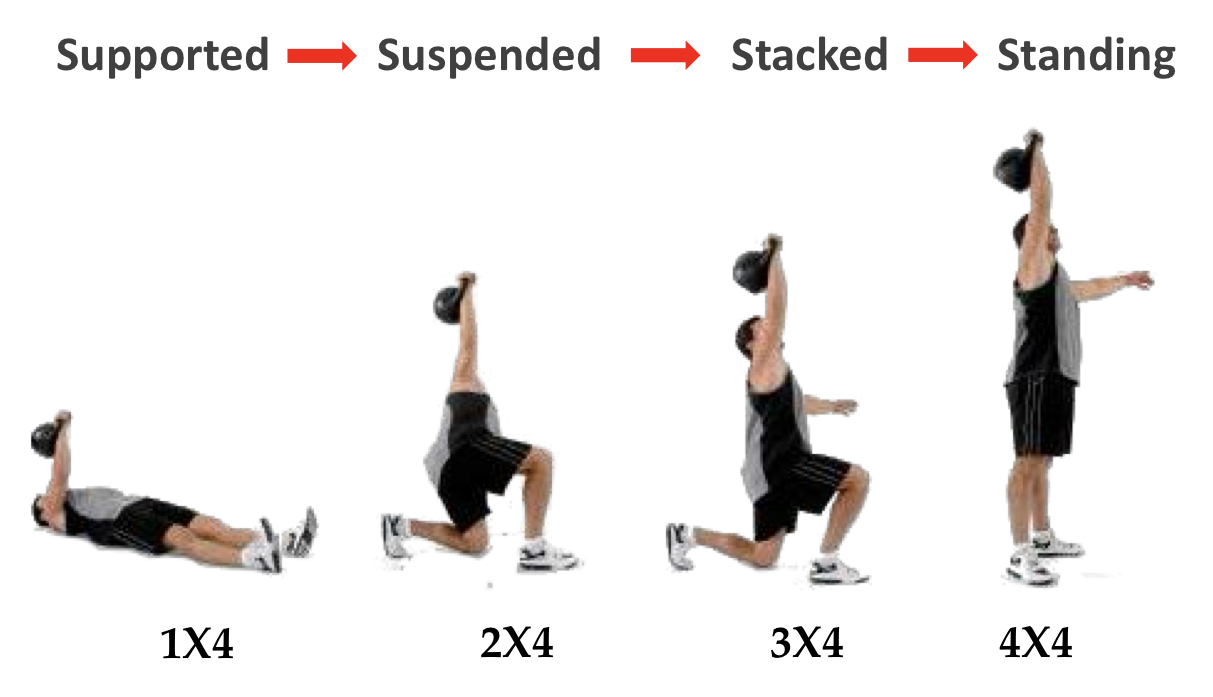
What is the development in Supported position
spinal mobility (flex/ext/rot)
segmental stability
cervical patterns
shoulder flexion
What is the development in Suspended position
spinal curves
cross-crawl pattern
pelvis to trunk disassociation
hip and shoulder flexion/extension
3 - Stacked is the first aspect of
axial loading
What is the development in Stacked position
beginning of single leg stance
hip and spine loaded stability
loaded hip extension
Flexibility
PROM of a given joint and surrounding tissue
Mobility
ability of a joint to move through AROM under neurological control
Useless flexibility
ability to get to a certain angle/ROM but not be able to use that angle/ROM in daily life
great PROM but can’t express it actively (AROM)
People that have joint hypermobility often describe feeling
very tight all the time
What is the relationship btw flexibility and injuries
U-shaped curve
very flexible = joint injuries
very tight = soft tissue injuries
The majority of increased ROM associated with stretching occur in the first
15sec of a stretch
Static stretching should be performed for
3-4 sets of 15-30sec
Ideal frequency for stretching
multiple times a day for 6-10wks
Proprioceptive Neuromuscular Facilitation (PNF)
all human beings have untapped existing potential
positive approach = focus on and reinforce tasks the pt can do
Three PNF inhibitory techniques
Hold Relax
Contract Relax
Contract Relax Antagonist Contract (CRAC)

Post-contraction inhibition
AKA autogenic inhibition
after the muscle is contracted, it is automatically in a relaxed state for a brief latent period
golgi tendon organs
What techniques utilizes post-contraction inhibition/autogenic inhibition
Hold relax, Contract relax, CRAC
Post-isometric relaxation (PIR) muscle energy technique/MET
Post-facilitation stretch (PFS)
Which of the techniques that utilize post-contraction inhibition/autogenic inhibition is 100% isometric
post-facilitation stretch (PFS)

Reciprocal inhibition
AKA Sherrington’s law
contraction of antagonist simultaneously inhibits the action of the agonist
muscle spindles
What techniques utilizes reciprocal inhibition/sherrington’s law
CRAC
Reciprocal inhibition (RI) muscle energy technique/MET
Which technique utilizes both postcontraction inhibition and reciprocal inhibition
CRAC
Hold relax
initial muscle stretched under tension for 15sec
pt contracts for 6sec while Dr matches resistance (isometric contraction)
muscle relaxes and slowly moves past its initial ROM to a new barrier, hold for 15sec
repeat 2-4x
Hold relax is almost identical to what other stretching technique
PIR (a type of MET)